Forging Equipment Manufacturer: Die Forging Machines, Open Die Forging Machines
Hydraulic Open Die Forging Press: Applications & Selection Guide
2026-10-09
A hydraulic open die forging press is used to shape heated metal billets, ingots, and other workpieces through controlled compression between forging tools. It is commonly considered for heavy-duty forging operations where workpiece size, deformation requirements, material properties, and process flexibility influence equipment selection.
For forging manufacturers, selecting a press involves more than comparing nominal pressing force. The machine must provide a suitable working stroke, opening height, tooling arrangement, control system, and workpiece-handling solution for the intended production process. The right configuration depends on what is being forged, how much deformation is required, and how the complete production operation will run.
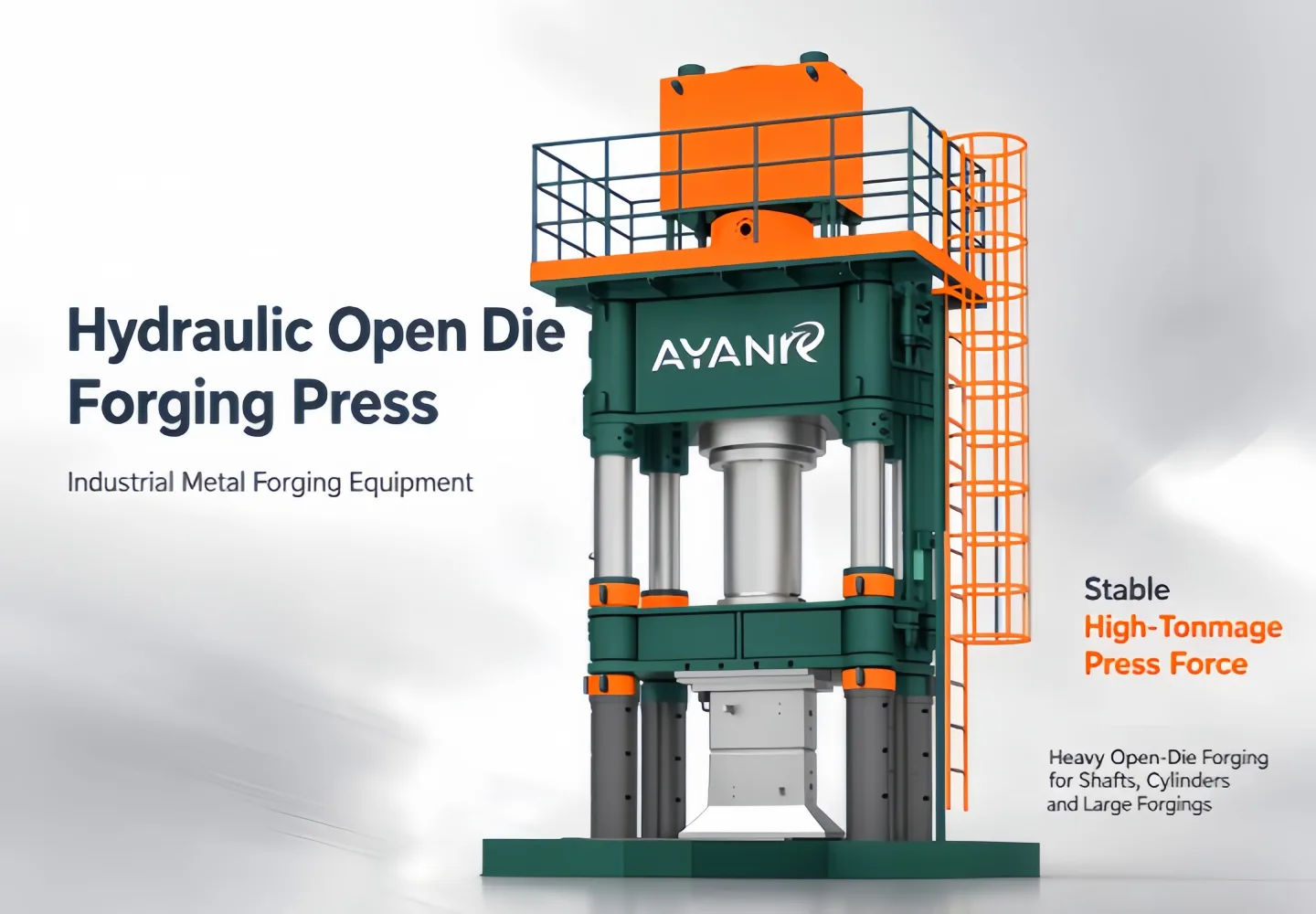
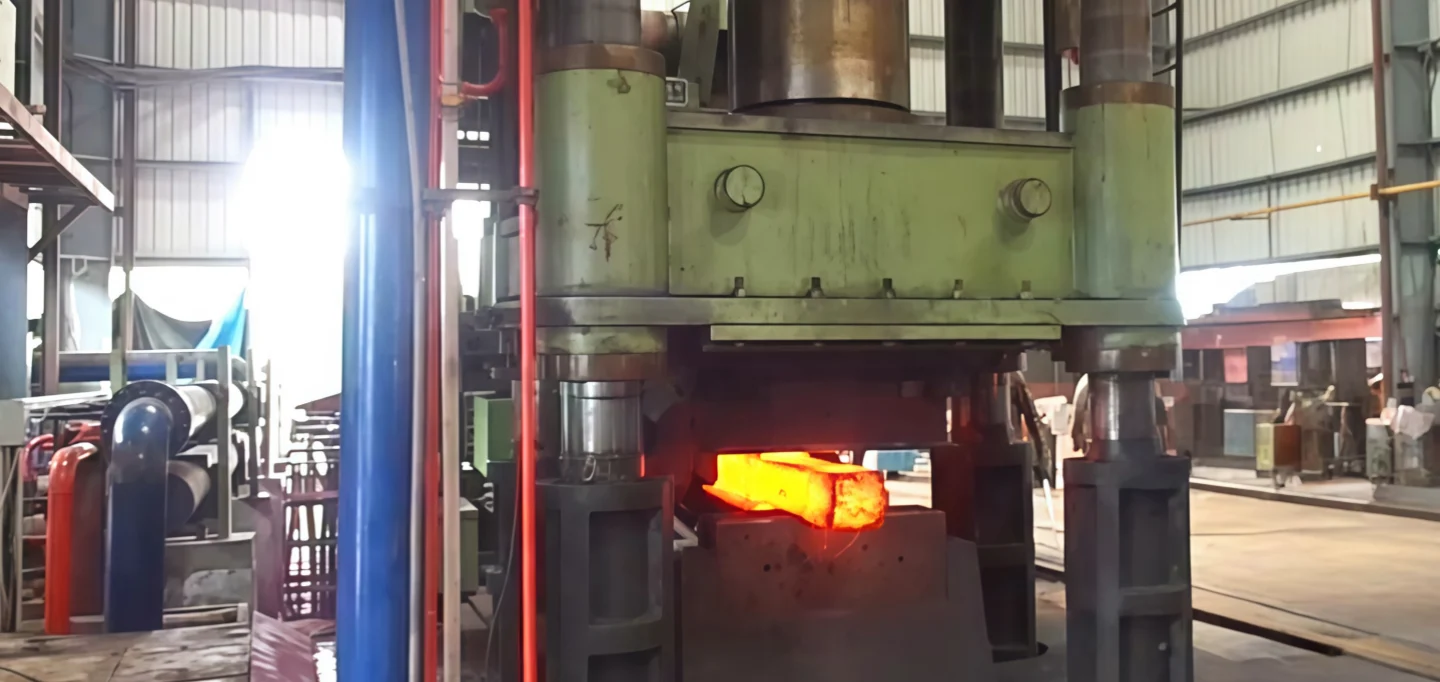
Hydraulic forging press equipment for open die forging applications. Confirm that the final image shows the actual machine and configuration being discussed.
Quick Answer
A hydraulic open die forging press compresses a heated workpiece between dies or tooling surfaces without fully enclosing the workpiece in a shaped cavity. The operator or handling system can reposition the material between pressing operations to produce the required shape and cross-section.
This process is commonly used for large or relatively simple forged forms, including shafts, bars, blocks, discs, and preforms for subsequent machining or forging operations. Whether a hydraulic press is suitable depends on the workpiece dimensions, material, required deformation, production volume, and target forging quality.
When evaluating equipment, buyers should review the complete operating requirements rather than choosing a machine based on pressing force alone. Stroke, working opening, die dimensions, loading method, control functions, and integration with material-handling equipment can all affect whether a proposed configuration meets the production requirement.
1. What Is a Hydraulic Open Die Forging Press?
A hydraulic open die forging press uses hydraulic power to move a ram and apply compressive force to a workpiece held between opposing forging tools. Unlike closed die forging, where the metal is shaped within a substantially enclosing die cavity, open die forging leaves the workpiece free to move or spread in directions not fully constrained by the tooling.
During the process, the workpiece is compressed in successive operations. The operator or a workpiece-manipulation system changes its position, orientation, or contact area between strokes to achieve the target dimensions and material flow. Depending on the component, the operation may involve upsetting, drawing out, flattening, or other deformation steps.
The hydraulic system supplies the force needed for deformation, while the machine structure, ram guidance, tooling, and control system influence how that force is applied. The appropriate equipment configuration depends on the intended forging method and the loads expected during actual operation.
How Is It Different from a Closed Die Forging Press?
The principal difference is the way the tooling constrains the workpiece. Open die forging relies on repeated deformation and workpiece repositioning, while closed die forging uses shaped cavities to form the metal into a more specifically defined geometry.
Open die forging can be appropriate for large workpieces, variable dimensions, and applications where the required shape does not justify a fully enclosing die set. Closed die forging may be more suitable for repeat production of components requiring a defined cavity shape and controlled near-net geometry. The choice should be based on part design, production volume, tooling cost, dimensional requirements, and downstream machining.
Hydraulic presses and forging hammers apply force in different ways. A hydraulic press develops force through controlled ram movement, whereas a forging hammer deforms metal through impact energy. Their suitability depends on the material, workpiece size, required deformation, production method, tooling, and operating preferences.
A press may be worth evaluating when controlled compression, a defined working stroke, or integration with a particular handling sequence is important. A hammer may suit processes that benefit from repeated impact deformation. Neither equipment type is universally preferable, so the comparison should be made against the actual workpiece and process requirements.
2. How Does a Hydraulic Open Die Forging Press Work?
The operating sequence varies by machine design, material, and forging procedure. In a typical hot open die forging operation, the process begins with material preparation and heating, followed by positioning, controlled deformation, inspection, and subsequent processing where required.
Step 1: Prepare and Heat the Workpiece
The starting material may be a billet, ingot, bar, or another suitable metal stock. Its dimensions and initial condition should be consistent with the planned forging sequence. For hot forging, the workpiece is heated to a temperature range appropriate for the material and process.
Material grade, initial temperature, temperature uniformity, transfer time, and allowable temperature loss influence deformation behavior. The forging procedure should establish suitable temperature limits and reheating requirements where necessary.
Step 2: Position the Workpiece Between the Dies
The heated workpiece is placed between the upper and lower tooling. Positioning accuracy, available working space, and the method used to support or manipulate the material affect how safely and consistently the operation can be performed.
Depending on the workpiece, handling may involve manual tools, a manipulator, a crane-assisted arrangement, or a more integrated material-handling system. Large or heavy workpieces require particular attention to lifting capacity, rotation, alignment, and the clearances needed throughout the forging sequence.
Step 3: Apply Controlled Compression
The ram moves toward the workpiece and applies compressive force through the tooling. The degree of deformation depends on the applied load, contact area, material temperature, material resistance, deformation rate, and the geometry of the workpiece and dies.
A successful operation requires the press to perform within its permitted operating envelope. Buyers should ask how the supplier defines rated force, available force across the stroke, permitted eccentric loading, and other limits that may affect the proposed forging process.
Step 4: Reposition and Repeat
In open die forging, a single press stroke generally does not create the complete component. The workpiece is repositioned between operations to reduce or redistribute its cross-section, increase its length, flatten selected areas, or establish the required preform.
The sequence must account for material flow, temperature changes, dimensional allowances, and the intended final geometry. For complex components, process planning and trials may be necessary to determine an appropriate sequence of deformation steps.
Step 5: Inspect and Continue Processing
After forging, the workpiece may require dimensional inspection, heat treatment, surface cleaning, machining, or other operations specified by the product requirements. Inspection criteria depend on the component's function, material specification, applicable standards, and customer requirements.
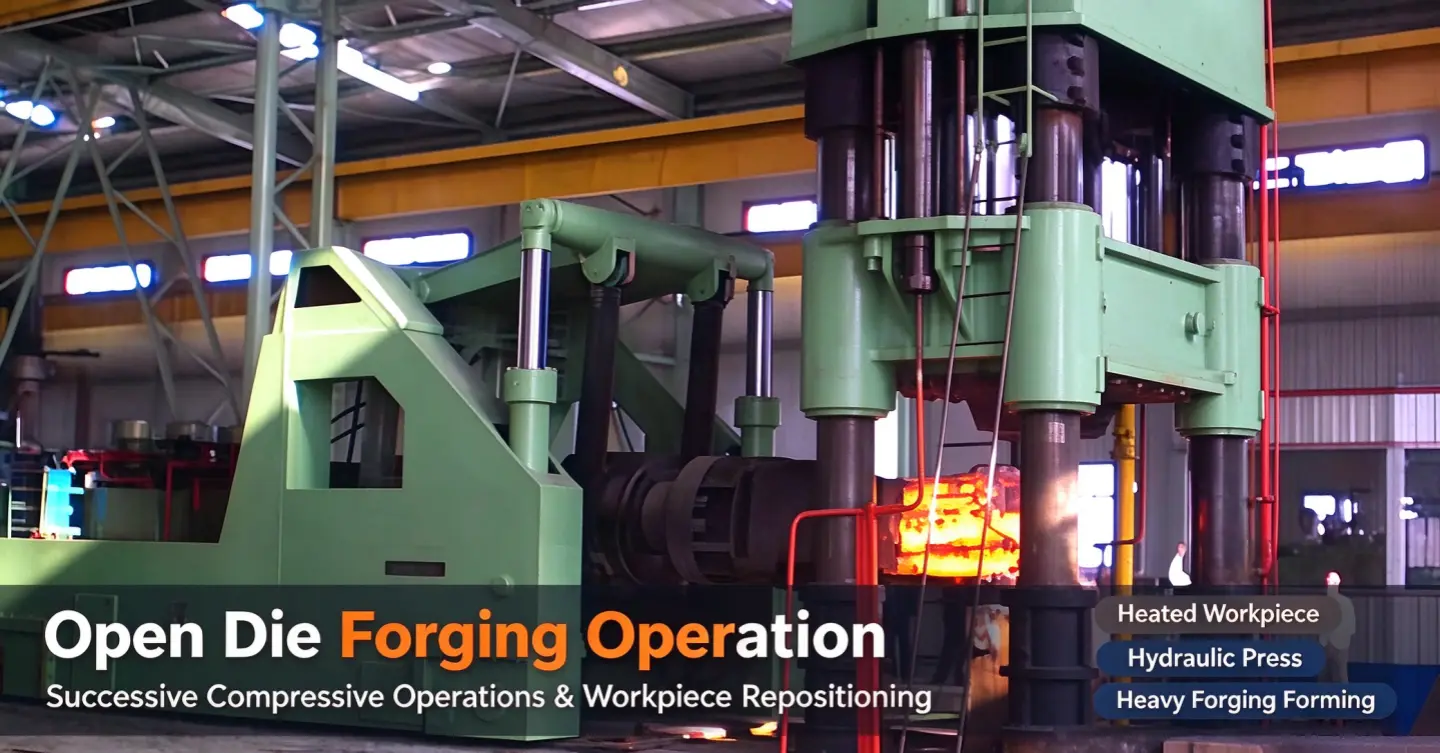
Open die forging involves successive compressive operations and workpiece repositioning. Use an actual process photograph or a reviewed diagram that accurately represents the operation.
The overall process is influenced by both the press and the supporting equipment. Heating, transfer, manipulation, inspection, and downstream processing should therefore be considered when evaluating the capacity of a forging cell or production line.
3. Applications of Hydraulic Open Die Forging Presses
Hydraulic open die forging presses are considered for applications where the workpiece can be formed through controlled compression and repositioning rather than by filling a fully enclosing die cavity. Actual suitability depends on the machine's verified capability, tooling arrangement, material, part geometry, and process requirements.
3.1 Shafts, Bars, and Long Components
Shaft and bar forging may involve drawing out heated stock to obtain a longer section with a reduced cross-section. The process requires a suitable relationship between press capacity, die width, available stroke, workpiece rotation, and material handling.
For long workpieces, buyers should pay particular attention to the press working opening and the space required for the manipulator or other handling equipment. The complete handling sequence may impose constraints that are not apparent from the part drawing alone.
3.2 Blocks and General Forged Blanks
Blocks and general forged blanks may be produced through upsetting, flattening, and other compressive operations. These components are often subsequently machined, so the forging allowance, material distribution, and final machining strategy should be considered together.
When evaluating a press for this work, review the initial stock dimensions, final dimensions, deformation sequence, and any requirements relating to internal material quality. The equipment supplier should assess the proposed process rather than assume that every block-shaped component can be forged on the same configuration.
3.3 Discs and Large Preforms
Disc-shaped workpieces and other broad preforms may require upsetting or flattening operations. The necessary press force is affected by the material, forging temperature, contact area, deformation amount, and friction conditions.
Tooling dimensions and workpiece handling are especially important where the component's diameter is large relative to its height. The press opening, die support, and handling arrangement should accommodate the workpiece throughout the intended sequence.
3.4 Rings and Ring-Shaped Preforms
Open die forging may be used to prepare stock or preforms for subsequent ring-forming operations. However, forging a ring preform is not the same as completing the ring-rolling process. Where the finished component requires controlled circumferential expansion, a dedicated ring rolling machine may be part of the production route.
Buyers should establish whether the project requires only a forged preform or a complete ring-forming solution. This distinction affects the equipment list, process sequence, handling requirements, and investment scope.
3.5 Heavy Industrial and Custom Forgings
Open die forging can also be considered for custom components that do not fit a standardized closed die production route. In these cases, the equipment evaluation should start with the workpiece drawing, material specification, target dimensions, required material properties, and production plan.
The label "heavy-duty" alone does not establish that a press is suitable. The proposed machine must be checked against the actual forging loads, workpiece envelope, tooling arrangement, and handling conditions.
Example workpiece types that may be evaluated for open die forging. Replace this image with actual AYANK workpiece samples and adjust the caption to match the parts shown.
A practical starting point is to classify the target components by material, maximum dimensions, starting stock, final forged weight, required deformation, and production volume. These details help determine whether an open die press, forging hammer, ring rolling machine, or a combination of equipment should be evaluated.
4. How to Select a Hydraulic Open Die Forging Press
Selecting a hydraulic open die forging press requires a review of the complete forging process, not simply the nominal press force. A machine that appears suitable based on tonnage may still be unsuitable if its working opening, stroke, tooling dimensions, loading arrangement, or control functions do not match the intended operation.
Before requesting a quotation, define the target workpieces and the production sequence. If the project includes several part families, assess the most demanding operating cases and establish which parts can share the same machine and tooling arrangement.
4.1 Required Press Force and Forging Load
Press force is one of the first parameters buyers examine, but the required force depends on more than the workpiece's weight. Material grade, forging temperature, deformation amount, contact area, strain conditions, die geometry, and friction can all influence the load required for a particular operation.
For preliminary evaluation, engineers may estimate the forging load using the expected deformation conditions and material behavior. The final machine selection should then be reviewed against the actual process, including the intended tooling and the supplier's permitted operating limits.
Buyers should ask the manufacturer to clarify the rated pressing force, how it is defined, and whether the required force is available at the stroke position used in the proposed operation. The evaluation should also consider any restrictions on eccentric loading or other operating conditions that could affect machine suitability.
4.2 Workpiece Material and Forging Temperature
Different metals have different deformation characteristics. Carbon steel, alloy steel, stainless steel, and non-ferrous alloys may require different forging temperatures, deformation sequences, and process controls. Even within one material family, grade and initial condition can influence the forging load.
Provide the equipment supplier with the exact material grade whenever possible. If the grade has not been finalized, identify the likely material range and explain which properties remain undecided. A selection based on an assumed material may lead to an unsuitable force estimate or process proposal.
The heating method and transfer route also matter. Workpiece temperature can change between the furnace and the press, and uneven temperature distribution may affect deformation and the resulting component. Heating capacity, transfer time, and the proposed forging sequence should be evaluated as parts of the process rather than as isolated machine details.
4.3 Stroke, Working Opening, and Tooling Space
The press stroke is the distance through which the ram can travel. The working opening or daylight is the available space between the relevant tooling or machine surfaces under the specified condition. These dimensions influence workpiece loading, die installation, the range of possible operations, and the handling space available around the forging area.
Buyers should check the maximum initial workpiece envelope, the required die height, the intended deformation sequence, and the clearances needed for loading and removal. If the workpiece must be rotated or repositioned during forging, the working space should be checked against the complete movement path rather than only the workpiece's static dimensions.
Die dimensions, die fastening, support arrangements, and access for maintenance should also be considered. A press may have sufficient nominal force yet still be impractical for a particular job if the tooling cannot be installed or the workpiece cannot be handled safely within the available space.
The working area must accommodate the dies, workpiece, and required handling movements. Use a verified machine photograph or dimensioned drawing when available.
4.4 Workpiece Weight and Handling Method
Workpiece weight affects loading, positioning, rotation, and removal. For large forgings, the press should be evaluated together with the handling equipment needed to move the material throughout the process.
Depending on the application, the handling solution may include lifting equipment, forging manipulators, transfer devices, or other auxiliary systems. The selection should account for the workpiece's maximum weight, dimensions, temperature, center of gravity, and required orientation changes.
Ask the supplier to identify the proposed handling arrangement and clarify which equipment is included in the quotation. The press, manipulator, furnace, transfer system, and safety equipment may be supplied under different scopes, so interface responsibilities should be documented before the project is finalized.
4.5 Production Volume and Operating Cycle
Production requirements influence machine configuration, automation, tooling strategy, and the number of auxiliary stations. A job-shop environment producing varied components may prioritize process flexibility and changeover access, while a more standardized operation may justify a greater level of automation.
The target cycle should be assessed across the entire operation, including loading, heating, positioning, pressing, repositioning, inspection, and transfer to the next process. The ram's movement time alone does not represent the production cycle of a complete forging operation.
When requesting a capacity estimate, provide expected production volume by part family, shift pattern, and the required output basis. Any supplier estimate should state its assumptions about material heating, workpiece handling, tooling changes, operator involvement, and downstream operations.
4.6 Control System and Operating Functions
The control system should support the intended forging sequence and the level of operator intervention required. Depending on the machine design, relevant functions may include ram movement control, pressure settings, position monitoring, operating modes, alarms, and safety interlocks.
Buyers should clarify which functions are standard and which are optional. Where repeatability is important, ask how the machine monitors and controls the relevant process variables, what operating data can be recorded, and whether the proposed controls can interface with auxiliary equipment.
Control capabilities should be verified against the actual application. Avoid assuming that every hydraulic press includes the same programmable functions, data interfaces, or automation features.
4.7 Installation and Factory Conditions
Installation planning should cover the machine foundation, floor loading, available headroom, access for transport and assembly, electrical supply, hydraulic system requirements, cooling arrangements where applicable, and maintenance access. The precise requirements depend on the machine design and the proposed production configuration.
Before ordering, request the manufacturer's installation drawings and utility requirements. Confirm that the factory can accommodate the equipment, auxiliary systems, material flow, and any lifting or maintenance operations required during the machine's service life.
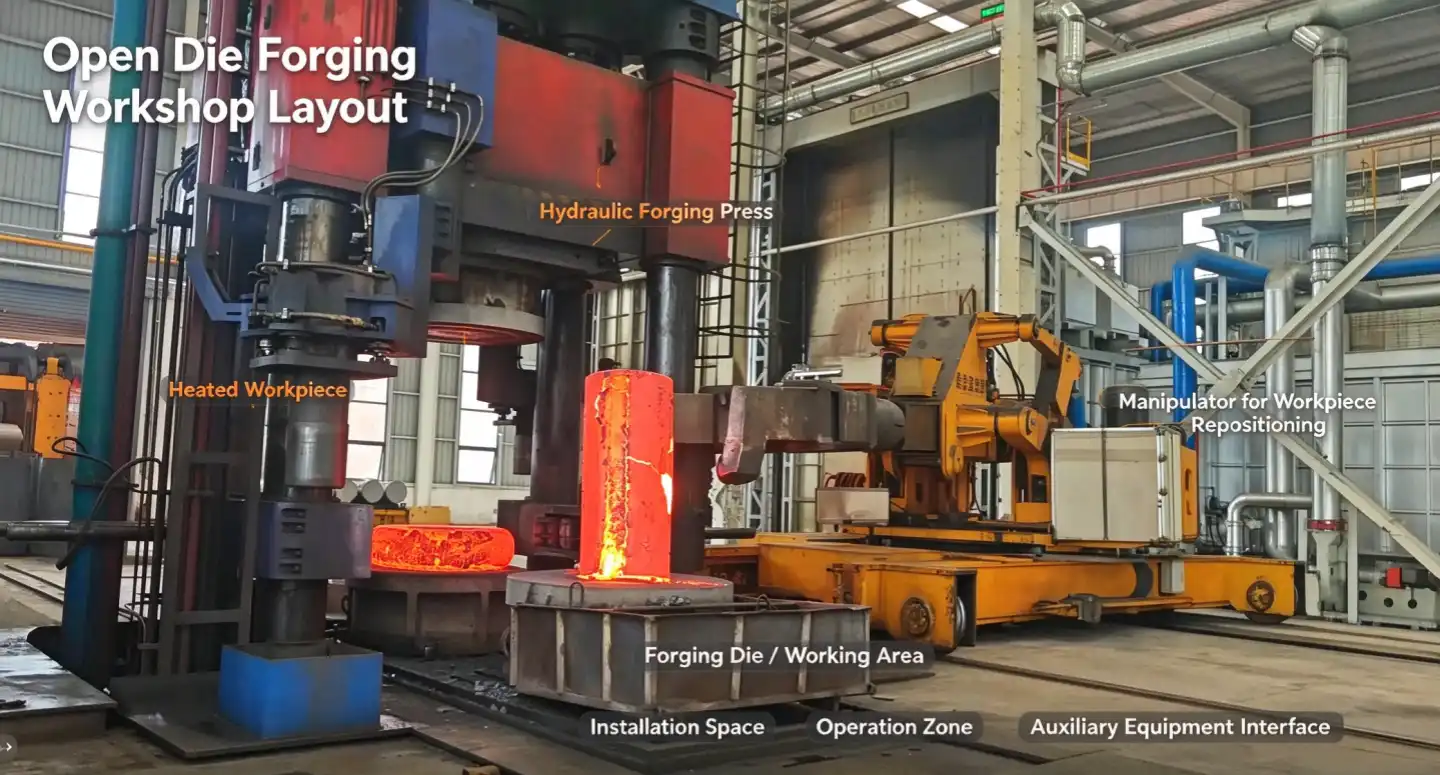
A verified general arrangement drawing helps buyers review machine dimensions, installation space, working access, and auxiliary equipment interfaces.
5. Hydraulic Open Die Forging Press vs. Forging Hammer
A hydraulic open die forging press and a forging hammer can both be used for forging applications, but they deliver deformation differently. A hydraulic press applies compressive force through ram movement, while a hammer uses repeated impacts to deform the workpiece.
Equipment selection should be based on the material, workpiece geometry, required deformation, production sequence, handling arrangement, and operating priorities. The following comparison provides a starting point rather than a universal ranking.
Selection factor
Hydraulic open die forging press
Forging hammer
Force application
Applies compressive force through controlled ram movement.
Applies impact energy through repeated blows.
Process control
May offer control of ram movement and other process variables, depending on configuration.
Control characteristics depend on hammer design, operating method, and the forging sequence.
Deformation sequence
Can suit operations organized around controlled pressing strokes and workpiece repositioning.
Can suit operations that benefit from repeated impact deformation.
Workpiece handling
Must be matched to the working opening, stroke, tooling, and press layout.
Must be matched to the hammer arrangement, die space, workpiece size, and handling method.
Equipment evaluation
Review rated force, stroke, working opening, control functions, and permitted loading conditions.
Review impact capability, tooling arrangement, workpiece requirements, and operating conditions.
Project integration
May require coordinated selection of hydraulic systems, heating, manipulators, and automation.
May require coordinated selection of heating, handling, tooling, and related production equipment.
A hydraulic press should not automatically be assumed to produce better parts, use less energy, or deliver higher productivity than a hammer. These outcomes depend on the application, equipment design, operating cycle, and production setup.
AYANK's forging equipment portfolio includes different forging technologies, including hydraulic forging hammers and open die forging hammers. Buyers comparing equipment should identify the target component and required process first, then evaluate the relevant machine category.
6. Hydraulic Press Configuration and Production Line Integration
A forging press rarely operates as an isolated machine in a complete production environment. The equipment layout may include a heating system, workpiece transfer, handling equipment, forging tools, inspection stations, and downstream processes.
The required configuration depends on workpiece dimensions, production volume, process sequence, operator involvement, and factory layout. Buyers should define the project boundary clearly so that the proposed press and auxiliary systems can be evaluated as a coordinated solution.
6.1 Standalone Press or Integrated Forging Cell?
A standalone press may be appropriate where the factory already has suitable heating, handling, and downstream equipment. An integrated forging cell may be worth considering where material transfer, repeatability, operator safety, or production coordination requires a more connected arrangement.
Before deciding, review the existing production route and identify its constraints. These may include furnace capacity, transfer time, workpiece rotation, handling bottlenecks, inspection requirements, and space for cooling or downstream processing.
6.2 Heating and Material Transfer
The heating system must support the required workpiece dimensions, material, target temperature, and production schedule. Transfer equipment should move the workpiece between stations while accommodating its size, temperature, and handling requirements.
When assessing a proposed line, clarify whether the furnace and transfer equipment are included in the scope. Also confirm how the press supplier and auxiliary equipment suppliers will coordinate interfaces, operating signals, installation responsibilities, and commissioning.
6.3 Manipulators and Workpiece Positioning
Workpiece manipulation can be a critical part of open die forging. The handling method must support the required positioning and rotation while keeping the workpiece within the permitted operating envelope of the press and its tooling.
For large or heavy workpieces, the manipulator or handling arrangement should be selected against the actual workpiece weight, geometry, temperature, gripping method, and movement path. These factors should be evaluated alongside the press rather than added after the main machine has been selected.
6.4 Automation and Process Monitoring
Automation can coordinate selected machine movements, transfers, and process-monitoring functions, depending on the system design. Its value should be assessed against the actual production requirements, not simply the number of automated functions.
Buyers should identify which operations need automation, which still require an operator, what data must be recorded, and how abnormal conditions will be handled. The supplier should explain the scope and limits of each proposed function.
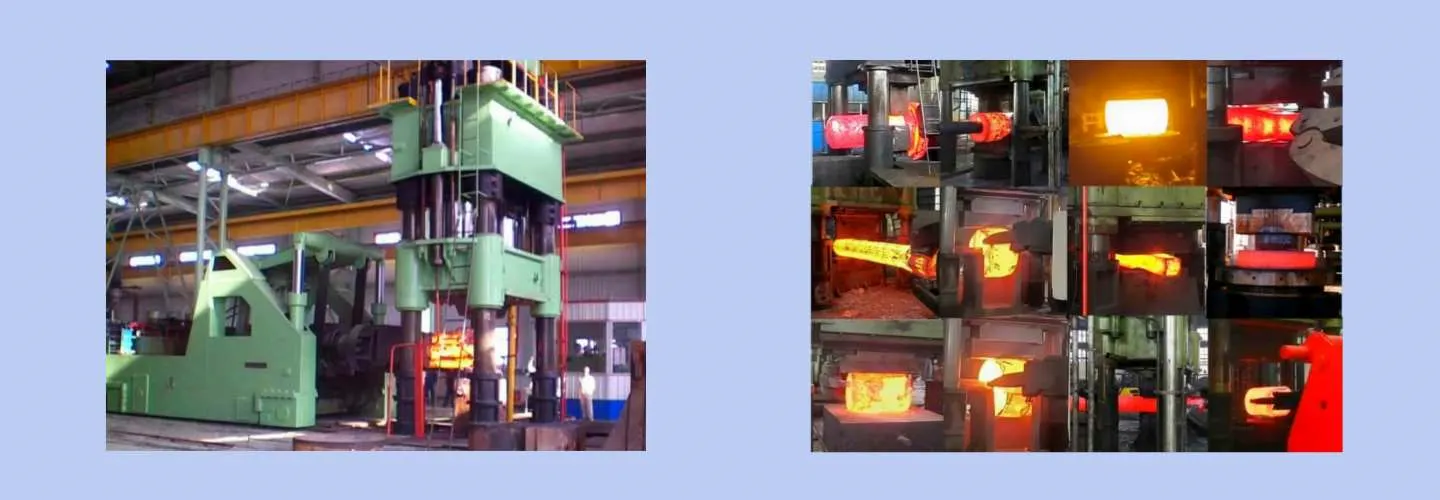
A forging line should be assessed as a complete process, including heating, pressing, handling, controls, and downstream operations. Use an actual installation photograph where available.
7. How to Evaluate a Hydraulic Forging Press Manufacturer
Choosing a manufacturer requires more than comparing quotations. The supplier should understand the proposed forging process, explain the basis of its equipment selection, and provide sufficient technical documentation for the buyer to assess the configuration.
7.1 Review Application and Engineering Capability
A useful supplier discussion begins with the workpiece rather than a standard machine model. Ask how the supplier evaluates material grade, starting stock, final geometry, forging temperature, deformation sequence, and required production volume.
Where the application is complex, clarify whether the proposal is based on engineering calculations, prior application experience, process trials, or other evidence. The supplier should distinguish confirmed capabilities from assumptions that still require validation.
7.2 Verify Machine Configuration and Documentation
Request the technical specification, general arrangement drawing, foundation requirements, utility information, operating limits, and details of included auxiliary equipment. These documents help the purchasing and engineering teams check the machine against factory conditions and production requirements.
Confirm which items are included in the quotation, which are optional, and which must be provided by the buyer or another contractor. This is particularly important for furnaces, manipulators, dies, safety systems, installation, training, and commissioning.
7.3 Assess Testing, Installation, and After-Sales Support
Clarify what inspections and tests are performed before shipment, what acceptance criteria apply, and what documentation will be supplied. If the project requires a production trial or a specific acceptance procedure, define its scope and responsibilities before placing the order.
Buyers should also review installation support, operator training, maintenance documentation, spare-parts availability, and the process for requesting technical assistance. The relevant support arrangement should be stated in the commercial and technical documents rather than assumed.
7.4 Consider AYANK's Forging Equipment Portfolio
AYANK focuses on forging equipment and related production solutions. Depending on the workpiece and process requirements, its equipment portfolio includes forging hammers, electric screw presses, roll forging equipment, and automatic forging production lines.
Relevant product families include the C66YA and C61YA open die forging hammers, the J58KA electric screw press, and the J58ZKA servo direct drive electric screw press. These are different equipment categories and should not be treated as interchangeable with a hydraulic open die forging press without an application-specific assessment.
For example, buyers evaluating electric screw press technology can review the J58KA electric screw press and the J58ZKA servo direct drive electric screw press. These links are provided for technology comparison, not as a claim that either model is a direct replacement for every hydraulic open die forging application.
If the project specifically requires a hydraulic open die forging press, request confirmation of the available machine configuration, rated capability, working dimensions, and project scope before treating a product or proposal as suitable.
8. Information to Prepare Before Requesting a Quotation
A complete request for quotation (RFQ) helps the supplier evaluate the application and reduces uncertainty around machine scope, auxiliary equipment, and installation. Buyers do not need to have every detail finalized at the first discussion, but they should identify known requirements and clearly mark any assumptions.
Workpiece and Material Information
Part drawing or representative workpiece photographs.
Material grade and initial material condition.
Billet or ingot dimensions and starting weight.
Target forged dimensions and final forging weight.
Required machining allowance and dimensional tolerances, where specified.
Required material properties, inspection criteria, or applicable standards.
Process and Production Requirements
Forging temperature range and heating method, if known.
Existing forging process and proposed deformation sequence.
Expected production volume, shift pattern, and target output.
Required workpiece rotation, transfer, and manipulation.
Die dimensions, tooling concept, and any existing tooling constraints.
Required process monitoring, operating modes, and automation functions.
Factory and Project Information
Factory layout and available installation space.
Floor, foundation, access, and lifting constraints, if known.
Available electrical supply and other relevant utility conditions.
Existing furnaces, manipulators, cranes, and downstream equipment.
Installation country and expected project schedule.
Required installation, commissioning, training, and service scope.
If some information is unavailable, send the current drawings and explain which values are preliminary. The supplier can then identify the missing data needed for a meaningful technical assessment.
9. Common Mistakes When Selecting an Open Die Forging Press
Choosing by Tonnage Alone
Nominal press force does not establish suitability by itself. The available force under the required operating conditions, working opening, stroke, tooling, and loading limitations must also match the process.
Ignoring Workpiece Handling
A press may accommodate the workpiece dimensionally but still be difficult to operate if there is insufficient space for rotation, transfer, or removal. Review the entire movement path and the handling equipment required for each major operation.
Using the Same Assumptions for Every Material
Material grade, temperature, and deformation behavior affect the forging process. Load estimates and process recommendations should be based on the actual material and operating conditions, not a generic assumption.
Confusing Press Cycle Time with Production Output
The time required for a ram movement is only one part of the forging cycle. Heating, transfer, repositioning, inspection, reheating, and downstream operations can also affect output. Production estimates should state their assumptions clearly.
Leaving Auxiliary Equipment Out of the Project Scope
If the quotation covers only the press, the buyer may still need to arrange tooling, heating, material handling, installation, and safety-related equipment. Establishing the supply boundary early makes quotations easier to compare and reduces the risk of missing project requirements.
10. Conclusion: Selecting the Right Hydraulic Open Die Forging Press
A hydraulic open die forging press should be selected around the workpiece, material, deformation sequence, and production environment. Required force is important, but it must be assessed together with stroke, working opening, tooling, workpiece handling, control functions, installation conditions, and the supporting production equipment.
Before committing to a machine, prepare representative part drawings, material information, starting stock dimensions, target forged dimensions, production requirements, and factory layout details. Ask the supplier to explain the proposed configuration, its operating limits, and the assumptions behind its technical recommendation.
For some projects, a hydraulic press will be a suitable candidate. For others, a forging hammer, electric screw press, roll forging machine, or integrated line may deserve evaluation. The appropriate choice depends on the actual process and should be confirmed through a technically grounded application review.
Planning a New Forging Project?
Share your workpiece drawing, material grade, billet dimensions, target forged weight, production volume, and automation requirements with AYANK. These details can help establish the relevant forging process, identify suitable equipment categories, and define the technical information needed for project evaluation.
If your project requires a hydraulic open die forging press, specify the required pressing force if known, working stroke, opening dimensions, tooling arrangement, and workpiece-handling method. If these parameters have not yet been established, indicate that an application assessment is required.
1. What is a hydraulic open die forging press used for?
A hydraulic open die forging press is used to deform heated metal stock through compression between forging tools without fully enclosing the workpiece in a shaped die cavity. Depending on the application, it may be considered for shafts, bars, blocks, discs, and preforms that can be produced through successive deformation and repositioning operations.
2. How do I determine the required press force?
Required press force depends on material grade, forging temperature, deformation amount, contact area, tooling geometry, friction, and the intended process sequence. Provide the supplier with the workpiece drawing, material information, starting stock dimensions, and target geometry so the required force can be assessed against the actual operating conditions.
3. What is the difference between a hydraulic open die forging press and a forging hammer?
A hydraulic open die forging press applies compressive force through ram movement, while a forging hammer deforms the workpiece through repeated impacts. Their suitability depends on workpiece geometry, material, required deformation, process sequence, handling arrangements, and production requirements.
4. What information should I provide when requesting a forging press quotation?
Provide part drawings, material grade, billet dimensions and weight, target forged dimensions and weight, forging temperature if known, production volume, required cycle, tooling information, handling and automation requirements, factory layout, utility conditions, and installation country. Clearly identify any values that are still preliminary.
5. Can a hydraulic open die forging press be integrated into an automatic production line?
Integration may be possible depending on the press design and the project requirements. The system may need coordinated heating, workpiece transfer, manipulation, process monitoring, safety functions, and downstream equipment. The supplier should confirm which functions are supported and define the scope and interfaces of the proposed line.
6. How do I evaluate a hydraulic forging press manufacturer?
Evaluate the manufacturer's application engineering capability, technical documentation, proposed machine configuration, operating limits, auxiliary equipment scope, testing and acceptance procedures, installation support, training, and after-sales service. Ask the supplier to explain how the proposed equipment matches the actual workpiece and production requirements.
7. Is a hydraulic open die forging press suitable for ring production?
A hydraulic open die forging press may be used to prepare or deform stock for a ring-shaped preform, depending on the process. If the target component requires controlled circumferential expansion to achieve its final ring dimensions, a dedicated ring rolling machine may also be required. The complete process route should be evaluated before selecting equipment.
8. What should I check before installing a hydraulic forging press?
Review the manufacturer's installation drawings, foundation and floor requirements, machine dimensions, transport and assembly access, electrical supply, relevant utility requirements, maintenance clearances, and interfaces with auxiliary equipment. Confirm the installation and commissioning responsibilities before the equipment is shipped.