
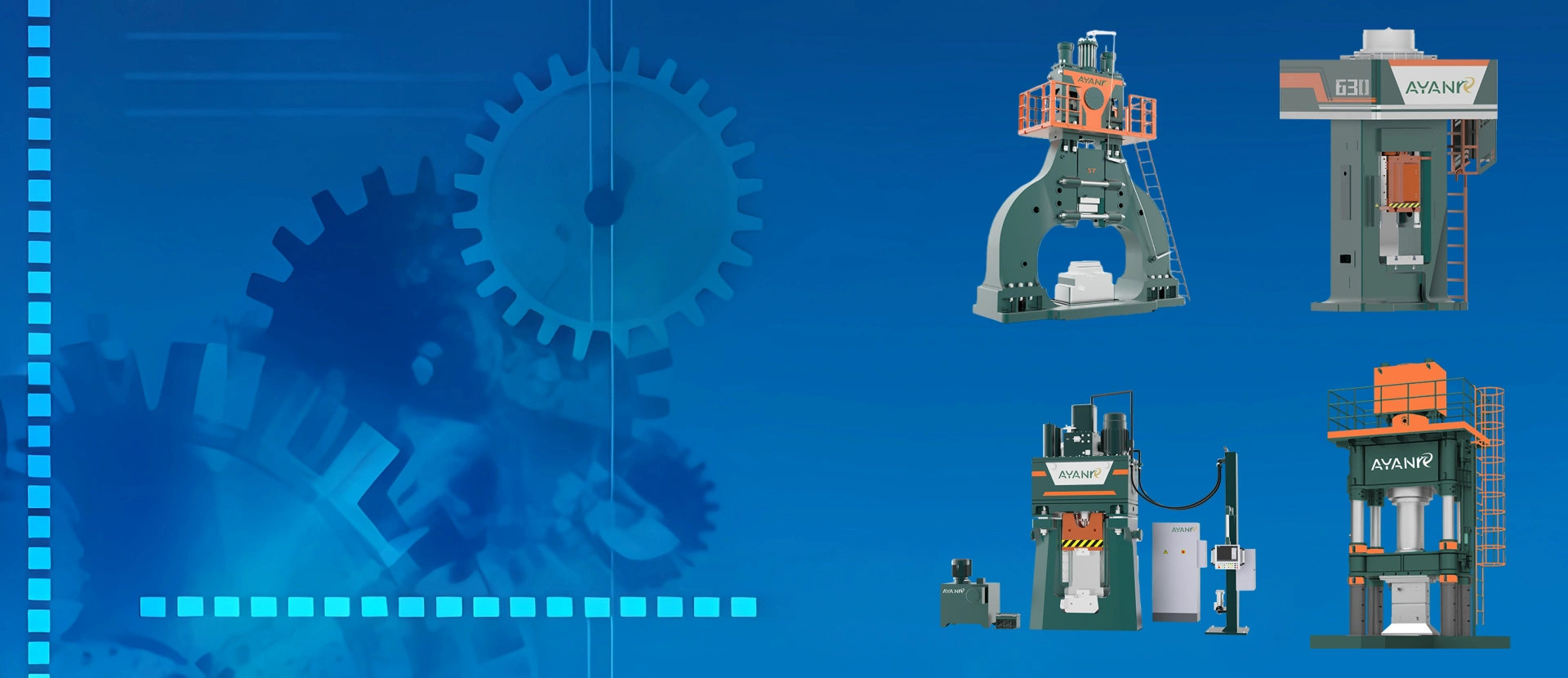
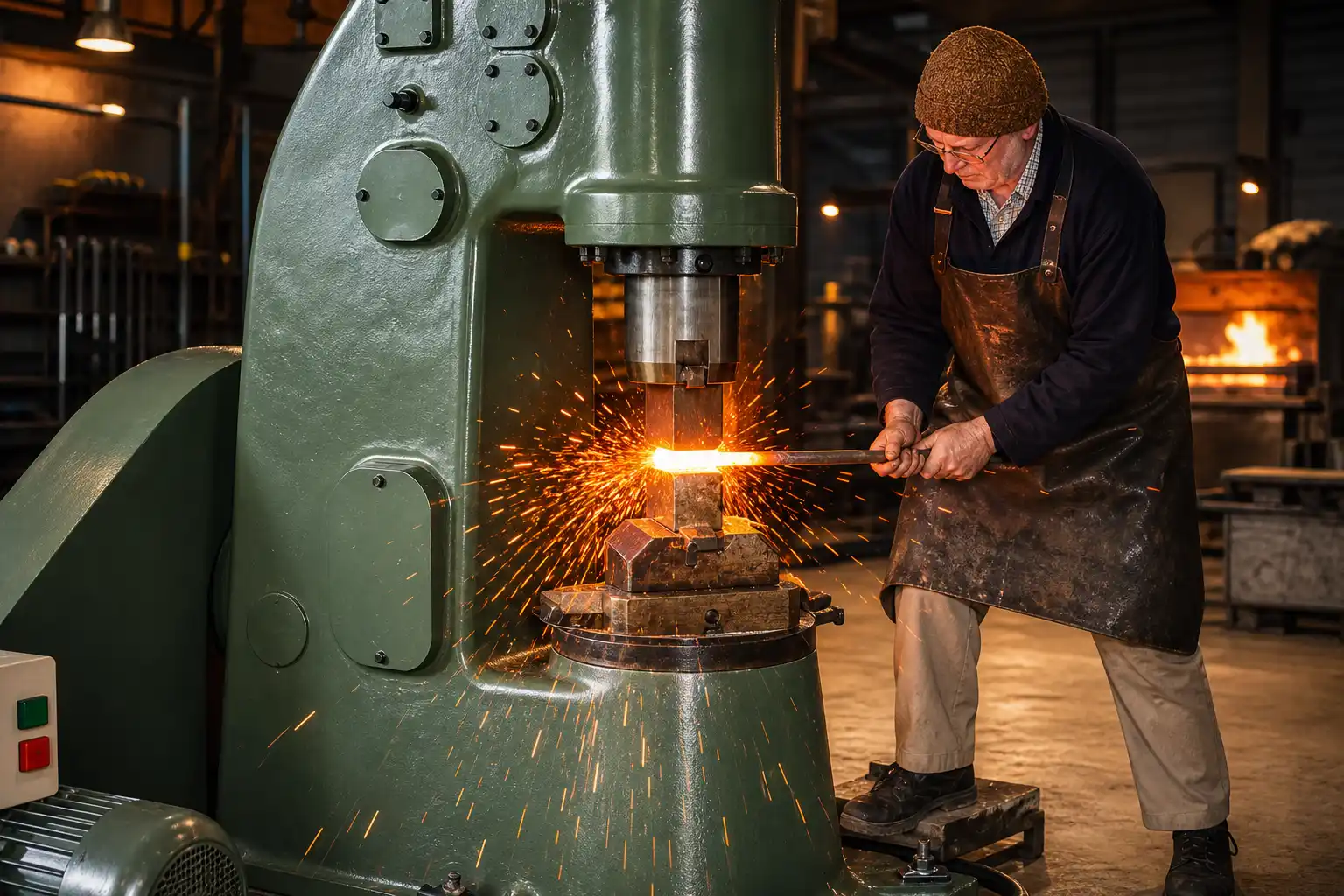
A blacksmith power hammer can help a forging workshop increase forming speed, reduce repetitive manual hammering, and produce more consistent workpieces. However, the right machine depends on more than hammer size or purchase price. Workpiece dimensions, material, required deformation, production volume, and available workshop space all affect equipment selection.
Quick Answer
A blacksmith power hammer is a powered forging machine that delivers repeated blows to hot or, in some specialized processes, suitably prepared metal to change its shape. Common types include mechanical or spring hammers, pneumatic power hammers, hydraulic forging hammers, and CNC-controlled forging hammers.
For a small blacksmith shop producing decorative ironwork, knives, tools, and small forged components, a compact power hammer may be sufficient. For a production workshop processing larger billets or manufacturing industrial forgings, a pneumatic or hydraulic forging hammer may be more appropriate. CNC forging hammers are worth evaluating when the process requires programmable control, repeatability, or integration into an automated production line.
Power hammer prices vary with machine type, rated capacity, tooling, control system, installation requirements, and after-sales support. Buyers should compare complete machine configurations and their suitability for the intended workpieces rather than choosing solely by the lowest quoted price.
1. What Is a Blacksmith Power Hammer?
A blacksmith power hammer is a machine that uses a powered mechanism to move a hammer ram or striking assembly repeatedly against a workpiece supported on an anvil or lower die. Unlike a hand hammer, which depends on the blacksmith's individual strikes, a power hammer supplies repeated mechanical impacts to support more productive forging operations.
Power hammers are used in traditional blacksmithing, artistic metalwork, toolmaking, general forging, and industrial metal forming. Depending on the machine design, they can support operations such as drawing out, upsetting, bending, punching, and shaping heated metal. Larger forging hammers may also be configured for open-die or closed-die forging applications.
The term blacksmith power hammer covers equipment with substantially different capacities and operating principles. A small spring hammer used for decorative ironwork is not equivalent to an industrial pneumatic hammer or a programmable hydraulic die forging hammer. Buyers should identify the intended process before comparing models.
What Does a Power Hammer Do?
The main function of a power hammer is to apply repeated impact force to deform metal. The workpiece is typically heated to an appropriate forging temperature when the material and process require hot forging. The operator or an automated handling system positions the workpiece beneath the hammer and controls its movement between blows.
Typical applications include:
- Drawing out: Elongating a heated bar or billet while reducing its cross-sectional area.
- Upsetting: Increasing the cross-sectional area of a selected section, usually by shortening it.
- Pointing and tapering: Producing tapered ends on bars, rods, and similar workpieces.
- Bending and shaping: Forming hooks, scrolls, decorative elements, and other profiles when the machine and tooling are suitable.
- Punching and related operations: Producing openings or local features with suitable tooling and process controls.
- Open-die forging: Deforming billets between relatively simple dies without fully enclosing the workpiece.
- Die forging: Forming a workpiece in shaped dies when the hammer, die system, and production process are designed for that purpose.
Not every power hammer is suitable for every operation. Required impact energy, workpiece size, die geometry, material behavior, and operator access should all be checked before selecting a machine.
How Does a Blacksmith Power Hammer Work?
Although the exact mechanism depends on the hammer type, the operating sequence is generally similar: a power source drives the hammer mechanism, the ram accelerates toward the workpiece, the impact deforms the metal, and the ram returns for the next blow.
Mechanical and spring hammers use mechanical linkages or spring arrangements to produce the striking motion. Pneumatic hammers use compressed air to drive the working piston and hammer assembly. Hydraulic forging hammers use a hydraulic system to control hammer movement and impact delivery. CNC forging hammers add programmable control to coordinate the striking process according to the machine's capabilities.
During forging, the operator or handling system repositions and rotates the workpiece as necessary. Multiple blows gradually produce the required dimensions and shape. The result depends on the interaction between impact energy, blow frequency, workpiece temperature, material properties, die design, and handling technique.
What Materials Can It Forge?
Power hammers can process a range of forgeable metals, but the suitable material and workpiece size depend on the machine's capacity and the selected forging process.
- Carbon steel: Commonly used for tools, shafts, general-purpose forgings, and decorative metalwork.
- Alloy steel: Used for components that require specific mechanical properties, subject to suitable forging temperatures and equipment capacity.
- Stainless steel: Can be forged when the machine, tooling, temperature control, and process are appropriate for the particular grade.
- Non-ferrous alloys: Certain aluminum, copper, and other alloys can be forged using equipment and process parameters appropriate to their material characteristics.
Material compatibility alone does not establish machine suitability. A hammer that can forge a particular grade in a small section may not have enough impact energy or working space for a much larger billet of the same material. Buyers should evaluate the actual billet dimensions, forging temperature, deformation required, and final part geometry.
What Are Its Main Benefits for Metalworking Businesses?
A power hammer can offer several production benefits when correctly matched to the application.
- Higher forging output: Powered striking reduces dependence on individual manual hammer blows and can support more productive forming operations.
- Reduced repetitive manual effort: The machine supplies the striking energy, allowing the operator to focus on positioning and manipulating the workpiece.
- Flexible forming operations: Suitable configurations can support drawing, upsetting, bending, and other forging tasks without requiring a dedicated machine for every operation.
- Repeatable operation: Appropriate machine controls, tooling, and process procedures can improve consistency between workpieces.
- Production scalability: Workshops can select from different machine types and capacities as their workpiece range and production requirements develop.
These benefits are not automatic. Productivity and consistency depend on operator skill, billet preparation, heating equipment, tooling, material handling, maintenance, and the selected forging sequence. A higher-capacity machine may also require a stronger foundation, more installation space, and additional safety provisions.
2. Types of Blacksmith Power Hammers for Different Applications
The main differences between power hammer types concern how the striking motion is generated, how impact energy is controlled, what level of production they support, and how easily they can be integrated into a larger manufacturing process.
For a small blacksmith shop, purchase price, footprint, operating simplicity, and tooling flexibility may be the main considerations. For an industrial forging plant, buyers also need to evaluate impact energy, billet dimensions, production requirements, automation, foundation design, and long-term service support.
Mechanical and Spring Power Hammers
Mechanical power hammers use mechanical transmission components to produce the striking motion. Spring hammers use a spring-based mechanism to transmit movement and assist the hammering action. These machines are commonly associated with small workshops, traditional blacksmithing, and artistic metalwork, although their capabilities vary by design.
They may be suitable for applications such as:
- Decorative ironwork and ornamental metal components.
- Small tools and general blacksmithing work.
- Forging operations involving relatively small bars and billets.
- Workshops that prioritize straightforward operation and a compact production setup.
Before purchasing, check the actual working capacity, available dies, ram travel, striking characteristics, machine condition, and maintenance requirements. A machine advertised as a blacksmith hammer should not be assumed to have sufficient capacity for industrial billet forging.
Pneumatic Power Hammers
A pneumatic power hammer uses compressed air to drive the working piston and hammer assembly. In many forging hammer designs, the operator can control the striking action to produce lighter or heavier blows and adapt the hammering sequence to the workpiece.
Pneumatic forging hammers are used in general blacksmithing and open-die forging, from smaller artistic metalworking applications to industrial forging operations. The appropriate model depends on the falling-part mass, blow energy, maximum blow frequency, working area, billet dimensions, and the material being forged.
AYANK's C41A series pneumatic forging hammer is one example of an equipment family spanning both smaller and industrial applications. The published product range covers nominal falling-part weights from 15 kg to 2,000 kg. This is a range of different machine models, not a claim that one hammer can handle every workpiece within that range.
The manufacturer lists features such as an integrated air-compression mechanism, adjustable striking action, and applications in open-die forging. Buyers should verify the precise configuration and utility requirements for the selected model rather than assuming that all pneumatic hammers have the same installation needs.
Explore the AYANK C41A pneumatic forging hammer specifications for model-by-model information.
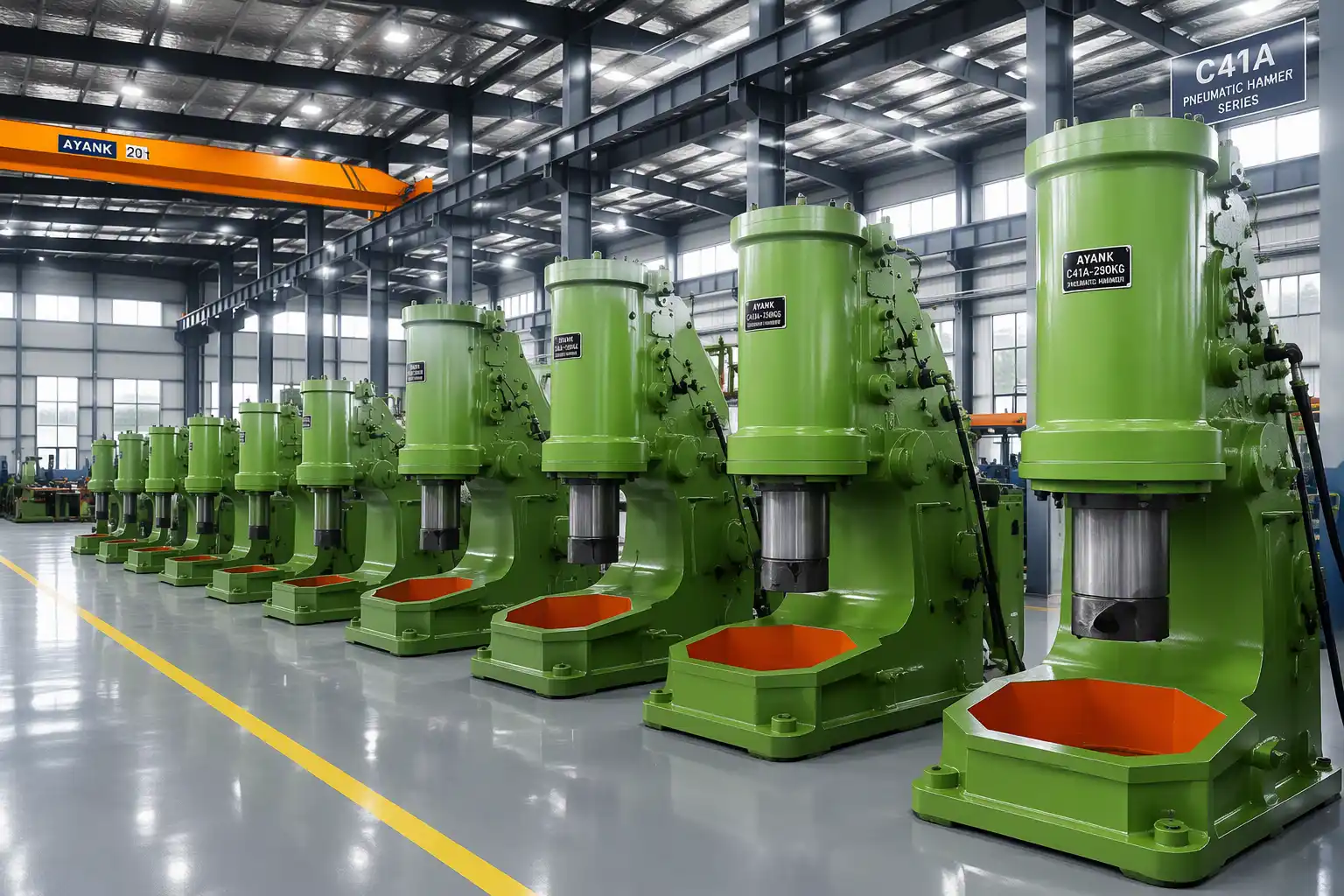
Example: AYANK C41A Pneumatic Forging Hammer Specifications
The following figures are taken from AYANK's published C41A product information. They illustrate how falling-part weight, blow energy, blow frequency, and working dimensions vary across models. They should be used as an initial comparison, not as a substitute for application-specific engineering evaluation.
| Parameter | C41A-25L | C41A-75L | C41A-150L | C41A-400B | C41A-1000L | C41A-2000L |
|---|---|---|---|---|---|---|
| Weight of falling part | 25 kg | 75 kg | 150 kg | 400 kg | 1,000 kg | 2,000 kg |
| Blow energy | 0.27 kJ | 1 kJ | 2.5 kJ | 9.5 kJ | 27 kJ | 54 kJ |
| Maximum blow frequency | 250 min⁻¹ | 210 min⁻¹ | 180 min⁻¹ | 120 min⁻¹ | 95 min⁻¹ | 80 min⁻¹ |
| Working area height | 240 mm | 300 mm | 370 mm | 530 mm | 800 mm | 1,000 mm |
| Motor power | 3 kW | 7.5 kW | 18.5 kW | 30 kW | 75 kW | 132 kW |
Source: AYANK C41A series pneumatic forging hammer product page. Specifications are published model data and should be reconfirmed with the supplier before ordering. Maximum blow frequency is not the same as guaranteed production output.
When comparing these models, do not select a machine solely because it has a larger falling-part weight or higher stated blow energy. The correct model must also provide a suitable working area, appropriate deformation capability, and sufficient access for the actual workpiece and dies.
Hydraulic Forging Hammers
Hydraulic forging hammers use hydraulic power to drive and control the hammer's striking motion. Depending on the design, they can provide controlled impact energy and operating flexibility for applications ranging from open-die forging to specialized die forging.
Industrial hydraulic hammers should be distinguished from conventional hydraulic presses. A hydraulic hammer delivers repeated impacts, whereas a hydraulic press primarily applies force through a controlled pressing stroke. The two technologies may serve overlapping markets, but they do not produce identical forming conditions.
Hydraulic forging hammers may be appropriate when a workshop needs to process larger workpieces, handle demanding forging operations, or develop a more structured production process. Selection should account for impact energy, control functions, die arrangement, material characteristics, and the required forging sequence.
AYANK offers distinct hydraulic hammer product families for different applications:
- Hydraulic open-die forging hammer — for suitable open-die forging applications.
- C86YA hydraulic die forging hammer — for applications requiring die forging.
These product categories should not be treated as interchangeable. Buyers should identify whether the intended process is open-die forging, closed-die forging, or another specialized forming operation before requesting a quotation.
CNC Forging Hammers
A CNC forging hammer uses programmable control to manage selected aspects of the forging cycle. Depending on the machine architecture, control functions may include striking commands, impact settings, operating sequences, and coordination with other production equipment.
CNC control can be valuable in production environments where repeatable operation, die-based forming, process coordination, or integration with an automated forging line is important. However, programmable control alone does not guarantee dimensional accuracy. Material temperature, billet positioning, die design, machine condition, and process parameters remain important.
AYANK's C92KA series is a CNC fully hydraulic die forging hammer family intended for die forging applications. It should be evaluated separately from a conventional blacksmith power hammer because its intended work, tooling, control requirements, and production environment may be substantially different.
For buyers considering automated or higher-volume die forging, review the AYANK hydraulic die forging hammer product information and confirm the required configuration with the manufacturer.
Before selecting a CNC forging hammer, establish which operations need to be programmed, what repeatability the production process requires, and whether billet heating, transfer, die lubrication, workpiece handling, and downstream operations also need automation.
3. How to Choose the Right Blacksmith Power Hammer
The right blacksmith power hammer is the machine that can perform the required forging operations reliably within the workshop's production, installation, and operating constraints. Selecting by nominal hammer weight alone can result in insufficient capacity, unnecessary capital expenditure, or a machine that is difficult to integrate into the existing process.
Before comparing quotations, define the workpiece range, forging method, production target, and operating conditions. These requirements give the supplier a practical basis for recommending a suitable machine configuration.
Choose the Hammer Based on Your Workpiece
Begin with the parts you intend to manufacture rather than the machine catalog. The workpiece determines how much material must be deformed, which operations are required, what tooling is needed, and how much working space the hammer must provide.
Prepare the following information for each representative part:
- Material grade and its forging characteristics.
- Initial billet shape, dimensions, and weight.
- Final workpiece dimensions and target weight.
- Required forging operations, such as drawing out, upsetting, bending, or die forging.
- Whether the workpiece is forged freely or formed in shaped dies.
- Required dimensional tolerances and any downstream machining.
If your product range includes both small decorative components and large industrial forgings, one machine may not be the most economical solution for every part. Compare the expected workload by product family and determine whether a single versatile hammer or multiple machines would better meet the production requirements.
Consider Blow Energy and Forging Capacity
Blow energy is an important parameter when evaluating a forging hammer, but it must be considered alongside the falling-part mass, striking characteristics, workpiece dimensions, material, forging temperature, and deformation required.
Maximum blow frequency also matters, particularly in production applications. However, a higher stated frequency does not necessarily mean more finished parts per hour. Actual output depends on the number of blows required, billet heating and transfer time, workpiece manipulation, die changes, and other cycle constraints.
Working area height and the clearance between the hammer and frame affect how easily operators can position and rotate the workpiece. The die dimensions and anvil arrangement must also be suitable for the intended forging process.
For an initial comparison, ask suppliers to provide:
- Falling-part weight and rated blow energy.
- Maximum blow frequency and available striking controls.
- Working area height and relevant machine clearances.
- Permissible billet dimensions for your intended application.
- Required motor power and utility connections.
- Foundation, anvil, and installation requirements.
For a demanding application, provide the workpiece drawing and process information to the manufacturer. A technical assessment based on the actual part is more useful than choosing a hammer from a single headline specification.
Match the Machine to Your Production Volume
Production volume helps determine whether a workshop needs a flexible general-purpose power hammer or a machine designed for more structured industrial production. A suitable choice should account for both the number of parts required and the time needed to complete each forging cycle.
For a small blacksmith shop, production may involve short runs, custom orders, and frequent changes in workpiece shape. Flexibility, straightforward adjustment, and tooling availability may therefore be more important than maximum output.
For a commercial forging workshop producing repeated batches, buyers should examine cycle time, heating capacity, billet handling, die changes, operator workload, and maintenance downtime. A hammer with sufficient impact energy may still become a production bottleneck if workpieces cannot be transferred or manipulated efficiently.
For industrial production, consider the complete process rather than the hammer alone. The production system may include billet cutting, heating, descaling where applicable, forging, trimming, heat treatment, inspection, and material transfer. The hammer's required output should be coordinated with these upstream and downstream operations.
When estimating capacity, ask the supplier to distinguish between the machine's maximum blow frequency and the expected production cycle for your actual workpiece. A credible estimate should state the assumptions about billet dimensions, material, forging sequence, tooling, heating, handling, and operator or automation arrangements.
Evaluate Installation, Utilities and Maintenance
Installation requirements can significantly affect the total cost of owning a blacksmith power hammer. Before purchasing, confirm that the workshop can accommodate the machine and provide the utilities, foundation, access, and safety measures required by the selected configuration.
Important checks include:
- Foundation and floor: Confirm the required foundation design, anchoring arrangements, floor capacity, and vibration considerations with the manufacturer and a qualified local engineer.
- Workshop clearance: Allow space for the hammer, workpiece manipulation, dies, maintenance access, and safe operator movement.
- Electrical supply: Verify the required voltage, frequency, phase configuration, motor power, protection, and control-system requirements.
- Compressed air or hydraulic utilities: Confirm the actual requirements for pneumatic or hydraulic equipment, including any auxiliary systems.
- Material handling: Determine whether the process needs tongs, manipulators, lifting equipment, conveyors, or automated billet transfer.
- Safety systems: Review guarding, controls, emergency stops, hot-work procedures, noise exposure, and applicable local machinery and workplace safety requirements.
- Maintenance access: Check access to wear components, lubrication points, control equipment, and parts that may require periodic inspection or replacement.
Maintenance planning should cover lubrication, inspection of the striking mechanism, die condition, fasteners, control systems, and any pneumatic or hydraulic components. The exact schedule depends on the hammer design, operating intensity, working environment, and manufacturer's instructions.
Before ordering, request the installation drawing, utility requirements, foundation recommendations, maintenance documentation, and spare-parts list for the specific machine. These documents help the buyer estimate installation costs and reduce the risk of delays after delivery.
4. How Much Does a Blacksmith Power Hammer Cost?
The price of a blacksmith power hammer depends on its type, capacity, mechanical design, control system, tooling, and intended production application. A compact hammer for a small workshop and a large industrial forging hammer belong to different equipment categories, so their prices should not be compared without considering their specifications.
There is no single price that applies to every blacksmith power hammer. For industrial equipment, the most reliable approach is to request a configuration-specific quotation based on the intended workpieces, production requirements, installation conditions, and delivery destination.
What Factors Affect Power Hammer Prices?
The following factors commonly influence the purchase price and the total cost of bringing a hammer into production.
| Cost factor | What the buyer should evaluate |
|---|---|
| Machine type | Mechanical, spring, pneumatic, hydraulic, and CNC-controlled machines use different mechanisms and control arrangements. |
| Capacity and working dimensions | Falling-part weight, blow energy, working area, and the size and weight of the intended workpieces. |
| Control system | Manual controls, programmable functions, monitoring, and interfaces for automated equipment. |
| Tooling and dies | Standard tooling, custom die requirements, die materials, and the number of workpiece types to be produced. |
| Auxiliary equipment | Heating, billet handling, manipulators, material transfer, and other equipment required by the production process. |
| Installation requirements | Foundation work, electrical connections, compressed-air or hydraulic utilities, lifting arrangements, and commissioning. |
| Delivery and logistics | Packing, inland transport, ocean or air freight where applicable, insurance, import duties, and local handling. |
| Service and spare parts | Warranty terms, replacement-part availability, technical support, training, and maintenance requirements. |
A low initial purchase price does not necessarily mean a lower total cost. Buyers should consider the expected production life, energy and utility consumption, tooling expenditure, maintenance, downtime, installation, and the cost of achieving the required output.
New vs. Used Blacksmith Power Hammers
A used blacksmith power hammer may offer a lower initial purchase cost, but the buyer needs to assess its mechanical condition and suitability for the intended application. For older machines, replacement parts, drawings, control components, and technical support may be difficult to obtain.
A new machine generally allows the buyer to specify the intended configuration and request current documentation, agreed acceptance criteria, and applicable warranty terms. However, these benefits depend on the supplier's actual scope of supply and contract conditions; they should not be assumed without written confirmation.
| Evaluation factor | New machine | Used machine |
|---|---|---|
| Initial purchase cost | Usually higher for a comparable configuration. | May be lower, depending on condition and availability. |
| Machine condition | Confirm manufacturing specifications and factory acceptance arrangements. | Inspect wear, cracks, alignment, operating controls, and maintenance history. |
| Documentation | Request current manuals, drawings, and technical specifications. | Check whether original drawings, manuals, and maintenance records are available. |
| Customization | Configuration may be specified before manufacturing. | Modifications may be possible but can increase cost and complexity. |
| Parts and support | Confirm spare-parts supply, warranty, and service scope. | Verify parts availability and whether the supplier supports the existing model. |
| Commissioning risk | Clarify installation and acceptance responsibilities. | Allow for transport, recommissioning, repairs, and replacement components. |
When inspecting a used hammer, involve a qualified technician familiar with the machine type. Pay particular attention to the frame, ram guides, striking mechanism, anvil and foundation interface, drive components, control systems, and evidence of abnormal vibration or previous repairs. Do not operate a machine that has not been assessed for safe use.
What Should Be Included in a Supplier Quotation?
A useful quotation should allow the buyer to compare technically equivalent offers. Request a written breakdown of the proposed machine, its included accessories, the scope of supply, and any items that must be purchased separately.
- Manufacturer, model, machine type, and principal technical specifications.
- Confirmation that the proposed machine is suitable for the submitted workpieces and forging process.
- Included dies, tooling, controls, and auxiliary equipment.
- Electrical, pneumatic, hydraulic, foundation, and installation requirements, as applicable.
- Manufacturing lead time, packing method, delivery terms, and shipping arrangements.
- Payment terms and quotation validity.
- Warranty conditions, spare-parts availability, and after-sales service scope.
- Installation, commissioning, training, inspection, and acceptance arrangements.
- Exclusions, optional equipment, and any additional charges.
For international purchases, also clarify the agreed Incoterms, the destination port or delivery address, responsibility for unloading and local transport, and the party responsible for import clearance and duties. These details help prevent a machine quotation from being mistaken for the total installed cost.
5. Blacksmith Power Hammer vs. Hydraulic Forging Hammer vs. Power Press
These equipment categories are related, but they use different forming mechanisms and serve different production requirements. A blacksmith power hammer is a broad term for powered striking equipment, while an industrial hydraulic forging hammer is a specific type of hammer using hydraulic power. A power press, by contrast, forms metal primarily through a pressing stroke.
Buyers should compare equipment based on the required forging process, workpiece geometry, deformation requirements, tooling, production rate, and control needs rather than assuming that one machine type is universally superior.
| Comparison factor | General blacksmith power hammer | Hydraulic forging hammer | Power press |
|---|---|---|---|
| Primary forming action | Repeated powered impacts. | Repeated impacts generated by a hydraulic hammer mechanism. | Force applied through a pressing stroke. |
| Typical use | Blacksmithing, general forging, and selected small-workshop applications. | Suitable open-die or die forging, depending on the machine design. | Press-based forming, including suitable forging and other metal-forming operations. |
| Process characteristics | Repeated blows allow the operator to progressively shape the workpiece. | Impact energy and operating controls depend on the hydraulic hammer design. | Deformation occurs during a controlled pressing stroke, subject to the press design. |
| Tooling considerations | Tooling varies with workshop operations and workpiece geometry. | Dies and working arrangements must match the intended forging application. | Die design, shut height, stroke, force capacity, and press configuration are important. |
| Selection priority | Flexibility, workpiece size, striking capability, and ease of operation. | Impact capability, forging process, billet handling, and industrial production requirements. | Required pressing force, stroke, die arrangement, cycle, and dimensional requirements. |
When Should You Choose a Hammer?
A forging hammer is worth evaluating when the process depends on repeated impacts to deform heated metal. It can be appropriate for open-die work, progressive shaping, and suitable die forging operations. The exact machine type should be selected according to the part geometry and the required deformation.
When Should You Choose a Press?
A press may be more appropriate when the process benefits from a controlled pressing stroke, a particular die-closing sequence, or the force and stroke characteristics of a press-based forming operation. Buyers should evaluate the actual load requirements, tooling, cycle time, and material flow before making the decision.
AYANK also supplies electric screw press equipment, including the J58KA electric screw press and the J58ZKA servo direct-drive electric screw press. These are additional options to consider when the required forming process is better suited to a screw press than to a hammer.
The correct comparison starts with the workpiece and process requirements. A supplier should explain why the proposed machine is suitable and identify the technical assumptions behind the recommendation.
6. What to Look for in a Blacksmith Power Hammer Manufacturer
Selecting a power hammer manufacturer involves more than comparing catalog prices. The supplier should be able to understand the forging application, explain the relevant machine specifications, define the scope of supply, and provide the documentation and support required to bring the equipment into production.
Manufacturing Experience and Technical Capability
Look for evidence that the manufacturer produces equipment relevant to your actual application. A supplier of compact blacksmith hammers may not have the same engineering scope as a manufacturer of industrial forging hammers or integrated forging lines.
Ask whether the manufacturer can review your workpiece drawings, assess the forging method, recommend a suitable machine type, and explain the limitations of the proposed configuration. Where possible, request examples of relevant machine designs, assembly processes, or application documentation that the supplier can substantiate.
Machine Specifications and Customization
A manufacturer should provide clear, model-specific specifications rather than relying on broad descriptions such as heavy-duty, high-performance, or industrial-grade.
Depending on the machine type, relevant information may include falling-part weight, blow energy, maximum blow frequency, working area, motor power, control functions, and utility requirements. The supplier should also clarify which dimensions, tooling arrangements, controls, or auxiliary systems can be customized.
Customization should have a defined scope. Ask for written confirmation of the proposed configuration, its effect on delivery time and price, and any limitations that could affect the intended forging process.
Quality Control and Testing
Before placing an order, establish what inspections and tests the manufacturer performs and what evidence will be supplied. Depending on the equipment, this may include component inspections, assembly checks, control-system verification, functional testing, and agreed factory acceptance tests.
For a machine intended for a specific workpiece, discuss whether a representative forging trial or other practical acceptance method is possible. Define the test material, tooling, process conditions, acceptance criteria, and responsibilities in advance. Do not assume that a general factory test guarantees a particular finished-part tolerance or production rate.
Spare Parts, Warranty and After-Sales Service
A forging hammer is a production asset, so long-term serviceability matters. Ask the supplier which components are expected to require routine replacement, which spare parts are recommended for initial stocking, and how technical support is provided.
Clarify the warranty period and exclusions, the process for handling technical issues, the availability of replacement parts, and whether remote troubleshooting or on-site service can be arranged. For imported equipment, confirm how service responsibilities are divided between the manufacturer, distributor, and local service provider.
Shipping, Installation and Commissioning
Large forging hammers may require specialized packing, lifting, transport, foundation preparation, and commissioning. These requirements should be addressed before the machine is dispatched.
Request the machine layout, installation instructions, foundation information, utility requirements, and a clear list of work that must be completed by the buyer. Confirm whether commissioning and operator training are included in the quotation or offered separately.
For international projects, also confirm the shipment configuration, destination logistics, documentation, installation responsibilities, and the acceptance process after the equipment arrives.
7. Why Consider AYANK for Industrial Forging Equipment?
AYANK focuses on industrial forging equipment, including forging hammers, hydraulic forging equipment, electric screw presses, and related forging production solutions. For buyers evaluating a blacksmith power hammer, the relevant question is whether the manufacturer's equipment range and engineering capabilities match the workpieces, production requirements, and intended manufacturing process.
Different forging applications require different machine configurations. A workshop producing small decorative components may need a different solution from a manufacturer processing large billets or producing repeated die forgings. AYANK's range of forging equipment gives buyers several machine categories to evaluate when defining a suitable production setup.
Forging Hammer Options for Different Applications
AYANK's published product portfolio includes the C41A pneumatic forging hammer series, hydraulic open-die forging hammer equipment, and hydraulic die forging hammer equipment. These categories serve different applications and should be evaluated against the buyer's actual workpiece requirements.
- AYANK power hammer equipment — review the available equipment range and identify the product category relevant to your application.
- C41A pneumatic forging hammer — review the published model specifications for suitable pneumatic hammer applications.
- Hydraulic open-die forging hammer — explore equipment intended for appropriate open-die forging operations.
- Hydraulic die forging hammer — evaluate equipment for suitable die forging applications.
Equipment Selection Based on the Workpiece
For a practical equipment recommendation, the starting point should be the product to be forged, not a predetermined machine model. Workpiece material, billet dimensions, final geometry, forging temperature, production target, and tooling requirements help establish which machine type and capacity should be evaluated.
When the process involves multiple stages, buyers should also consider whether auxiliary equipment or production-line integration is needed. Heating, handling, forging, trimming, and downstream operations can influence the overall system design and production balance.
AYANK's broader equipment portfolio includes electric screw presses and other forging and rolling equipment. These alternatives may be relevant when a hammer is not the most suitable forming technology for the intended process.
For model-specific details, refer to the published product information and request written confirmation of the configuration, technical specifications, scope of supply, and service arrangements. Any proposed machine should be assessed against the actual production requirements before an order is placed.
Choosing a Power Hammer That Fits Your Production Needs
The right blacksmith power hammer depends on the parts you intend to manufacture, the forging operations required, your production volume, and the conditions of your workshop. Mechanical and spring hammers may suit certain small-scale applications, pneumatic hammers offer a range of options for general and industrial forging, and hydraulic or CNC-controlled forging hammers may be appropriate for more specialized production requirements.
Before comparing prices, establish the workpiece dimensions, material, forging method, required output, tooling, installation conditions, and expected level of automation. Then compare suppliers using equivalent machine configurations, clearly defined delivery terms, documented testing arrangements, and realistic maintenance and service expectations.
A suitable machine is not necessarily the largest or most expensive one. It is the machine that can perform the intended forging operations safely and reliably, with an acceptable total cost of ownership and room for the production requirements you actually expect.
9. Request a Quote for Your Blacksmith Power Hammer
Looking for the right forging hammer for your production needs? Contact AYANK to discuss your workpieces, technical requirements, and equipment options.
To help assess a suitable machine, please provide as much of the following information as possible:
- Workpiece material and dimensions: Material grade, billet size, initial weight, and finished-part dimensions.
- Forging type and application: General blacksmithing, open-die forging, die forging, or another forming operation.
- Required production capacity: Expected parts per shift, daily output, batch size, and production schedule.
- Preferred machine type: Mechanical, pneumatic, hydraulic, or CNC-controlled, if already known.
- Country of installation: This helps establish applicable electrical requirements, shipping arrangements, and installation considerations.
- Tooling and automation requirements: Existing dies, heating arrangements, billet handling, and any planned production-line integration.
If available, attach a part drawing, photograph, or sample-part specification. These materials can help the manufacturer understand the application and determine what additional technical information is needed.
Contact AYANK to discuss the application and request a quotation for a suitable forging equipment configuration.
8. Frequently Asked Questions
What Is the Best Power Hammer for a Small Blacksmith Shop?
The best choice depends on the size and type of workpieces, the forging operations required, available workshop space, budget, and production volume. A compact mechanical, spring, or pneumatic hammer may suit some small workshops, but the buyer should compare working capacity, tooling, utilities, and safety requirements before selecting a model.
What Is the Difference Between a Power Hammer and a Forging Hammer?
Power hammer is a broad term for powered equipment that delivers repeated blows to deform metal. Forging hammer commonly describes a hammer designed specifically for forging operations, including industrial open-die and die forging. The terms overlap, so the machine's actual mechanism, capacity, and intended application are more useful than the name alone.
How Do I Choose the Right Hammer Size?
Start with the workpiece material, billet dimensions and weight, final geometry, forging temperature, and the amount of deformation required. Then evaluate falling-part weight, blow energy, working area, blow frequency, and available tooling. Ask the manufacturer to confirm suitability for a representative workpiece rather than selecting solely by hammer weight.
Is a Pneumatic or Hydraulic Forging Hammer Better for My Application?
Neither is universally better. A pneumatic hammer may suit general forging applications where its operating characteristics and utility requirements meet the process needs. A hydraulic forging hammer may be preferable for certain industrial applications requiring a different combination of impact control, capacity, or machine configuration. Compare the actual workpiece, production target, installation requirements, and total cost of ownership.
How Much Does an Industrial Power Hammer Cost?
The price depends on machine type, capacity, working dimensions, controls, tooling, auxiliary equipment, shipping, installation, and service requirements. Because industrial hammers differ substantially in configuration, request a quotation based on the actual workpiece and intended production process. Compare the complete scope of supply rather than the machine price alone.
Can a Forging Hammer Be Customized for Specific Workpieces?
Depending on the machine design and manufacturer's capabilities, a forging hammer project may allow customization of tooling, die arrangements, controls, auxiliary equipment, and production-line integration. Confirm which modifications are technically feasible, whether they affect machine capacity or delivery time, and what acceptance tests can verify the proposed configuration.
What Information Is Needed to Request a Power Hammer Quotation?
Provide the workpiece material and dimensions, billet weight, final-part drawing, forging type, expected production volume, and preferred machine type if known. Include tooling, automation, workshop utilities, installation country, and any special requirements. If some details are unavailable, send the information you have and ask the manufacturer which additional data is needed for equipment selection.