Forging Equipment Manufacturer: Die Forging Machines, Open Die Forging Machines
How to Choose the Right Forging Press for Your Manufacturing Needs
2026-10-17
Choosing a forging press is not simply a matter of selecting a machine with sufficient force. The right equipment must match the workpiece material, part geometry, production volume, tooling requirements, and level of automation. Buyers also need to consider installation, auxiliary equipment, maintenance, and long-term operating costs.
This forging press buying guide explains the main types of forging presses, the manufacturing applications they serve, and the practical factors to evaluate before requesting a quotation. It is designed to help forging companies compare equipment options and identify a machine configuration suited to their production requirements.
The appropriate forging press depends on the workpiece, production process, tooling, and required manufacturing output.
Quick Answer: How Do You Choose the Right Forging Press?
To choose the right forging press, start with the parts you need to manufacture and the process required to produce them. Compare the available machine types against the material, workpiece dimensions, required forging force, production volume, die arrangement, and automation plan.
Electric screw press: Consider it for forging applications where controlled forming energy, process flexibility, and suitable integration with the intended production process are important.
Hydraulic forging press: Evaluate it for applications that require controlled pressing force and stroke, including suitable open-die and specialized forging processes.
Mechanical forging press: Consider it when the forming process, tooling, and production requirements suit a mechanically driven press and its operating cycle.
Hot die forging press: Evaluate it for production processes that use dedicated dies to form heated metal components.
Before making a final decision, ask the manufacturer to assess the actual workpiece, process route, die requirements, production target, and complete equipment configuration. Machine capacity alone does not determine whether a press is suitable.
What Is a Forging Press?
A forging press is a metal-forming machine that applies compressive force through a ram or other press mechanism to deform a workpiece. Depending on the machine design and process, the workpiece may be formed between open dies, shaped in closed dies, or processed through another dedicated tooling arrangement.
Forging presses are used in manufacturing components for industries such as automotive, machinery, energy, transportation, and general industrial equipment. Their applications range from individual or relatively large forgings to repeatable production of components using dedicated tooling.
The term forging press covers several machine technologies. Electric screw presses, hydraulic forging presses, mechanical presses, and hot die forging presses do not operate in exactly the same way and should not be treated as interchangeable. The correct choice depends on the forming process and the production objectives.
How a Forging Press Shapes Metal
In a typical hot-forging process, a metal billet is heated to the temperature required for the material and forming operation. The workpiece is then positioned in the tooling, and the press applies force to change its shape. Depending on the component, the operation may involve one or several forming stages, with handling or repositioning between stages.
The result depends on more than the nominal capacity of the machine. Material properties, workpiece temperature, deformation resistance, die geometry, lubrication where applicable, and the sequence of forming operations all influence the process. The machine must be selected as part of the complete forging system rather than in isolation.
Open-die and closed-die forging also have different tooling requirements. Open-die processes allow the workpiece to be formed between dies without a fully enclosing cavity, while closed-die processes use shaped die cavities to produce the required component geometry. A suitable press configuration must reflect the intended process.
Main Types of Forging Presses
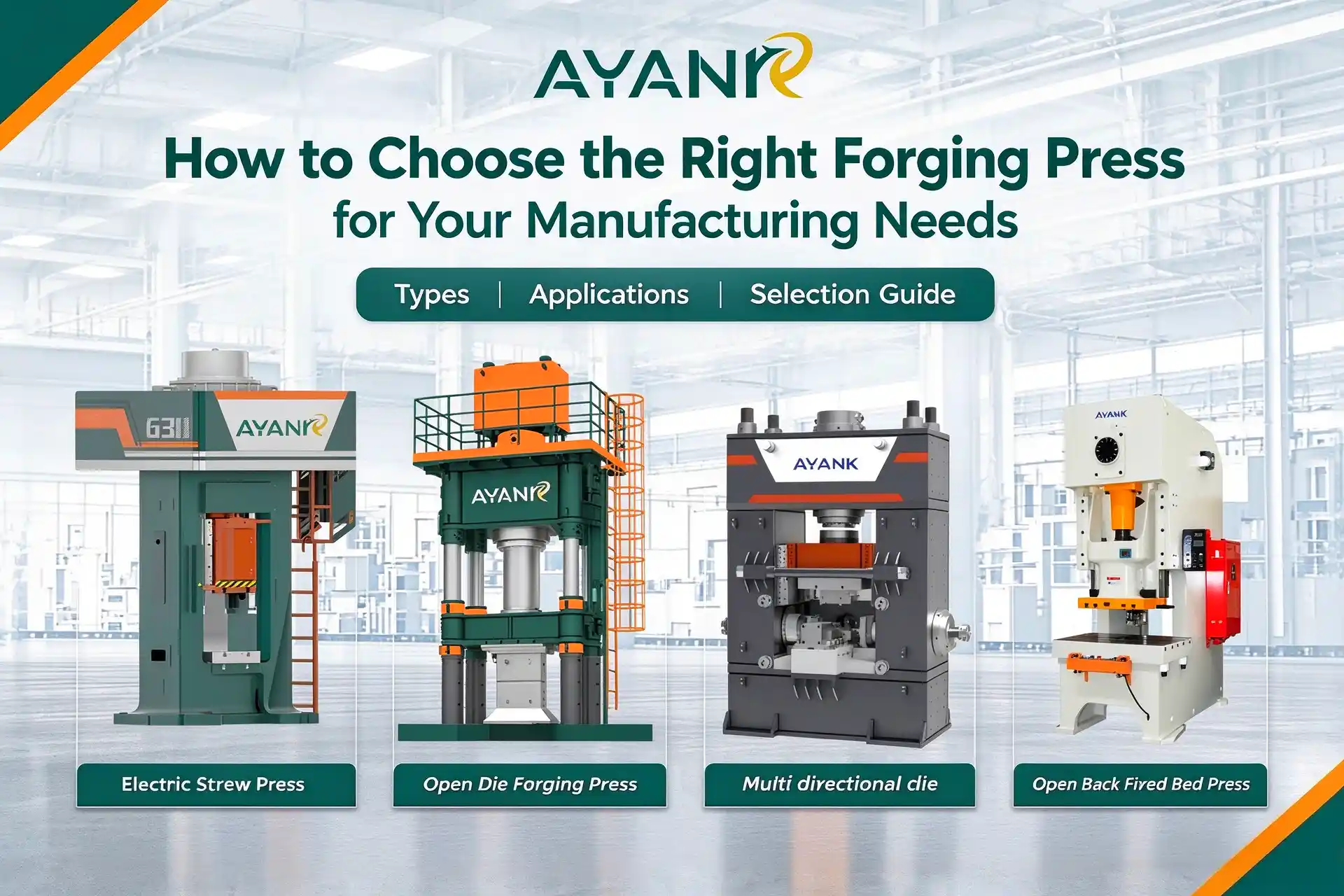
The main types of forging presses can be distinguished by their drive system, force application, tooling arrangement, and intended forming process.
Electric screw presses use a screw-based drive arrangement. Depending on the design, available control functions and process characteristics differ between machine models.
Hydraulic forging presses use a hydraulic system to generate and control pressing force. They are used in a range of forging applications, including open-die and specialized processes.
Mechanical forging presses use a mechanical drive mechanism to move the press slide. Their suitability depends on the forming operation, tooling, and required production cycle.
Hot die forging presses are configured for hot forging operations that use dedicated dies to shape heated workpieces. Their design and supporting equipment depend on the component and production process.
These categories can overlap in the broader metal-forming market, and product names may vary by manufacturer. When comparing quotations, confirm the actual drive system, intended process, machine configuration, and scope of supply rather than relying on the machine name alone.
Forging Press vs. Forging Hammer
A forging press and a forging hammer both deform metal, but they apply force differently. A press forms the workpiece through a pressing action, while a forging hammer uses repeated impact blows. These differences affect process planning, tooling, handling, and the selection of supporting equipment.
A press may be appropriate when the process benefits from a controlled pressing action and a tooling arrangement designed for the intended component. A forging hammer may be more appropriate for processes built around impact-based deformation and repeated blows. Neither option is universally better: material, geometry, production volume, operator handling, and required part quality must all be considered.
Understanding the main types of forging presses is an essential step in equipment selection. Each technology has its own operating characteristics and is suited to particular combinations of material, part geometry, tooling, and production requirements.
The following comparison is intended as a starting point for evaluating equipment. Final suitability should be confirmed against the actual workpiece and proposed process.
Electric Screw Press
An electric screw press is a forging machine driven by an electric system through a screw-based mechanism. It is used in forging applications where the forming process and machine control characteristics are compatible with the workpiece and tooling. Buyers should compare the specific machine design, control functions, production requirements, and available automation before selecting a configuration.
AYANK offers numerical-control electric screw presses and servo direct-drive electric screw presses. These are different configurations, so buyers should evaluate the proposed model against their part geometry, die arrangement, production plan, and process requirements rather than assuming that all electric screw presses provide identical capabilities.
An electric screw press machine may be worth evaluating for production that needs a suitable combination of forming capability, repeatable operation, and integration with the intended manufacturing process. The selection should be based on the specific component and verified machine data, not on the drive technology alone.
A hydraulic forging press uses a hydraulic system to generate pressing force. Its configuration can be designed for different forming operations, and the required force, stroke, working opening, tooling arrangement, and handling method should be evaluated together.
Hydraulic forging presses may be used for open-die forging of components such as shafts, blocks, and other workpieces suited to the process. Specialized hydraulic configurations can also serve multi-directional forging operations, in which forming actions from different directions may be required by the component design. The appropriate configuration depends on the workpiece, die system, forming sequence, and production objective.
For open-die applications, buyers should consider the dimensions and weight of the billet, the required deformation sequence, available working space, and the equipment needed to manipulate the workpiece. For multi-directional forging, the tooling arrangement and interaction between forming directions require particular attention during process planning.
A mechanical press uses a mechanical drive system to convert input motion into slide movement. Mechanical presses are commonly evaluated for production processes where the drive characteristics, tooling, forming stroke, and required operating cycle match the manufacturing task.
In a forging or metal-forming environment, buyers should confirm the exact intended operation before selecting a mechanical press. Not every mechanical press is designed for hot forging. An open-back fixed-bed press, for example, may be intended for a particular stamping or pressing application rather than the same duty as a dedicated hot forging press.
Important questions include whether the machine is suitable for the workpiece material and temperature, whether the die and slide arrangement meet the process requirements, and whether the planned operating cycle is compatible with the machine's design.
A hot die forging press is used for processes in which heated metal is formed using dedicated dies. The die cavity defines important aspects of the component geometry, while the press and tooling must be configured for the material, billet dimensions, forming sequence, and intended production volume.
This type of equipment may be considered for repeat production of components whose geometry and process route are suited to hot die forging. Tooling design, billet preparation, heating, workpiece transfer, trimming where required, and downstream handling all affect the performance of the overall production system.
Buyers should evaluate the complete process rather than considering the press alone. The die design, heating equipment, handling method, and planned production cycle must work together to produce consistent parts.
Press technology should be matched to the workpiece, tooling, forming process, and production plan.
How to Choose a Forging Press for Your Production
The most suitable forging press is the one that can perform the required forming process reliably within the planned production system. Before comparing machine quotations, define the component, material, forming sequence, target output, tooling arrangement, and factory constraints. These requirements help determine which machine technologies should be considered and which configurations can be ruled out.
Workpiece Material and Dimensions
Start with the material grade, billet dimensions, billet weight, forging temperature, and final component geometry. Different materials and workpiece shapes require different forming conditions. A machine suitable for a relatively simple steel forging may not automatically be suitable for a complex component, a non-ferrous alloy, or a part that requires several forming stages.
The maximum workpiece dimensions are only one part of the assessment. The manufacturer should also review the required deformation sequence, material flow, die geometry, workpiece orientation, and the space needed for loading, turning, repositioning, and unloading.
When possible, provide a part drawing or three-dimensional model. Include material specifications, starting billet dimensions, final dimensions, and any critical quality requirements. This allows the equipment supplier to assess the process more accurately than a general description of the part.
Required Forging Force and Energy
Required forming force and energy depend on the material, temperature, deformation resistance, part geometry, die design, and forming operation. Buyers should not select a press based only on the final part's weight or on the nominal capacity of a machine used for a different application.
The appropriate engineering assessment depends on the machine type. For a hydraulic press, the supplier should evaluate the required pressing force and operating conditions. For a mechanical press, the drive characteristics and forming requirements must be compatible. For an electric screw press, the proposed machine's verified forming capability and control characteristics should be assessed against the intended process.
Ask the manufacturer to explain the basis for its recommendation and identify any operating limits relevant to your part. Where process validation is necessary, discuss sample forging trials or other practical verification before finalizing the machine specification.
Production Volume and Cycle Time
Production targets influence both the choice of press and the design of the surrounding equipment. A process intended for frequent product changes may need more flexibility in tooling and setup. A stable, high-volume operation may place greater emphasis on repeatable production cycles, automated handling, quick die changes, and integration with heating and downstream processes.
Evaluate the complete production cycle rather than the press movement alone. The cycle may include billet heating, transfer, positioning, forming, workpiece removal, trimming or other follow-up operations, inspection, and die servicing. A machine with a suitable forming cycle can still become a production bottleneck if material handling or auxiliary equipment cannot keep pace.
Ask the supplier to state the assumptions behind any quoted production-rate estimate, including the workpiece, tooling, operating method, and automation level. Do not compare cycle-time figures unless the underlying conditions are reasonably consistent.
Die Design and Working Space
The die arrangement affects machine selection, working space, and production planning. Review the required die dimensions, installation method, working opening, available stroke, and space needed to position the billet and remove the finished part. The machine must also provide suitable access for tooling maintenance and changeover.
For closed-die forging, the die cavity and forming sequence are central to the process. For open-die forging, the working area and the ability to manipulate the workpiece between forming operations are especially important. Specialized multi-directional forging may require coordinated tooling and adequate space for the different forming actions.
Share the proposed die layout with the manufacturer whenever possible. This can help identify interference, handling, clearance, and maintenance-access issues before the equipment is installed.
Automation and Complete Production Line Requirements
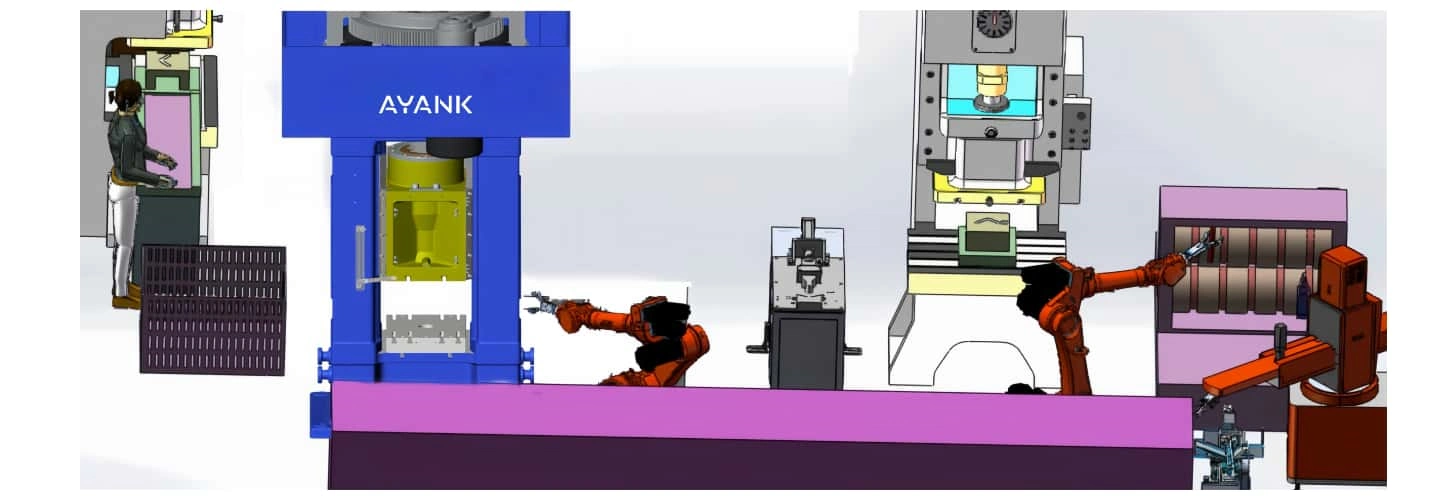
A forging press should be assessed as part of the complete production line if the project requires automated or semi-automated operation. Depending on the process, the system may include billet heating, transfer equipment, manipulators, loading and unloading devices, lubrication or die-spray systems, trimming equipment, inspection, and material handling.
Automation requirements should be defined early. Confirm which operations will be performed by operators and which will be handled automatically. The supplier should clarify the interfaces between the press, control system, auxiliary equipment, safety devices, and any factory-level production system.
Buyers should also consider future production changes. If new parts, additional stations, or higher output may be required later, discuss which machine configurations and automation options can accommodate those plans. The goal is not to automate every operation by default, but to choose a level of integration that is technically suitable and economically justified.
The press, tooling, heating system, handling equipment, and controls should be planned as one production system.
Forging Press Comparison: Which Machine Fits Your Application?
Comparing forging press technologies is most useful when the same workpiece and production requirements are used as the basis for each option. The following table provides a general guide. Actual performance, flexibility, and production rates depend on the specific machine design, tooling, process, and level of automation.
Machine Type
Typical Application Fit
Flexibility Considerations
Production and Automation Considerations
Electric screw press
Suitable hot-forging, precision-forming, coining, and related applications, depending on the model and tooling
Evaluate programmable control, part changes, and tooling requirements for the specific configuration
Can be integrated with suitable automated forging equipment; the complete line determines achievable output
Hydraulic forging press
Suitable open-die forging and specialized hydraulic forging processes, depending on configuration
Review stroke, working space, force control, and the intended forming sequence
Cycle time and automation depend on the hydraulic system, handling equipment, and process design
Mechanical press
Suitable metal-forming operations that match the drive system, tooling, and machine duty
Tooling, stroke characteristics, and process suitability should be checked before selecting a machine
May suit repeat production with compatible tooling and feeding systems
Hot die forging press
Hot forging of components using dedicated dies
Flexibility depends on die design, changeover requirements, and the range of parts to be produced
Production planning should include billet heating, transfer, die handling, and downstream operations
Forging hammer
Impact-based forging processes suited to the hammer design and workpiece
Depends on tooling, operator or manipulator handling, and the sequence of blows
Automation options depend on the hammer, workpiece, and supporting equipment
Electric Screw Press vs. Hydraulic Press
An electric screw press and a hydraulic forging press use different drive systems and have different process characteristics. An electric screw press may be appropriate when its forming characteristics, control functions, and production flexibility match the part. A hydraulic press may be appropriate when the process benefits from hydraulic force application, the required stroke, or a configuration designed for open-die or specialized forging.
The decision should be based on the workpiece and production requirements rather than a general claim that one technology is always faster, more accurate, or more economical. Compare the proposed machine's verified technical data, tooling requirements, production cycle, maintenance needs, and integration costs.
Mechanical Press vs. Screw Press
A mechanical press and an electric screw press have different drive arrangements and forming characteristics. A mechanical press may suit a repeatable operation when its slide motion, tooling, and operating cycle match the process. An electric screw press may be worth evaluating when the application's requirements align with its screw-based drive and available control functions.
Confirm that both machines are designed for the actual operation under consideration. In particular, do not assume that a mechanical press intended for stamping is suitable for hot forging without verification from the manufacturer.
Forging Press vs. Forging Hammer
A forging press applies compressive force through a pressing action, while a forging hammer forms metal through repeated impacts. This distinction affects the deformation process, equipment arrangement, tooling, workpiece handling, and production-line design.
When comparing a press with a hammer, consider the material and geometry of the forging, the required forming sequence, the production target, the available factory space, and the operator or manipulator arrangement. Ask the supplier to explain why the proposed process is appropriate for the component and what supporting equipment is required.
How Much Does an Industrial Forging Press Cost?
The cost of an industrial forging press depends on the machine type, required capacity, configuration, tooling, auxiliary equipment, automation, installation scope, and service arrangements. There is no single price that applies to every forging press because two machines with similar nominal capacity may be designed for very different processes.
For a meaningful comparison, request a quotation based on the same workpiece, production target, scope of supply, and installation requirements. Compare the complete project cost rather than the machine price alone.
Machine Type and Capacity
The selected drive system and machine capacity are major factors in the quotation. Different press technologies require different mechanical, hydraulic, electrical, and control configurations. Larger or more specialized equipment may also require different foundations, handling arrangements, transportation planning, and installation resources.
A machine should not be oversized or undersized based on nominal capacity alone. Ask the supplier to confirm the proposed capacity against the intended material, workpiece, process, and operating conditions. A technically appropriate configuration is a more useful basis for price comparison than a tonnage figure without context.
Tooling and Auxiliary Equipment
Dies and auxiliary equipment can represent a significant part of the total investment. Depending on the process, the project may require billet heating, manipulators, loading and unloading equipment, trimming equipment, die-handling devices, lubrication systems, conveyors, inspection stations, and safety equipment.
Confirm which items are included in the quotation and which must be purchased separately. Also ask whether tooling design, manufacturing, commissioning, and any required process trials are included in the supplier's scope.
Automation and Installation Costs
Automation can add equipment, controls, engineering, and integration costs, but the value of automation should be evaluated against the actual production requirements. Relevant factors include labor availability, workpiece handling, safety, product consistency, expected output, and the number of product changes.
Installation costs may include foundation work, electrical and utility connections, transport, unloading, assembly, alignment, commissioning, and operator training. International projects may also require export packaging, shipping coordination, travel, local lifting resources, and site preparation.
Ask the manufacturer to define the responsibilities of both parties before the order is placed. A clear installation scope helps prevent unexpected expenses and delays after delivery.
Operating Costs and Long-Term Value
The purchase price is only one part of the total cost of ownership. Buyers should also consider electricity or other energy use, routine maintenance, spare parts, tooling life, expected downtime, staffing, and the availability of technical support.
Request operating-cost estimates based on the proposed machine configuration and intended production conditions. When comparing energy-efficiency or productivity claims, check the test conditions and assumptions behind the figures. Results from different processes or machine configurations may not be directly comparable.
A useful purchasing decision balances the initial investment with expected production needs, maintainability, service support, and the cost of operating the complete forging system over time.
How to Choose a Reliable Forging Press Manufacturer
A forging press supplier should be able to do more than provide a machine catalogue and price. The manufacturer should understand the intended forging process, explain the basis of its machine recommendation, define the scope of supply, and provide a practical plan for testing, installation, commissioning, and after-sales support.
Technical Capabilities and Machine Configuration
Review whether the manufacturer supplies the type of press required for your application and can explain how its configuration matches the workpiece and production process. Relevant areas include machine structure, drive system, control functions, tooling compatibility, handling requirements, and auxiliary equipment.
Ask for the proposed technical specification, general arrangement drawing, utility requirements, foundation information, and scope of supply. If the project involves a complete production line, clarify which equipment and engineering tasks are handled by the press manufacturer and which are assigned to other suppliers.
Quality Control and Testing
Ask how the manufacturer verifies the machine before shipment. Depending on the equipment and contract, this may include component inspection, assembly checks, control-system verification, functional testing, and a factory acceptance test.
Confirm the inspection items, acceptance criteria, documentation, and responsibilities of both parties before production begins. If the machine must meet specific process requirements, agree on how those requirements will be demonstrated and documented.
Real factory, assembly, testing, and installation records can help buyers evaluate a supplier's capabilities. Request evidence relevant to the proposed machine rather than relying only on general marketing statements.
Installation and After-Sales Support
Installation and after-sales arrangements are particularly important for overseas forging equipment projects. Before ordering, confirm how the machine will be assembled, tested, disassembled if necessary for transport, reassembled at the destination, commissioned, and handed over to the production team.
AYANK's stated service arrangement includes factory installation and commissioning before the equipment is disassembled for packing and shipment to the customer's factory. AYANK also provides overseas installation and technical service support, including installation and commissioning at the customer's site as agreed for the project.
AYANK states that its complete machine warranty is one year. The after-sales response arrangements described by AYANK are:
Domestic service: On-site arrival within 48 hours, according to the stated service arrangement.
Overseas technical support: Priority remote support through a technical video meeting within 24 working hours.
Local overseas repair: If the issue cannot be resolved remotely, a local repair team is dispatched for on-site inspection within 48 hours, subject to the stated service conditions and local arrangements.
Factory specialist support: If the issue remains unresolved, AYANK states that it will arrange for factory technicians to visit the site within seven working days.
These response times should be confirmed in the quotation or service agreement, including their start point, time zone, working-day definition, local service coverage, travel conditions, and any exclusions. Response targets and on-site arrival depend on the agreed service scope and the circumstances of the project.
Buyers should also confirm the warranty start date, covered components, exclusions, spare-parts arrangements, remote diagnostic capabilities, and the process for requesting service. Clear written terms help both parties plan for commissioning and long-term operation.
What to Include in an RFQ
A detailed request for quotation (RFQ) helps a manufacturer recommend suitable equipment and prepare a more meaningful proposal. Provide as much of the following information as possible:
Part drawing, 3D model, or representative workpiece photographs
Material grade and relevant material properties
Billet dimensions and weight
Final forging dimensions and target part weight
Forging temperature and existing process route, if known
Required production volume and target cycle time
Die drawings, die dimensions, and tooling information, if available
Required forming operations and critical quality requirements
Automation level and workpiece handling requirements
Factory layout, available space, and foundation constraints
Electrical supply and other site utility requirements
Installation country and expected delivery arrangements
Required training, warranty, and after-sales support
If some information is not yet available, explain what is known and ask the manufacturer to identify the missing data needed for preliminary evaluation. An early engineering discussion can help establish a realistic scope before detailed design and procurement.
Why Consider AYANK for Forging Equipment?
AYANK is a forging equipment manufacturer offering equipment for different forging processes. When evaluating AYANK for a project, buyers should start with the required workpiece and production process, then identify the equipment category and configuration that best match those requirements.
Matching Equipment to Your Forging Process
A forging project may require a single machine or a coordinated production system. The appropriate solution depends on the material, component geometry, forming process, production volume, tooling, and required handling method.
AYANK's product range includes electric screw presses, hydraulic forging presses, forging hammers, and other forging and production-line equipment. This range allows buyers to discuss different equipment approaches when the application requires a comparison of processes. The final recommendation should be based on the workpiece and verified technical requirements rather than on a preference for a particular machine category.
Electric Screw Presses and Hydraulic Forging Presses
For electric screw press applications, AYANK offers the J58KA CNC electric screw press and the J58ZKA servo direct-drive electric screw press. Buyers can compare these configurations with the intended forming process, control requirements, tooling, and automation plan.
For hydraulic forging applications, AYANK offers the Y13A open-die forging hydraulic press family and the Y13KA fast open-die forging hydraulic press family. AYANK also lists the Y16A multi-directional die forging hydraulic press for suitable specialized forging applications.
Product specifications, available configurations, and application suitability should be confirmed with AYANK for the specific project.
Request a Machine Recommendation and Quotation
If you are planning a new forging project or evaluating replacement equipment, provide the part drawing, material, billet dimensions, target production volume, and known process requirements. If you already operate a forging line, include information about the current machine, tooling, handling system, and the production problems you want to address.
These details help establish whether an electric screw press, hydraulic forging press, mechanical press, hot die forging press, forging hammer, or a combination of equipment should be evaluated. The final recommendation should follow a review of the actual manufacturing requirements.
Planning a New Forging Project?
Send AYANK your workpiece drawing, material grade, billet dimensions, production target, and automation requirements for an equipment recommendation and quotation.
Common categories include electric screw presses, hydraulic forging presses, mechanical presses, and hot die forging presses. Their suitability depends on the drive system, forming process, workpiece, tooling, and production requirements. A forging hammer is another type of forging equipment, but it forms metal through impact rather than a pressing action.
How do I choose the right forging press capacity?
Start with the material, billet dimensions, workpiece geometry, forming temperature, die design, and required production process. Have the manufacturer evaluate the required force or energy using the appropriate method for the proposed machine type. Also check the working opening, stroke, tooling space, handling requirements, and production target before confirming the machine capacity.
What is the difference between a forging press and a forging hammer?
A forging press deforms metal through a pressing action, while a forging hammer uses repeated impact blows. The two approaches have different process characteristics and equipment requirements. The appropriate choice depends on the workpiece, material, forming sequence, tooling, production volume, and handling arrangement.
Is an electric screw press suitable for my forging application?
An electric screw press may be suitable when its forming capability, control functions, tooling arrangement, and production characteristics match the intended part and process. Share the workpiece drawing, material, billet dimensions, production target, and tooling requirements with the manufacturer so that the proposed machine can be assessed against the application.
What information should I provide when requesting a forging press quotation?
Provide the part drawing or 3D model, material grade, billet dimensions and weight, final part dimensions, target production volume, required process, tooling information, automation needs, factory layout, utility requirements, and installation country. If some details are unavailable, state what is known and ask the manufacturer which additional information is needed for evaluation.