
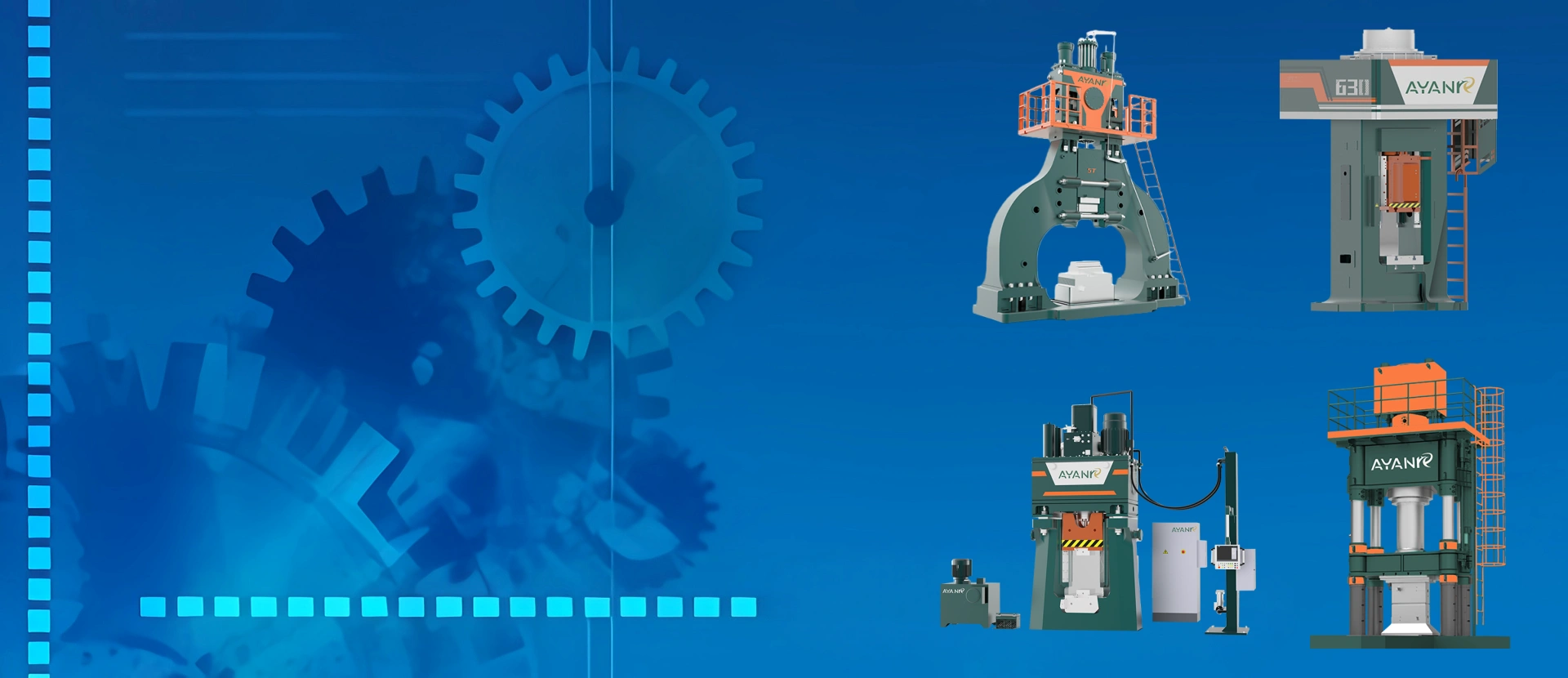
A forging hammer is an industrial forging machine that shapes heated metal by delivering controlled impact energy through a moving ram and die. Depending on the design, forging hammers can be powered pneumatically, hydraulically, mechanically, or by other drive systems and are widely used for open-die and closed-die forging of steel and other metals.
Quick Answer
A forging hammer uses repeated impact blows to plastically deform metal between dies or forging tools. Unlike a forging press, which generally applies force over a longer stroke, a forging power hammer delivers energy rapidly through impact.
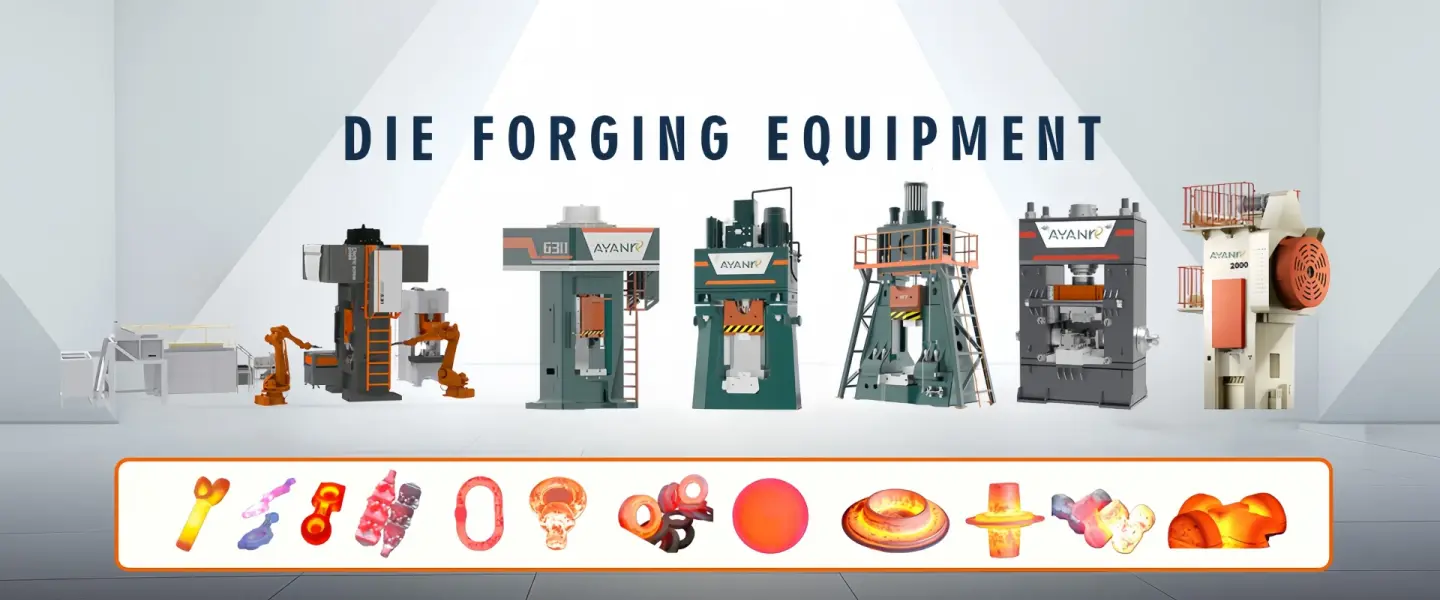
Industrial forging hammer machines include pneumatic, hydraulic, mechanical, and drop-hammer designs. The appropriate machine depends on the forging process, workpiece size, required blow energy, production volume, die configuration, and level of automation.
What Is a Forging Hammer?
A forging hammer is a type of forging equipment designed to shape metal by applying high-energy impact blows. The workpiece, usually heated to a suitable forging temperature, is placed between forging dies or tools. A moving ram then transfers impact energy into the workpiece, causing the material to flow and gradually take the required shape.
In industrial terminology, terms such as forging power hammer, power hammer for forging, and forging hammer machine may describe different configurations of powered hammer equipment. The common principle is that mechanical energy is converted into rapid impact energy for metal forming.
Forging hammers are used in applications ranging from relatively simple open-die forging to high-volume closed-die production of automotive, machinery, agricultural, railway, and other industrial components.
How Does a Forging Hammer Work?
The basic working principle of a forging hammer is the conversion of stored or generated energy into a high-speed downward movement of the ram. When the upper die or forging tool strikes the heated workpiece, kinetic energy is transferred into the metal and produces plastic deformation.
A typical power hammer forging cycle can be divided into several stages:
- Billet preparation: Raw material is cut into the required billet size.
- Heating: The billet is heated to the appropriate forging temperature using an induction heater, furnace, or other heating system.
- Positioning: The heated billet is transferred to the forging die or anvil.
- Hammering: The ram delivers one or more controlled blows to deform the metal.
- Material flow: Each impact forces the metal to flow according to the die geometry and forging sequence.
- Final forming: Additional blows complete the required shape and dimensional characteristics.
- Post-forging operations: The forged part may proceed to trimming, heat treatment, shot blasting, machining, or inspection.
Unlike static loading, hammer forging applies energy over a very short period. The number and intensity of blows can be adjusted according to the workpiece, material, forging stage, and machine design.
Main Components of a Forging Hammer Machine
Although the exact construction varies between different hammer designs, an industrial forging hammer machine normally contains several major systems.
1. Frame
The frame supports the major components of the machine and must withstand repeated dynamic loads generated during forging.
2. Ram
The ram is the moving component that carries the upper die or forging tool. Its mass and velocity directly influence the impact energy delivered to the workpiece.
3. Forging Dies
In closed-die forging, upper and lower dies contain impressions that progressively form the heated billet. Open-die hammer forging may instead use flat or specially shaped tools.
4. Anvil or Die Holder
The lower die and supporting structure absorb and transmit forging loads while maintaining accurate positioning during repeated blows.
5. Drive System
The drive system generates or controls ram movement. Depending on the hammer type, this may involve compressed air, hydraulic pressure, mechanical transmission, or another power source.
6. Control System
Modern industrial forging equipment may incorporate electronic controls, sensors, programmable operating parameters, safety interlocks, and interfaces for automated production lines.
Types of Forging Hammers
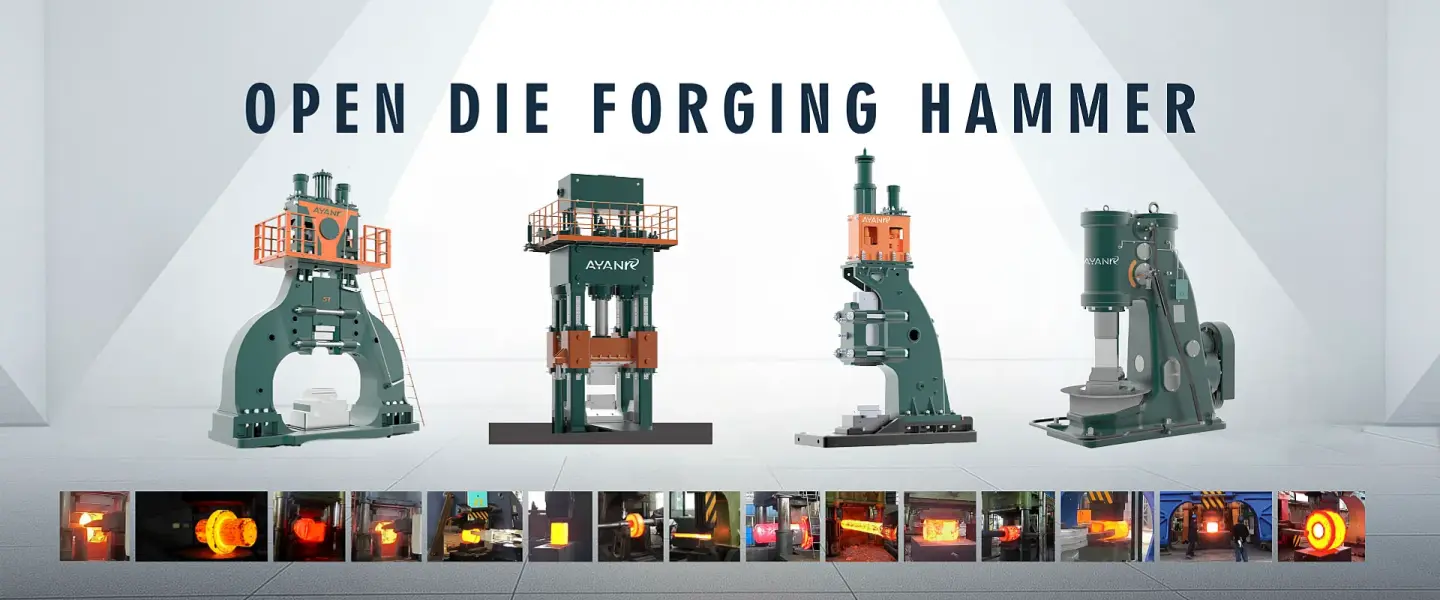
Forging hammers can be classified according to how the ram is powered and how impact energy is generated. Understanding these differences is important when selecting a power hammer for forging.
1. Pneumatic Forging Hammer
A pneumatic forging hammer uses compressed air to control the movement of the hammer ram. Pneumatic designs are widely used for general forging operations and can provide flexible control over repeated blows.
Smaller pneumatic hammers are often suitable for workshops and relatively small forgings, while industrial configurations can handle heavier production requirements.
2. Hydraulic Forging Hammer
A hydraulic forging hammer uses a hydraulic drive and control system to manage ram movement and impact energy. Modern hydraulic designs can provide accurate energy control, repeatable forging cycles, and integration with automated production systems.
Hydraulic forging hammers are particularly relevant where manufacturers require high production efficiency, controlled blow energy, and repeatable forging quality.
3. Mechanical Forging Hammer
Mechanical forging hammers use a mechanical drive mechanism to generate hammer motion. Different historical and modern designs use different transmission arrangements, but their common purpose is to convert motor power into repeated forging impacts.
4. Drop Hammer
A drop hammer generates impact primarily through the downward movement of a raised ram or hammer assembly. Depending on the machine design, additional power may also assist the downward stroke.
Drop hammer forging has long been used for impression-die forging because repeated blows can progressively fill the die cavity and form complex components.
Open-Die vs Closed-Die Hammer Forging
The forging hammer itself is only one part of the process. The tooling arrangement determines whether the machine is used primarily for open-die or closed-die forging.
| Factor | Open-Die Hammer Forging | Closed-Die Hammer Forging |
|---|---|---|
| Tooling | Flat or simple-shaped dies | Profiled die cavities |
| Part Shape | Relatively simple or progressively formed | More complex and repeatable geometry |
| Production Volume | Low to medium | Medium to high |
| Tooling Cost | Generally lower | Generally higher |
| Typical Use | Shafts, rings, bars, custom forgings | Automotive and industrial production parts |
Forging Hammer vs Forging Press
One of the most important distinctions in forging equipment is the difference between a forging hammer and a forging press.
A forging hammer forms the workpiece through rapid impact energy. A forging press generally applies force more progressively through the stroke. Because of this difference, the two machines can produce different material-flow behavior and may be better suited to different components and production requirements.
| Factor | Forging Hammer | Forging Press |
|---|---|---|
| Forming Method | Impact blows | Progressive pressure |
| Loading | High-speed dynamic loading | Longer-duration loading |
| Forging Sequence | Often multiple blows | Controlled press strokes |
| Operator / Process Control | Depends strongly on hammer and automation system | Typically controlled by stroke and force parameters |
| Typical Applications | Open-die and closed-die forging | Closed-die, extrusion, upsetting and other press forging |
Neither process is universally suitable for every forging. Equipment selection should be based on workpiece geometry, material, required deformation, production volume, tooling, automation, and investment requirements.
What Materials Can Be Forged with a Forging Hammer?
Forging hammers are commonly used to process metals that can undergo plastic deformation under appropriate forging temperatures and process conditions.
- Carbon steel
- Alloy steel
- Stainless steel
- Tool steel
- Aluminum alloys
- Copper alloys
- Other forgeable metals and alloys
Material composition affects forging temperature, deformation resistance, die design, required energy, heating method, and the number of blows needed to complete the forging.
Common Applications of Forging Hammers
Industrial forging power hammers can be used across a wide range of metal-forming industries. Typical applications include:
- Automotive drivetrain and chassis components
- Gears, shafts and connecting components
- Flanges and fittings
- Agricultural machinery components
- Railway components
- Construction and mining machinery parts
- Hand tools and industrial tools
- General machinery forgings
The appropriate hammer size and configuration vary considerably between applications. Part weight alone should therefore not be used as the only criterion for selecting a forging hammer.
Advantages of Forging Hammer Machines
Hammer forging remains an important industrial forming process because it combines high impact energy with flexible control over the deformation sequence.
Rapid Energy Transfer
A forging hammer transfers energy to the workpiece in a very short period, enabling rapid plastic deformation of heated metal.
Multiple-Blow Forging
Operators or automated systems can use a sequence of blows to progressively distribute material and fill the required die geometry.
Wide Application Range
Depending on hammer design and tooling, the process can accommodate both open-die and closed-die forging applications.
Flexible Production
Forging hammers can be configured for different dies, workpiece sizes, materials, and production sequences, making them suitable for many industrial forging environments.
Limitations of Hammer Forging
A forging hammer is not automatically the best choice for every forged component. Buyers should also consider several practical limitations.
- Repeated impact produces significant dynamic loads.
- Foundation and vibration control may be important for larger machines.
- Noise levels can be higher than some press-forging processes.
- Die life depends strongly on process design, material, temperature, lubrication, and impact conditions.
- Process consistency depends on machine control, tooling, billet temperature, and handling.
- Some components may be more efficiently produced on a screw, mechanical, hydraulic, or other forging press.
How to Choose a Forging Hammer
Selecting a forging hammer machine should begin with the forging process rather than simply choosing a machine according to nominal size.
Before selecting equipment, a forging manufacturer should evaluate:
- Workpiece material
- Billet dimensions and weight
- Final forged-part dimensions and geometry
- Open-die or closed-die process
- Required deformation and blow energy
- Annual production volume
- Forging temperature
- Die design and number of forging stages
- Manual or automatic material handling
- Available foundation and workshop conditions
- Required production-line automation
Two parts with similar weights can require significantly different forging equipment because material, projected area, geometry, deformation sequence, and die design influence the actual energy requirement.
For this reason, buyers should provide part drawings, material specifications, billet dimensions, target production volume, and existing process information when requesting equipment selection.
Forging Hammer vs Electric Screw Press: Which Process Should You Use?
Both forging hammers and electric screw presses can be used for industrial hot forging, but their energy delivery and process control are different.
A forging hammer uses high-speed impact blows and can progressively form the workpiece through multiple impacts. An electric screw press converts motor energy into controlled ram movement through a screw-drive system and is often selected where repeatable stroke energy and automated production control are important.
The correct choice depends on the forged component rather than on the machine name alone. Forging drawings, material, billet size, die process, required energy, production rate, and automation requirements should be evaluated before selecting either process.
Can a Forging Hammer Be Integrated into an Automatic Forging Line?
Yes. Modern forging equipment can be integrated with upstream and downstream systems to create a semi-automatic or fully automatic forging production line.
Depending on the process, a production line may include:
- Billet cutting equipment
- Induction heating
- Temperature monitoring
- Automatic feeding
- Robotic or manipulator transfer
- Forging hammer
- Trimming equipment
- Conveying and cooling systems
- Process monitoring and control
Automation configuration should be designed around the actual forging sequence rather than adding individual machines independently.
Information to Provide When Requesting a Forging Hammer
To evaluate a suitable power hammer for forging, providing detailed process information is more useful than asking only for a particular hammer size.
| Information | Why It Matters |
|---|---|
| Forged part drawing | Helps evaluate geometry, projected area and forming difficulty |
| Material grade | Affects forging temperature and deformation resistance |
| Billet size and weight | Helps estimate material volume and process requirements |
| Final part weight | Provides basic sizing information |
| Annual production quantity | Influences productivity and automation requirements |
| Existing forging process | Helps identify equipment replacement or process-improvement requirements |
| Automation requirement | Determines feeding, transfer and production-line configuration |
Frequently Asked Questions About Forging Hammers
What is a forging hammer used for?
A forging hammer is used to plastically deform heated metal through repeated impact blows. It can be used for open-die forging, closed-die forging, drawing, upsetting, shaping, and other industrial forging operations depending on the machine and tooling.
What is the difference between a power hammer and a forging hammer?
Power hammer is a broad term for powered hammer equipment. A forging hammer specifically refers to hammer equipment used for metal forging. In industrial searches, terms such as forging power hammer and power hammer for forging are often used to describe powered forging equipment.
What are the main types of forging hammers?
Common categories include pneumatic forging hammers, hydraulic forging hammers, mechanical forging hammers, and drop hammers. Each uses a different method to generate and control ram movement and impact energy.
Is a forging hammer better than a forging press?
They use different forming methods and are suited to different production requirements. Forging hammers use rapid impact blows, while forging presses generally apply force over a longer stroke. Selection should be based on the part, material, die process, production volume, and required process control.
How do I select the correct forging hammer size?
Hammer selection should consider more than forged-part weight. Material, billet size, part geometry, projected area, die design, forging stages, required blow energy, and production volume should all be evaluated.
Can forging hammers be automated?
Yes. Industrial forging hammers can be integrated with billet heating, automatic feeding, robotic transfer, trimming, conveying, and production monitoring systems to form an automated forging line.
Conclusion
A forging hammer is a fundamental piece of industrial forging equipment that shapes metal through controlled impact energy. Pneumatic, hydraulic, mechanical, and drop-hammer systems provide different approaches to generating and controlling the forging blow.
Selecting the correct forging hammer requires an understanding of the complete forging process, including material, billet dimensions, part geometry, dies, required energy, production volume, and automation requirements.
AYANK supplies industrial forging equipment for different metal-forming applications. For equipment selection, providing your forging drawing, material grade, billet size, part weight, and required production capacity allows the engineering team to evaluate a more appropriate forging solution.