
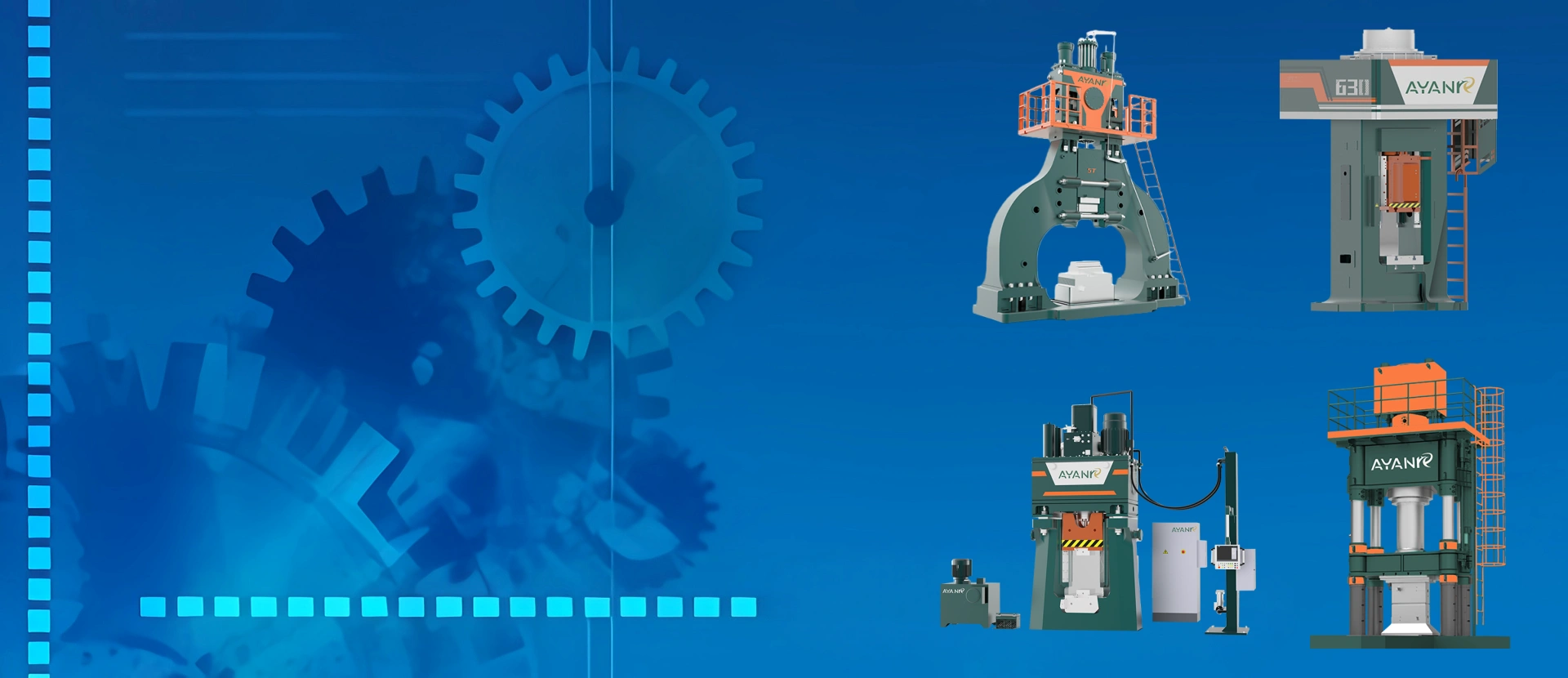
Best Forging Hammer: How to Choose the Right Hammer for Your Application
The best forging hammer is not simply the largest machine or the hammer with the highest nominal capacity. The correct choice depends on the material, billet dimensions, final forging geometry, forging process, production volume, die configuration, required impact energy, and factory conditions.
Quick Answer
There is no single best forging hammer for every application. For flexible open-die forging and general drawing, upsetting, and shaping operations, a pneumatic forging hammer can be a practical solution. Hydraulic forging hammers are used for heavier industrial applications and processes requiring different energy-control characteristics, while drop and other die-forging hammers can be suitable for repeat production of defined components.
The best hammer should therefore be selected from the forged part and process, not from the machine specification alone. Before choosing a hammer, evaluate the workpiece material, billet weight and dimensions, final part geometry, required deformation, die type, annual output, handling method, and installation conditions.
What Is the Best Forging Hammer?
When buyers search for the best hammer for forging, they often expect a specific hammer type, capacity, or model. In industrial forging, however, the answer depends on what the machine needs to produce.
A hammer that works efficiently for drawing small and medium shafts may not be the right machine for producing repeat closed-die automotive components. Similarly, equipment selected for flexible open-die production may not be the most appropriate solution for an automated high-volume forging line.
The better question is:
Which forging hammer provides the appropriate impact energy, working space, control, productivity, and process characteristics for my specific forged component?
Answering that question requires understanding both the available hammer technologies and the forging process itself.
If you are new to forging hammers, start with our guide to forging hammers to understand their basic working principle, components, and applications.
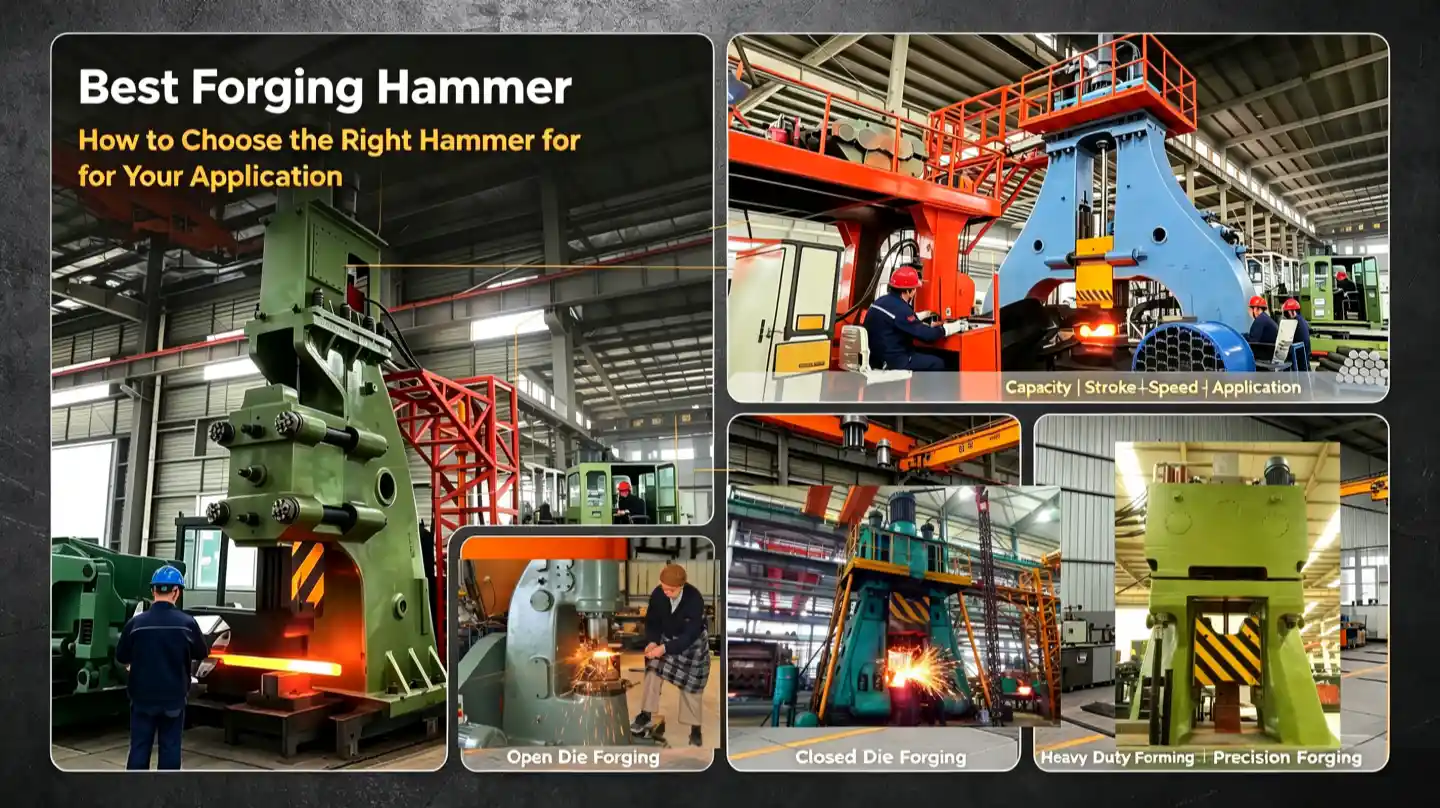
Best Forging Hammer by Application
Instead of ranking forging hammers from best to worst, it is more useful to match each hammer technology to the applications for which its operating characteristics are suitable.
| Forging Requirement | Hammer Type to Evaluate | Why It May Be Suitable |
|---|---|---|
| General open-die forging | Pneumatic Forging Hammer | Flexible repeated blows for drawing, upsetting, bending and shaping |
| Small and medium flexible forging | Pneumatic Forging Hammer | Suitable for varied open-die forging operations and workpiece manipulation |
| Heavier industrial open-die forging | Hydraulic Forging Hammer | Can be configured for larger industrial forging requirements |
| Repeat impression-die forging | Die Forging / Drop Hammer | Shaped dies and repeated impact can produce defined component geometries |
| Processes requiring controlled impact energy | Hydraulic Forging Hammer | Hydraulic control can support controlled hammer operation depending on machine design |
| Processes requiring progressive pressing rather than impact | Consider a Forging Press | A hammer may not be the correct forming technology for the process |
This table is a starting point rather than a machine-selection formula. Final equipment selection should be based on actual drawings, material, billet dimensions, forging sequence, required output, and other production conditions.
Main Types of Forging Hammers Compared
Several types of industrial forging hammer are available. Although they all use impact to deform metal, the way they generate and control that impact differs.
Pneumatic Forging Hammer
A pneumatic forging hammer uses compressed air as part of the system controlling hammer movement. In a self-contained design, a motor-driven compression system supplies air to control the working piston and ram.
Pneumatic hammers are particularly relevant to flexible open-die operations such as:
- Drawing
- Upsetting
- Flattening
- Bending
- Punching
- General shaping
The operator can reposition and rotate the heated workpiece between blows, making the machine useful when the forging sequence requires progressive manual or mechanized manipulation.
Learn more in our Pneumatic Forging Hammer Guide.
Hydraulic Forging Hammer
A hydraulic forging hammer uses hydraulic power and control systems as part of the hammer's operating mechanism. Different designs can be configured for open-die or die-forging applications.
Hydraulic systems can provide controlled operating characteristics and are used in industrial applications where the workpiece, required impact energy, production method, or machine configuration makes hydraulic hammer technology appropriate.
Learn more about its working principle and applications in our Hydraulic Forging Hammer Guide.
Drop Hammer
A drop hammer produces forging impact through the downward movement of the hammer or ram. Depending on machine design, the downward movement can be gravity-based or power-assisted.
Drop hammer forging is frequently associated with impression-die forging, where the heated billet passes through preforming, blocking, and finishing operations until the required component geometry is produced.
See our Drop Hammer Forging Guide for a detailed explanation of the process.
Mechanical Forging Hammer
Mechanical forging hammers use mechanical drive arrangements to generate or transmit hammer motion. Their operating characteristics depend on the specific machine design and transmission system.
When evaluating a mechanical hammer, buyers should compare actual impact characteristics, working dimensions, control method, production requirements, and maintenance needs rather than relying on the machine category alone.
Forging Hammer Comparison
| Hammer Type | Typical Application | Forming Characteristic | Key Selection Factors |
|---|---|---|---|
| Pneumatic Hammer | General open-die forging | Repeated controllable impact blows | Workpiece size, operation, working space and hammer capacity |
| Hydraulic Hammer | Industrial open-die or die forging depending on design | Hydraulically controlled impact | Impact requirement, workpiece, control and production process |
| Drop Hammer | Open-die or impression-die forging depending on equipment and tooling | Falling or power-assisted impact | Die process, blow energy, workpiece and production requirements |
| Mechanical Hammer | Application-dependent | Mechanically generated hammer movement | Drive design, impact characteristics, workpiece and output |
Best Forging Hammer for Open-Die Forging
Open-die forging requires the workpiece to remain accessible so that it can be repositioned, rotated, drawn, upset, or otherwise manipulated between forming operations.
For many general-purpose small and medium open-die applications, a pneumatic forging hammer is one machine type worth evaluating because repeated blows can be combined with flexible workpiece manipulation.
Typical components can include:
- Shafts
- Bars
- Rings
- Flanges
- Tool blanks
- Stepped forgings
- General machinery forgings
As workpiece dimensions, required impact energy, or production requirements increase, larger pneumatic or hydraulic hammer configurations may need to be considered.
Machine selection should therefore be based on the largest required forging operation rather than only the average component produced in the workshop.
Best Forging Hammer for Closed-Die Forging
Closed-die forging creates a different equipment requirement. Instead of continuously repositioning a workpiece between relatively simple tools, the material must flow through shaped die impressions to produce a repeatable geometry.
The forging sequence may include:
- Billet heating
- Preforming
- Blocking
- Finish forging
- Trimming
- Cooling and post-forging operations
For this reason, selecting a hammer for closed-die forging requires evaluation of die geometry, billet volume, material flow, required impact energy, number of blows, production rate, and handling method.
A hydraulic die-forging hammer or another dedicated die-forging hammer configuration may be evaluated depending on the component and production requirements.
Best Forging Hammer for Steel Forging
There is no single best forging hammer for steel because steel grade alone does not define the forging requirement.
Carbon steel, alloy steel, stainless steel, and tool steel can have significantly different deformation behavior. Even two components made from the same steel grade may require different machines when their dimensions and forging processes differ.
For steel forging, evaluate:
- Steel grade
- Billet temperature
- Billet diameter, length and weight
- Final forging geometry
- Maximum cross-section
- Required deformation
- Open-die or closed-die process
- Production quantity
Best Forging Hammer for Small and Medium Forgings
For workshops producing a variety of small and medium open-die forgings, flexibility can be more important than optimizing the machine for one specific component.
A self-contained pneumatic forging hammer can be considered when the production mix includes drawing, upsetting, bending, flattening, and similar general forging operations.
AYANK's C41A pneumatic forging hammer series is one equipment family intended for this type of general industrial forging application. The appropriate machine size should still be determined from actual workpiece and process information rather than selecting a model from finished-part weight alone.
Best Forging Hammer for Large or Heavy Forgings
As forging size increases, machine selection becomes increasingly dependent on actual deformation requirements rather than a simple relationship between finished-part weight and hammer size.
Larger open-die forgings can require:
- Higher available impact energy
- Larger working space
- Greater die dimensions
- Workpiece manipulators
- Material-handling equipment
- More substantial foundation design
- Coordinated heating and transfer equipment
Hydraulic open-die forging hammers can be evaluated for heavier industrial applications, but the correct machine still depends on material, billet dimensions, deformation, workpiece handling, and required output.
Pneumatic vs Hydraulic Forging Hammer: Which Should You Choose?
Pneumatic and hydraulic forging hammers both use repeated impacts to deform metal, but their operating systems and typical equipment configurations differ.
| Factor | Pneumatic Forging Hammer | Hydraulic Forging Hammer |
|---|---|---|
| Working Medium | Compressed air | Hydraulic system |
| Common Application | Flexible open-die forging | Industrial open-die or die forging depending on design |
| Typical Workpiece Range | Depends on hammer capacity and configuration | Depends on hammer capacity and configuration |
| Control | Pneumatic control characteristics | Hydraulic control characteristics |
| Maintenance Focus | Air system, cylinders, guides and moving components | Hydraulic system, seals, valves, cylinders and moving components |
| Selection | Should be based on the workpiece, forging process, required impact, production requirements and factory conditions. | |
A pneumatic hammer should not automatically be considered an entry-level version of a hydraulic hammer, nor should a hydraulic hammer automatically be considered the better machine. They are different equipment solutions whose suitability depends on the forging process.
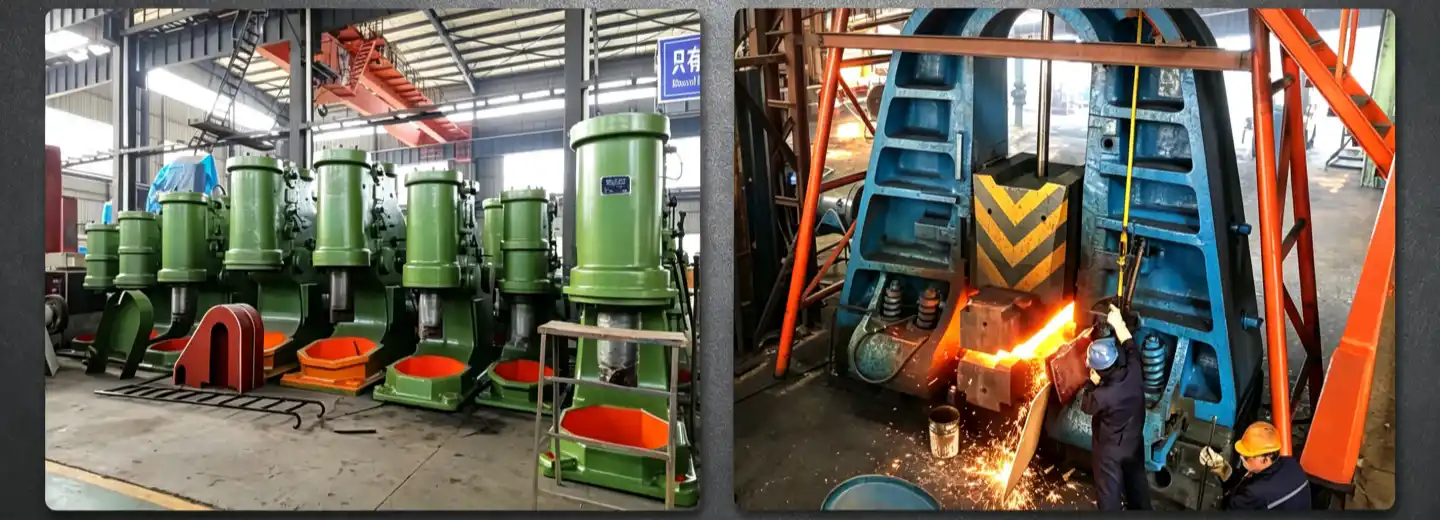
Forging Hammer vs Forging Press: Do You Actually Need a Hammer?
Before buying a forging hammer machine, manufacturers should first confirm that impact forging is appropriate for the component.
A forging hammer transfers energy to the workpiece through rapid impact. A forging press generally applies force or energy more progressively through its working stroke.
| Requirement | Forging Hammer | Forging Press |
|---|---|---|
| Forming Action | Impact | Progressive pressing |
| Typical Forming Sequence | Repeated blows | One or more controlled strokes |
| Dynamic Loading | Higher impact loading | Generally lower impact loading |
| Flexible Open-Die Manipulation | Often well suited | Depends on press and process design |
| Closed-Die Production | Possible with suitable hammer and tooling | Widely used with suitable press and tooling |
For some components, the correct answer to "What is the best forging hammer?" may actually be that a hammer is not the most suitable forming machine.
Electric screw presses, hydraulic presses, mechanical presses, and other forging machines should also be evaluated when their forming characteristics better match the component and production requirements.
How to Choose the Best Forging Hammer
Once hammer forging has been identified as an appropriate process, machine selection should proceed systematically.
1. Start With the Material
Identify the exact material grade rather than simply stating "steel." Different alloys have different deformation resistance, forging temperature ranges, and process requirements.
2. Define the Starting Billet
Record the billet diameter or cross-section, length, and weight. The starting dimensions help determine how much deformation the hammer must produce.
3. Define the Final Forging
Provide a drawing whenever possible. Maximum dimensions, minimum sections, changes in cross-section, ribs, bosses, bends, and other geometry affect the forging process.
4. Determine the Forging Operation
Identify whether the component requires drawing, upsetting, bending, punching, preforming, closed-die forming, or several operations in sequence.
5. Determine the Production Requirement
Annual and hourly output can significantly change the appropriate equipment configuration. A flexible workshop and a dedicated mass-production line should not automatically use the same solution.
6. Consider Workpiece Handling
Determine whether parts will be handled manually, with lifting equipment, with a forging manipulator, or by an automated transfer system.
7. Evaluate the Complete Factory
Heating equipment, material flow, available floor space, foundation conditions, electrical supply, tooling changes, maintenance access, and downstream processes should be considered before finalizing the hammer.
Why Forging Weight Alone Is Not Enough
One of the most common purchasing questions is: "What size forging hammer do I need for a 20 kg, 50 kg, or 100 kg part?"
Weight is useful information, but it does not describe the complete deformation requirement.
Consider two forgings with the same finished weight:
- Part A is a relatively compact, thick component requiring limited deformation.
- Part B is a long stepped shaft requiring substantial drawing and repeated reduction.
Although their final weights may be similar, their forging sequences, required working space, number of blows, material flow, and machine requirements can be very different.
This is why a reliable forging hammer recommendation should use the drawing, billet dimensions, material, and process rather than a simple part-weight table.
How Much Forging Hammer Capacity Do You Need?
After determining that hammer forging is suitable for the component, the next question is usually how much hammer capacity is required.
This is where buyers should be careful. A forging hammer should not be selected only by comparing one nominal specification with the finished weight of the workpiece.
The required machine capacity depends on a combination of:
- Material grade
- Starting billet dimensions and weight
- Forging temperature
- Final part dimensions
- Maximum and minimum cross-sections
- Amount of deformation
- Open-die or closed-die process
- Die geometry
- Required impact energy
- Available working space
- Number of forging operations
- Required production rate
For example, drawing a thick billet into a long stepped shaft can require a very different forging sequence from upsetting a billet into a short, thick component, even when the finished parts have similar weights.
For this reason, the most reliable approach is to send the equipment manufacturer the workpiece drawing, material, billet dimensions, final dimensions, and production requirements before selecting the hammer model.
Key Specifications to Compare When Buying a Forging Hammer
When comparing different forging hammer machines, do not compare only the model name or nominal capacity. Review the complete technical specification.
| Specification | Why It Matters |
|---|---|
| Hammer / Falling Parts Mass | One indicator of the hammer system, but not a complete measure of forging capability |
| Impact Energy | Helps determine the energy available for workpiece deformation |
| Stroke | Affects hammer movement and available forging conditions |
| Blow Frequency | Influences forging rhythm and production process |
| Working Height | Must accommodate tooling and workpiece dimensions |
| Die / Anvil Dimensions | Determines available tooling and forging area |
| Motor Power | Important for electrical planning and understanding machine configuration |
| Machine Dimensions | Required for workshop layout and installation planning |
| Machine Weight | Relevant to transport, foundation and installation |
| Control System | Affects machine operation and process control |
| Tooling Configuration | Must match open-die or closed-die production requirements |
| Foundation Requirements | Important because hammer operation creates repeated dynamic loads |
When two machines have a similar headline specification, differences in these parameters can still make them suitable for different forging applications.
Common Mistakes When Buying a Forging Hammer
Choosing the wrong hammer can result in insufficient forging capability, unnecessary investment, poor productivity, installation problems, or a machine that does not match the intended process.
1. Selecting the Machine Only by Forging Weight
Workpiece weight is useful, but it does not describe geometry or deformation. Always provide dimensions and drawings together with weight.
2. Choosing the Largest Hammer Available
A larger machine is not automatically a better machine. Oversizing can increase equipment, foundation, electrical, tooling, and operating requirements without providing a corresponding production benefit.
3. Comparing Only Purchase Price
Initial machine price is only one part of the investment. Installation, foundation, tooling, electrical requirements, maintenance, spare parts, material handling, and production efficiency should also be considered.
4. Ignoring Working Space
A machine may have sufficient nominal capacity but insufficient working clearance for a long shaft, large billet, special die, or required workpiece manipulation.
5. Ignoring the Forging Process
Buying a hammer before defining the forging sequence reverses the correct engineering process. First determine how the component should be forged, then select equipment that can perform those operations.
6. Ignoring Material Handling
Larger workpieces may require lifting equipment, manipulators, robots, or other transfer systems. The hammer and material-handling system should be considered together.
7. Ignoring Foundation Requirements
Forging hammers generate repeated impact loads. Foundation and vibration considerations should therefore be evaluated before installation, not after the machine arrives.
8. Buying from Specifications Without Technical Confirmation
Catalog specifications are useful for comparison, but the final model should be confirmed against actual workpiece and production information.
New vs Used Forging Hammer: Which Is Better?
Used forging equipment can reduce initial investment, but purchase price should not be the only consideration.
When evaluating a used power hammer for forging, buyers should investigate:
- Machine age and operating history
- Frame condition
- Ram and guide wear
- Cylinder condition where applicable
- Hydraulic or pneumatic system condition
- Anvil and tooling condition
- Motor and transmission condition
- Control-system condition
- Availability of replacement parts
- Technical documentation
- Previous repairs or modifications
A lower purchase price can become less attractive if the machine requires major rebuilding, difficult-to-source components, or extensive modification before it can produce the intended forgings.
New equipment can be configured around current production requirements and is generally easier to integrate with new heating, handling, automation, and control systems. The appropriate choice depends on budget, production requirements, technical condition, and long-term operating plans.
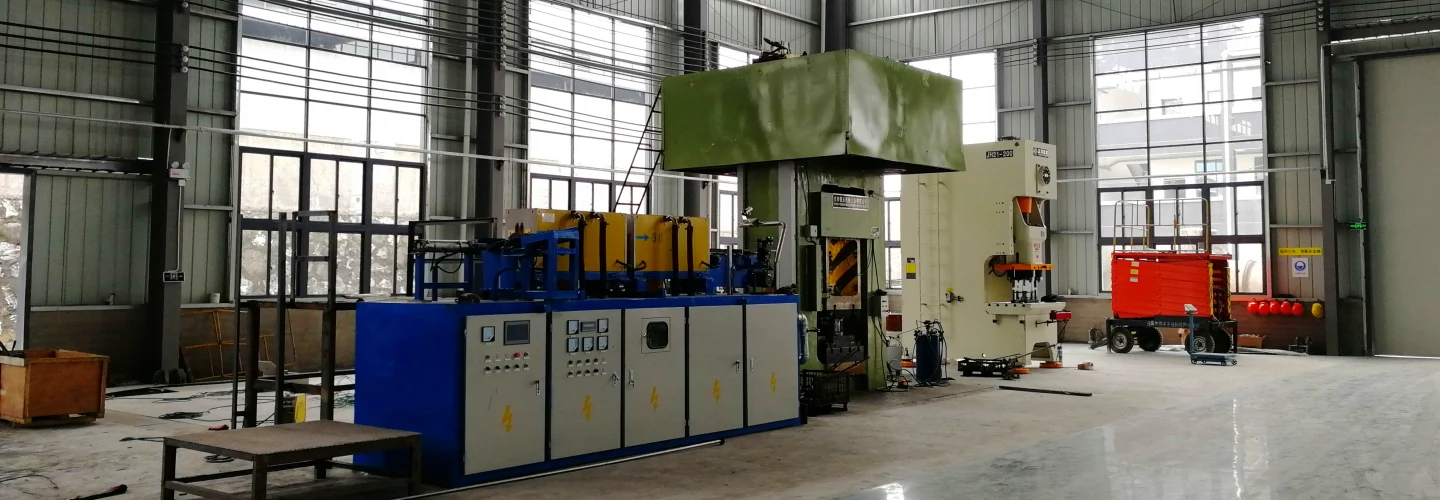
Forging Hammer Alone or Complete Forging Production Line?
Another important purchasing decision is whether the factory needs only a hammer or a complete forging system.
A standalone forging hammer may be appropriate when the factory already has suitable heating, material handling, trimming, and supporting equipment.
For a new production project, however, the complete process may need to be considered together. A forging production line can include:
- Billet cutting
- Automatic feeding
- Billet heating
- Temperature monitoring
- Descaling
- Preforming
- Main forging
- Trimming
- Robotic or mechanical transfer
- Cooling and downstream handling
The equipment should be matched by production cycle rather than simply connecting independent machines. Heating capacity, transfer time, forging cycle, trimming cycle, and downstream handling must work together.
What Information Should You Send to a Forging Hammer Manufacturer?
If you want a manufacturer to recommend a suitable machine, a short message saying "I need a forging hammer" is not enough.
The following information makes equipment selection much more accurate:
| Information | Example / Requirement |
|---|---|
| Workpiece Drawing | 2D or 3D drawing showing final geometry |
| Material | Exact steel or alloy grade |
| Billet Dimensions | Diameter / section × length |
| Billet Weight | Weight before forging |
| Final Part Dimensions | Maximum length, diameter, section and other key dimensions |
| Final Part Weight | Finished forging weight |
| Forging Process | Open die, closed die, drawing, upsetting, preforming, etc. |
| Production Requirement | Pieces per hour, day or year |
| Existing Equipment | Current hammer or press if this is a replacement project |
| Handling Method | Manual, manipulator, robot or other system |
| Factory Power | Voltage and frequency |
| Destination | Country and installation location |
With this information, the manufacturer can evaluate the forging process before recommending a specific hammer type and model.
Forging Hammer Buyer Checklist
Before placing an order, confirm that the proposed equipment has been evaluated against the complete production requirement.
- Has the manufacturer reviewed the actual workpiece drawing?
- Has the material grade been confirmed?
- Have billet and final forging dimensions been provided?
- Has the required forging process been defined?
- Is the hammer capacity appropriate for the required deformation?
- Is there sufficient working space for the largest workpiece?
- Are die and tooling requirements clear?
- Has production output been considered?
- Has the workpiece-handling method been defined?
- Are voltage and frequency compatible with the destination factory?
- Have foundation requirements been confirmed?
- Are installation and commissioning responsibilities clear?
- Are operating and maintenance documents available?
- Are spare and wear parts available?
- Has after-sales technical support been discussed?
How to Compare Forging Hammer Manufacturers
The best forging hammer also depends on whether the supplier can correctly match the machine to the forging process.
When evaluating a forging hammer manufacturer, consider whether the supplier can provide:
- Technical evaluation based on workpiece drawings
- Clear machine specifications
- Forging process recommendations
- Machine drawings and installation information
- Foundation requirements
- Tooling support
- Production-line integration where required
- Installation and commissioning support
- Operating and maintenance documentation
- Spare-parts support
A useful quotation should explain why a machine configuration is being recommended rather than simply providing a model number and price.
Which Forging Hammer Should You Choose?
A practical selection path is to start with the forging process and narrow the equipment options from there.
| Your Requirement | Equipment to Evaluate |
|---|---|
| Flexible general open-die forging | Pneumatic forging hammer |
| Drawing, upsetting and shaping small/medium forgings | Pneumatic forging hammer |
| Heavier industrial open-die forging | Hydraulic forging hammer |
| Impact-based die forging | Hydraulic or other die-forging hammer depending on the process |
| Progressive press deformation | Forging press rather than hammer |
| Controlled closed-die production | Evaluate hammer and press solutions from the actual component process |
| High-volume automated production | Evaluate the complete forging line rather than only the main machine |
This is why there is no universal answer to the question "Which is the best forging hammer?" The correct machine is the one whose working characteristics match the component and production process without unnecessary undercapacity or overcapacity.
Frequently Asked Questions About Choosing a Forging Hammer
What is the best forging hammer?
There is no single best forging hammer for every application. The appropriate hammer depends on the workpiece material, billet dimensions, final geometry, forging process, required impact energy, production volume, tooling, handling method, and factory conditions.
What is the best forging hammer for open-die forging?
Pneumatic forging hammers are commonly evaluated for flexible small and medium open-die forging, while hydraulic forging hammers can be considered for heavier industrial applications. Final selection depends on workpiece size, deformation requirements, working space, and production needs.
What is the best forging hammer for steel?
There is no single best forging hammer for all steel components. The correct machine depends on the steel grade, billet dimensions, forging temperature, final geometry, required deformation, forging process, and production volume.
How do I choose the correct forging hammer size?
Forging hammer size should be selected using the material, billet dimensions and weight, final forging dimensions, required deformation, die configuration, working space, impact requirements, and production rate. Finished-part weight alone is not sufficient.
Is a pneumatic or hydraulic forging hammer better?
Neither is universally better. Pneumatic and hydraulic forging hammers use different operating systems and can suit different forging applications. Selection should be based on the workpiece, required forging process, impact requirements, production conditions, and machine configuration.
What is the difference between a forging hammer and a forging press?
A forging hammer deforms metal through rapid impact blows, while a forging press generally applies force or energy more progressively through the working stroke. The appropriate process depends on the component, material, die design, deformation requirements, and production conditions.
Can I choose a forging hammer based only on workpiece weight?
No. Workpiece weight is useful but does not describe geometry, material flow, deformation, working space, die design, or production requirements. Drawings and billet dimensions should also be evaluated before selecting the machine.
What information should I send when requesting a forging hammer quotation?
Provide the workpiece drawing, material grade, billet dimensions and weight, final forging dimensions and weight, forging process, required production output, handling method, factory voltage, and destination country.
Conclusion: The Best Forging Hammer Is the One That Matches Your Process
The best forging hammer cannot be selected from a universal ranking. Pneumatic, hydraulic, drop, and other forging hammers have different operating characteristics and are suited to different workpieces and production processes.
For flexible open-die production, a pneumatic forging hammer may be a practical solution. Heavier industrial applications may require a hydraulic hammer configuration, while repeat die-forging production may require a dedicated die-forging hammer or, depending on the process, a forging press.
The correct selection begins with the component: material, billet dimensions, final geometry, deformation, die process, production volume, and handling requirements. Only after these factors are understood should hammer type and capacity be determined.
AYANK manufactures forging equipment for industrial metal-forming applications. Send us your workpiece drawing, material grade, billet dimensions, final forging dimensions, and required production output to evaluate a suitable forging hammer configuration for your project.