
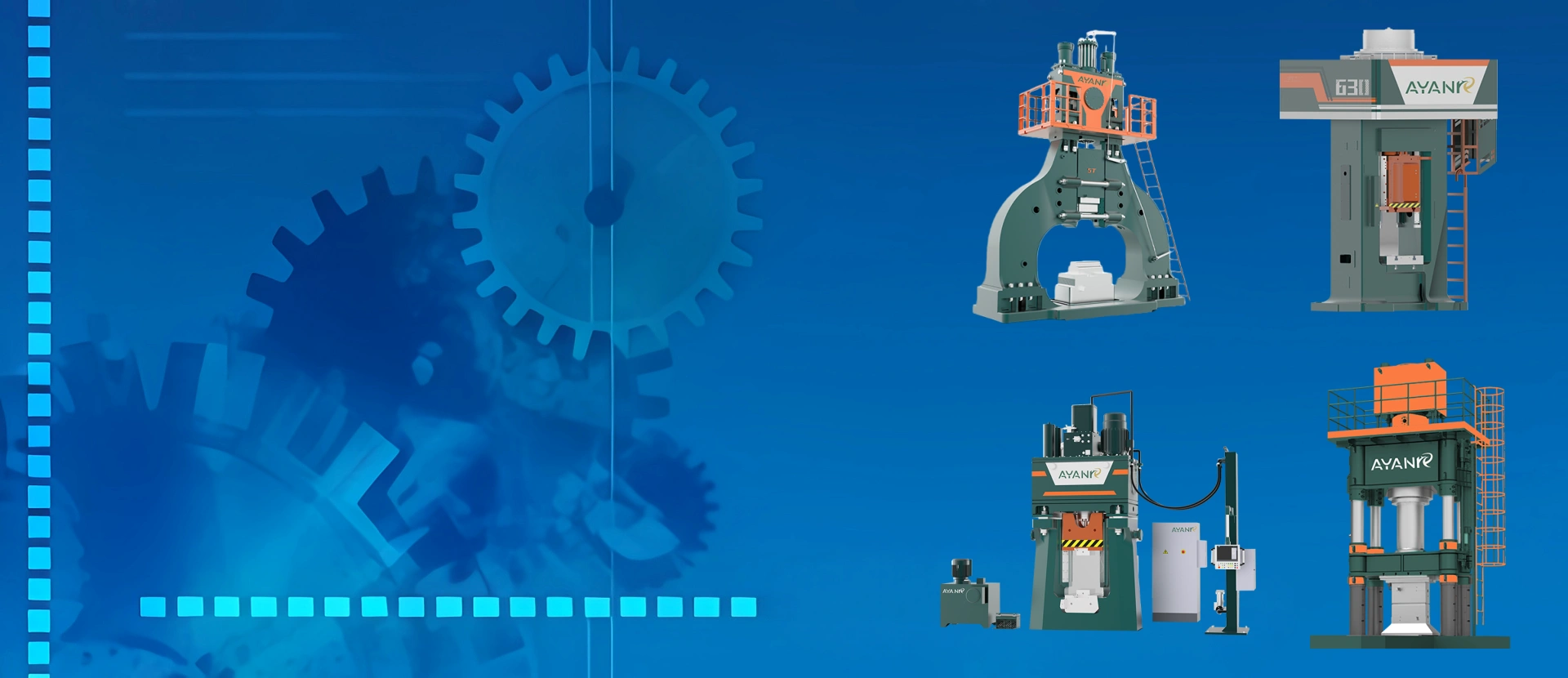
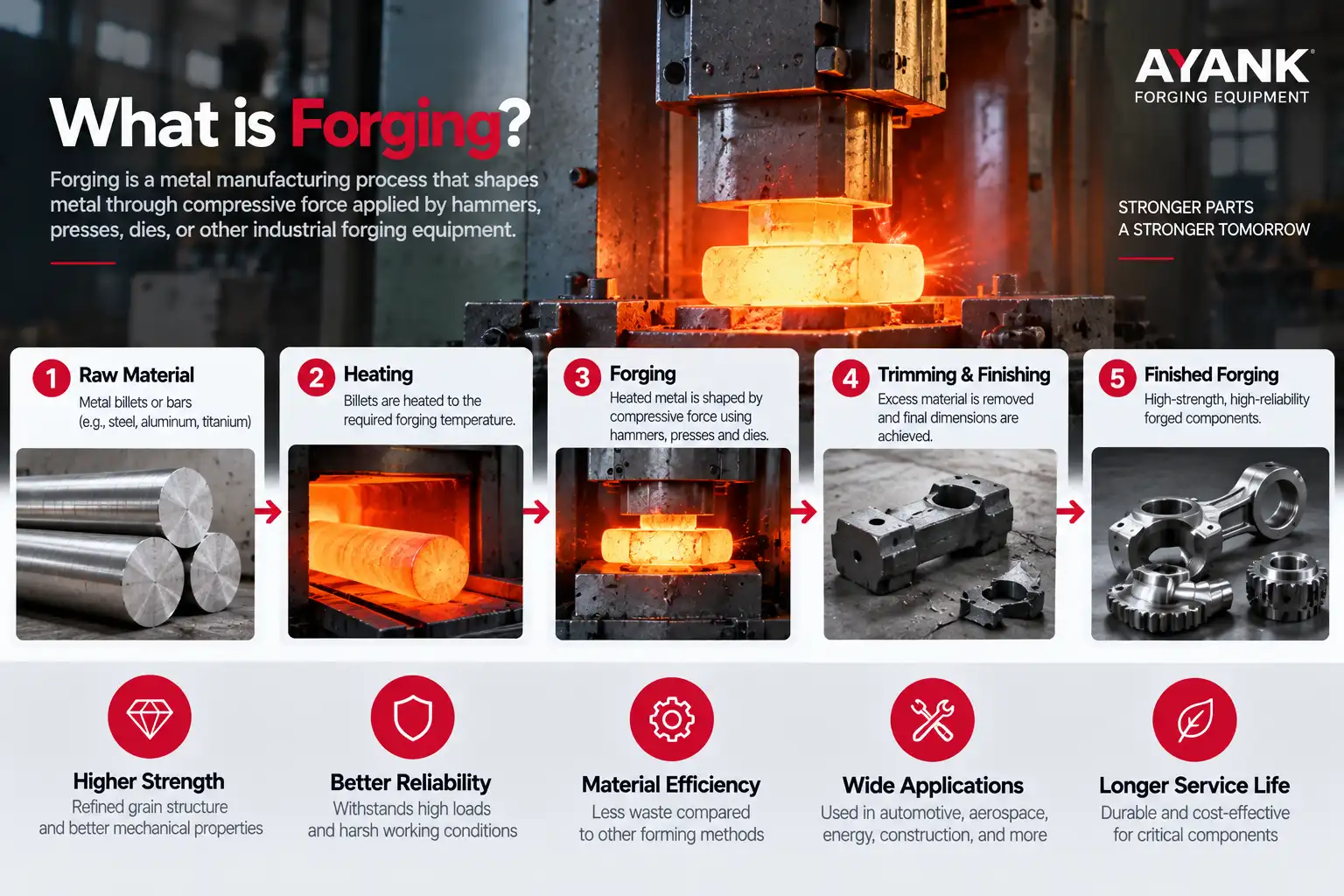
Forging is a metal manufacturing process that shapes a workpiece through compressive forces applied by hammers, presses, dies, or other forging equipment. The process can be performed at different temperatures and is widely used to manufacture strong, reliable components for automotive, aerospace, energy, railway, agricultural, construction, and general machinery applications.
Quick Answer
Forging is a manufacturing process in which metal is plastically deformed into a required shape by applying compressive force. The force may be delivered gradually by a forging press or rapidly through repeated impacts from a forging hammer.
Depending on the material, temperature, tooling, and production requirements, forging can be classified into processes such as hot forging, warm forging, cold forging, open-die forging, and closed-die forging. Compared with simply cutting a component from raw material, a properly designed forging process can also produce favorable grain flow around the shape of the part.
What Is Forging?
Forging is the process of shaping metal by plastic deformation under compressive forces. During forging, the workpiece is placed between dies or forging tools and subjected to pressure or impact until it reaches the required geometry.
Unlike machining, which creates a component primarily by removing material, forging changes the shape of the original workpiece through controlled deformation. Material may move outward, lengthwise, into a die cavity, or in several directions depending on the tooling and forging process.
Industrial forging can range from relatively simple open-die operations on shafts and rings to highly controlled closed-die production of complex automotive and machinery components.
The process may use a forging hammer, screw press, mechanical press, hydraulic press, or other specialized forging equipment. The appropriate machine depends on the component, material, deformation requirements, production volume, and process design.
How Does the Forging Process Work?
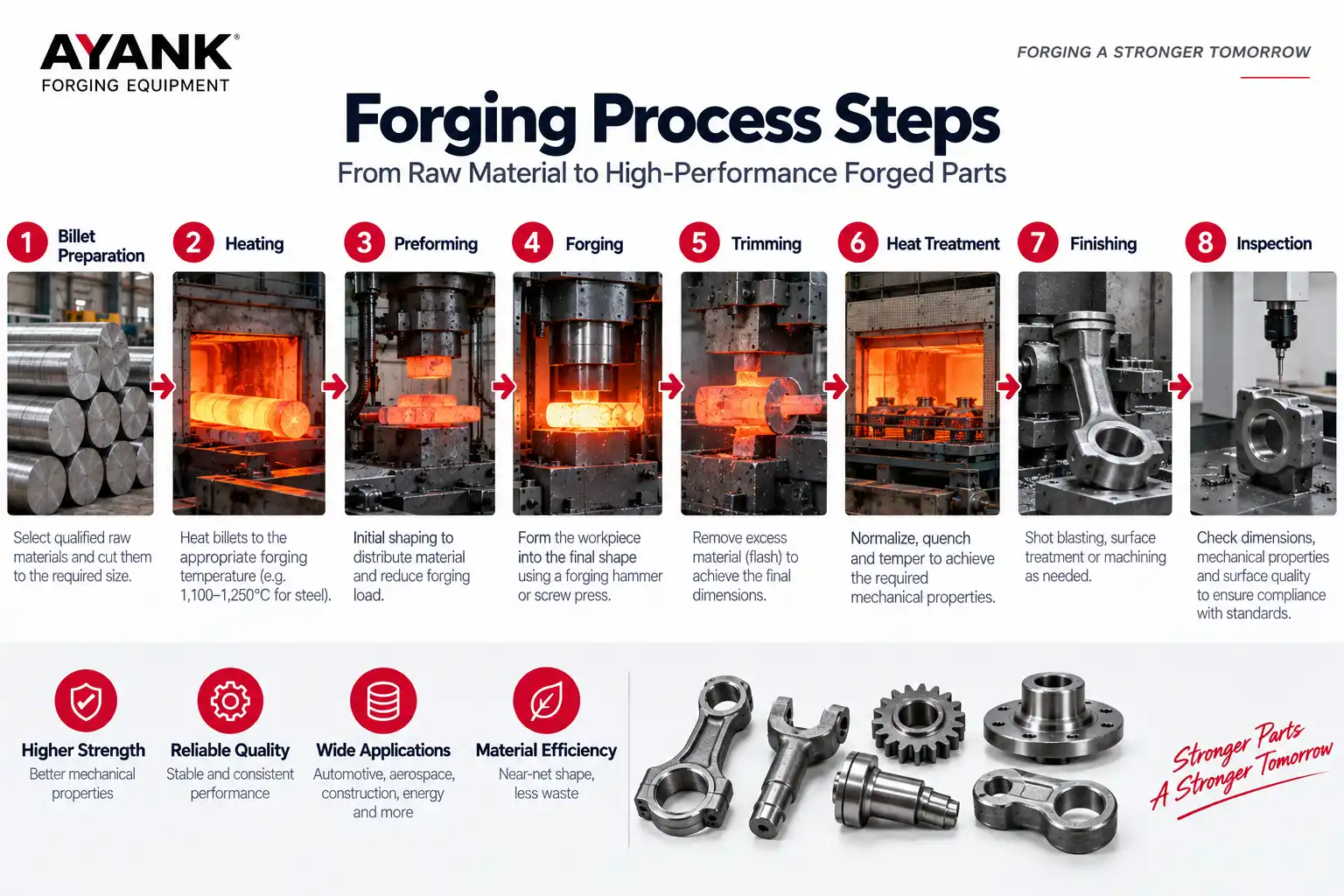
The exact forging process depends on whether the component is produced by hot, warm, or cold forging and whether open or closed dies are used. However, a typical industrial hot-forging process can be understood through several basic stages.
1. Raw Material Selection
The process begins by selecting a material with suitable chemical composition and mechanical properties. Carbon steel, alloy steel, stainless steel, aluminum alloys, titanium alloys, copper alloys, and other forgeable metals may be used depending on the application.
2. Billet Preparation
Bars or other raw materials are cut into billets containing the amount of metal required to produce the forged component.
Billet dimensions and volume are important because they influence material distribution, die filling, flash formation, and overall material utilization.
3. Heating
In hot forging, the billet is heated to an appropriate temperature before deformation. Heating reduces the material's resistance to deformation and allows substantial changes in shape without requiring the extremely high forces that would otherwise be necessary.
Induction heating and industrial furnaces are commonly used depending on material, billet size, production rate, and factory configuration.
4. Preforming
Complex components may require preliminary deformation before the final forging operation. Preforming distributes material so that the billet more closely matches the volume distribution required by the final component.
Typical preliminary operations can include:
- Drawing
- Upsetting
- Fullering
- Edging
- Bending
- Blocking
5. Forging
The prepared workpiece is placed between forging tools or dies. A hammer or press then applies compressive force, causing the metal to plastically deform.
In hammer forging, deformation may occur through a sequence of impact blows. In press forging, force is generally applied more progressively through the working stroke.
6. Trimming
Some closed-die forging processes produce excess material around the perimeter of the component, known as flash. When flash is present, it is removed in a subsequent trimming operation.
7. Heat Treatment
Depending on the material and required properties, the forged component may undergo heat treatment after forming. The specific heat-treatment process is determined by the alloy and final performance requirements.
8. Finishing and Inspection
Forged parts may subsequently undergo shot blasting, straightening, machining, surface treatment, dimensional inspection, and other quality-control operations before final use.
What Happens to Metal During Forging?
To understand what metal forging is, it is important to understand plastic deformation. When sufficient compressive stress is applied, the metal changes shape permanently rather than returning completely to its original geometry.
During forging, the material flows according to the direction of applied force, die geometry, friction, temperature, and the shape of the surrounding material.
For example, upsetting compresses a workpiece along its length and increases its cross-sectional area. Drawing performs the opposite general operation by reducing cross-section while increasing length.
In closed-die forging, material is forced to flow into shaped die cavities. Proper preform and die design help distribute the metal into ribs, bosses, webs, corners, and other features of the finished component.
Why Does Grain Flow Matter in Forging?
One important characteristic of forging is that deformation can influence the orientation and flow of the material's grain structure.
With appropriate process and die design, grain flow can follow the geometry of the forged component rather than being interrupted in the same way that may occur when a shape is produced primarily by machining material away from a larger stock section.
This is one reason forging is commonly selected for components subjected to demanding mechanical loads.
However, forging alone does not guarantee a high-quality component. Material quality, temperature control, deformation, die design, heat treatment, and defect control all influence the final properties of the part.
Main Types of Forging
There is no single forging process. Forging can be classified according to temperature, tooling, equipment, and how the material is constrained during deformation.
Two particularly useful ways to understand the types of forging are by forging temperature and die configuration.
Hot Forging vs Warm Forging vs Cold Forging
Hot Forging
Hot forging is performed at an elevated temperature that allows the material to undergo substantial plastic deformation with lower resistance than it would have at room temperature.
Hot forging is widely used for steel and other alloys where significant changes in geometry are required. It is common in the production of automotive, agricultural, railway, energy, and general machinery components.
Warm Forging
Warm forging is performed at a temperature between conventional hot-forging and cold-forging conditions. The objective is to balance formability, forming load, surface condition, dimensional control, and tooling requirements.
Cold Forging
Cold forging is performed without heating the workpiece to conventional hot-forging temperatures. It can provide good dimensional accuracy and surface finish for suitable materials and geometries, but generally requires higher forming loads and careful process design.
| Factor | Hot Forging | Warm Forging | Cold Forging |
|---|---|---|---|
| Forming Temperature | High | Intermediate | Low / near room-temperature conditions depending on process |
| Material Formability | Generally high | Intermediate | More limited for large deformation |
| Required Forming Load | Generally lower than cold forging | Intermediate | Generally higher |
| Dimensional Accuracy | Depends on process and thermal effects | Can provide improved control | Can provide high dimensional accuracy |
| Typical Selection | Large deformation and broad industrial applications | Applications requiring a balance of forming and accuracy | Suitable high-volume precision components |
Open-Die Forging
Open-die forging deforms the workpiece between dies that do not completely enclose the metal. The operator or manipulator moves the workpiece between forging strokes so that different areas can be progressively formed.
Common open-die operations include:
- Drawing
- Upsetting
- Flattening
- Punching
- Bending
- Cogging
Open-die forging is particularly useful for relatively simple geometries, flexible production, large components, shafts, rings, bars, and low-to-medium production quantities depending on the application.
Closed-Die Forging
Closed-die forging, also commonly called impression-die forging in many applications, uses shaped die cavities to control the flow of metal and produce a defined component geometry.
The billet may pass through several impressions before reaching its final form. These can include preforming, blocking, and finishing stages.
Closed-die forging is widely used for repeat production of components such as:
- Connecting rods
- Gear blanks
- Transmission components
- Levers
- Flanges
- Automotive components
- Agricultural machinery parts
- General industrial forgings
Open-Die Forging vs Closed-Die Forging
| Factor | Open-Die Forging | Closed-Die Forging |
|---|---|---|
| Die Design | Simple or partially shaped tools | Dedicated shaped die cavities |
| Material Constraint | Not completely enclosed | Controlled by die impressions |
| Part Complexity | Generally simpler | Can produce more complex geometry |
| Tooling Investment | Generally lower | Generally higher |
| Production Flexibility | High | More component-specific |
| Typical Production | Custom, flexible or large-component forging | Repeat production of defined parts |
Hammer Forging
Hammer forging uses rapid impact blows to deform the workpiece. Depending on the process, the operator or automated handling system can reposition the component between blows or move it through several die impressions.
Different hammer technologies include pneumatic and hydraulic forging hammers as well as other mechanical and drop-hammer configurations.
Learn more about specific hammer processes:
Press Forging
Press forging generally applies forming force more progressively than hammer forging. Depending on the machine, energy, force, stroke, speed, and position can be controlled to meet different forging requirements.
Industrial forging presses include several different technologies, such as mechanical, hydraulic, and screw presses.
An electric screw press converts motor energy into controlled ram movement through a screw-drive system and is widely used for industrial hot-forging and closed-die applications.
Forging Hammer vs Forging Press
One of the most fundamental equipment differences in forging is how the forming load is applied.
| Factor | Forging Hammer | Forging Press |
|---|---|---|
| Forming Action | Rapid impact | Progressive pressing action |
| Typical Cycle | Often multiple blows | One or more controlled strokes |
| Dynamic Loading | Higher impact loading | Generally lower impact loading |
| Material Deformation | Produced through impact energy | Produced through sustained forming force or energy |
| Equipment Selection | Depends on component geometry, material, die process, required deformation, production rate, tooling, and automation requirements. | |
Neither machine type is universally suitable for every forged component. Equipment selection should begin with the part and process requirements rather than choosing a machine first.
Forging vs Casting
Forging and casting are both widely used metal manufacturing processes, but they create components in fundamentally different ways.
Forging shapes solid metal through plastic deformation under compressive force. Casting melts the material and pours or injects the molten metal into a mold, where it solidifies into the required shape.
| Factor | Forging | Casting |
|---|---|---|
| Basic Process | Plastic deformation of solid metal | Molten metal solidifies inside a mold |
| Material Flow | Can develop directional grain flow through deformation | Structure develops during solidification |
| Complex Shapes | Limited by forging and die-forming requirements | Can produce highly complex geometries |
| Mechanical Applications | Common for highly loaded components | Suitable for a very broad range of components |
| Typical Equipment | Forging hammer or press | Melting furnace and casting system |
The correct manufacturing process depends on component geometry, material, required mechanical properties, production quantity, dimensional requirements, tooling investment, and cost. Neither process is automatically the correct choice for every component.
Forging vs Machining
Forging changes the shape of the material through deformation, while machining primarily produces geometry by removing material with cutting tools.
These processes are not necessarily alternatives. Many industrial components are first forged into a near-net or intermediate shape and then machined to achieve final dimensions, surfaces, holes, threads, or other precision features.
For example, a forged gear blank or shaft may undergo:
- Billet preparation
- Heating
- Forging
- Trimming
- Heat treatment
- Machining
- Final inspection
Using forging before machining can reduce the amount of material that must be removed when the forging is designed close to the final component geometry.
Advantages of Forging
Forging is used across demanding industries because the process can provide several important manufacturing and material advantages when correctly designed and controlled.
Favorable Grain Flow
Plastic deformation can orient material flow around the shape of the forged component. Appropriate grain flow is particularly valuable for parts subjected to significant mechanical loads.
Suitable for High-Strength Components
Forging is widely used for structural and load-bearing components where strength, toughness, fatigue performance, and reliability are important design considerations.
Wide Range of Part Sizes
Forging processes can be applied to relatively small precision components as well as much larger shafts, rings, blocks, and industrial forgings.
Broad Material Selection
Carbon steels, alloy steels, stainless steels, aluminum alloys, titanium alloys, copper alloys, and many other forgeable metals can be processed using suitable forging methods.
High-Volume Production Is Possible
Closed-die forging can be integrated with billet heating, automatic feeding, forging, trimming, conveying, and robotic handling to support repeat industrial production.
Near-Net Shape Production
Properly designed dies can produce a workpiece relatively close to the required final geometry, potentially reducing subsequent machining compared with producing the same shape entirely from larger stock.
Disadvantages and Limitations of Forging
Forging also has practical limitations. Whether these are significant depends on the component and selected process.
Equipment Investment
Industrial forging requires suitable hammers, presses, heating systems, dies, handling equipment, and supporting infrastructure. Larger production systems can require substantial capital investment.
Tooling Cost
Closed-die components normally require dedicated tooling. Complex components may require multiple preforming, blocking, finishing, and trimming dies.
Process Development
Successful forging requires control over billet size, temperature, lubrication, material flow, die geometry, forming energy or force, and forging sequence.
Dimensional Limitations
Forged parts may still require machining where tight dimensional tolerances or specific surface requirements cannot be achieved economically by the forging operation alone.
Material and Geometry Restrictions
Not every material or component geometry is suitable for forging. Extremely complex internal geometries, for example, may be more practical using another manufacturing process.
What Materials Can Be Forged?
Many metals can be forged, but their forging behavior differs considerably. Material composition, temperature range, deformation resistance, ductility, oxidation behavior, and heat-treatment requirements all influence process design.
| Material Group | Typical Forging Applications | Important Considerations |
|---|---|---|
| Carbon Steel | Shafts, flanges, machinery parts, tools | Grade and carbon content affect forging behavior |
| Alloy Steel | Gears, automotive parts, high-load components | Temperature and heat treatment require careful control |
| Stainless Steel | Industrial, energy and corrosion-resistant components | Higher deformation resistance may affect equipment requirements |
| Aluminum Alloys | Transportation and lightweight components | Temperature window and die conditions are important |
| Titanium Alloys | Aerospace and high-performance applications | Process and temperature control are particularly important |
| Copper Alloys | Electrical, industrial and mechanical components | Forging behavior varies with alloy composition |
Common Forging Defects
Understanding what forging is also requires understanding that a forged component is only as reliable as the process used to produce it. Incorrect billet preparation, temperature, die design, material flow, or equipment settings can create defects.
Underfilling
Underfilling occurs when the material does not completely fill the required die cavity. Possible causes include insufficient billet volume, unsuitable preforming, low forging temperature, inadequate forming energy, or poor die design.
Laps and Folds
Improper material flow can cause metal surfaces to fold over one another instead of joining into the intended geometry. Preform and die design are important for reducing this risk.
Cracks
Cracking can result from unsuitable material conditions, excessive deformation, incorrect temperature, stress concentration, or other process problems.
Die Shift
Misalignment between upper and lower dies can create an offset between corresponding sections of the forged component.
Excessive Flash
Incorrect billet volume or process design can generate unnecessary flash, increasing material consumption and trimming requirements.
Scale and Surface Defects
During hot forging, oxidation can produce scale on the billet surface. Heating conditions, descaling, die condition, and process control can influence the resulting surface quality.
What Equipment Is Used for Forging?
Industrial forging equipment is selected according to how the required force or energy must be delivered to the workpiece.
Forging Hammers
Forging hammers deform metal through impact energy. They include pneumatic, hydraulic, mechanical, and other hammer configurations used for open-die and closed-die applications.
Related guides:
Electric Screw Presses
An electric screw press uses an electric drive and screw mechanism to convert motor energy into ram movement. It is widely used for hot forging and closed-die forging where controlled forming energy and repeatability are required.
Read the Electric Screw Press Machine Guide for a detailed explanation of its working principle and selection.
Mechanical Forging Presses
Mechanical presses use mechanical drive systems to produce controlled ram motion and are commonly applied to repeat production where stroke characteristics and production rate match the forging process.
Hydraulic Forging Presses
Hydraulic presses use hydraulic cylinders to generate forming force and can provide controlled movement throughout the working stroke. They are used in a variety of open-die and closed-die forming applications depending on machine design.
Auxiliary Forging Equipment
A complete forging factory requires more than the primary hammer or press. Supporting equipment may include:
- Billet cutting machines
- Induction heating systems
- Industrial furnaces
- Roll forging machines
- Manipulators
- Robots
- Trimming presses
- Conveyors
- Cooling systems
- Descaling equipment
- Inspection and process-control systems
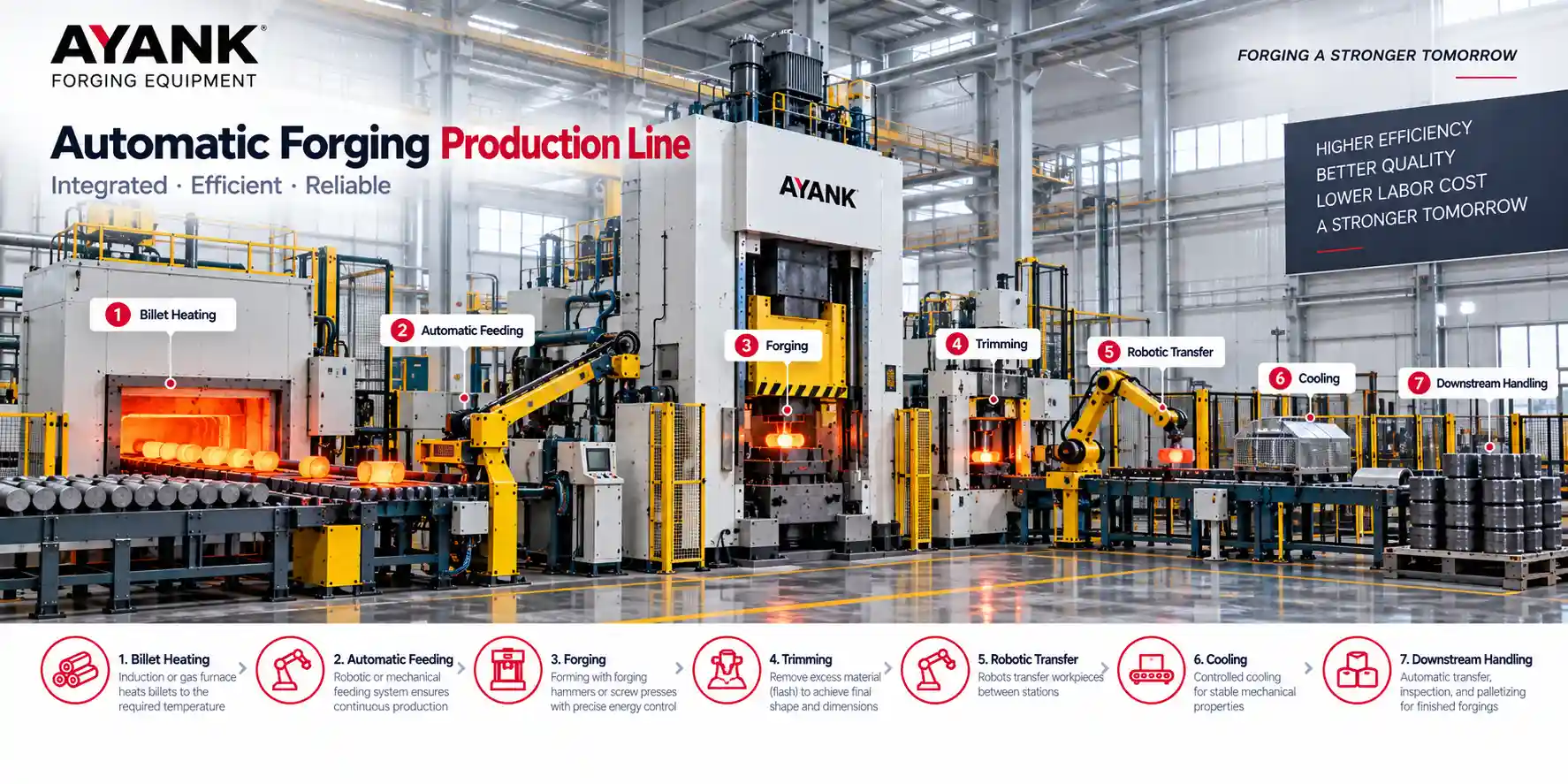
What Is an Automatic Forging Production Line?
In high-volume manufacturing, individual forging machines can be connected with heating, handling, forming, trimming, and downstream equipment to create an automated forging production line.
A typical hot-forging line may follow this sequence:
- Raw material cutting
- Billet feeding
- Induction heating
- Temperature inspection
- Preforming
- Main forging
- Trimming
- Automatic transfer
- Cooling
- Inspection or downstream processing
The purpose of automation is not simply to connect several machines. Cycle times, billet temperature, transfer distance, die sequence, forming capacity, and downstream operations must be coordinated as one production system.
Where Is Forging Used?
Forged components are used across industries where mechanical performance, reliability, repeatable production, or efficient material forming is important.
Automotive Industry
Automotive forging applications include drivetrain, transmission, chassis, steering, suspension, and other mechanically loaded components.
Aerospace
Forging is used for selected structural and mechanical components where material performance and manufacturing control are critical.
Agricultural Machinery
Forged components are used in tractors, tillage equipment, harvesting machinery, transmission systems, and other agricultural equipment.
Construction and Mining
Heavy machinery requires durable components for demanding operating environments, making forging relevant to many construction and mining applications.
Railway
Railway applications use forged components in various load-bearing and mechanical systems.
Energy and Industrial Equipment
Forging is also used for flanges, shafts, rings, fittings, valves, and other components for energy and general industrial machinery.
Hand Tools
Wrenches, hammers, pliers, and many other industrial and hand tools can be manufactured using forging processes.
How to Choose the Right Forging Process
There is no single forging process suitable for every component. Process selection should begin with the product requirements rather than with an existing machine.
Important factors include:
- Material grade
- Billet dimensions and weight
- Final component geometry
- Required mechanical properties
- Dimensional tolerances
- Surface requirements
- Annual production volume
- Required forming energy or force
- Tooling complexity
- Automation requirements
- Available factory infrastructure
- Investment and operating cost
For example, flexible production of shafts and simple components may favor an open-die process, while repeat production of a defined automotive component may justify dedicated closed-die tooling and an automated forging line.
The forging machine should therefore be selected after evaluating the material flow and required manufacturing process.
What Information Is Needed to Plan a Forging Process?
When discussing a new forging project with an equipment manufacturer, providing detailed workpiece information makes preliminary process and machine selection significantly more useful.
| Information | Why It Matters |
|---|---|
| Part drawing | Shows geometry, dimensions and forming difficulty |
| Material grade | Determines material behavior and forging conditions |
| Finished part weight | Provides basic component information |
| Billet size and weight | Defines the starting material condition |
| Annual production | Influences equipment and automation selection |
| Current process | Useful for replacement or process improvement projects |
| Required tolerances | Influences forging and subsequent machining requirements |
| Factory conditions | Influences installation and line configuration |
Frequently Asked Questions About Forging
What is forging?
Forging is a manufacturing process that shapes metal through plastic deformation under compressive force. The force can be applied by forging hammers, presses, dies, or other specialized forging equipment.
How does forging work?
Forging works by applying sufficient compressive force to permanently deform a metal workpiece. Depending on the process, the metal may be heated before forming and then shaped through hammer impacts or controlled press strokes.
What are the main types of forging?
Forging can be classified in several ways. Common categories include hot forging, warm forging, cold forging, open-die forging, closed-die forging, hammer forging, and press forging.
What is hot forging?
Hot forging forms metal at an elevated temperature so that substantial plastic deformation can occur with lower resistance than under cold conditions. It is widely used for steel and other industrial alloys.
What is the difference between open-die and closed-die forging?
Open-die forging shapes metal between tools that do not completely enclose the workpiece, allowing it to be repositioned during forming. Closed-die forging uses shaped die impressions to control material flow and produce a defined component geometry.
What is the difference between forging and casting?
Forging shapes solid metal through plastic deformation, while casting melts metal and solidifies it inside a mold. The processes therefore create the component using fundamentally different material-forming mechanisms.
What metals can be forged?
Common forgeable materials include carbon steel, alloy steel, stainless steel, aluminum alloys, titanium alloys, copper alloys, and other metals with suitable deformation characteristics.
What machines are used for forging?
Common forging machines include pneumatic and hydraulic forging hammers, drop hammers, electric screw presses, mechanical presses, hydraulic presses, and other specialized forging equipment.
Why are forged parts strong?
A properly designed forging process plastically deforms the metal and can develop favorable grain flow around the component geometry. Final performance also depends on material quality, deformation, heat treatment, process control, and component design.
Conclusion
Forging is a metal manufacturing process that uses compressive force to plastically deform a workpiece into the required shape. Depending on the application, the process may use hot, warm, or cold material and can be performed with open dies, closed dies, forging hammers, or forging presses.
The correct forging process depends on much more than component weight. Material, geometry, deformation, tooling, production volume, required properties, automation, and downstream processing should all be considered together.
AYANK supplies industrial forging equipment including forging hammers, electric screw presses, forging presses, and integrated forging production solutions. For a new forging project, providing the part drawing, material grade, billet dimensions, production volume, and current process allows the equipment configuration to be evaluated around the actual manufacturing requirements.