
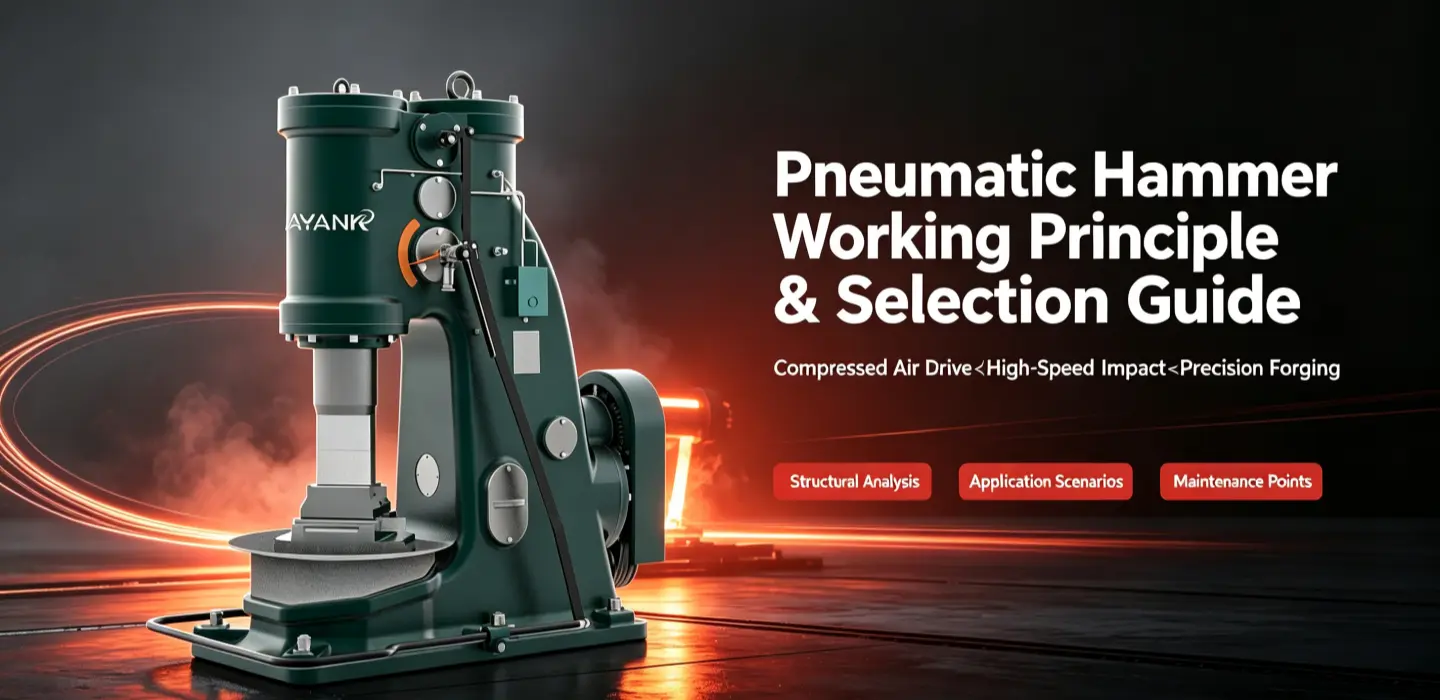
A pneumatic forging hammer is a power hammer that uses compressed air to control the movement of the hammer ram and deliver repeated impact blows to a heated metal workpiece. Pneumatic forging hammers are widely used for drawing, upsetting, bending, punching, shaping, and other open-die forging operations.
Quick Answer
A pneumatic forging hammer uses compressed air to drive and control a reciprocating hammer ram. During operation, the heated workpiece is positioned between the upper and lower forging tools, while repeated controlled blows progressively deform the metal into the required shape.
Pneumatic hammers are particularly useful for open-die forging because the operator can control the forging sequence while repositioning the workpiece between blows. Machine selection should consider the workpiece material, billet dimensions, forging dimensions, required deformation, production requirements, and hammer capacity.
What Is a Pneumatic Forging Hammer?
A pneumatic forging hammer is an industrial forging hammer machine that uses compressed air as part of its power and control system. The machine repeatedly raises and lowers a hammer ram fitted with an upper forging die or tool.
When the ram moves downward, the upper tool strikes the heated workpiece against the lower die or anvil. Each impact causes plastic deformation of the metal. By controlling the intensity and number of blows while repositioning the workpiece, the operator can progressively create the required forged shape.
This makes the pneumatic hammer particularly suitable for open-die forging operations where the material must be repeatedly manipulated during the forming process.
The pneumatic forging hammer belongs to the broader family of powered forging hammers. For an overview of the different hammer technologies, see What Is a Forging Hammer? Types, Working Principle & Applications.
How Does a Pneumatic Forging Hammer Work?
The working principle of a pneumatic forging hammer is based on compressed air acting on pistons inside the machine. The system converts motor-driven mechanical energy and compressed-air pressure into reciprocating movement of the hammer ram.
Although specific machine structures can vary, the basic forging cycle can be understood through the following stages.
1. The Electric Motor Drives the Compression System
In a self-contained pneumatic forging hammer, an electric motor drives the machine's compression mechanism. This produces the compressed air required to operate the hammering system.
Unlike a simple externally supplied air tool, an industrial pneumatic forging hammer can incorporate its own compression and working-cylinder arrangement within the machine.
2. Compressed Air Controls Ram Movement
The machine directs compressed air through the operating system to control the hammer piston and ram. Changes in air pressure and distribution allow the ram to rise, fall, or remain in a controlled position according to the operating command.
3. The Ram Accelerates Toward the Workpiece
During the working stroke, the hammer ram accelerates downward toward the heated billet. The moving mass of the ram and upper forging tool develops kinetic energy before impact.
4. The Hammer Delivers the Forging Blow
When the upper tool contacts the workpiece, impact energy is transferred into the heated metal. The material plastically deforms between the upper and lower tools.
5. The Workpiece Is Repositioned
In open-die forging, the workpiece is often moved, rotated, or turned between blows. This allows deformation to be distributed along different sections of the billet.
6. Repeated Blows Form the Final Shape
The process continues through a sequence of controlled impacts until the required dimensions and geometry are achieved.
This repeated-blow capability is one of the defining characteristics of power hammer forging. Rather than attempting to complete the entire deformation in one stroke, the material can be progressively worked through multiple impacts.
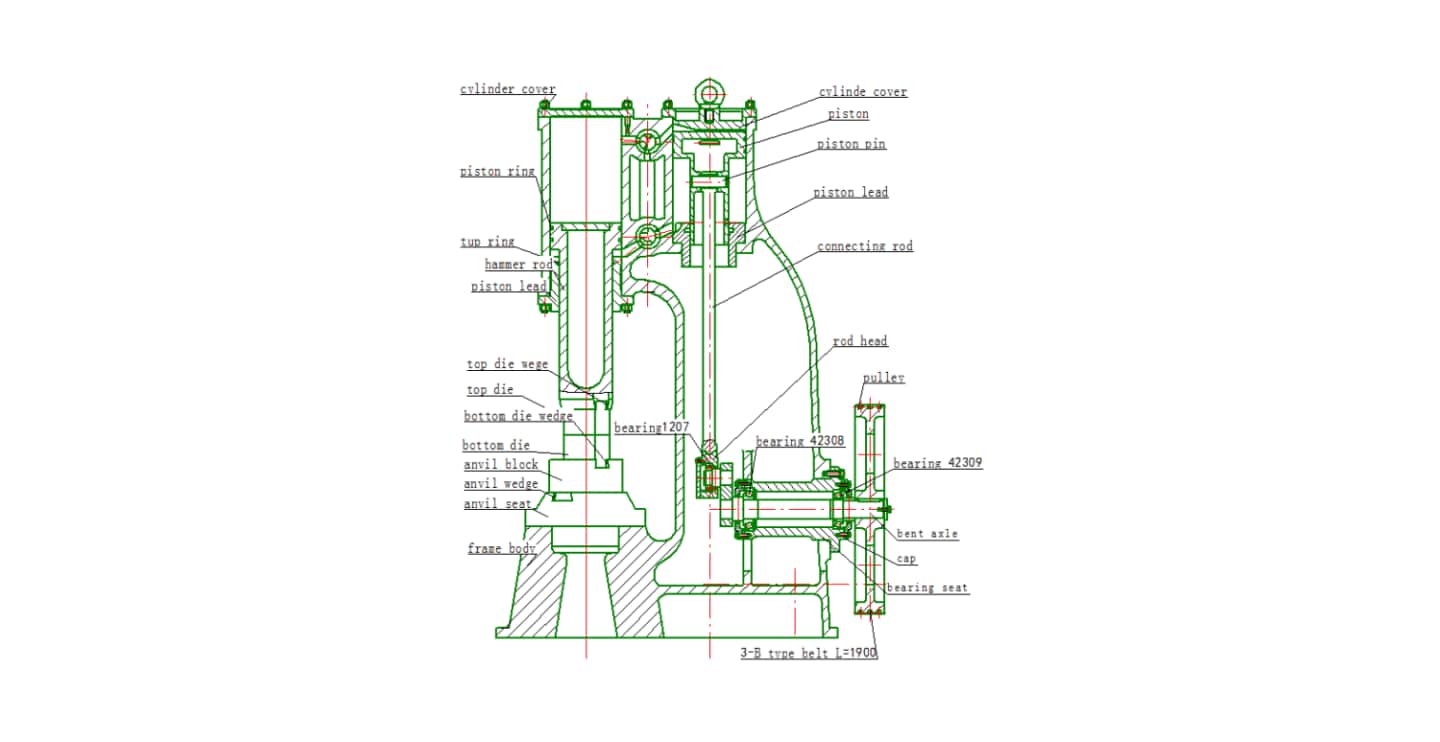
Main Components of a Pneumatic Forging Hammer
Understanding the main components helps explain why a pneumatic forging hammer machine behaves differently from hydraulic and mechanically driven forging equipment.
Machine Frame
The frame supports the hammer mechanism and maintains the alignment of the working components. Because the machine operates under repeated impact loading, structural rigidity is important for stable operation.
Compression Cylinder
In a self-contained pneumatic hammer design, the compression cylinder generates the compressed air used by the working system.
Working Cylinder
The working cylinder uses controlled air pressure to move the hammer piston and ram during the forging cycle.
Hammer Ram
The ram carries the upper forging tool and repeatedly moves toward and away from the workpiece. Ram mass, movement, and operating characteristics influence the energy delivered during forging.
Upper and Lower Forging Tools
The workpiece is forged between the upper and lower tools. Different tool shapes can be installed depending on the required forging operation.
Anvil and Base
The anvil supports the lower forging tool and receives the impact transmitted through the workpiece. The machine base and foundation must provide adequate support for repeated hammer operation.
Control Mechanism
The control mechanism regulates hammer operation and allows the working cycle to be adapted to the forging process. Depending on machine design, the operator can control individual blows or repeated hammering.
Pneumatic Forging Hammer vs Air Powered Power Hammer
Search terms such as air powered power hammer and pneumatic power hammer are sometimes used broadly, but they do not always describe exactly the same machine configuration.
A pneumatic forging hammer is specifically designed for forging metal through controlled impact blows using a pneumatic operating principle. Some industrial designs are self-contained and generate the required compressed air within the machine.
By contrast, the term "air powered power hammer" can also be used for machines that depend on an external compressed-air supply. Therefore, when comparing equipment, buyers should examine the actual drive system and machine structure rather than relying only on terminology.
| Factor | Self-Contained Pneumatic Forging Hammer | Externally Air-Powered Hammer |
|---|---|---|
| Air Supply | Generated within the machine system | Typically requires an external compressed-air source |
| Main Application | Industrial forging | Depends on machine design |
| System Design | Integrated compression and hammer mechanism | Air supply and hammer may be separate systems |
| Selection | Verify actual machine structure, hammer capacity, workpiece range, control method, and production requirements. | |
Common Pneumatic Forging Hammer Operations
The ability to reposition a workpiece between repeated blows makes pneumatic hammers suitable for many traditional and industrial open-die forging operations.
Drawing Out
Drawing reduces the cross-sectional area of the workpiece while increasing its length. The billet is progressively moved and rotated as repeated hammer blows distribute deformation along the required section.
Upsetting
Upsetting increases the cross-sectional area by compressing the workpiece along its length. It can be used to prepare material for subsequent forging stages or create thicker sections.
Flattening
Flat forging tools can be used to reduce thickness and create flatter surfaces while controlling the direction of material flow.
Fullering and Local Reduction
Suitable forging tools can concentrate deformation in specific areas of the workpiece, allowing material to be redistributed before subsequent shaping.
Bending
Appropriate tooling and workpiece manipulation can be used to bend heated material as part of the forging sequence.
Punching and Forming
Depending on tooling and machine capacity, pneumatic hammers can also assist with punching and other forming operations on heated workpieces.
What Materials Can Be Forged with a Pneumatic Hammer?
A pneumatic hammer for forging can process a variety of forgeable metals when the material is prepared and heated under appropriate process conditions.
- Carbon steel
- Alloy steel
- Stainless steel
- Tool steel
- Aluminum alloys
- Copper alloys
- Other forgeable metals and alloys
The material grade influences forging temperature, deformation resistance, heating requirements, hammer capacity, and the number of blows required. Two workpieces of similar dimensions may therefore require different forging conditions when their material properties differ.
Typical Applications of Pneumatic Forging Hammers
Pneumatic forging hammers are especially useful where manufacturers need flexible open-die forging and repeated control over workpiece deformation.
Typical applications can include:
- Shafts and stepped shafts
- Rings and collars
- Bars and billets
- Flanges and fittings
- Agricultural machinery parts
- Hand tools and industrial tools
- Repair and maintenance forgings
- Small and medium industrial forgings
- Preforming operations for subsequent forging processes
Actual suitability depends on the workpiece size, material, required deformation, machine capacity, tooling, and production target.
Advantages of Pneumatic Forging Hammers
Flexible Blow Control
Repeated hammering allows the forging process to be adjusted according to the stage of deformation. Lighter and heavier blows can be applied as required by the workpiece and process.
Suitable for Open-Die Forging
The workpiece can be repositioned between blows, making the machine well suited to drawing, upsetting, bending, flattening, and other open-die operations.
Multiple Forging Operations on One Machine
By changing tooling and operating methods, the same machine can perform several different forging operations rather than being limited to one component geometry.
Relatively Simple Forging Process
For appropriate workpieces, a pneumatic forging hammer provides a straightforward method of converting powered ram movement into repeated forging impacts.
Useful for Flexible Production
Pneumatic hammers can be appropriate for workshops and production environments handling different workpiece sizes and forging operations rather than a single high-volume closed-die component.
Pneumatic Forging Hammer vs Hydraulic Forging Hammer
Both machines use powered systems to generate repeated forging blows, but their drive systems, control characteristics, and typical applications differ.
| Factor | Pneumatic Forging Hammer | Hydraulic Forging Hammer |
|---|---|---|
| Working Medium | Compressed air | Hydraulic fluid |
| Drive System | Pneumatic compression and working system | Hydraulic pumps, valves, cylinders and related components |
| Common Process | Flexible open-die forging | Open-die or closed-die forging depending on design |
| Typical Production | Flexible production and varied forging operations | Can be configured for repeat industrial production and automation |
| Maintenance Focus | Air system, cylinders, guides and mechanical components | Hydraulic fluid, valves, seals, accumulators and hydraulic components |
| Correct Selection | Depends on forged part geometry, material, required energy, production volume, tooling, factory conditions, and automation requirements. | |
For a detailed explanation of the alternative system, see Hydraulic Forging Hammer: Working Principle, Types & Applications.
Pneumatic Forging Hammer vs Mechanical Forging Hammer
Pneumatic and mechanical forging hammers both deliver repeated impact blows, but they use different methods to generate and control ram movement.
A pneumatic forging hammer uses compressed air as part of its operating system, while a mechanical forging hammer relies primarily on a mechanical transmission mechanism to convert motor power into hammer motion.
| Factor | Pneumatic Forging Hammer | Mechanical Forging Hammer |
|---|---|---|
| Operating Principle | Compressed-air-controlled ram movement | Mechanical transmission drives hammer movement |
| Blow Control | Can provide flexible control over repeated blows | Depends on the mechanical drive and control design |
| Typical Use | Open-die forging and flexible forging operations | Depends on hammer design and production process |
| Maintenance Focus | Air system, cylinders, guides and moving components | Mechanical transmission, bearings and moving components |
| Selection Basis | Workpiece material, dimensions, forging process, required impact energy, production volume and factory conditions. | |
Pneumatic Forging Hammer vs Forging Press
A pneumatic power hammer and a forging press deform metal in fundamentally different ways. Understanding this difference is important when selecting equipment for a new forging process.
The pneumatic hammer delivers a sequence of rapid impact blows. The workpiece can be moved and rotated between impacts, allowing the operator to progressively control material distribution.
A forging press generally applies force over a longer working stroke. Instead of repeated hammer impacts, deformation is produced through controlled pressing action.
| Factor | Pneumatic Forging Hammer | Forging Press |
|---|---|---|
| Forming Method | Repeated impact blows | Progressive pressing force |
| Workpiece Handling | Can be repositioned between blows | Depends on die and press process |
| Typical Process | Flexible open-die forging | Closed-die and other press-forging operations |
| Dynamic Loading | Significant impact loading | Generally lower impact loading |
| Production Selection | Should be based on part geometry, material, required deformation, tooling, output and process requirements. | |
Neither process is universally better. A shaft requiring flexible open-die drawing and a high-volume precision closed-die component can have completely different equipment requirements, even when their finished weights are similar.
How to Choose a Pneumatic Forging Hammer
Selecting a pneumatic forging hammer machine should start with the workpiece rather than simply choosing a hammer according to price or nominal model size.
The following factors should be evaluated before equipment selection.
1. Workpiece Material
Material grade affects deformation resistance, forging temperature and the energy required to shape the workpiece. Carbon steel, alloy steel, stainless steel and non-ferrous alloys can require different forging conditions.
2. Billet Dimensions and Weight
Provide the original billet diameter, length and weight. These dimensions help determine the amount of material that must be deformed and the working space required.
3. Final Forging Dimensions
The required final dimensions are just as important as billet size. Drawing a short, thick billet into a long shaft creates a different forging requirement from making a relatively small dimensional correction to the same billet.
4. Required Forging Operations
Determine whether the process involves drawing, upsetting, flattening, bending, punching, preforming, or a combination of several operations.
5. Hammer Capacity
Pneumatic hammer models are commonly differentiated by the mass of the falling or working parts, but this specification should not be considered independently.
Machine stroke, blow characteristics, working dimensions, tool space and the actual forging application must also be considered when matching a hammer to a workpiece.
6. Production Volume
A machine used for repair work or small-batch production may have very different requirements from equipment operating continuously in an industrial forging workshop.
7. Available Working Space
Long shafts and large workpieces require sufficient clearance around the dies and machine. Workshop layout should therefore be considered before selecting the hammer.
8. Foundation and Installation Conditions
Because hammer forging generates repeated impact loads, foundation design and installation conditions must be evaluated according to the machine and local workshop conditions.
Understanding Pneumatic Forging Hammer Capacity
One of the most common mistakes when buying a power hammer for forging is assuming that one headline specification can determine whether the machine is suitable.
Pneumatic forging hammers are often identified by a nominal hammer or falling-parts weight. However, that number alone does not describe the entire forging capability of the machine.
Equipment evaluation should also consider:
- Ram or falling-parts mass
- Stroke characteristics
- Blow frequency
- Working height
- Die dimensions
- Available forging space
- Motor power
- Workpiece material
- Billet and final forging dimensions
- Required forging operation
This is particularly important when comparing machines from different manufacturers. Two models with similar nominal capacities should not automatically be assumed to have identical working characteristics.
C41A Pneumatic Forging Hammer for Industrial Forging
The C41A series is a pneumatic forging hammer configuration used for open-die forging operations. Different machine sizes can be selected according to workpiece dimensions, material, forging operation and production requirements.
Typical C41A applications include drawing, upsetting, bending, flattening and other general free-forging operations for steel and other forgeable materials.
Rather than selecting a C41A model only from the nominal hammer specification, buyers should provide the workpiece information required to evaluate the complete forging process.
Example: Selecting a Pneumatic Hammer for Shaft Forging
Consider a manufacturer that needs to forge heated alloy-steel billets into stepped shafts. The correct equipment cannot be determined simply from the finished shaft weight.
The equipment manufacturer would also need to know:
- Steel grade
- Starting billet diameter and length
- Final shaft dimensions
- Maximum and minimum forged sections
- Required drawing ratio
- Forging temperature
- Required production quantity
- Whether handling is manual or mechanized
For example, a long shaft requiring substantial drawing deformation can place very different demands on the hammer than a shorter component of similar weight.
This is why workpiece drawings and process information are more useful for hammer selection than asking only, "What size pneumatic hammer do I need for a 20 kg forging?"
Installation Requirements for a Pneumatic Forging Hammer
Correct installation is essential for reliable hammer operation. Requirements vary according to machine size and configuration, so the final installation should follow the manufacturer's technical documentation.
Foundation
The foundation must support the machine and account for repeated impact loads. Foundation design should consider the selected hammer, soil and building conditions, and local engineering requirements.
Machine Clearance
Sufficient space should be provided around the hammer for workpiece manipulation, maintenance, tooling changes and safe operator access.
Electrical Supply
The electrical system must match the motor and control requirements of the selected machine, including local voltage and frequency.
Material Handling
Larger or longer forgings may require manipulators, lifting equipment or other handling systems. These requirements should be considered during workshop layout planning rather than after the hammer has been installed.
Pneumatic Forging Hammer Maintenance
Regular inspection and preventive maintenance help maintain stable operation and identify wear before it develops into a larger equipment problem.
Check the Air System
Compression and working cylinders, air passages and associated components should be inspected according to the manufacturer's maintenance requirements.
Inspect the Ram and Guides
Ram movement should remain stable and properly aligned. Guide surfaces, clearances and lubrication should be inspected for abnormal wear.
Inspect Forging Tools
Upper and lower tools should be checked for cracking, deformation and excessive wear. Damaged tooling can affect both forging quality and operating safety.
Check Fasteners and Structural Connections
Repeated hammer impact can affect fasteners and structural connections. Critical mounting points should therefore be included in routine inspection.
Maintain Proper Lubrication
Moving components should be lubricated according to the machine manufacturer's instructions. Lubrication intervals should reflect actual operating conditions and production intensity.
Monitor Abnormal Operation
Unusual vibration, sound, temperature, ram movement or changes in hammer performance should be investigated rather than treated as normal operating variation.
What Information Should You Send to a Pneumatic Forging Hammer Manufacturer?
When requesting a quotation, providing detailed forging information allows the manufacturer to evaluate whether a particular pneumatic hammer model is suitable for your application.
| Information | Why It Matters |
|---|---|
| Part drawing or photo | Shows geometry and required forging shape |
| Material grade | Affects forging temperature and deformation resistance |
| Billet dimensions | Defines the starting workpiece condition |
| Billet weight | Supports preliminary hammer selection |
| Final forging dimensions | Shows the amount and direction of required deformation |
| Forging operation | Determines whether drawing, upsetting, bending or other operations are required |
| Production quantity | Helps evaluate productivity requirements |
| Existing machine | Useful when replacing or upgrading current equipment |
| Destination country | Helps confirm electrical and installation requirements |
Supplying these details is more useful than requesting a quotation based only on a model number. It allows the equipment manufacturer to match the machine to the actual forging application.
When Should You Consider a Pneumatic Forging Hammer?
A pneumatic forging hammer is worth considering when the production process requires flexible, repeated impact forging and the workpiece needs to be manipulated between blows.
It can be particularly relevant when:
- The main process is open-die forging.
- Workpieces require drawing, upsetting, bending or flattening.
- Different workpiece geometries are produced on the same machine.
- Operators need flexible control over the forging sequence.
- Production does not justify dedicated closed-die equipment for every component.
- The workshop needs a general-purpose powered forging hammer.
For high-volume closed-die production, highly automated forging, or processes requiring different forming characteristics, a hydraulic forging hammer, electric screw press, mechanical press or another forging system may also need to be evaluated.
Pneumatic Forging Hammer FAQ
What is a pneumatic forging hammer?
A pneumatic forging hammer is a powered forging machine that uses compressed air to control reciprocating hammer movement and deliver repeated impact blows to heated metal. It is commonly used for open-die forging operations such as drawing, upsetting, bending and flattening.
How does a pneumatic forging hammer work?
A pneumatic forging hammer uses compressed air to control the hammer piston and ram. The ram carries the upper forging tool and repeatedly strikes the heated workpiece against the lower tool, gradually deforming the metal into the required shape.
Does a pneumatic forging hammer need an external air compressor?
Not necessarily. Many self-contained industrial pneumatic forging hammers incorporate their own compression and working-cylinder system. Other air-powered hammer designs may use an external compressed-air source, so buyers should verify the actual machine configuration.
What is a pneumatic forging hammer used for?
Pneumatic forging hammers are commonly used for drawing, upsetting, flattening, bending, fullering, punching and other open-die forging operations. Typical workpieces include shafts, rings, bars, flanges, tools and general industrial forgings.
What is the difference between a pneumatic and hydraulic forging hammer?
A pneumatic forging hammer uses compressed air as its working medium, while a hydraulic forging hammer uses hydraulic fluid and hydraulic control components. Their machine structure, control characteristics, maintenance requirements and typical applications can therefore differ.
How do I choose the right pneumatic forging hammer?
Selection should consider material grade, billet dimensions and weight, final forging dimensions, required forging operations, hammer capacity, working space, production quantity and installation conditions. Part weight alone is not sufficient for accurate selection.
What materials can be forged with a pneumatic hammer?
Pneumatic forging hammers can process many forgeable materials, including carbon steel, alloy steel, stainless steel, tool steel and selected non-ferrous alloys, provided that the material, forging temperature, tooling and hammer capacity are appropriate for the application.
Is a pneumatic forging hammer suitable for industrial production?
Yes. Pneumatic forging hammers are used for industrial open-die forging and flexible production. Suitability depends on the required workpiece range, production volume, forging operations and machine capacity.
Conclusion
A pneumatic forging hammer provides a flexible method of shaping heated metal through repeated controlled impact blows. Its ability to combine powered hammering with workpiece repositioning makes it particularly suitable for drawing, upsetting, bending, flattening and other open-die forging operations.
However, choosing the correct pneumatic hammer for forging requires more than comparing nominal hammer sizes. Material, billet dimensions, final forging geometry, required deformation, tooling, working space and production requirements should all be considered.
AYANK supplies pneumatic forging hammer equipment for industrial metal-forming applications. For machine selection, provide your workpiece drawing, material grade, billet dimensions, final forging dimensions and required production capacity so that the appropriate equipment configuration can be evaluated.