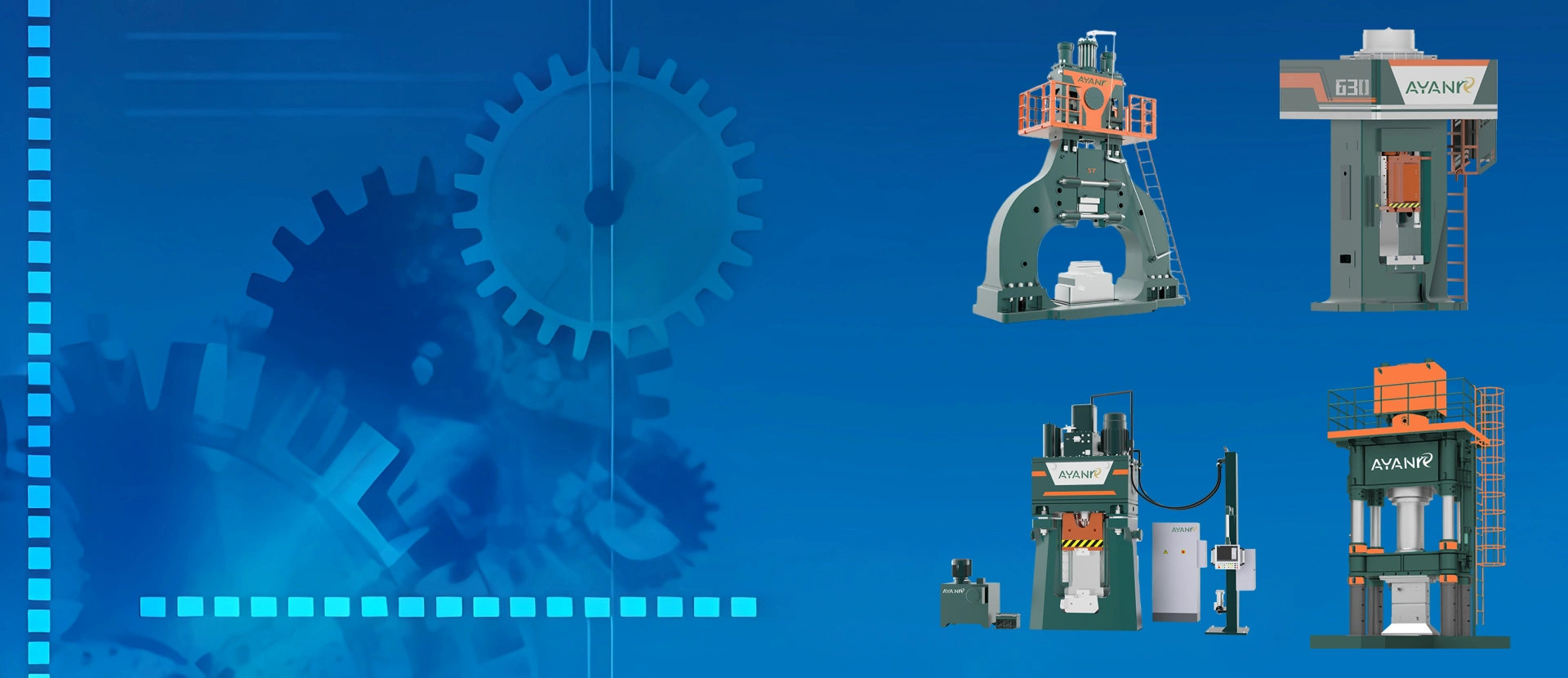
A forging screw press is a type of forging equipment. After decades of development, three categories dominate the market today: friction screw presses, CNC electric screw presses, and servo direct-drive electric screw presses.
All three use a screw and nut as the transmission mechanism. The screw drive converts the forward and reverse rotary motion of the flywheel into the up-and-down reciprocating motion of the slide, which is what deforms the workpiece. In operation the drive system accelerates the flywheel to store energy while the screw and nut carry the slide downward. When the slide meets the workpiece the flywheel is forced to decelerate to a stop, and the stored rotational kinetic energy becomes impact energy, delivered through the slide. After the blow the motor reverses the flywheel and the slide returns to its initial position. What has changed over the decades is the drive and transmission system, and it has moved in one direction: higher efficiency and energy saving, better safety and environmental performance, wider applicability, and finer precision.
A friction press is driven by a motor that turns a transmission shaft one way through V-belts, with two friction discs mounted on that shaft. Press the descent button and a directional valve shifts, the operating cylinder piston moves down and, through a lever system, slides the main shaft along its axis so the left friction disc presses against the flywheel. Friction drives the flywheel, and the screw turns that rotation into the slide's linear motion.
Once the slide meets the workpiece through the die, all the kinetic energy stored in flywheel and slide is released: the flywheel's inertial torque becomes the forging force the slide applies. Press the ascent button and the directional valve shifts again, the piston moves up, and the right friction disc presses against the flywheel to reverse it and return the slide. At the preset position the valve shifts once more, a return spring brings the friction discs back to neutral, and the brake stops the slide at the set point.
An electric screw press uses a motor to drive the flywheel or large gear - and the screw fixed to it - forward and reverse through a pinion. On the start signal the motor accelerates screw and slide downward through pinion and flywheel. Once the motor reaches the speed that gives the preset impact energy it stops accelerating, and the kinetic energy stored in the flywheel does the forming work. At the same time the motor drives the large gear in reverse; after a set angle it brakes, and the slide comes back to the preset position.
Direct-drive screw presses are a further step up from the electric type. An AC permanent magnet synchronous servo motor drives the flywheel or large gear directly; everything else works on the same principle. Because the servo motor is connected straight to the screw, the structure is more compact, there are fewer transmission stages, efficiency and precision are higher, noise is lower and service life is longer - which is what makes them the choice for high-precision, advanced forgings.
Friction screw presses are an older generation of product. When they were dominant, motor technology was not good enough, so friction discs had to carry the energy storage. They have more transmission stages, lose more energy in them, and need more frequent maintenance at higher cost, which is why few manufacturers still build them and most are legacy equipment in the field. Electric screw presses are the upgraded product built on the same idea: the friction disc transmission is gone, a digital control system takes its place, and the shorter transmission chain lifts energy efficiency - typically 50–55% saved against a friction press - while maintenance comes up less often and costs less. The digital control system and closed-loop position control also lift forging precision and consistency. CNC electric screw presses are what dominate the market now, and the rest of this page describes them in detail.
The CNC electric screw press uses frequency conversion control in a structure that is simple and reliable. Striking energy is set digitally and held stable at the set value, which reduces the mechanical and thermal stress the die sees and extends die life. Its strokes are relatively short, the output energy is stable and repeatability is high, so it suits pre-forging, precision forging, trimming, straightening and coining in steel, aluminium and other alloys. The full list of advantages of the J58KA series electric screw press is set out separately. It is an energy-saving, environmentally friendly press with broad process adaptability, used in automotive, railway, shipbuilding, coal machinery, medical devices, hardware, cutlery and aerospace.
The transmission principle gives the electric screw press two characters at once, that of a hammer and that of a press. Larger die forgings are formed over several strikes, and the machine offers single strike, continuous strike and inching. The striking force follows the deformation: smaller when the workpiece deforms easily, larger when it does not, which is the case in cold striking. In that respect it behaves like a hammer.
What it does not share is the hammer's speed. Slide speed is around 0.5–0.7 m/s, roughly one tenth of a forging hammer's, and the striking force stays inside the closed frame. The result is stable operation, far less vibration than a hammer, and no need for a massive foundation. A slip-type safety mechanism caps the maximum striking force at twice nominal pressure and protects the machine.
Against a crank-driven mechanical press there is no fixed bottom dead centre, so stroke position can be set digitally. Against die forging hammers and hot die forging presses it offers wider process adaptability, better cost-effectiveness, a simpler structure, and easier and cheaper maintenance. Against friction screw presses and hydraulic presses it runs quieter, has a shorter transmission chain, strikes more efficiently, and controls striking energy accurately and stably.
AYANK FORGING screw presses add the following:
Eleven models cover 250 T to 10,000 T. Nominal force sets the projected area you can forge, stroke number sets output per hour, and worktable size sets the largest die you can mount. All models carry the J58KA- prefix.
| Item | Unit | J58KA-250 | J58KA-315 | J58KA-400 | J58KA-630 | J58KA-1000 | J58KA-1600 | J58KA-2500 | J58KA-4000 | J58KA-6300 | J58KA-8000 | J58KA-10000 |
|---|---|---|---|---|---|---|---|---|---|---|---|---|
| Nominal force | kN | 2,500 | 3,150 | 4,000 | 6,300 | 10,000 | 16,000 | 25,000 | 40,000 | 63,000 | 80,000 | 100,000 |
| Max. allowable working force | kN | 4,000 | 5,000 | 6,300 | 10,000 | 16,000 | 25,000 | 40,000 | 64,000 | 100,000 | 125,000 | 160,000 |
| Slide stroke H0 | mm | 320 | 380 | 400 | 450 | 500 | 600 | 650 | 750 | 850 | 850 | 1,000 |
| Stroke number | strokes/min | 28 | 26 | 24 | 20 | 18 | 16 | 14 | 12 | 10 | 9 | 8 |
| Min. die height H | mm | 500 | 550 | 570 | 720 | 750 | 960 | 1,050 | 1,510 | 1,720 | 1,800 | 2,160 |
| Table plate thickness h | mm | 120 | 120 | 120 | 160 | 200 | 220 | 250 | 310 | 320 | 320 | 360 |
| Worktable size (F × B × L × R) | mm | 560 × 600 | 640 × 700 | 730 × 750 | 900 × 820 | 1,050 × 920 | 1,280 × 1,000 | 1,400 × 1,200 | 2,200 × 1,680 | 2,200 × 2,000 | 2,400 × 2,200 | 3,000 × 2,400 |
| Slider bottom size (F × B × L × R) | mm | 560 × 560 | 620 × 654 | 730 × 630 | 870 × 710 | 1,020 × 850 | 1,280 × 968 | 1,560 × 1,110 | 2,000 × 1,500 | 2,100 × 1,750 | 2,200 × 2,000 | 2,800 × 2,000 |
For a model recommendation, send your forged-part drawing, material, part weight and required output per shift - see the J58KA forging screw press product page.
An HMI is used to set every parameter digitally. A Siemens PLC with an ABB frequency inverter drives an AC variable-frequency motor, governing striking energy and position together, while a position encoder reports the slide position back in real time. Stroke is therefore closed-loop, which is what makes the regulation of both forging energy and position precise - and high forging accuracy and consistency follow from it.
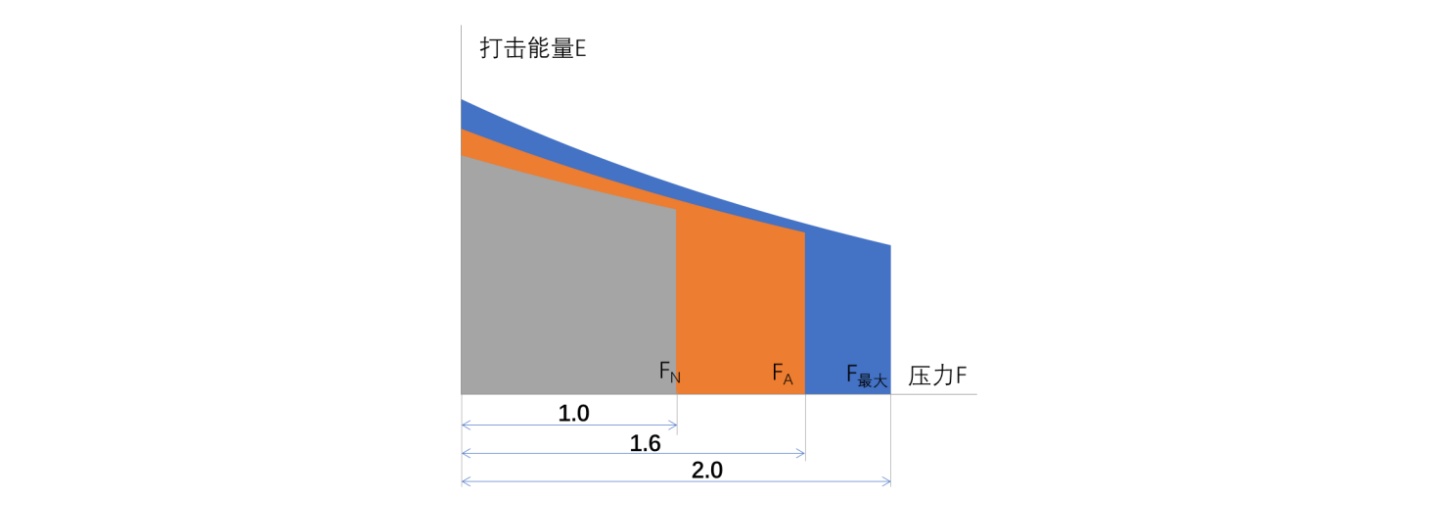
The presses built here reach a maximum pressure - the blue curve - of up to twice rated pressure, and the long-term allowable working pressure, the red curve, reaches 1.6 times rated pressure.
Two things carry it: the screw pair and the frame.
Purpose-written programming with precise position and speed feedback from the encoders, using the PLC's fast computation and the inverter's response, produced the press's short-stroke strike function. It keeps striking frequency high even at low energy settings, which saves time and lifts output.
Striking energy is relatively large and slide speed stays consistent, which is what suits forgings with deep die cavities.
A long slide, long guideways and a robust screw together give high resistance to eccentric load. That makes the press usable where loading is off-centre to some degree, and it carries multi-cavity forging in both pre-forging and precision forging.
The system covers operational status control, comprehensive efficiency evaluation, operation and maintenance information, maintenance cycle management, historical alarm records and document queries. It delivers three things:
Put to work, those three functions are predictive (production changes forecast from periodic capacity statistics), decision-supportive (equipment utilisation optimised against consumption statistics to cut wasted energy) and preventive (unplanned downtime from equipment failure minimised).
With 70 years of experience manufacturing forging equipment and serving the forging industry, AYANK FORGING has a professional design and installation team and advanced processing equipment. Every fundamental component of the screw press is designed and machined in house, which is the guarantee behind product stability and dependability.

Presses of 1,600 tons and below use a one-piece monoblock frame. From 2,500 tons up, the frame is a split pre-stressed design. The material is ZG270-500, normalised after casting, and the design is optimised by finite element analysis so the structure meets both strength and rigidity requirements.
Machining: all frame machining is completed in house. To guarantee machining accuracy - particularly the positional tolerance of the working surfaces that forging geometrical precision depends on - every relevant machining operation on a frame is completed in a single setup, using the rotary function of the machining platform.
Inspection: after machining, all machined surfaces and primary load-bearing surfaces undergo non-destructive testing (NDT), so nothing with a defect goes on to delivery and installation. Geometric tolerances are then verified with laser measuring equipment.
The slide is cast from the same ZG270-500 and normalised. It carries X-type long-stroke guideways, which give accurate guidance and strong resistance to eccentric load, and the guideways are adjusted by a wedge block structure with set bolts.
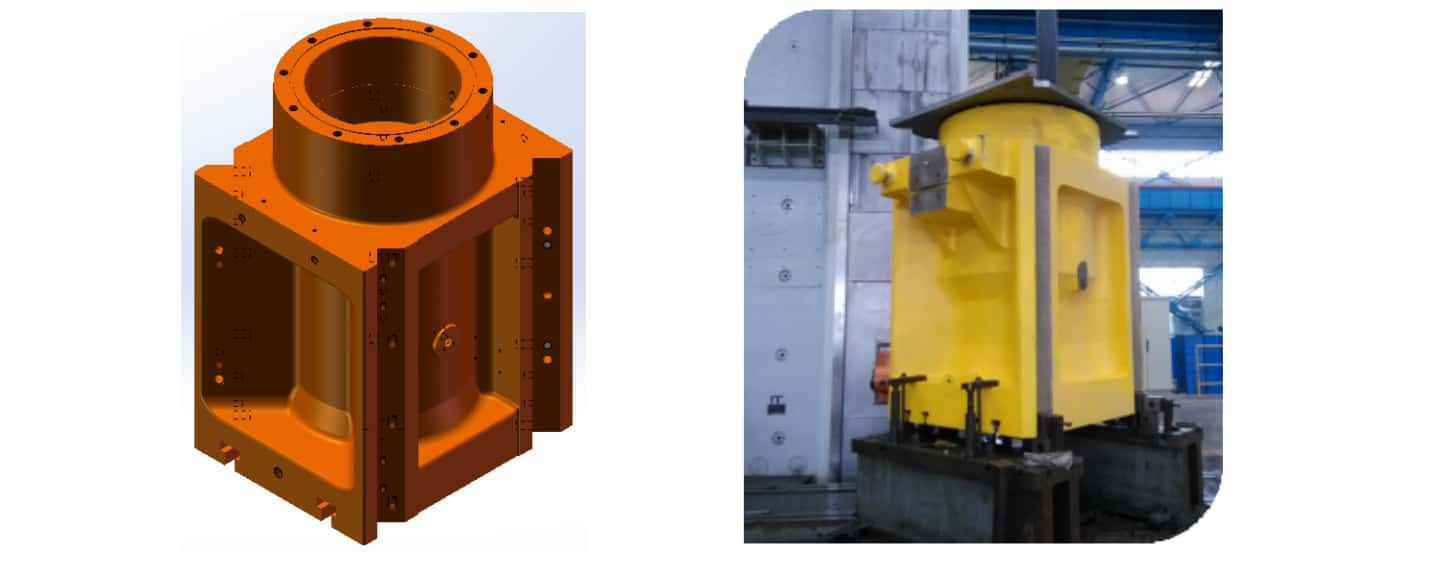
Machining: TJK6920 CNC boring and milling machines and TK42200 CNC gantry boring and milling machines do the work. To hold the flatness of both the guideway surfaces and the die contact surface, the machined guideways are hand-scraped.
Precision assurance: once machining is complete, all machined surfaces and primary load-bearing surfaces undergo non-destructive testing, so components reach delivery free of defects.
The main nut is centrifugally cast from ZCuZn25Al6Fe3Mn3, chosen for its wear resistance. The main screw is forged from 35CrMoV, with an optimised thread profile that gives high strength and low frictional resistance.
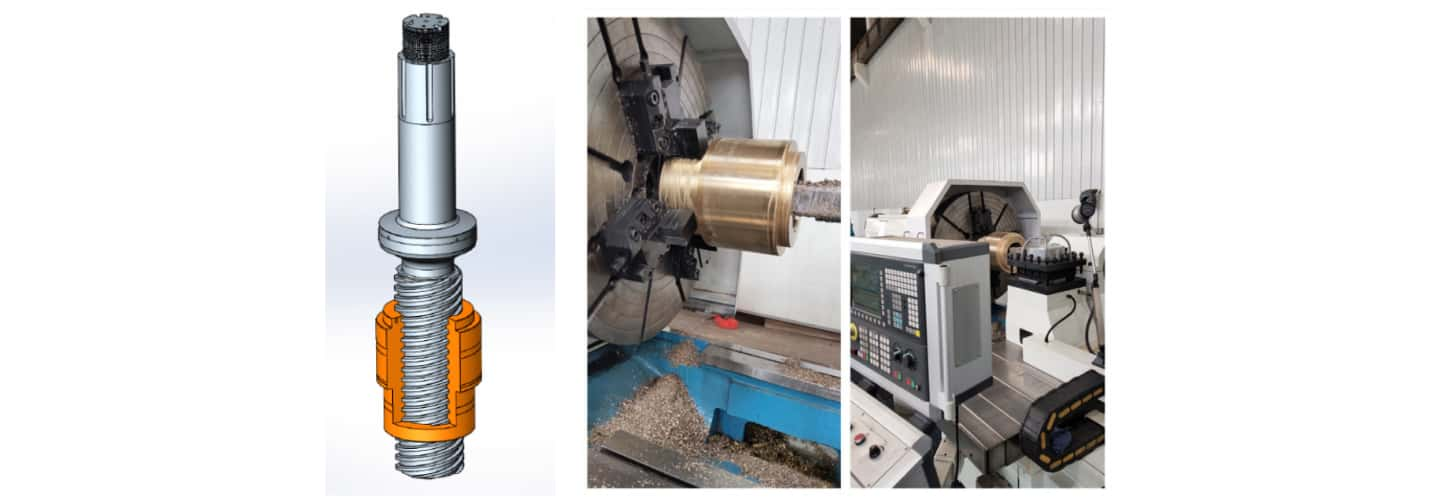
Machining and quality assurance: both screw and bronze nut are turned on CNC lathes. Once fitted to the machine, and before the press goes to the customer, the pair runs a 100-hour running-in test. That lets the mating surfaces wear in and reach working condition, so the press arrives stable, smooth and reliable.
The electrical system is built around an ABB frequency conversion cabinet, a Siemens PLC and an HMI operator panel. Four screens carry the work:

The motor is a purpose-designed AC asynchronous unit with 180° symmetrical mounting, which spreads force evenly across the flywheel and prevents uneven wear in the drive components. The pinion is polymer, for high strength at low inertia, and it couples to the motor shaft through a sliding friction connection that protects the motor when striking force overloads.
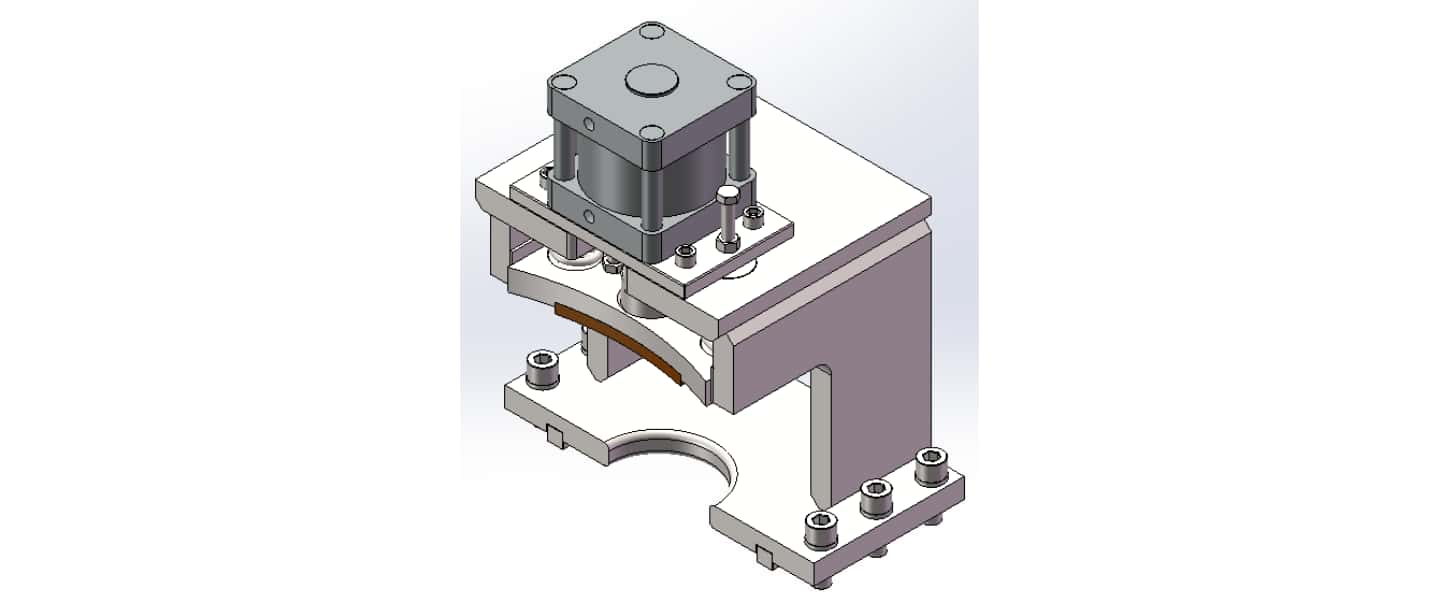
The brake also uses 180° symmetrical layout and sits above the flywheel. It stops flywheel and slide when required, and it prevents the slide from descending under its own weight.
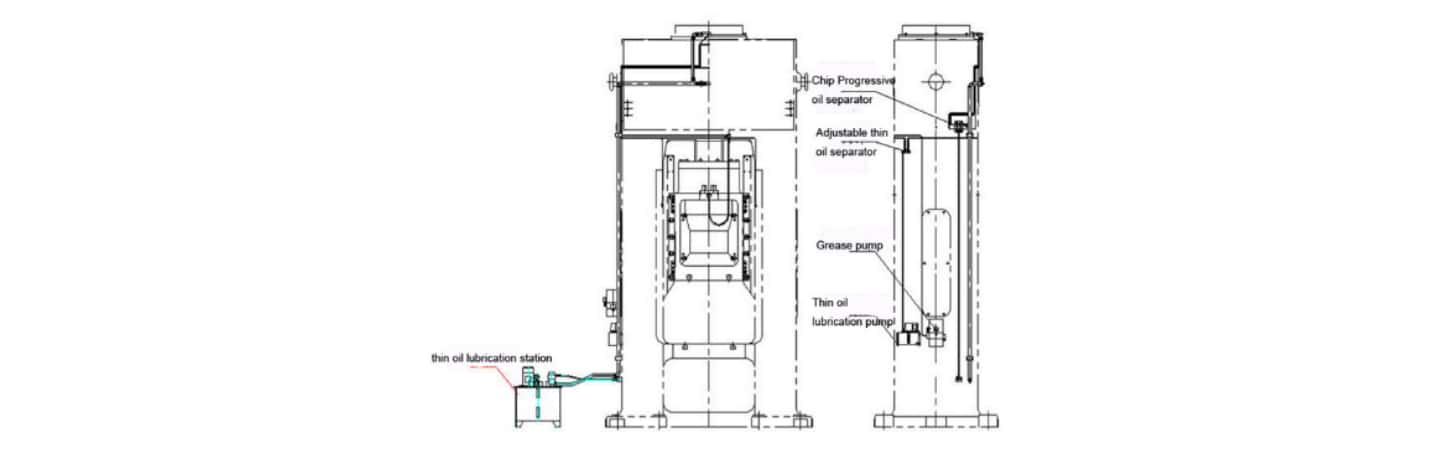
Lubrication comes from a centralised station, split by what it serves:
The Siemens S7-200 SMART PLC offers two routes to a host system:
With that spread of options, the protocol that fits a given automated line can be selected and implemented against its requirements. How those interfaces are put to work on a running line is described in the automated forging production line guide.
Communicating with an industrial PC and using the relevant PLC modules, the system collects, displays, analyses and reports actual operating data:
With a remote control and monitoring module, carried over an encrypted S-Line network connection, the machine can be diagnosed and watched from a distance:

Against a traditional hydraulic press, the variable frequency drive gives fast system response, short cycle times, a rapid operating rhythm and high impact frequency, which suits both small and medium batches and larger runs.
Electrical energy is used efficiently because gear transmission beats friction drive, and the motor runs only while it is working, so there is no no-load rotation to pay for.
The electric screw press is a new generation of intelligent equipment for the forging industry. It is versatile, structurally simple, easy to adjust and maintain, and because the slide has no fixed bottom dead centre, die design is easier. It produces high-accuracy forgings and suits precision forging, coining, sizing and straightening of steel, aluminium and other alloys, in both hot forging and precision forging or sizing. Typical J58KA electric screw press applications by industry are listed separately; the industries themselves are these:
The company is certified to ISO 9001:2015 for quality management and ISO 14001:2015 for environmental management. A dedicated quality control team runs a strict regime across the whole process: raw material intake, machining, parts warehousing, assembly, testing, painting and dispatch.
On every electric screw press, the critical components - frame, slide, flywheel and screw - undergo non-destructive testing at each manufacturing stage, starting from the rough casting or forging, which is how potential defects are eliminated rather than discovered later.
The matching nut and screw are machined on the same CNC lathe with an identical program, so the pair fits as intended.
Major stress points on the frame are inspected by NDT before final assembly, so structural integrity is verified rather than assumed.
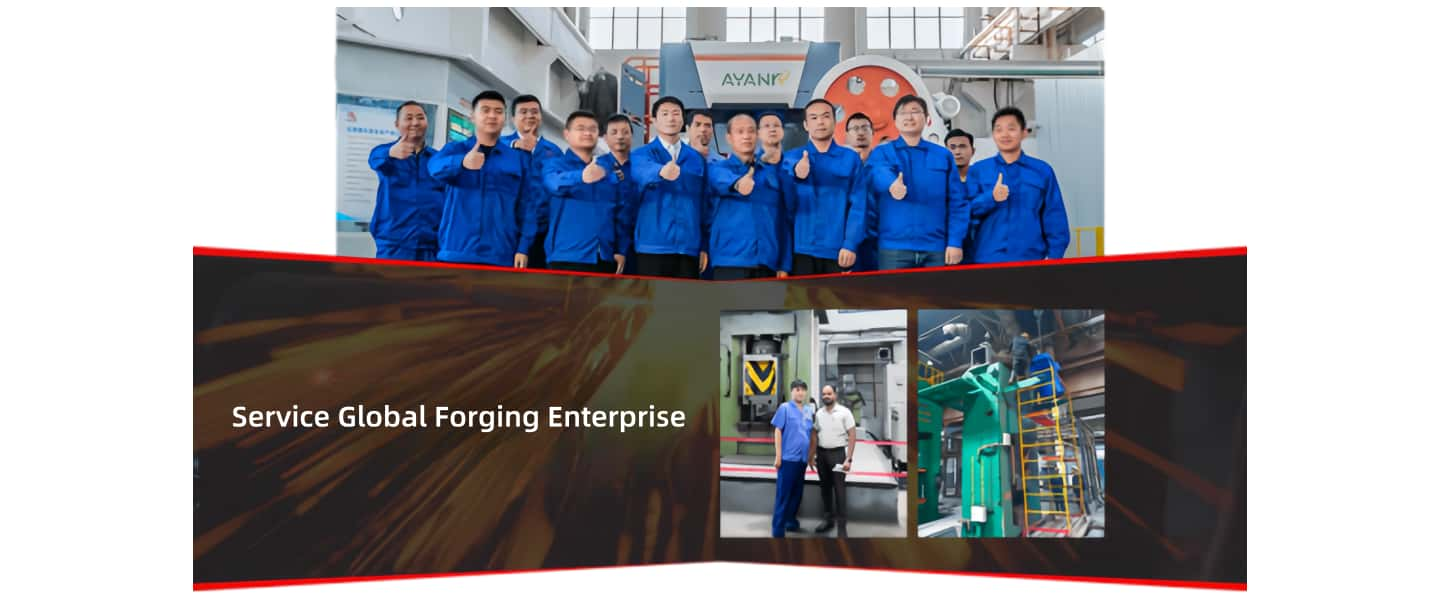
On the principle of winning customers with quality and expanding markets with credibility, AYANK FORGING engineers analyse what the customer needs and recommends either a suitable model or an economical, efficient process solution. The recommendation comes with the performance characteristics of the selected machine set out plainly, so the choice is made on facts.
Contract terms are followed as written and production progress is reported continuously, with every manufacturing step under control so that a high-quality machine arrives on schedule.
A dedicated team covers on-site unpacking and parts verification, installation and commissioning, technical training, and problem resolution, with the customer's need first at each step. Technical guidance is free for the life of the machine.
The service hotline runs 24/7. On quality feedback, AYANK FORGING proposes a course of action within 24 hours and sends personnel to site within 72 hours. Cause analysis and responsibility are settled once normal operation is restored.
Seventy years of service to the forging industry means these machines have been validated in the field. If a product shows an abnormality within the 12-month warranty period under normal operating conditions, AYANK FORGING repairs or replaces it and supplies the maintenance knowledge that goes with it.
A forging screw press holds its accuracy only as long as four clearances stay inside tolerance. Measure them on a fixed schedule, not after a fault appears:
Around those sit the items that are easiest to neglect: the 68# guideway oil in the thin-oil station, the 00# lithium-based grease in the lubrication pump, and the two flywheel oil cups that take grease once a quarter. The complete electric screw press maintenance routine - pre-run preparation, operating limits, mechanical tolerances, and the electrical and sensor checks - is set out section by section on its own page, together with the 10,000-cycle fastener inspection.
Because drive type changes what a tonnage figure actually means, model sizing is set out separately in electric screw press machine selection, which puts the energy path, the drive comparison and the tonnage range on one page.
Nominal force sets the projected area you can forge, stroke number sets output per hour, and worktable size sets the largest die you can mount. With eleven models from 250 T to 10,000 T, a recommendation starts from your forged-part drawing, the material, the part weight and the output you need per shift.
Presses of 1,600 tons and below use a one-piece monoblock frame. From 2,500 tons up, the frame is a split pre-stressed design. Both are cast in ZG270-500 and normalised, and the design is optimised by finite element analysis.
Maximum pressure reaches up to twice rated pressure, and the long-term allowable working pressure reaches 1.6 times rated pressure. A slip-type safety mechanism caps the maximum striking force at twice nominal pressure.
Typically 50 to 55 percent, because gear transmission is more efficient than friction drive, the friction discs are gone, and the motor runs only while it is working rather than idling.
Thrust bearing axial clearance at 0.7 mm maximum, guideway composite clearance at 0.4 to 0.6 mm, gear backlash between the large and small gears at 0.5 to 0.7 mm, and brake lining gap at 2 to 3 mm. Measure them on a fixed schedule rather than after a fault.
The warranty runs 12 months under normal operating conditions. The service hotline operates 24/7, a course of action is proposed within 24 hours of quality feedback, and personnel are sent to site within 72 hours. Technical guidance is free for the life of the machine.

Send your forging drawing or part details — we will recommend the machine that fits and quote it.
Receive the news that you are interested in.
