I. Introduction to Multi-Directional Forging Hydraulic Presses
II. Working Principle of the Multi-Directional Forging Hydraulic Press
III. Characteristics of the Multi-Directional Forging Hydraulic Press
IV. Multi-Directional Die Forging Hydraulic Press Selection Process
V. Multi-Directional Die Forging Process Validation
VI. Industries Applicable for Multi-Directional Die Forging Hydraulic Presses
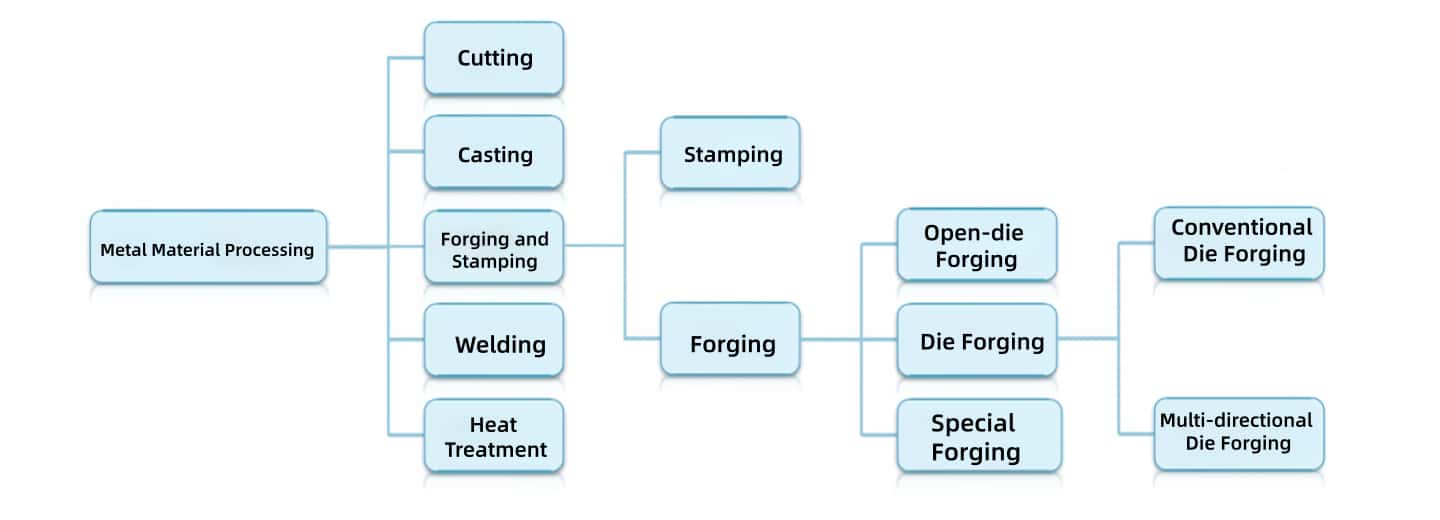
Multi-directional die forging technology refers to a technique that uses separable dies to obtain flash-free forgings with little or no draft angle in a single stroke of a multi-directional die forging press. It is a specialized process performed on a multi-directional die forging hydraulic press, where a heated blank is transformed into a complex, multi-directional cavity forging that is flash-free and has no (or minimal) draft angle in a single press stroke, utilizing multi-partition die assembly forging dies.
Multi-directional die forging is a combination of extrusion and die forging, incorporating the advantages of both processes. It significantly enhances metal plasticity, facilitates the forming of hard-to-deform alloys with narrow forging temperature ranges, and promotes the healing of material defects. Consequently, the resulting forgings exhibit a denser microstructure and superior mechanical properties. Compared to other machining methods, it offers the following characteristics:
1、Produces forgings that are flash-free and draft-free, enabling near-net shape forming and precise shape control.
2、Capable of forging parts with more complex geometries and higher dimensional accuracy, including intricate shapes with multiple branches, bosses, and internal cavities.
3、The metal grain flow follows the contour of the forging, preventing the exposure of flow line ends and thereby improving resistance to stress corrosion.
4、Enables precision forming, achieving energy savings of 20-35%, material savings of 20-35%, and reduced forging costs.
5、Facilitates force-saving forming, allowing larger parts to be produced on smaller equipment. The forming equipment features lower tonnage requirements, a flexible structure, and lower overall investment. The number and layout of hydraulic cylinders can be flexibly configured according to process needs.
6、A single heating of the blank and a single press stroke reduce the burning loss of valuable materials, surface decarburization, and depletion of alloying elements in the forging. It is a single-station, multi-pass forming process, making it easy to automate.
7、The part cavity is composed of multiple die components. The core die structure is simple, allowing for easy replacement and maintenance.
Shortcomings:
The forging process is relatively complex. Process parameters differ for various parts, making process design challenging and requiring support from a capable technical R&D team.
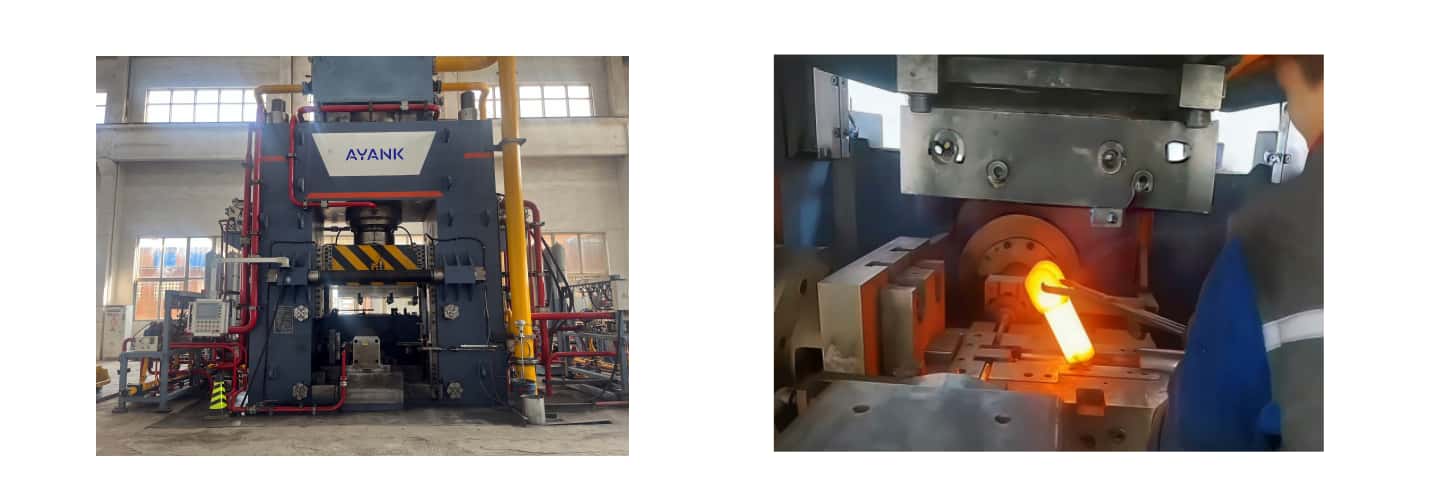
The AYANK FORGING Y16A series flexible multi-directional die forging hydraulic press is a new-generation intelligent multi-directional forging and forming equipment—an advanced forging center that integrates data acquisition, visual inspection, and intelligent control. It features enhanced structural rigidity and guidance accuracy, a large mold and operating space, and fast loading speeds. Equipped with an intelligent detection and control system, it digitally controls the sequence and speed of movements in all directions, achieving excellent synergy. This system not only enables the direct forging of convex and concave holes in various directions of the workpiece but also significantly improves the mechanical properties of the material. The press offers advantages such as high precision, strong stability, rapid forming, high efficiency, superior mechanical properties of forgings, and material savings.
Advantages and Disadvantages of Conventional Multi-Directional Die Forging Hydraulic Presses
During multi-directional die forging, two or more punches (or punch cores) apply pressure to the blank from different directions, either simultaneously or sequentially, for extrusion or upset-extrusion forming. The main process advantages are as follows:
1、Capable of forming complex die forgings with internal multi-directional cavities and external convex/concave variations.
2、High internal quality of forgings. Since most forging shapes are formed by die forging, the fiber structure follows the forging contour under triaxial compressive stress, resulting in excellent mechanical properties—typically increasing strength by over 30%.
3、Forgings are flash-free. Compared to open-die forging, material utilization is higher. Forgings can be designed as hollow, and draft angles for piercing can be eliminated or minimized, reducing 4、subsequent machining. This saves 30%-50% of metal, shortens manufacturing cycles, and improves production efficiency.
5、Suitable for forming high-alloy steels and special alloys. The blank deforms under triaxial compressive stress, enhancing its process plasticity and greatly facilitating the forming of materials with poor plasticity and narrow forging temperature ranges. The application of multi-directional die forging extends to materials with narrower temperature ranges and lower plasticity. Such materials might develop cracks leading to scrap in conventional forging due to tensile stress states. However, in multi-directional die forging, the blank is always under intense triaxial stress, resulting in higher metal plasticity, enabling even hard-to-deform metals to undergo forging deformation.
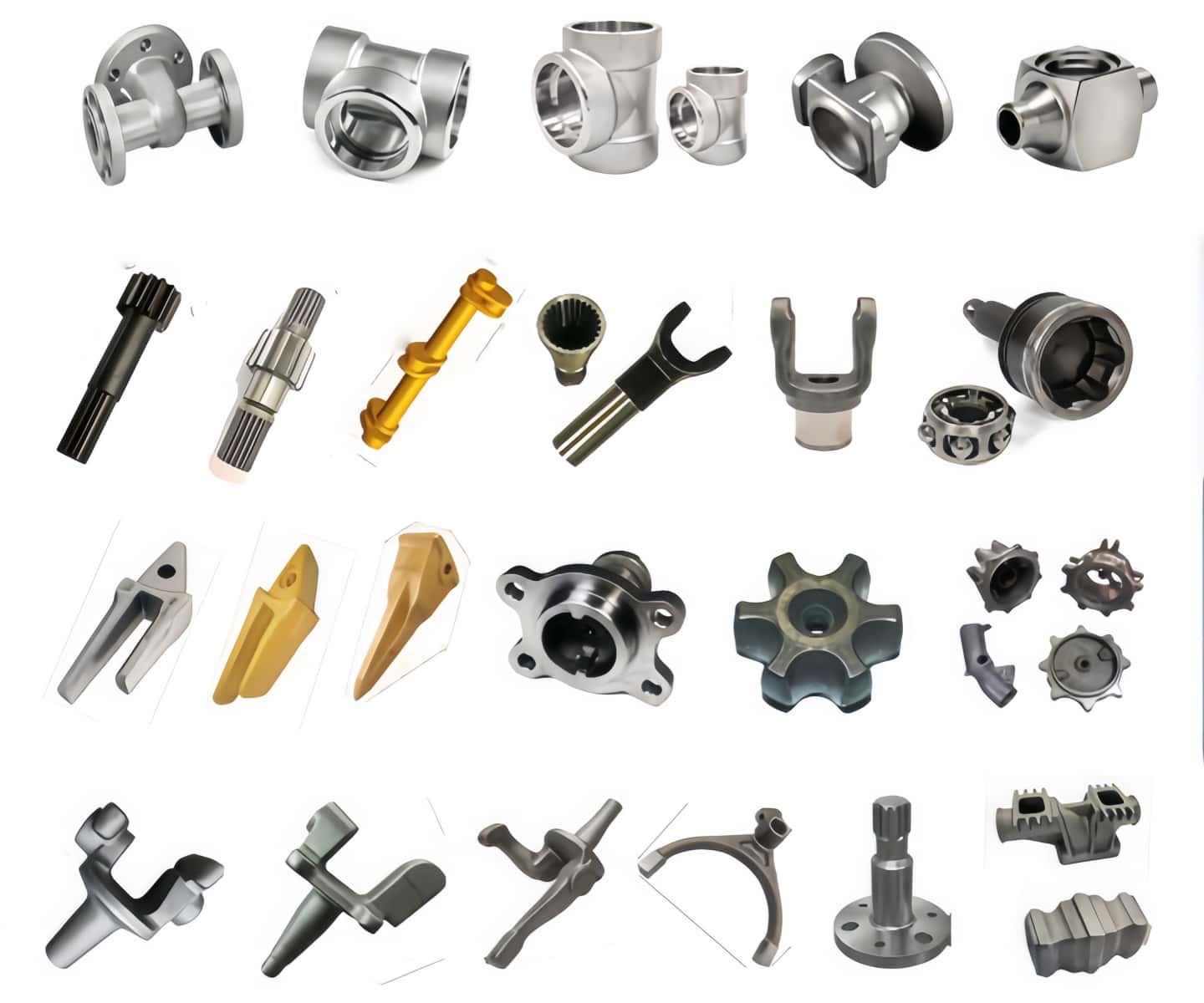
5、Wide applicability. It can be used for various types of hollow frame structures, solid and hollow branched forgings, fork-shaped forgings, cylindrical parts, various valve bodies, pipe fittings, and shaft-type forgings made from different alloys.
Shortcomings:
The forging process is relatively complex. Processes and parameters vary for different parts, making process design challenging and requiring a strong technical R&D team for support.
Compared to conventional multi-directional die forging hydraulic press production lines, the flexible multi-directional die forging hydraulic press and production line developed by AYANK FORGING have the following features:
Versatility: Multiple forging directions. Currently developed for up to 9 directions, allowing complex forgings to be formed in one operation or sequentially from 9 directions.
Flexibility: Different forming processes can be programmed for different forgings. Servo proportional valves and electric PLC control enable the setting of any sequence and speed for movements in various directions, ensuring adaptability to different forgings.
Rapidity: Utilizes high-flow piston pumps, servo proportional valves, and accumulators to ensure maximum speed for forging forming, resulting in high efficiency. Additionally, due to the short forming time, die life is multiplied compared to conventional multi-directional die forging.
Precision: Forming cylinder control employs servo proportional valves and magnetostrictive sensors for precise piston rod positioning, achieving multi-directional precision forming.
Stability: High structural rigidity, excellent guiding accuracy, strong resistance to eccentric loading, and good product consistency.
Intelligence: The entire production line is equipped with KUKA robots for automatic loading and unloading. After forging, a vision system performs precise dimensional and quality inspections. The line includes various data acquisition devices to ensure smooth "intelligent" production.
Forging Design
Forging Forming Scheme
For multi-directional die forging, the external shape of the forging is primarily determined by the cavity after die closure. The forming mainly relies on the different action sequences of the various punches to complete.
Forging Numerical Simulation Analysis
Forging External Shape Filling Quality
During the multi-directional die forging process, the primary objectives are to ensure the forging is fully formed with minimal or no flash/burrs, and secondly, to avoid defects like cracks or folds that affect forging performance.
Trial production was conducted on a multi-directional die forging production line. The process flow was: Blank preparation → Blank heating → Die preparation → Multi-directional die forging forming → Non-destructive testing → Heat treatment → Inspection.
The blank specification was φ82mm × 457mm, heated to 1150°C, using a water-based graphite lubricant. Trial production was carried out according to the simulated scheme. The trial forging product, as shown in the figure, exhibited good external forming, full filling, and no defects such as folds or cracks.
Suitable for forming various complex die forgings and special alloys, such as: hollow frame structures, solid and hollow branched forgings, fork-shaped forgings, cylindrical parts, various valve bodies, pipe fittings, shaft-type forgings, etc. Widely used in industries including aerospace, thermal power, nuclear power, petrochemical equipment, automotive, shipbuilding, and rail transportation.

Receive the news that you are interested in.