I. Introduction to the C41A Series Pneumatic Forging Hammer
II. Product Definition and Working Principle
III. Core Advantages of AYANK FORGING Pneumatic Hammers
IV. Features and Application Scope of AYANK FORGING Pneumatic Hammers
V.Structure and Functions of Large Pneumatic Forging Hammers
VI.Maintenance and Care Instructions for Pneumatic Forging Hammers

Product Name: C41A Series Pneumatic Forging Hammer
AYANK FORGING Credentials: Possesses 70 years of continuous experience in manufacturing pneumatic forging hammers. Its pneumatic hammers have been awarded the China National Quality Award (Silver Medal), making it the sole manufacturer in China to receive this award for pneumatic hammers. AYANK FORGING participated in the formulation of Chinese National Standards for pneumatic hammers (GB/T 25720-2010, GB/T 25721-2010) and is a drafting unit for the Chinese National Standard for power hammers. Holds certifications such as FDA and CE.
Product Advantages:Stable, durable, easy to maintain; worry-free and highly efficient; comprehensive specifications covering various free forging needs for small and medium-sized forgings.
Specifications & Models:C41A Series, core specification range C41A 15kg-2000kg, comprising 13 models: C41A-15KG, C41A-25KG, C41A-40KG, C41A-55KG, C41A-75KG, C41A-110KG, C41A-150KG, C41A-250KG, C41A-400KG, C41A-560KG, C41A-750KG, C41A-1000KG, C41A-2000KG.
Key Large-Tonnage Product: C41A-2000kg Air Hammer
Global Reach: Products exported to 97 countries and regions including the USA, Germany, Japan, the United Kingdom, etc.
Parameter specification table
| item | unit | C41A-15L | C41A-25L | C41A-40L | C41A-55L | C41A-75L | C41A-110L | |
| Weight of falling part | kg | 15 | 25 | 40 | 55 | 75 | 110 | |
| Blow energy | kJ | 0.16 | 0.27 | 0.53 | 0.7 | 1 | 1.98 | |
| Max. blow frequency | min-1 | 300 | 250 | 245 | 230 | 210 | 180 | |
| Working area height | mm | 160 | 240 | 245 | 270 | 300 | 355 | |
| Distance from center line of hammer rod to frame |
mm | 170 | 235 | 270 | 300 | 330 | 400 | |
| Malleable blank |
Square | mm | 30×30 | 40×40 | 52×52 | 60×60 | 65×65 | 110×110 |
| Round | mm | Φ35 | Φ48 | Φ68 | Φ75 | Φ85 | Φ120 | |
| motor | Model | / | Y100L1-4-B3 | Y132S-6-B3 | Y132M1-6-B3 | Y160M-6 | Y132M-4 | Y180L-6-B3 |
| Power | kW | 2.2 | 3 | 4 | 7.5 | 7.5 | 15 | |
| Machine weight |
Frame | kg | 290 | 770 | 920 | 1380 | 2700 | 3300 |
| Steel Mount |
kg | 200 | 310 | 343 | 370 | |||
| Machine dimensions | mm | 1180*650*1575 | 1470*740*1835 | 1650*800*1920 | 1860*880*2100 | 1620*930*2220 | 1910*1070 *2382 |
|
| item | unit | C41A-150L | C41A-250B | C41A-400B | C41A-560B | C41A-750B | C41A-1000L | C41A-2000L | |
| Weight of falling part | kg | 150 | 250 | 400 | 560 | 750 | 1000 | 2000 | |
| Blow energy | kJ | 2.5 | 5.6 | 9.5 | 13.7 | 19 | 27 | 54 | |
| Max. blow frequency | min-1 | 180 | 140 | 120 | 115 | 105 | 95 | 80 | |
| Working area height | mm | 370 | 450 | 530 | 600 | 670 | 800 | 1000 | |
| Distance from center line of hammer rod to frame |
mm | 350 | 420 | 520 | 550 | 750 | 800 | 950 | |
| Malleable blank |
Square | mm | 130×130 | 145×145 | 220×220 | 270×270 | 270×270 | 290×290 | 350×350 |
| Round | mm | Φ145 | Φ175 | Φ240 | Φ280 | Φ300 | Φ320 | Φ400 | |
| motor | Model | / | Y180M-4 | Y180L-4 | Y200L-4 | Y280S-6 | Y280M-6 | Y315S-6 | Y315L2-6 |
| Power | kW | 18.5 | 22 | 30 | 45 | 55 | 75 | 132 | |
| Machine weight |
Frame | kg | 3260 | 5000 | 8000 | 9800 | 17000 | 20000 | 48000 |
| Steel Mount |
kg | 1500 | 2500 | 4800 | 6720 | 9000 | 12000 | 24000 | |
| Machine dimensions | mm | 2390*1085*2150 | 2700*1000*2540 | 3075*1100*2884 | 3480*1160*3157 | 3920*1370*3175 | 4300*1500*3652 | 5820*2140*4390 | |
II. Product Definition and Working Principle
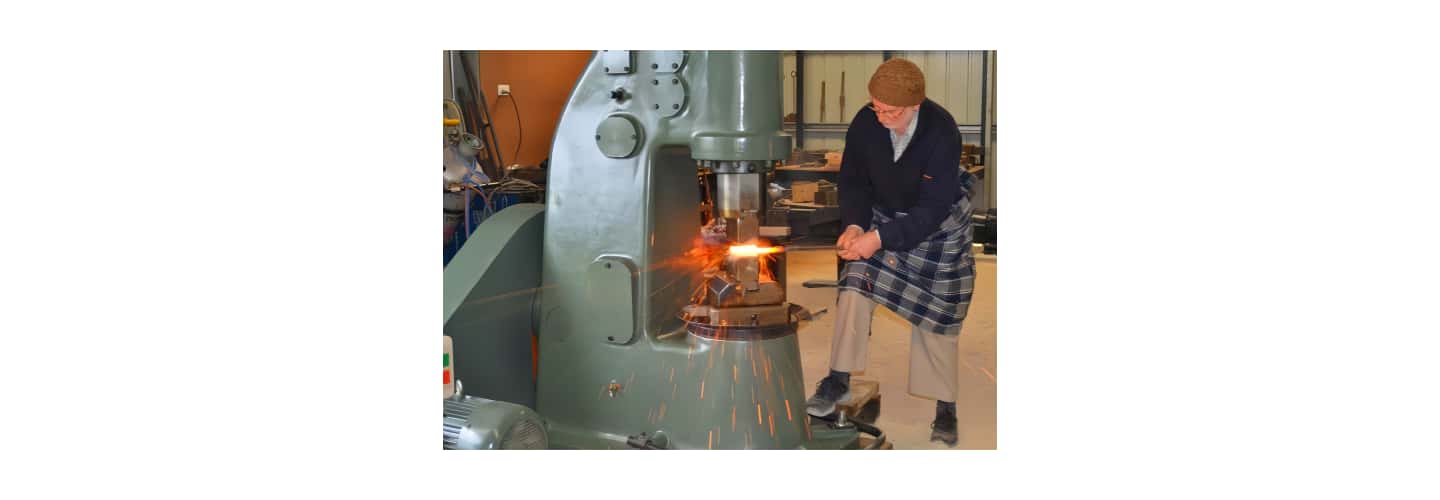
Product Definition: An air hammer is a type of free forging equipment capable of performing various striking actions. It is suitable for all kinds of free forging and, when used with bolster dies, can accomplish various open-die forging operations.
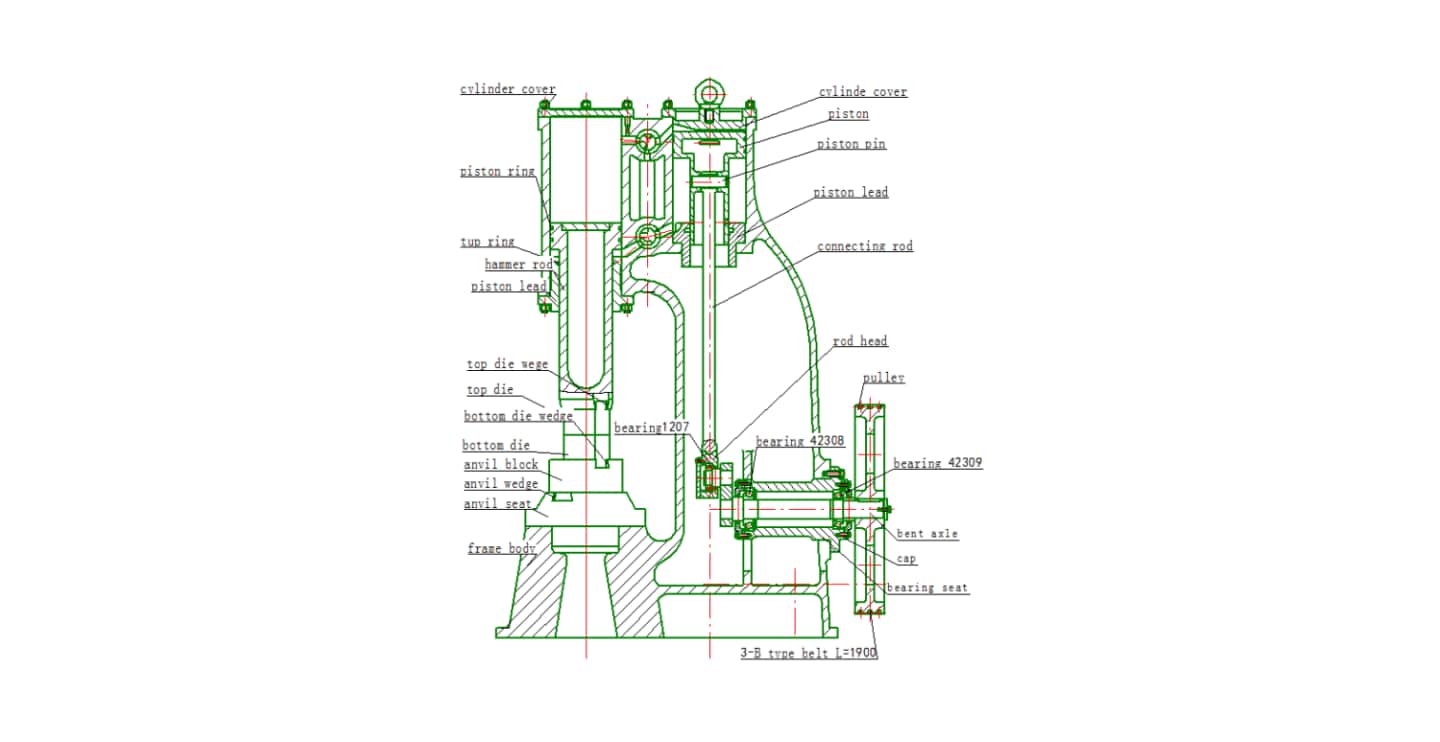
Working Principle: The motor drives the compressor piston in the compression cylinder to move up and down via a reduction mechanism, crankshaft, and connecting rod. The compressed air is then directed through a distribution valve into the working cylinder, pushing the piston and the hammer head to perform reciprocating up-and-down motions, thereby completing the striking action. Equipped with its own air compression mechanism, it starts simply by connecting to a power source. The transmission system is a two-stage design housed within an enclosed gearbox. During operation, lubricating oil inside the gearbox is splashed by the high-speed rotating gears to lubricate the transmission shaft and the bearings at both ends of the crankshaft. Additionally, a self-priming lubrication pump is included to provide automatic lubrication for the working and compression cylinders.
Equipment Composition: Consists of seven core sections: the frame section (frame, working cylinder cover, compression cylinder cover, etc.), the working section (hammer rod, hammer rod guide, upper and lower anvil dies, anvil cap, anvil block, etc.), the compression section (piston, piston guide, connecting rod, etc.), the transmission section (crankshaft, gears, transmission shaft, etc.), the control section (upper and lower valve cores, control handle assembly, etc.), the electrical section (starter, motor, etc.), and the foundation section (foundation bolts, base plate, etc.).
Specification Advantage: Full specification coverage from 15KG to 2000KG meets free-forging production needs in various scenarios.
Operational Advantage: Plug-and-play operation eliminates the need for additional air compression equipment. Flexible control adapts to all forging processes, allowing quick switching between forging modes.
Durability Advantage: High-rigidity frame (integral cast iron or cast steel structure) withstands intense impact forces. Key components (piston, hammer rod, cylinders, etc.) undergo strengthening treatment. The frame cylinders are precision-honed to reduce part wear, ensuring long equipment life. It is approximately 25% heavier than comparable hammers on the market, resulting in greater sturdiness, durability, and reliability.
Maintenance Advantage: Simple structure, stable performance, and low maintenance costs. Upgradeable to adapt to long-term production needs.
Cost-Effectiveness Advantage: High cost-performance ratio covers small to medium-scale forging needs comprehensively without requiring excessive additional investment.
Quality Advantage: A well-established quality assurance system includes on-site quality control points for key components and assembly processes, ensuring stable and durable product performance.
Safety Advantage: Equipped with a hammer-lifting safety device to prevent accidents from misuse. The electrical section includes phase-loss, short-circuit, and over-voltage protection to ensure normal equipment operation.
Warranty: One year of free warranty is provided. Ensures worry-free after-sales support.
Spare Parts: The factory maintains a comprehensive spare parts system, with an inventory of various parts, including those for pneumatic hammers, valued at approximately 100 million RMB, enabling rapid response to part requests.
Features of the C41A Series Pneumatic Hammer:
Structural Feature: Simple design uses an electric motor as the power source, driving the compressor piston via a crank-connecting rod mechanism to generate compressed air, which in turn drives the working piston and hammer head. It contains no complex redundant structures.
Operational Feature: Convenient, flexible, and easy to control. By manipulating the hand lever or foot pedal to change the position of the upper and lower valve cores, the flow path of compressed air is controlled to achieve idling, hammer lift, continuous striking, single striking, and pressing actions. It allows flexible control over striking energy (light, continuous, or heavy blows) and rhythm, clearly distinguishing between light and heavy blows, making it suitable for various manual free-forging processes.
Applicability Feature: Wide applicability range. Capable of performing multiple forging processes such as upsetting, drawing out, punching, bending, twisting, hot shearing, and forge welding. Suitable for production scenarios involving multiple product types and small batch sizes.
Performance Feature: Stable performance, fast forging frequency, controllable striking energy, stable equipment operation, and low failure rate.
Application Scope of the C41A Pneumatic Hammer:
Core Forging Processes: Suitable for various free-forging operations including drawing out, upsetting, punching, shearing, forge welding, twisting, and bending. It can perform various open-die forging operations when used with dies.
Specification Classification and Uses:
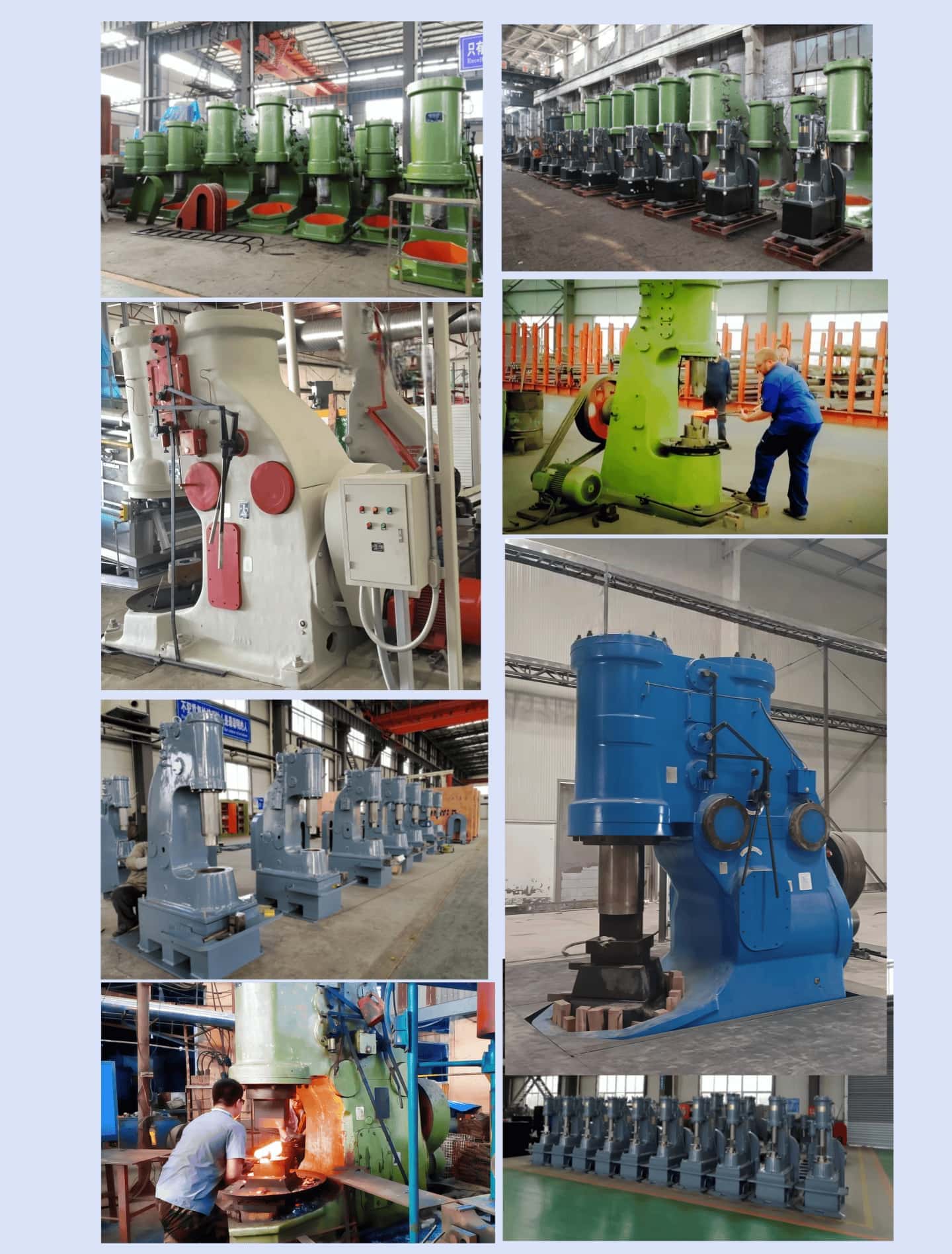
Small Air Hammers (15KG, 25KG, 40KG, 55KG, 75KG, 110KG): Primarily used for artistic iron forging.
Large Air Hammers (150KG, 250KG, 400KG, 560KG, 750KG, 1000KG, 2000KG): Primarily used for industrial forging.
Suitable Production Scenarios: Widely applicable for producing a variety of free-forged parts in small batches, as well as for scenarios like the finishing of steel balls. Adapts to the production needs of various forging workshops.

A large pneumatic forging hammer mainly consists of the frame, transmission mechanism, compression cylinder and working cylinder, compression piston, falling parts, air distribution mechanism, and anvil block.
1、Frame: The main body of the hammer, which compactly integrates the transmission, working, and control mechanisms mounted on it.
2、Transmission Mechanism: Includes the pulley, gearbox, crankshaft, and connecting rod system. It converts the motor's rotary motion into the reciprocating up-and-down motion of the compression piston.
3、Compression and Working Cylinders: Their upper and lower parts are connected to the upper and lower rotary valves. The up-and-down motion of the compression piston generates compressed air to drive the working piston.
4、Falling Parts: Comprise the working piston, hammer rod, and upper anvil. The hammer rod and working piston are an integrated unit, often made hollow to meet specified weight requirements. The hammer rod connects to the hammer head via a dovetail groove and wedge.
5、Air Distribution Mechanism: Consists of the upper valve, lower valve, operating hand lever, or foot pedal lever. It controls the execution of various operations.
6、Anvil Block: Supports the anvil cap and lower anvil die. For forging stability, the anvil block's mass should be 12-15 times that of the falling parts. It is mounted on a solid reinforced concrete foundation with cushioning timber in between to absorb shock vibrations during striking.
To ensure long-term service for all users, AYANK FORGING recommends the following maintenance practices for your pneumatic forging hammer:
1、Constantly monitor the oil level in the gearbox beneath the piston cylinder to ensure gears are lubricated during operation.
2、Use appropriate lubricating oil. Ordinary engine oil suffices; it need not be expensive. Select oil with suitable viscosity according to temperature changes.
3、Always ensure the oil pump contains an adequate amount of oil, with the level not below the lower mark. Before starting the hammer, operate the oil pump handle ten 4、times to pump oil into the cylinder. This significantly reduces wear during startup.
5、Regularly check the oil circuit for leaks by observing oil droplets from the oil cup atop the oil pump.
6、Before forging, inspect all parts such as the anvil dies and guides for any looseness.
After forging, re-check all exposed bolts and tighten any that are loose.
7、Depending on usage, it is generally recommended to change the gearbox oil every 3 to 6 months.
Air Hammer to Electro-Hydraulic Hammer Conversion Service:
Suitable Models: 250kg to 2000kg pneumatic hammers.
Conversion Solution:Utilizes the original air hammer foundation and frame, integrated with an electro-hydraulic hammer power system.
Conversion Advantages:Low investment, high cost-effectiveness; upgrades equipment grade; eliminates oil fumes and reduces noise, improving the working environment; increases striking energy by approximately 10%; offers stable comprehensive performance, reducing maintenance frequency and costs.
Upgrade Option:Can be simultaneously upgraded to an electronically controlled automatic striking electro-hydraulic hammer, enabling coordinated electronic control of strikes with a manipulator, allowing a single operator to perform all hammer actions.
Spare Parts and After-Sales Maintenance Service:
Spare Parts Supply:Stocks over a hundred types of common forging parts for quick response to spare part demands, ensuring equipment uptime.
After-Sales Team:Possesses a professional after-sales service team providing worry-free and efficient maintenance services to ensure prompt fault resolution.
Service Guarantee:Full-process follow-up on equipment usage, providing technical support.
Receive the news that you are interested in.