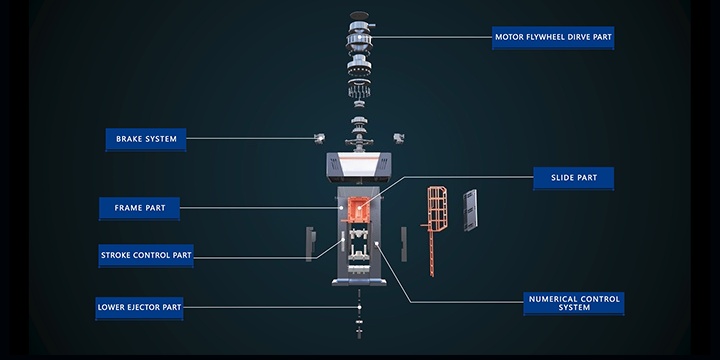
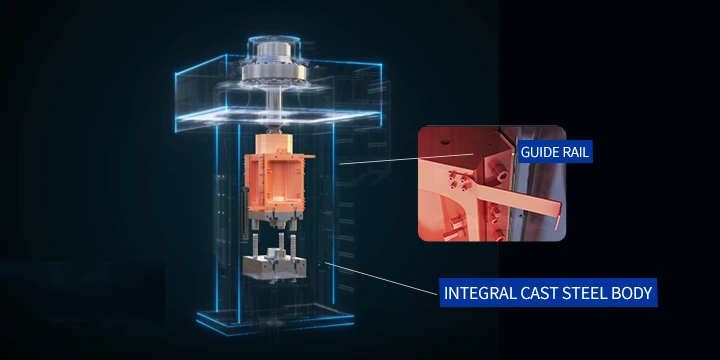
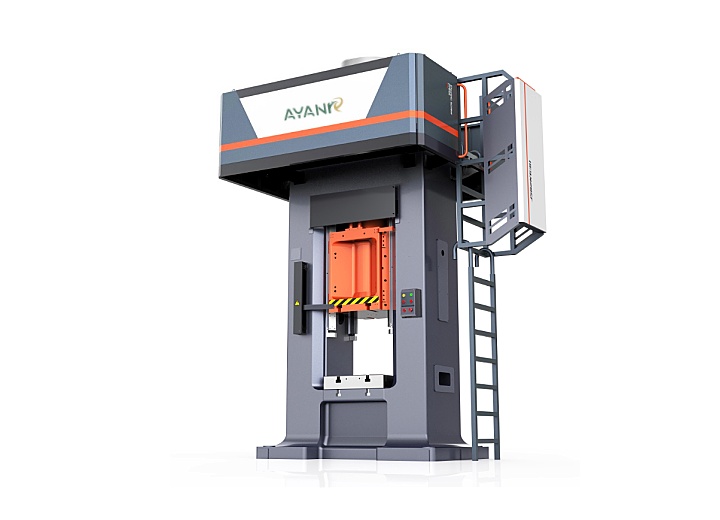
Product parameters
| item |
unit |
J58KA-250 |
J58KA-315 |
J58KA-400 |
J58KA-630 |
J58KA-1000 |
J58KA-1600 |
J58KA-2500 |
J58KA-4000 |
J58KA-6300 |
J58KA-8000 |
J58KA-10000 |
| Nominal force |
kN |
2500 |
3150 |
4000 |
6300 |
10000 |
16000 |
25000 |
40000 |
63000 |
80000 |
100000 |
| Maximum allowable working force |
kN |
4000 |
5000 |
6300 |
10000 |
16000 |
25000 |
40000 |
64000 |
100000 |
125000 |
160000 |
| Slide stroke H0 |
mm |
320 |
380 |
400 |
450 |
500 |
600 |
650 |
750 |
850 |
850 |
1000 |
| Stroke number |
min-1 |
28 |
26 |
24 |
20 |
18 |
16 |
14 |
12 |
10 |
9 |
8 |
| Min. die height H |
mm |
500 |
550 |
570 |
720 |
750 |
960 |
1050 |
1510 |
1720 |
1800 |
2160 |
| Thickness of table plate h |
mm |
120 |
120 |
120 |
160 |
200 |
220 |
250 |
310 |
320 |
320 |
360 |
| Worktable size (F*BxL*R) |
mm |
560*600 |
640*700 |
730*750 |
900*820 |
1050*920 |
1280*1000 |
1400*1200 |
2200*1680 |
2200*2000 |
2400*2200 |
3000*2400 |
| Slider bottom size(F*B x L*R) |
mm |
560*560 |
620*654 |
730*630 |
870*710 |
1020*850 |
1280*968 |
1560*1110 |
2000*1500 |
2100*1750 |
2200*2000 |
2800*2000 |
*Note:Above parameters are standard parameters and no announce if there are any changes.
Choosing the J58KA Tonnage
Each block below is the frame size, the die envelope it accepts, and the one thing that changes at that step.
J58KA-250 — 250 Ton Electric Screw Press
2,500 kN nominal · 4,000 kN max · 560 × 600 mm table · 500 mm shut height · 28 strokes/min
The smallest frame in the range. A 500 mm shut height leaves little room for a tall die, so it suits short-stroke coining and trimming where the die block stays inside the table.
J58KA-400 — 400 Ton Electric Screw Press
4,000 kN nominal · 6,300 kN max · 730 × 750 mm table · 570 mm shut height · 24 strokes/min
The step up from 250 t buys table area and stroke length as much as force, which is what allows a larger die block at the same stroke rate.
J58KA-630 — 630 Ton Electric Screw Press
6,300 kN nominal · 10,000 kN max · 900 × 820 mm table · 720 mm shut height · 20 strokes/min
Table plate thickens from 120 mm to 160 mm at this size, which is where a heavier die set starts to sit properly on the frame.
J58KA-1000 — 1,000 Ton Electric Screw Press
10,000 kN nominal · 16,000 kN max · 1,050 × 920 mm table · 750 mm shut height · 18 strokes/min
The same 750 mm shut height as the 630 t, with a wider table, a 200 mm plate and more force behind the die.
J58KA-1600 — 1,600 Ton Electric Screw Press
16,000 kN nominal · 25,000 kN max · 1,280 × 1,000 mm table · 960 mm shut height · 16 strokes/min
Shut height jumps to 960 mm here from 750 mm, which is the size that takes a tall die the smaller frames cannot.
Above 1,600 t the table and the shut height scale with the die rather than the force: 2,200 × 1,680 mm at 2,500 t, 2,200 × 2,000 mm at 6,300 t and 3,000 × 2,400 mm at 10,000 t, with minimum shut heights from 1,510 mm to 2,160 mm.
A Finished J58KA-400 Before Delivery
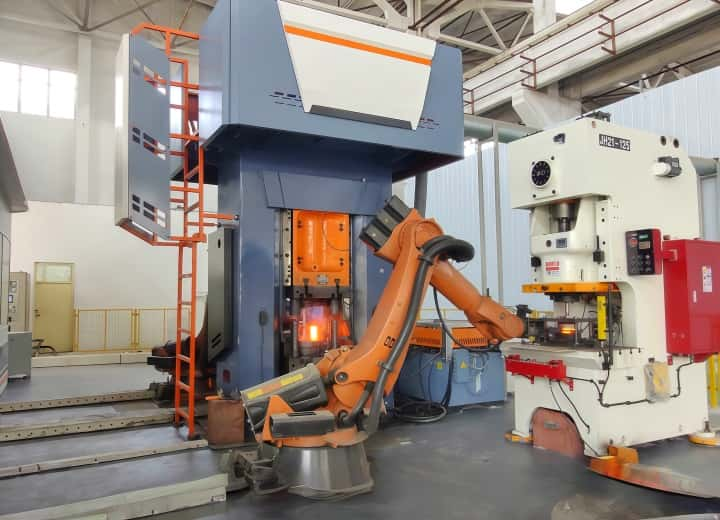
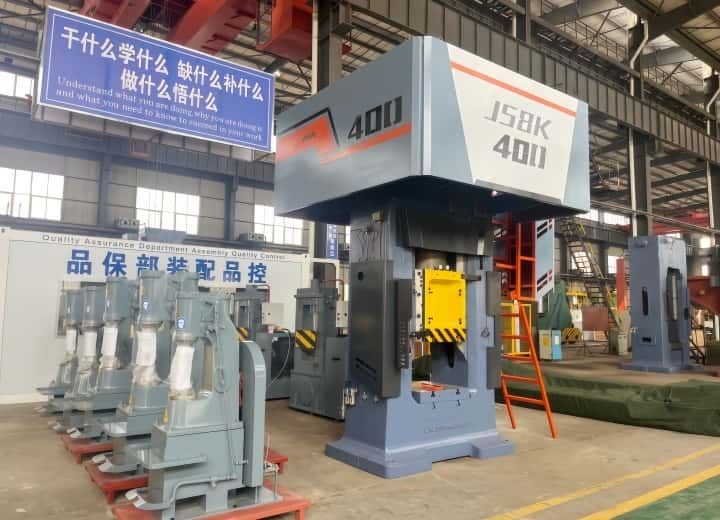
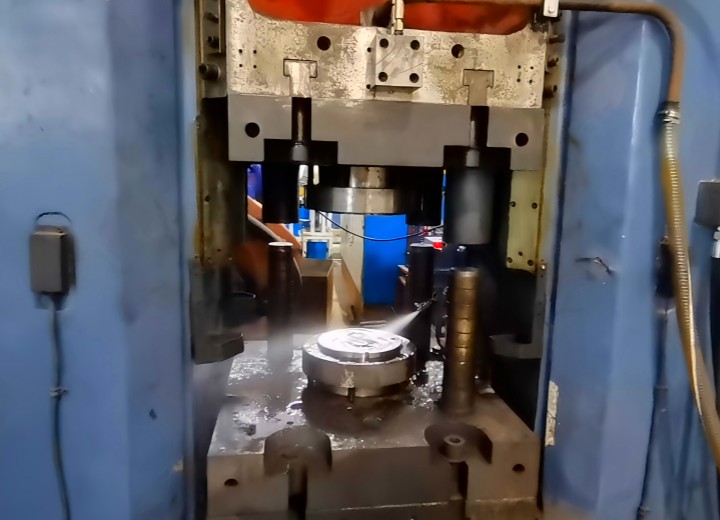
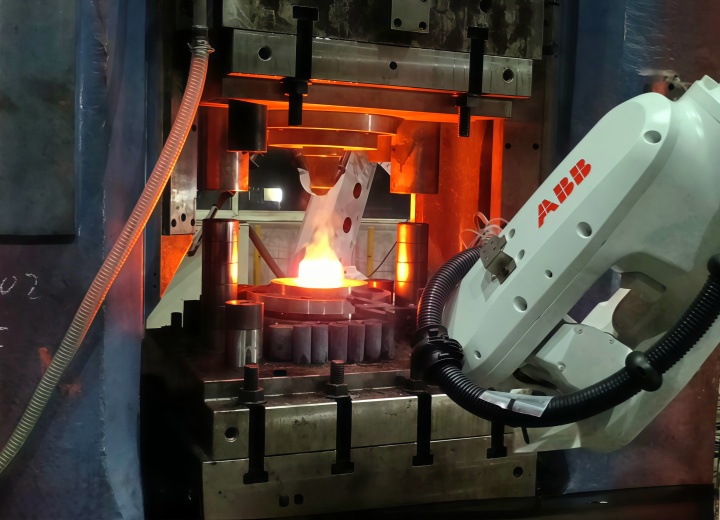
Every press is run before it leaves the works. The unit in this clip is a J58KA-400 — 400 t, 4,000 kN nominal force — in the geared build, with the frame, screw pair and brake assembled and the control panel set for its first load test. Blow energy on this model repeats within ±1.5% across a batch, and the slide has no fixed bottom dead centre, so the shut height follows the die rather than a crank position.
J58KA-400 electric screw press, finished and tested before dispatch.
Frequently Asked Questions – J58KA Electric Screw Press
Technical answers on the 250–10000T electric screw press.
What tonnage range does the J58KA electric screw press cover?
The J58KA series covers 11 capacities from 250T to 10000T, with nominal force from 2,500 kN to 100,000 kN. Maximum allowable working force runs from 4,000 kN on the smallest model to 160,000 kN on the 10000T model.
Which forging processes can an electric screw press perform?
Hot forging, precision forging, coining, trimming and calibration. Because blow energy is digitally controlled, the machine combines the dual properties of a hammer and a press, so die forging and precision sizing can run on the same unit.
How accurate is the blow energy control?
Blow energy is held to ±1.5% of the set value through the frequency-conversion drive, with position encoders closing the loop on stroke. That keeps part-to-part variation low and reduces scrap, and it is the main reason a screw press is chosen over a friction press for precision forging.
How much energy does the J58KA save?
The short transmission chain and the frequency-conversion drive save 50% to 55% energy compared with a friction screw press, and reduce maintenance cost by more than 30%. There are no friction discs, and the motor draws power only while it is forging.
What drive system does the J58KA use?
A frequency-conversion drive: an AC asynchronous motor run through an ABB inverter, with position encoders closing the loop on slide position and blow energy. The servo direct-drive version is the J58ZKA, where a permanent-magnet synchronous motor drives the screw directly — that is the model to specify when the part needs the tighter energy window.
Which materials is the electric screw press best suited to?
It has a particular advantage in forging non-ferrous metals such as aluminium alloy and copper, where controlled blow energy and low noise matter. It is also used for steel hot forging, coining and trimming.
How do I choose the right model for my forging?
Send your forged-part drawing or photo, material, forging weight and production requirements. We recommend the model from the 11 capacities and send a quotation. As a reference, slide stroke ranges from 320 mm on the 250T model to 1000 mm on the 10000T model.
Send your forging drawing or part details — we will recommend the machine that fits and quote it.
Drawings by email, so the file arrives intact. We reply within 24 hours. Prefer to type it out? Use the message form at the bottom of this page.
Email your drawing