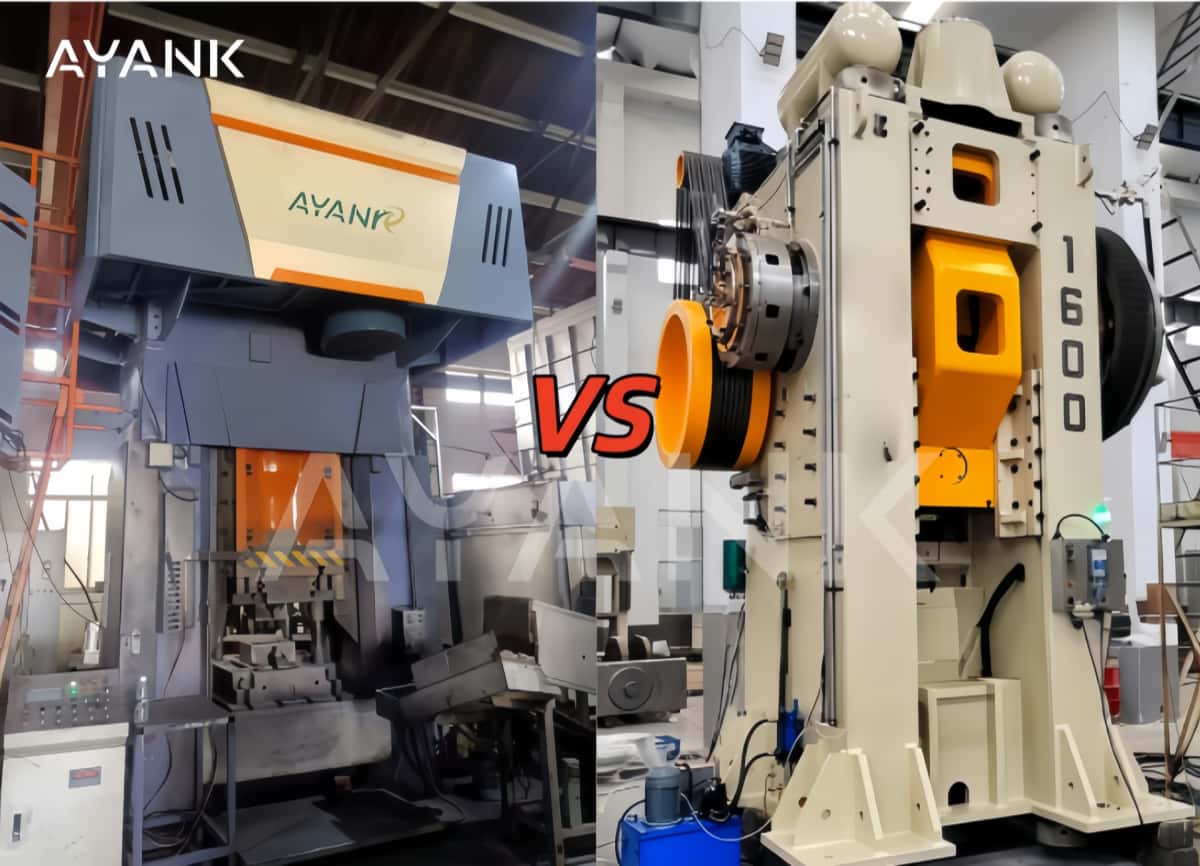
The comparison of electric screw presses and the hot die forging press are two types of die forging equipment commonly used for precision forgings. They differ significantly in working principles, process characteristics, and applicable scenarios.
| Feature Dimension | J58KA Electric Screw Press | Hot Die Forging Press |
| Working Principle | The servo motor drives the flywheel and screw to rotate, converting rotational kinetic energy into the vertical impact force of the slider. It belongs to fixed-energy forming. | Operates through a crank-link or crank-wedge mechanism, generating impact force via slider movement. |
| Process Characteristics | No fixed bottom dead center. Impact force is related to the deformation of the workpiece. Capable of multiple strikes for forming, offering high process flexibility. | Fixed bottom dead center. Impact force is determined by the mechanism, with lower process flexibility. |
| Striking Speed |
|
Relatively lower striking speed, with longer contact time between die and material. |
| Applicable Scenarios | Suitable for multi-variety, small to medium batch production; processes like precision forging, sizing, and straightening; die-friendly. | Suitable for large batch production of complex-shaped forgings. |
| Equipment Features | Relatively simple structure; slightly weaker resistance to eccentric loading; generally lower investment and maintenance costs. | Complex structure but high rigidity; strong resistance to eccentric loading. |
| Energy Consumption & Efficiency | The servo motor starts on demand, offering significant energy savings (over 50% compared to friction presses), but single-cycle time may be longer. | Higher energy consumption; generally higher efficiency in mass production scenarios. |
Based on the table above, you can make your selection according to the following key requirements:
If you require large production quantities with standardized product types and demand high forging precision, the hot die forging press is recommended.
If you produce a wide range of forging types in small batches, frequently change molds, and require processes such as coining, sizing, and straightening, the J58KA series electric screw press is better suited to your needs.
If cost efficiency and low operating expenses are priorities, the electric screw press offers more significant advantages in energy savings. For long-term investment in mass production of a single type of high-precision forging, the hot die forging press is the suggested choice.
For materials sensitive to deformation speed, such as aluminum, copper and other non-ferrous metals, J58ka electric screw press is more suitable.
Therefore, the J58KA series electric screw press is suitable for non-ferrous metals, and the types of forging forgings are more, while the hot forging press is more suitable for less varieties and whole batch forging.
If you want to know what kind of forging equipment you are suitable for, please share your forging type, investment budget, monthly output of forging, we can make detailed forging plan for you, and provide you with project budget.
Receive the news that you are interested in.