
Quick Answer
Tonnage is the wrong place to start when you are specifying a hydraulic press for knife making. What governs a billet is squeeze pressure: tonnage divided by billet face area. A 25 t press on a 50 × 50 mm billet delivers 10 kgf/mm²; a 50 t press on a 100 × 50 mm billet delivers exactly the same. Most knife shops need between 25 t and 50 t, but the specifications that actually stop a build are stroke, platen size and the power supply available in the workshop, not the tonnage figure on the nameplate.
What a Hydraulic Press Actually Does in a Knife Shop
A hydraulic press for knife making performs four jobs, and only the first one justifies the purchase on its own:
- Forge welding a layered billet — consolidating a stack of alternating steel into one solid bar before any shaping begins.
- Drawing out — reducing section along the length of a blade or tang blank.
- Straightening — correcting warp after quenching, while the part is still tempered or in a stress-relieved state.
- Forming — pressing guards, bolsters and fittings that are difficult to produce cleanly by hand hammering.
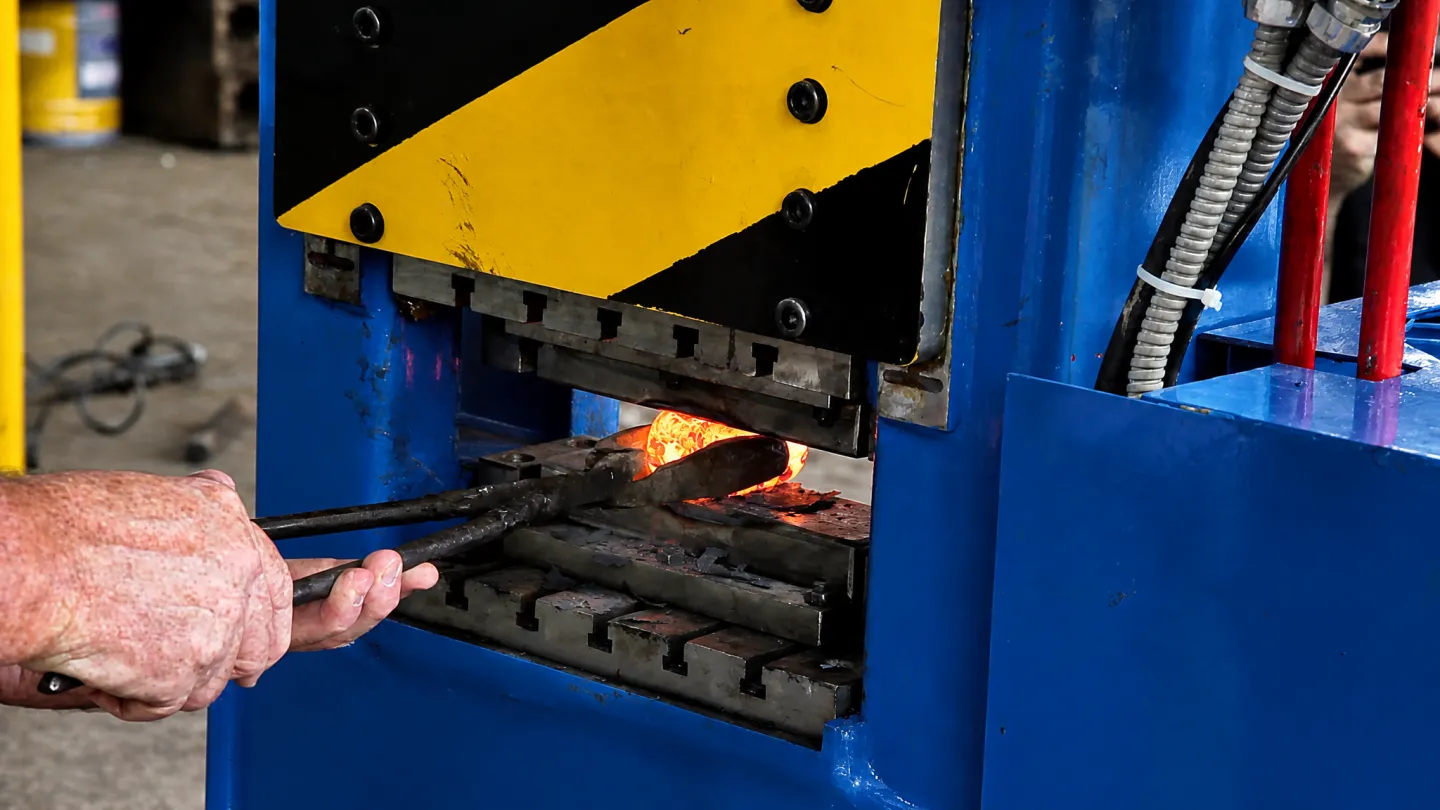
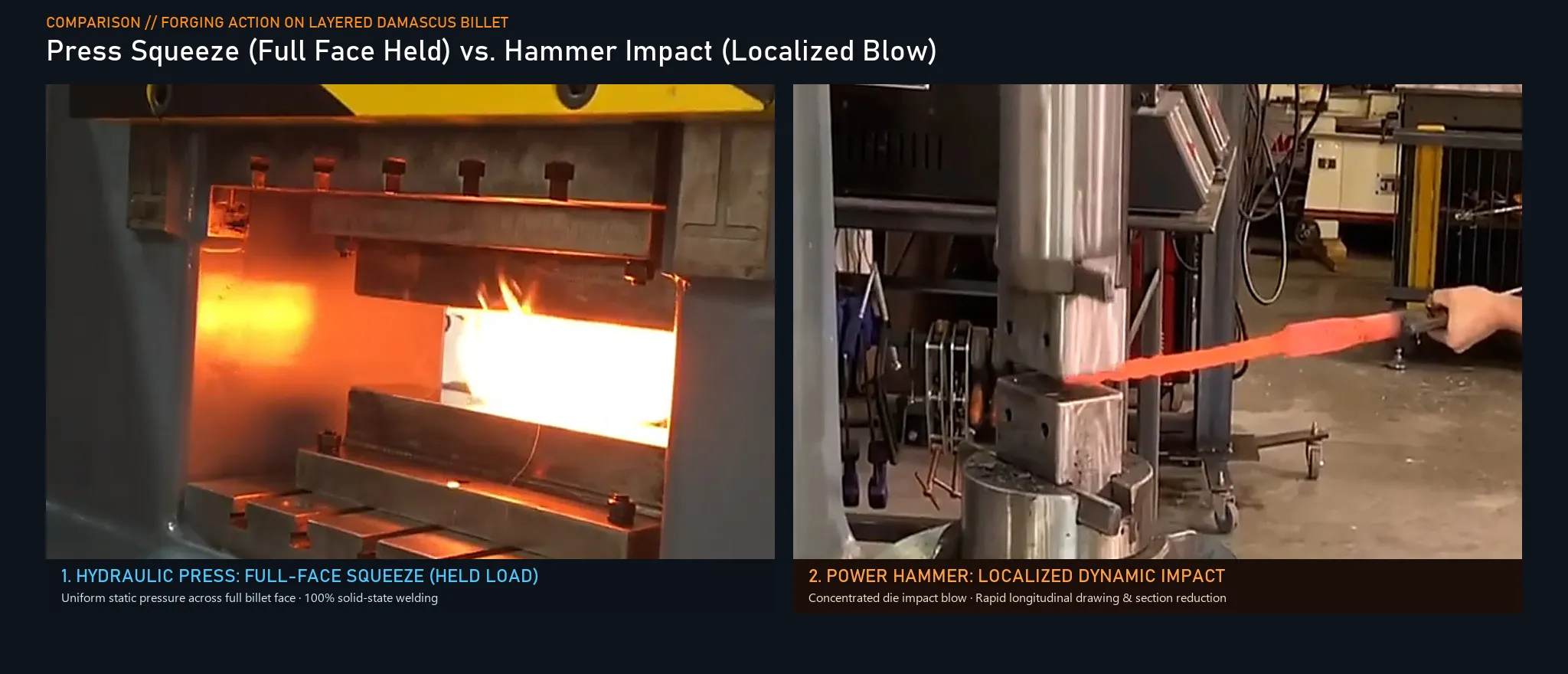
The mechanical difference between a press and a hammer is not force. It is how the force is delivered. A hammer transfers energy in a blow lasting milliseconds, through a die face that is usually narrower than the workpiece. A hydraulic press applies a sustained load through two flat, parallel surfaces, and holds it.
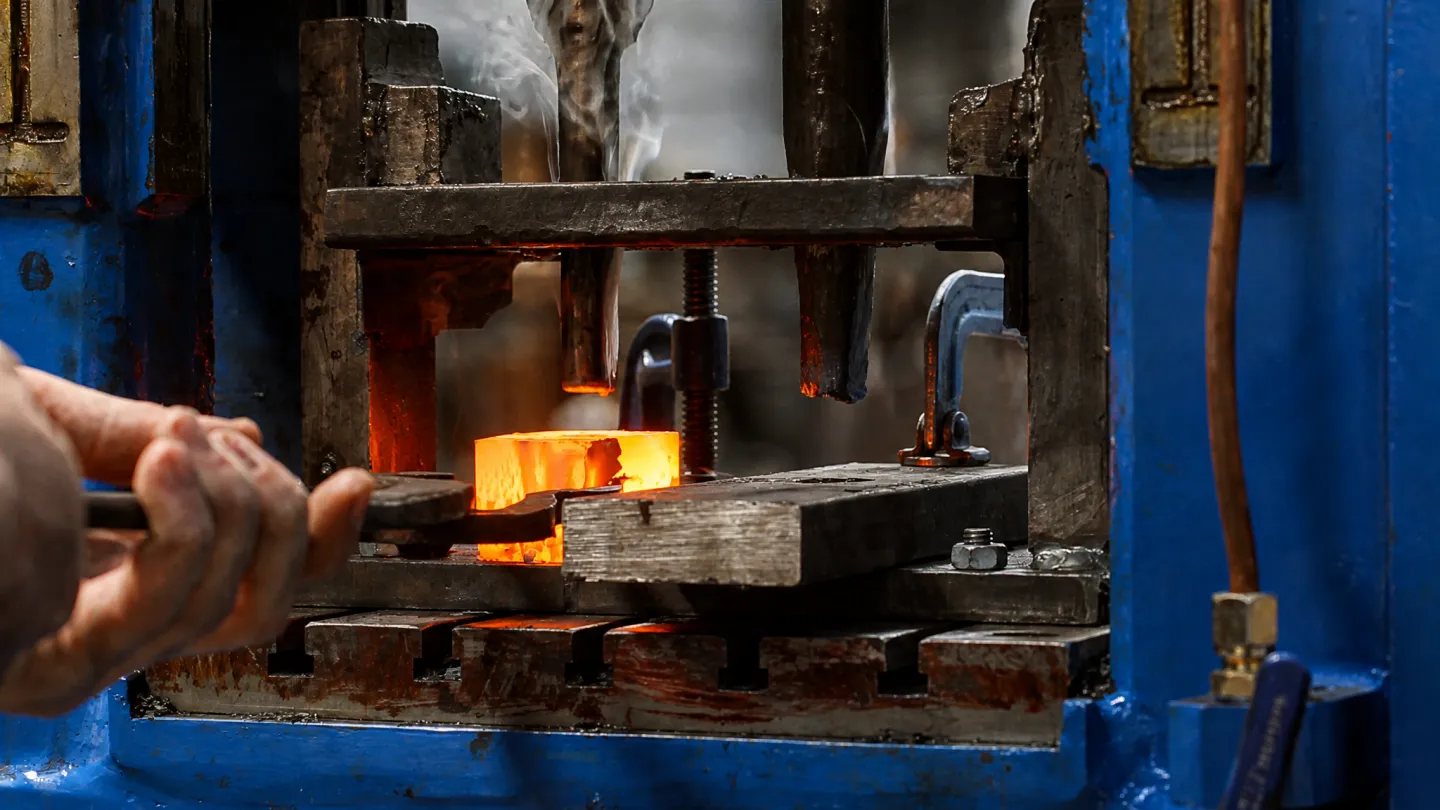
That distinction decides billet quality. Take a twelve-layer stack of 2 mm stock: the starting height is roughly 24 mm. If the top and bottom surfaces are not parallel while the layers consolidate, the stack shears rather than welds, and the resulting bar is wedge-shaped. The wedge has to be ground away, which means the pattern you planned is no longer where you planned it. Parallel platens do not eliminate operator skill, but they remove one whole category of error from the process.
The second consequence is dwell. Welding a layered billet is a time-at-temperature problem as much as a pressure problem. A press can sit at load for as long as the billet stays inside its welding window, letting the interface consolidate. A hammer cannot hold. It strikes, rebounds, and the billet cools between blows.
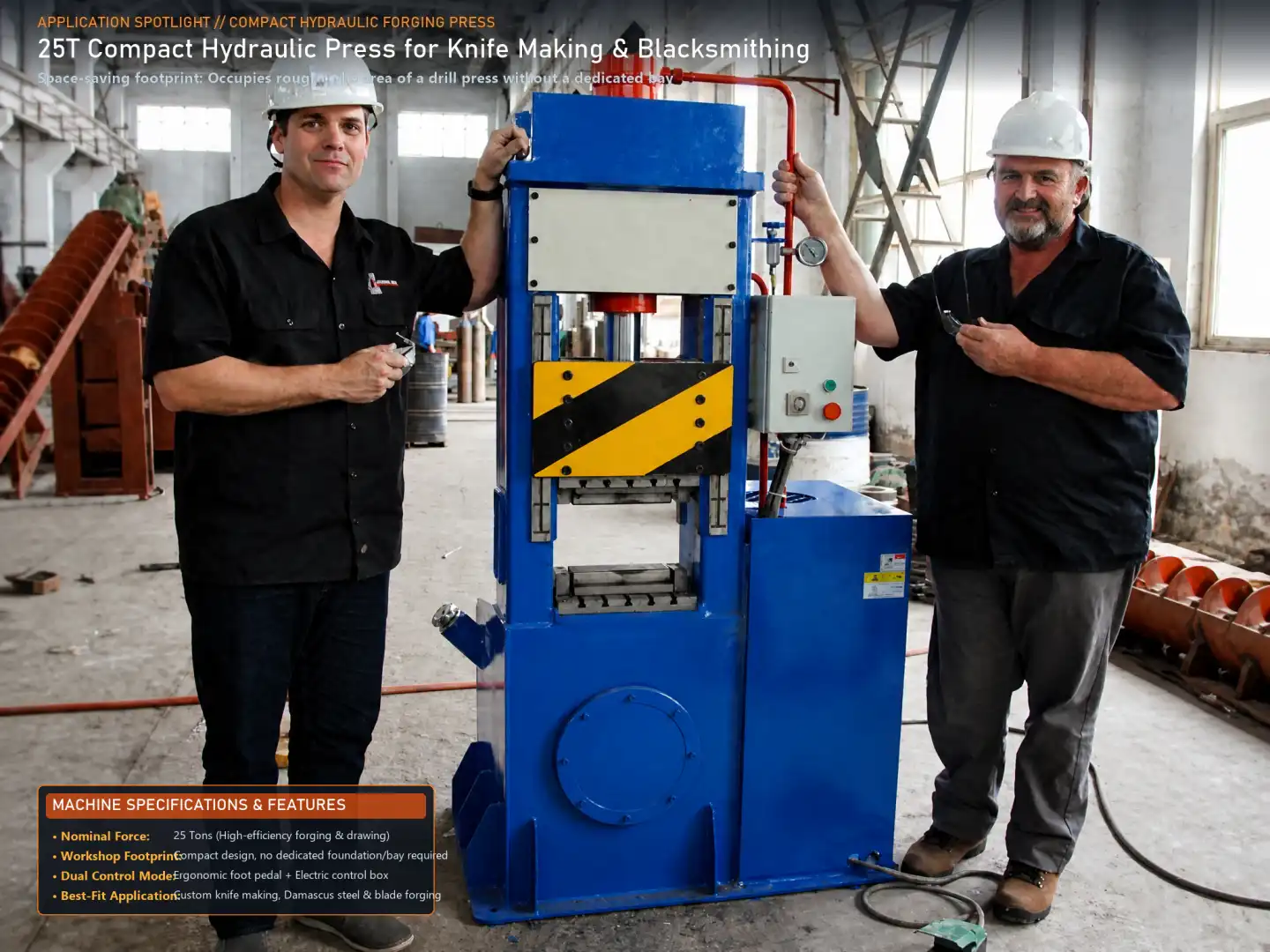
The press does not replace the hammer everywhere. For long, progressive section reduction, a hammer removes material height far faster per unit of energy input, because each blow does work across the full face and the operator can rotate and advance the bar between blows. A press drawing out a long section is doing one slow squeeze at a time. Shops that produce both layered billets and long blades usually end up with both machines, and the press is the one that protects the weld.
Press or Power Hammer: Which One Does the Welding
The two machines are not competing for the same operation, and treating them as alternatives is the most common reason a shop buys the wrong machine first when shopping for a hydraulic press for knife making. The comparison below is about the welding and consolidation stage specifically.
| Factor | Hydraulic press | Power hammer |
|---|---|---|
| Load delivery | Sustained squeeze, held for a set time | Repeated impact, no dwell |
| Face parallelism | Set by the platen and die, constant across the billet | Dependent on die alignment and operator technique |
| Billet thickness control | Reproducible; the same fixture gives the same height | Variable between heats and between operators |
| Oxide and contaminant behaviour | Slow squeeze squeezes scale out ahead of the weld line | Fast impact can fold scale into the interface |
| Noise | Pump and motor noise; no impact report | Impact noise dominates and is difficult to contain |
| Drawing out long sections | Slow per unit reduction | Fast per unit reduction |
| Where it earns its place | Welding, flattening, straightening, forming | Drawing out, tapering, spreading |
The practical sequence in most shops is press first, hammer second: consolidate the billet on the press while the layers are still clean, then move to the hammer for section reduction once the bar is solid. Reversing that order means drawing out a stack that has not fully welded, which is where most delamination failures originate.
AYANK builds pneumatic and hydraulic hammers as well as presses, so this comparison does not favour one product line. Which machine a shop should buy first depends on whether the bottleneck is weld quality or section reduction — and for a shop starting on layered work, it is almost always weld quality.
If the workpiece is a closed-die part rather than a layered bar, the comparison changes entirely and the relevant reference is the forging press selection guide instead.
How Much Tonnage Do You Need? Start With Billet Area, Not a Number
Buyers specifying a hydraulic press for knife making usually ask how many tons they need. Suppliers answer with a number. Both are skipping the variable that decides the outcome.
A press does not apply pressure. It applies force. Pressure at the billet face is that force divided by the area it acts on:
| Squeeze pressure | Formula |
|---|---|
| kgf/mm² | nominal tonnage (kgf) ÷ billet face area (mm²) |
| MPa | kgf/mm² × 9.81 |
Run the three Y04 models against four realistic billet sizes and the reason becomes obvious:
| Billet face | Area (mm²) | Y04-25 (25 t) | Y04-50 (50 t) | Y04-150 (150 t) |
|---|---|---|---|---|
| 50 × 50 mm | 2,500 | 10.0 kgf/mm² | 20.0 kgf/mm² | 60.0 kgf/mm² |
| 100 × 50 mm | 5,000 | 5.0 kgf/mm² | 10.0 kgf/mm² | 30.0 kgf/mm² |
| 100 × 100 mm | 10,000 | 2.5 kgf/mm² | 5.0 kgf/mm² | 15.0 kgf/mm² |
| 150 × 100 mm | 15,000 | 1.7 kgf/mm² | 3.3 kgf/mm² | 10.0 kgf/mm² |
Three conclusions follow, and each one changes how a buyer should be talking to a supplier.
A bigger press is not automatically more pressure
A 25 t press on a 50 × 50 mm billet and a 50 t press on a 100 × 50 mm billet both deliver 10 kgf/mm². The second machine has twice the force and twice the contact area, so the pressure at the interface is identical. A 150 t press on a 150 × 100 mm billet lands on exactly the same 10 kgf/mm² — six times the tonnage, six times the area, no change in squeeze pressure.
This is why a shop that buys a larger hydraulic press for knife making and keeps working the same small billet does not see better welds. It sees the same welds, produced more slowly and at greater cost. Tonnage above what the billet area requires buys nothing at the interface.
"How many tons do I need" is the wrong question
The answerable version is: what is my billet face area, and what squeeze pressure does this steel grade need at this temperature? Tonnage is the output of those two inputs, not an input in itself. A supplier of a hydraulic press for knife making who answers the tonnage question without asking for billet dimensions is guessing, and the guess will be conservative in the direction of a larger machine.
Large billets hit the stroke and platen limits before they hit the tonnage limit
Once billet area is settled, the constraint moves to whether the machine can physically accept the work. A twelve-layer 2 mm stack is already 24 mm tall before dies and any spacer plate are counted. Add a die set and a bolster and a 300 mm stroke closes down faster than most buyers expect. Platen size imposes a second, independent ceiling. Both are covered in the next section.
Squeeze pressure also depends on how fast the load is applied. All three Y04 models are specified at a maximum pressing speed of 20 mm/s or below, and approach speed is a separate figure: the ram travels down at ≥ 40 mm/s on the 25 t model, ≥ 50 mm/s on the 50 t and ≥ 150 mm/s on the 150 t. The largest machine therefore closes the gap nearly four times faster than the smallest while pressing at the same rate. That is the correct arrangement. Fast approach removes dead time from the cycle; slow pressing gives the billet time to equalise temperature through its thickness and pushes scale and contaminant out ahead of the weld line. A press that presses fast traps that scale at the interface. Two machines with identical tonnage and different pressing speeds are not equivalent for welding work, which is why the speed figures belong on the specification sheet next to the tonnage.
Stroke, Platen Size and Power Supply: The Three Specifications Buyers Get Wrong
When a buyer first enquires about a hydraulic press for knife making, tonnage is the specification they negotiate over. It is rarely the one that kills a project. Three other figures decide whether the machine can physically do the work and whether the workshop can run it at all.
| Specification | Unit | Y04-25 | Y04-50 | Y04-150 (CNC) |
|---|---|---|---|---|
| Nominal force | t | 25 | 50 | 150 |
| Ram stroke | mm | 300 ± 5 | 300 ± 5 | 400 ± 5 |
| Maximum pressing speed | mm/s | ≤ 20 | ≤ 20 | ≤ 20 |
| Fast approach / fast return | mm/s | ≥ 40 / ≥ 60 | ≥ 50 / ≥ 55 | ≥ 150 / ≥ 100 |
| Maximum forging range | mm | 300 × 400 | 380 × 400 | 600 × 600 |
| Worktable size | mm | 300 × 200 | 380 × 300 | 600 × 400 |
| Worktable height | mm | 900 ± 20 | 900 ± 20 | 700 ± 20 |
| Hydraulic working pressure | MPa | ≤ 25 | ≤ 25 | ≤ 25 |
| Main motor power | kW | 4 | 7.5 | 30 |
| Hydraulic oil, 46# anti-wear | L | 240 | 450 | 450 |
| Footprint, L × W | mm | 1200 × 765 | 1550 × 1110 | 2850 × 1600 |
| Overall height | mm | 2080 | 2140 | 4080 |
| Machine weight | kg | 890 | 1900 | 9150 |
Stroke is travel, not usable opening
A 300 mm ram stroke does not mean 300 mm of clear space for the work. It is the total distance the ram travels. What accepts the workpiece is the gap between the upper die face at the top of the stroke and the worktable — a different dimension, and one that standard data sheets frequently leave out.
The arithmetic catches people out. Twelve layers of 2 mm stock is a 24 mm billet before anything else is counted. Add a die block above and below, a spacer plate to bring the stack into a comfortable working height, and the clearance needed is several times the billet thickness. A shop that buys a hydraulic press for knife making on tonnage alone and discovers this after delivery is looking at a die redesign, not a machine swap.
Ask for the clear opening at top of stroke, in millimetres, in writing. A supplier who cannot produce that number has not been asked it before, which tells you something about how the machine is normally sold.
Worktable size and maximum forging range are two different limits
The data sheet lists both, and they are not interchangeable. Worktable size is the mounting surface. Maximum forging range is the working envelope the machine is intended to cover. On the Y04-25 these read 300 × 200 mm and 300 × 400 mm respectively; on the Y04-150, 600 × 400 mm and 600 × 600 mm.
For a layered billet the worktable figure governs, because the billet and its fixture have to sit on the table under the die. For a long blade being straightened, the envelope figure matters more, because the work extends beyond the table and has to be supported. Measure the longest piece you intend to process, not the average one.
Worktable height is the third dimension almost nobody compares. The 25 t and 50 t models sit at 900 mm; the 150 t sits at 700 mm. Nine hundred millimetres is close to standing bench height and lets an operator work without stooping over a long session. A lower table suits heavier work that is loaded with assistance, but it changes how the operator stands for the whole shift. On a machine an operator will feed several hundred times a day, this is a fatigue variable, not a cosmetic one.
Power supply is a model constraint, not a cost line
The three models draw 4 kW, 7.5 kW and 30 kW. That spread is often discussed as a running-cost difference. It is more usefully read as an eligibility filter.
Many knife workshops operate from a single-phase service or a three-phase supply with limited spare capacity. A 30 kW main motor is not a machine you can add to that service by plugging it in; it needs a supply assessment, possibly a service upgrade, and the cost and lead time of that upgrade sit entirely outside the machine quotation. Confirming the required supply — phases, voltage, rated current, and whether the motor is offered in a single-phase configuration — before comparing prices will eliminate more unsuitable options than any comparison of tonnage will.
The 4 kW model is the reason a small shop can consider a hydraulic press at all. It is also the model most often skipped in a conversation that starts with tonnage, because 25 t sounds small next to a 150 t machine.
A note on the 25 MPa figure
The ≤ 25 MPa in the table is hydraulic circuit working pressure. It is not the pressure at the billet face, and the two are routinely conflated in supplier conversations. Circuit pressure multiplied by cylinder area produces the force that the tonnage rating describes; the pressure the billet actually sees is that force divided by billet area, as calculated earlier. Quoting 25 MPa as though it were a workpiece pressure overstates the load at the interface by an order of magnitude on a typical billet.
Which Model Fits a Knife Shop: Y04-25, Y04-50 or Y04-150
With billet area, clearance and supply established, the choice of forging press for knife making usually becomes obvious. The three machines are not a good-better-best ladder; they answer three different workshop situations.
| Consideration | Y04-25 | Y04-50 | Y04-150 (CNC) |
|---|---|---|---|
| Typical buyer | Blade-focused shop, one or two makers | Shop doing both welding and drawing | Production shop running scheduled batches |
| Billet face it suits | Up to roughly 50 × 50 mm at 10 kgf/mm² | Up to roughly 100 × 50 mm at 10 kgf/mm² | Up to roughly 150 × 100 mm at 10 kgf/mm² |
| Footprint | 1200 × 765 mm | 1550 × 1110 mm | 2850 × 1600 mm |
| Machine weight | 890 kg | 1900 kg | 9150 kg |
| Overall height to check against the ceiling | 2080 mm | 2140 mm | 4080 mm |
| Motor | 4 kW | 7.5 kW | 30 kW |
| Handling on delivery | Pallet truck, four people | Forklift | Crane or heavy forklift, floor loading assessment |
| Structure | C-frame or four-column configuration, depending on order specification | ||
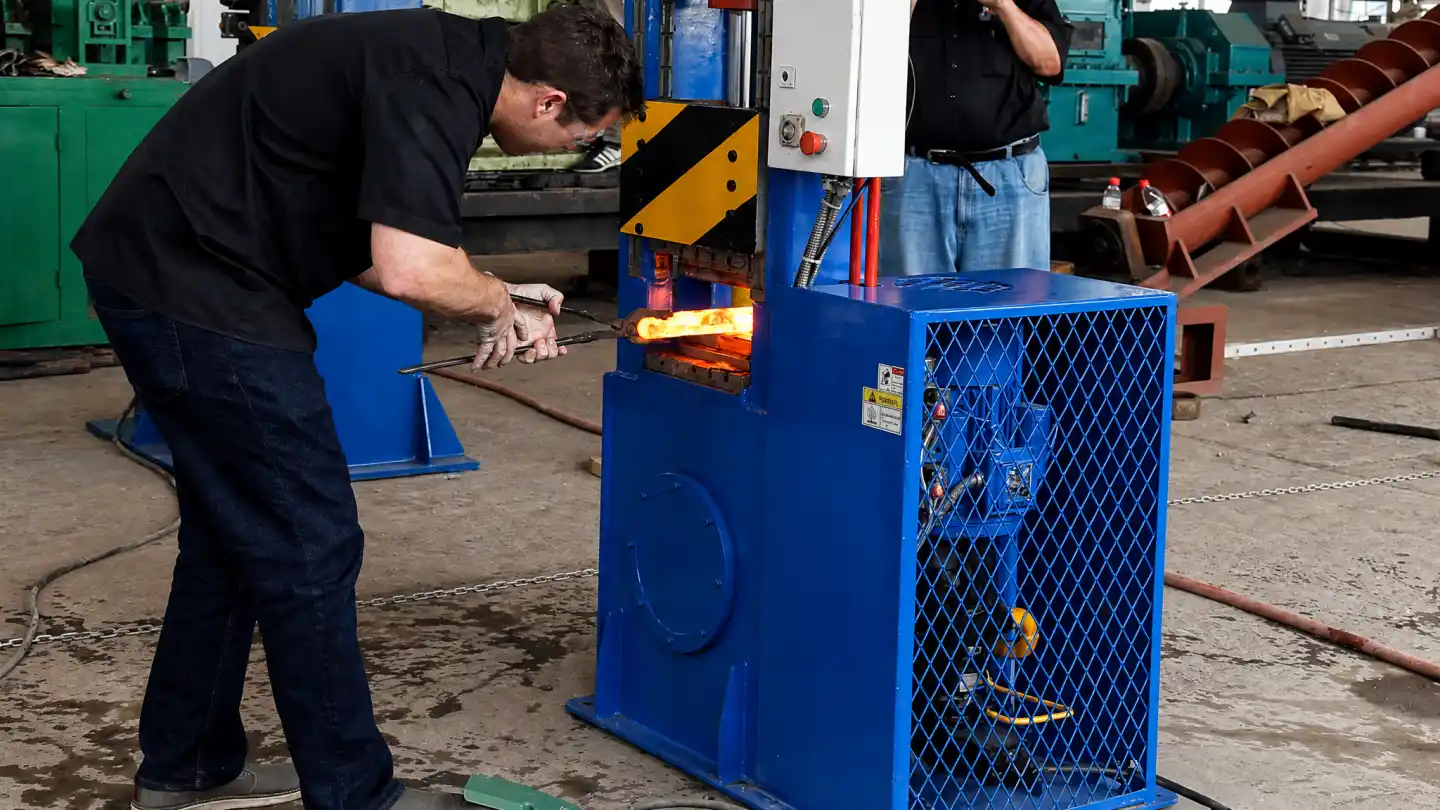
The 25 t machine is the right answer more often than its size suggests. A shop making pattern-welded stock up to about 50 × 50 mm, working alone, in a rented unit with a 16 A or 32 A supply, is exactly the case the Y04-25 is built for. It weighs 890 kg, fits through a standard door, and runs on 4 kW — the size class buyers usually have in mind when they search for a mini forge press.
The 50 t machine is the answer when the shop does not yet know what it will be making. Welding at 100 × 50 mm and drawing out both fall inside its envelope, and 7.5 kW is still within reach of a modest three-phase service. This is the model that gets specified when a buyer says they want one press and does not want to revisit the decision in two years.
The 150 t machine is a production decision, not a workshop decision. At 9150 kg and 4080 mm overall height it needs a floor loading assessment, lifting equipment and a building with the clear height to take it. A CNC variant at this size is bought by shops scheduling batches against delivery dates, where repeatability across operators matters more than the maximum size of any single billet.
Two practical warnings. First, the weights above are shipping-relevant: 9150 kg is not a machine you move with an engine crane, and the floor it stands on may need to be assessed rather than assumed. Second, 4080 mm of overall height is taller than many light-industrial units allow once lighting, extraction and roller doors are accounted for. Measure the building before comparing prices — the machine is the cheap part of a wrong decision.
Full dimensions, table sizes and options for the three models are listed on the small hydraulic press specification page.
Dies and Tooling: The Cost Nobody Quotes
A hydraulic forge press for knife making does nothing without tooling. The tooling is where a first-time buyer's budget most often breaks, because quotations commonly price the machine and leave dies to a separate conversation that happens after the deposit.
For layered billet work, four die types cover most of the range:
- Flat dies — the baseline. Full-face contact for consolidation and flattening. Every shop needs a matched pair before anything else.
- Combination dies — flat on one face, open groove on the other. Consolidate on the flat, rough-shape on the groove, without changing dies mid-billet.
- Drawing dies — profiled to reduce section along the length. These are what make a press useful for blade stock rather than only for billets.
- Forming dies — for guards, bolsters and fittings, cut to the part rather than to a generic profile.
Because both platens carry T-slots, a shop with machining capability can make its own fixtures rather than buying every die from the machine supplier. That is a genuine cost advantage on simple flat and combination tooling. It is not an advantage on the first die set: buying one matched flat pair from the machine builder gives you a known reference surface, and every die you make afterwards can be checked against it. Shops that start by making their own tooling tend to spend their first month chasing parallelism problems that were never the machine's fault.
Ask for the tooling list as a separate line with a price against each item, and ask which dies the machine is quoted with. A press quotation that does not mention dies is not a complete quotation.
What the Quote Must Break Down
Machine prices for a hydraulic press for knife making vary with configuration, tooling and destination, so a published figure would be misleading. What can be compared objectively is the structure of the quotation. A complete one separates seven items:
| # | Cost item | What to check |
|---|---|---|
| 1 | Machine | Model, motor power, structure, control type, options included |
| 2 | Dies and tooling | Itemised list with a price per die, not a lump sum |
| 3 | Crating and freight | Packing standard, port of departure, Incoterm, insurance |
| 4 | Duty and clearance | HS classification, duty rate at destination, broker fees |
| 5 | Electrical works | Supply capacity, cable, protection, any service upgrade |
| 6 | Installation and commissioning | Who unpacks, who sets the machine, who signs off the test |
| 7 | Spares | Recommended first-year parts list and lead time per item |
Item 5 is the one that most often turns a comparison upside down. A 4 kW machine and a 30 kW machine are not 7.5 times apart in purchase price, but the electrical work behind them is far more than 7.5 times apart, and it is paid to a local contractor rather than to the equipment supplier. Two quotations that look comparable on the machine line can differ substantially on total installed cost.
The comparison that matters is total cost to first good billet, not machine price at the port. A cheaper machine with tooling quoted later, freight excluded and electrical work unaccounted is not cheaper; it is a quotation that has been split into pieces so the first piece looks attractive.
How to Verify a Supplier Before You Wire the Deposit
Purchases of a hydraulic press for knife making are usually made at a distance, from a supplier whose factory the buyer has not visited. Six requests separate a supplier who can support the machine from one who can only ship it. All six are things a real manufacturer can produce within days.
- A welding test using your billet dimensions. Not a stock video, not a render — a video of a billet of your size and layer count being consolidated on the machine model you are being quoted. Ask for the squeeze speed and the billet dimensions to be stated on camera or in the accompanying note.
- A platen parallelism measurement. A number, in millimetres or microns, across the working area. This is the property that decides whether your billets come out flat, and it is measurable before delivery.
- The hydraulic test record. The machine is rated to ≤ 25 MPa working pressure; ask for the test sheet showing the pressure it was proved at and the hold time.
- A spares list with lead times. Seals, filters and the parts most likely to wear should have a stated availability. A supplier who cannot name them has not supported a machine through its service life.
- An electrical drawing. Phases, voltage, rated current, and the motor configuration offered. This is what your electrician needs before the machine arrives, and asking for it reveals whether the supplier has considered single-phase as an option or only quotes three-phase.
- A reference installation you can contact. Preferably in your region and, if possible, in a similar application. A reference that only exists as a logo on a website is not a reference.
Signals that should slow a purchase down: only renders and stock photography; a claim that any tonnage and any billet size can be accommodated without asking for dimensions; a refusal to itemise tooling; a quotation with no Incoterm; and pressure to pay a deposit before a test video is produced. None of these is proof of a bad supplier. All of them mean the buyer is being asked to accept risk that the supplier has not been asked to carry.
For context on how this equipment sits within a wider forging equipment range, see AYANK's forging hydraulic press category; the same verification questions apply at every size.
Installation, Commissioning and the First Ten Pressures
The machine arrives as a hydraulic system that has been tested and then drained or shipped with oil, depending on the arrangement. Several things have to be true before the first billet goes into a new hydraulic press for knife making.
Before the machine lands
- Floor loading. 890 kg, 1900 kg and 9150 kg are three different problems. The first sits on a standard workshop slab. The third should be checked against the building, not assumed.
- Clear height. Overall heights are 2080 mm, 2140 mm and 4080 mm. Measure to the lowest obstruction, not to the ceiling.
- Access route. Door widths, thresholds and any step between the delivery point and the final position. A machine that fits the room but not the doorway is a crane hire.
- Hydraulic oil. 46# anti-wear, 240 L or 450 L depending on model. This is a consumable you supply, and 450 L is not a quantity to discover on the installation day.
- Electrical supply. In place and tested before the machine arrives, sized to the motor rather than to the previous machine.
The commissioning sequence
Three tests, in this order, before production work begins:
- Full stroke, no load. Run the ram through its complete travel several times, checking for smooth motion, correct limit positions and no abnormal noise at either end.
- Pressure build to rated working pressure. Bring the hydraulic circuit up to its rated ≤ 25 MPa and confirm the relief setting behaves as specified.
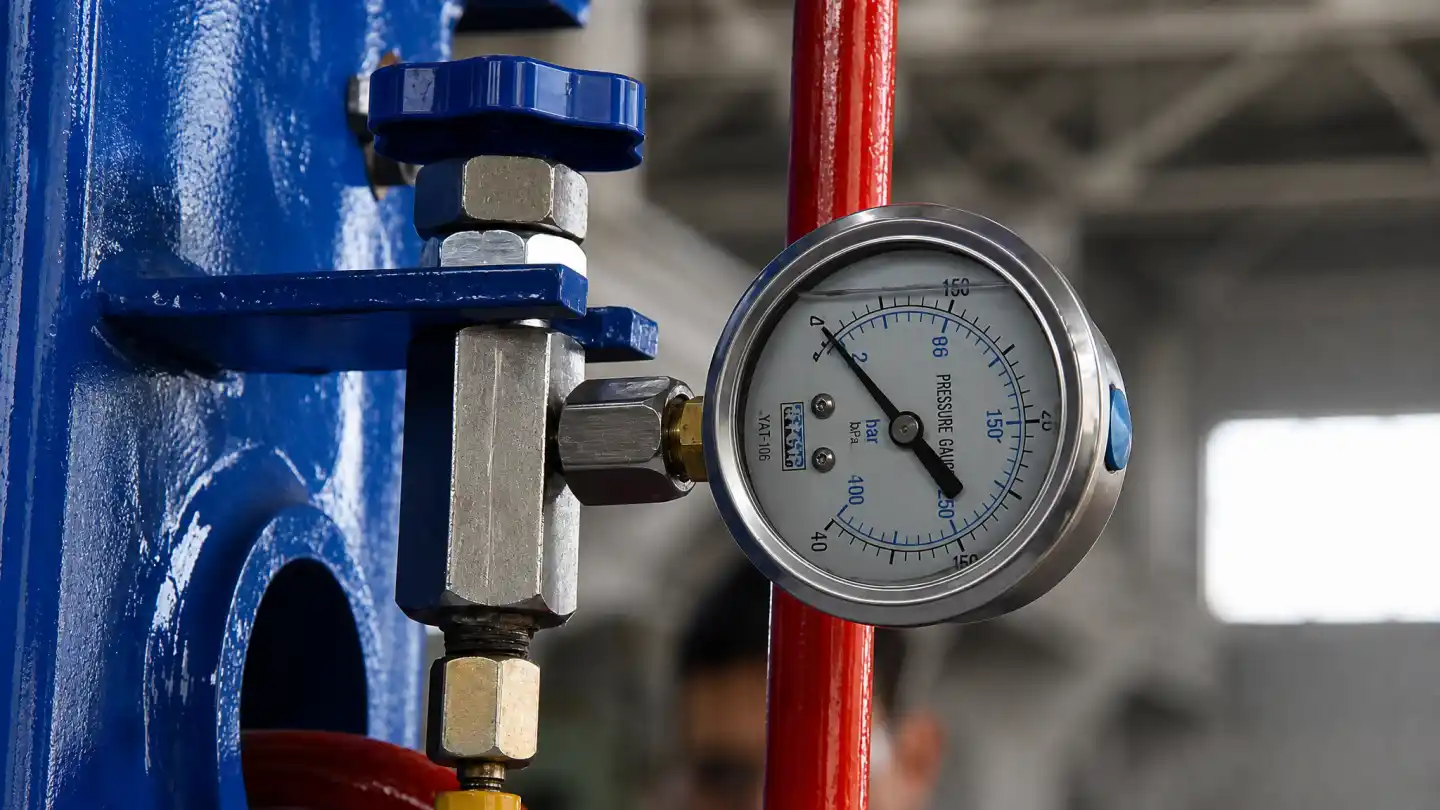
- A hold test. Hold at pressure for ten minutes with the ram stationary and watch the gauge. A circuit that drifts down over ten minutes has a leak path, and finding it now is a warranty conversation rather than a production stoppage.
Then press a scrap billet — not a good one. The first billet on any new press is a setup exercise: it tells you where the ram actually stops relative to the die face, how the material flows at your working temperature, and whether your die stack has the clearance you calculated. Burning a piece of scrap to learn that is cheaper than burning a patterned stack.
Shops moving up from a hand-operated or small blacksmith hydraulic press usually find the commissioning step straightforward; the adjustment is in process discipline, not in operating the machine.
Maintenance and the Failures That Actually Happen
A hydraulic press for knife making is a simple machine with a small number of failure modes, and most of them are visible before they become expensive.
| Symptom | Usual cause | What to check first |
|---|---|---|
| Oil temperature climbing during continuous work | Duty cycle beyond what the reservoir and cooling arrangement were sized for | Reservoir level, oil condition, ambient temperature, and how long the machine runs between pauses |
| Oil seepage at fittings or the cylinder | Seal ageing, or a fitting that loosened under thermal cycling | Wipe the area clean, run a cycle, and trace the first fresh trace rather than the oldest stain |
| Ram no longer stopping where it used to | Limit position drift, or a changed die stack height | Confirm the die stack has not changed, then check the limit setting before adjusting anything |
| Pressure slow to build, or a drift on hold | Internal leakage, or a relief setting that has moved | Repeat the ten-minute hold test from commissioning and compare against the original reading |
| Billets coming out with a taper | Die wear, a damaged die seat, or contamination under a die block | Clean the seats, re-check platen parallelism, then inspect die faces |
Two habits prevent most of this. Keep a written record of the commissioning readings — the hold-test pressure drop, the platen parallelism figure, the oil volume charged — so that "it used to be better" becomes a number rather than an impression. And keep the reservoir and the oil clean: most hydraulic problems in small shops start as contamination, not as component failure.
Oil change intervals depend on duty cycle, oil temperature and contamination, so the manufacturer's schedule for the specific configuration should be followed rather than a general figure carried over from another machine. Ask for that schedule at commissioning, along with the filter part numbers, so the first service does not become a search.
Working Out a Press Size for a Specific Billet?
Send AYANK the billet face dimensions, layer count, steel grade, target output per shift, and the electrical supply available where the machine will stand. Those five items are enough to work the calculation back from squeeze pressure to a model, and to confirm whether the clearance and the supply will accept it. Send them through the AYANK contact form.
Frequently Asked Questions
Can a hydraulic press forge-weld Damascus steel?
Yes. A press applies load across the full billet face and holds it, which consolidates the interface while the billet is still inside its welding window. The variables that matter are squeeze pressure at the billet face, pressing speed and platen parallelism — not tonnage alone.
Is 25 tons enough for knife making?
For a billet face up to roughly 50 × 50 mm, 25 t delivers about 10 kgf/mm², which is a practical working pressure for layered stock. The same 25 t on a 100 × 100 mm billet delivers only 2.5 kgf/mm². Tonnage is only meaningful next to the billet size it is applied to.
Press or power hammer for Damascus?
Consolidate on the press and draw out on the hammer. A press holds pressure and keeps the billet faces parallel; a hammer delivers impact and removes section faster. Drawing out a stack that has not fully welded is where most delamination comes from, so the press step comes first.
How thick a billet can a 25-ton press weld?
Thickness is limited by clearance rather than by force. The ram stroke on the Y04-25 is 300 mm, but usable opening is the gap between the upper die face at top of stroke and the worktable, minus your die stack and spacers. Ask for the clear opening figure in writing before committing to a layer count.
What power supply does a small forging press need?
The Y04 range uses 4 kW, 7.5 kW and 30 kW main motors. The 4 kW model is the practical entry point for a small workshop. Confirm phases, voltage and rated current with the supplier and have your electrician check the service before the machine is ordered, because a supply upgrade is a separate project on a separate timeline.
How much does a knife making hydraulic press cost?
Price depends on model, tooling, destination and Incoterm, so a single figure would not be reliable. Compare quotations on seven items: machine, dies and tooling, crating and freight, duty and clearance, electrical works, installation and commissioning, and spares. A quote that omits tooling or electrical work is not a lower price, it is a partial one.
Can I use a shop press for knife making?
A shop press can consolidate small billets and is a legitimate way to start. Its limits appear at three points: short stroke and limited opening, no controlled pressing speed or hold, and a frame and table sized for assembly work rather than repeated forging loads. Once billet size or output rises, those limits become the constraint rather than the tonnage.
What dies do I need for Damascus billets?
Start with one matched flat die pair for consolidation, and add a combination die if you also rough-shape in the same heat. Drawing dies come later, once section reduction becomes part of the process. Because both platens carry T-slots, further fixtures can be shop-made and checked against the reference flat pair.