Reading the C86YA Specifications
Ten rows, ten capacities, and four of those rows decide which machine you need. The other six confirm it.
- Strike energy (kJ) — 25 to 630 kJ, the work one blow delivers, and the number in the model name. Where a buyer quotes tonnage instead, it is the steam-air equivalent at roughly 35 kJ per tonne, so the 630 kJ frame sits in the 18 ton class.
- Hammer mass (kg) — 1,000 to 25,000 kg of falling weight. It sets how deep the blow reaches into a given section. It is a weight, not a tonnage, and the two are not convertible.
- Minimum closed die height (mm) — 220 to 500 mm. This is the row most often skipped: it is the shortest die stack the hammer can close, so a shallow die that will not reach the blow still will not work on a bigger model.
- Rail spacing (mm) — 540 to 1,300 mm. The die block has to sit inside it; a die wider than the rails does not go in, whatever the energy figure says.
- Strike frequency (min-1) — 55-70 blows per minute up to the 125 kJ, easing to 35-40 at the 500 and 630 kJ. The heavier the falling mass, the fewer blows it returns per minute.
- Motors and oil pumps — 1 pump on the 25 kJ up to 10 on the 450-630 kJ, at 55 or 75 kW each. On the largest frame that is ten 75 kW motors, a connected load of about 750 kW, which is the figure to check against your supply.
| Model |
Strike energy |
Hammer mass |
Min. closed die height |
Strike frequency |
Motors / pumps |
| C86YA-25 |
25 kJ |
1,000 kg |
220 mm |
55-70 |
1 × 55 kW |
| C86YA-50 |
50 kJ |
2,000 kg |
260 mm |
55-70 |
2 × 55 kW |
| C86YA-75 |
75 kJ |
3,000 kg |
350 mm |
55-70 |
3 × 55 kW |
| C86YA-125 |
125 kJ |
5,000 kg |
400 mm |
55-65 |
4 × 55 kW |
| C86YA-200 |
200 kJ |
8,000 kg |
430 mm |
55-65 |
5 × 75 kW |
| C86YA-250 |
250 kJ |
10,000 kg |
450 mm |
50-60 |
6 × 75 kW |
| C86YA-400 |
400 kJ |
16,000 kg |
500 mm |
45-55 |
8 × 75 kW |
| C86YA-450 |
450 kJ |
18,000 kg |
500 mm |
40-50 |
10 × 75 kW |
| C86YA-500 |
500 kJ |
20,000 kg |
500 mm |
35-40 |
10 × 75 kW |
| C86YA-630 |
630 kJ |
25,000 kg |
500 mm |
35-40 |
10 × 75 kW |
*Figures are taken from the parameter table above. Maximum stroke runs 1,000 mm on the 25 kJ to 1,700 mm on the 630 kJ. The part, its material and the die decide the capacity — the table is the start of the conversation, not the answer.
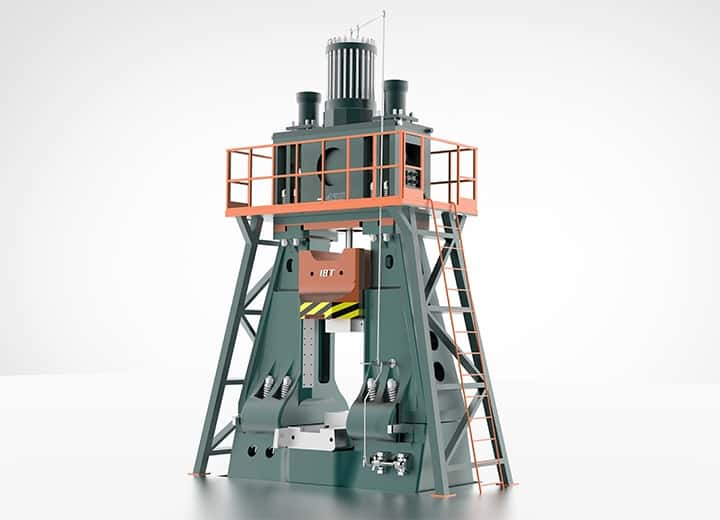
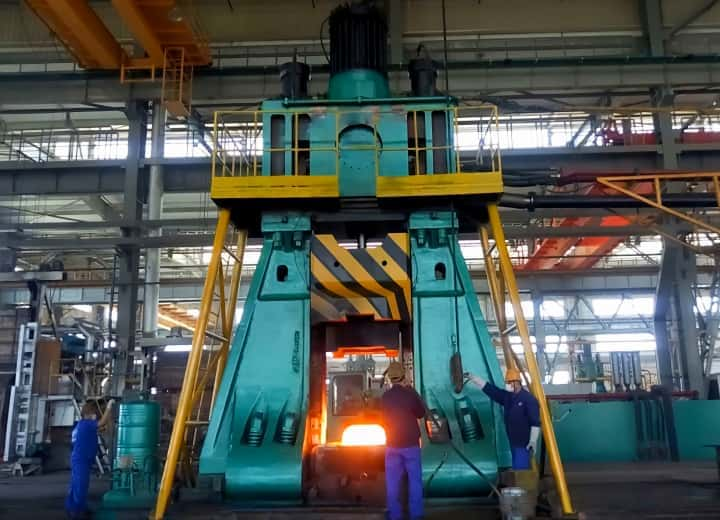
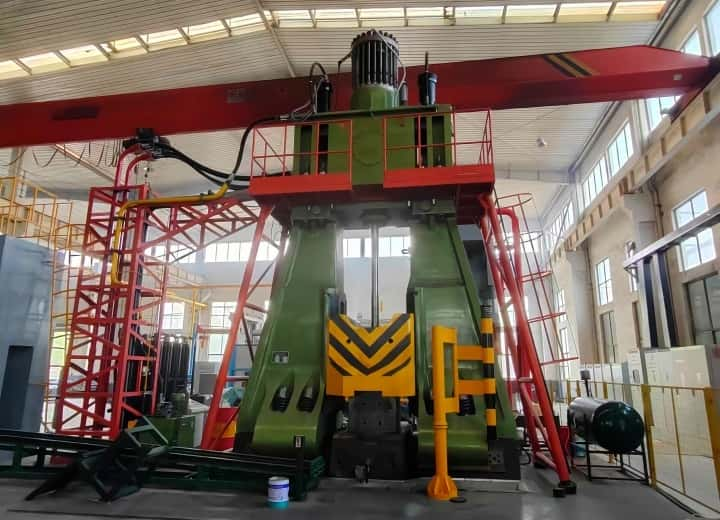
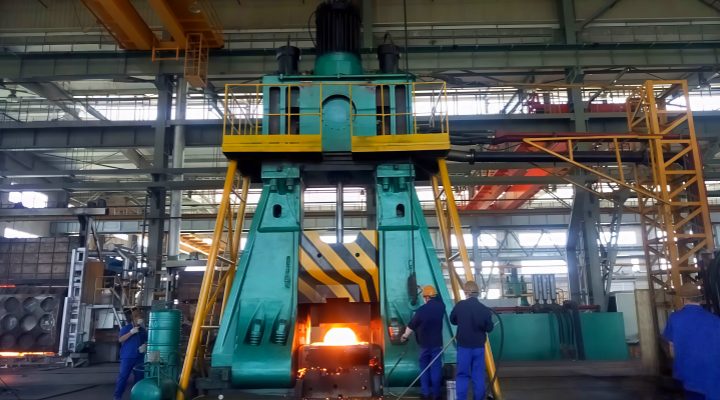
Two of those rows explain how the machine behaves in production. The first is the minimum closed die height: a hammer closes a die stack between its ram and its anvil, and if your die is shorter than the minimum the ram runs out of stroke before the blow lands. Buying a larger model does not fix that — it makes it worse, because the minimum grows from 220 mm to 500 mm as the frame gets bigger.
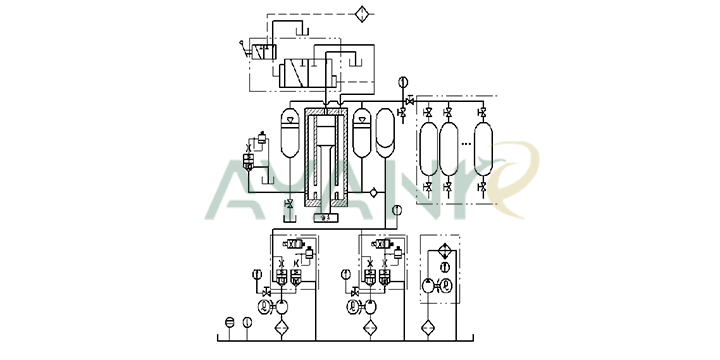
The second is the pump count. Each motor drives its own oil pump, and the pumps are switched in as the blow needs more flow: one pump on the 25 kJ, ten on the 450 kJ and above. That is why the strike frequency stays in the 55-70 range up to 125 kJ and then eases off — the frame is carrying more falling mass, not a weaker drive, and the connected load rises from 55 kW to about 750 kW across the range.
What a Closed Die Hammer Forges
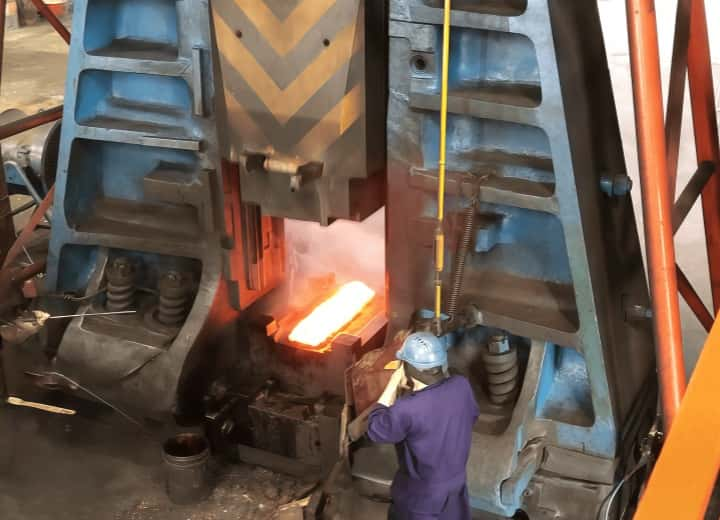
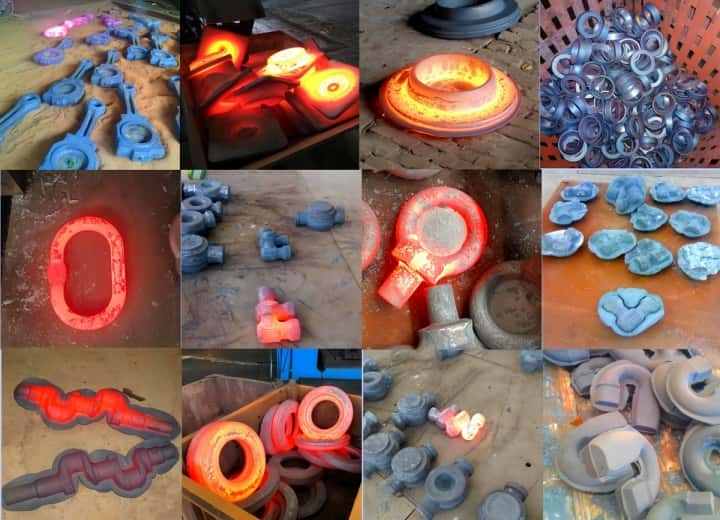
Closed die forging shapes the part inside a machined cavity. The billet is heated, set in the bottom die, struck, turned or transferred, and struck again until the cavity is full and the surplus leaves as flash. One part is normally a sequence: an upset to spread the metal, a blocker to rough the shape, and a finisher that fills the corners.
The hammer does that in milliseconds, which is the reason it still holds its place next to a press. A thin rib or a sharp corner fills because the energy arrives before the metal can chill against the die face; a slow squeeze on the same section can leave the corner short. On the C86YA the blow repeats to ±1.5%, so the finisher on the hundredth part is the same as on the first, and the flash line stays where the die was cut for it.
For the drive side — what the hydraulic circuit does between blows, the main components, the types of hydraulic hammer, and how they compare with a pneumatic one — see how a hydraulic forging hammer works.
Work this hammer is normally tooled for:
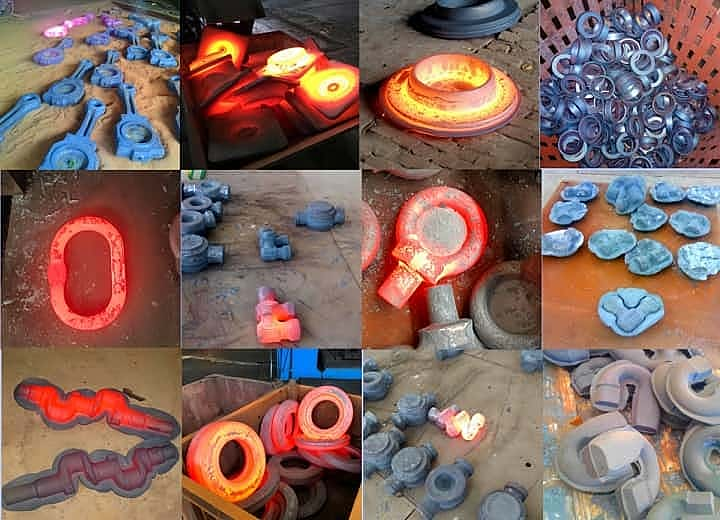
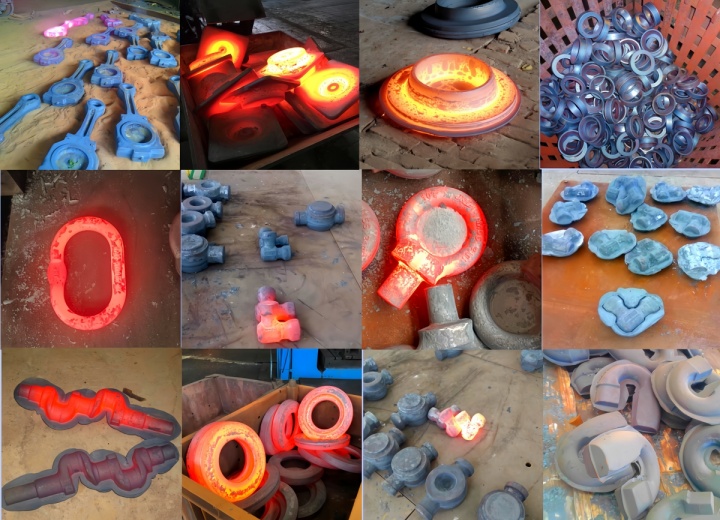
- Hand tools, hardware and fittings — the high-volume family this series was built around
- Automotive forgings — levers, yokes, brackets and similar parts with a consistent machining allowance
- Aerospace and general engineering blanks — where the weight of the forging has to stay inside a band
- Flanges, couplings and valve bodies — upset and finished in two or three blows
- Preforms for a press line — where the hammer distributes the metal and the press finishes the tolerance
Materials: carbon and low-alloy steels, medium-carbon alloy steels such as 42CrMo, tool and die steels, stainless and heat-resistant alloys. On the heat-resistant grades the repeatability matters more than the tonnage — the window in which the alloy will fill a cavity without cracking is narrow, and a blow that varies by a few percent moves the part outside it.
Three numbers size the hammer, in this order: the maximum forging weight or the largest projected area (that sets strike energy), the die block size and minimum die height (that sets rail spacing and the frame), and the annual output (that decides how much of the cycle has to be automated). Send the die drawing with the part drawing and we size from those three.
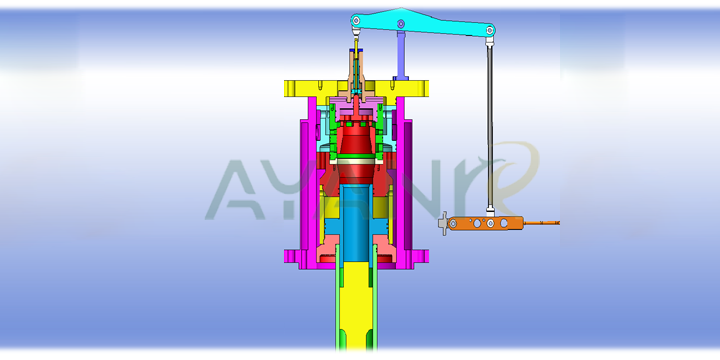
If the mechanism behind those three numbers is what needs explaining — how the ram is driven, where the energy comes from on each blow and why the die closes the way it does — die forging hammer principles sets it out from first principles.
C86YA or C92KA: Two Closed Die Hammers
These two are the closest pair in the range. The C86YA covers 25 to 630 kJ, the C92KA covers 16 to 625 kJ, and between 25 and 625 kJ the capacity does not decide it — the control does.
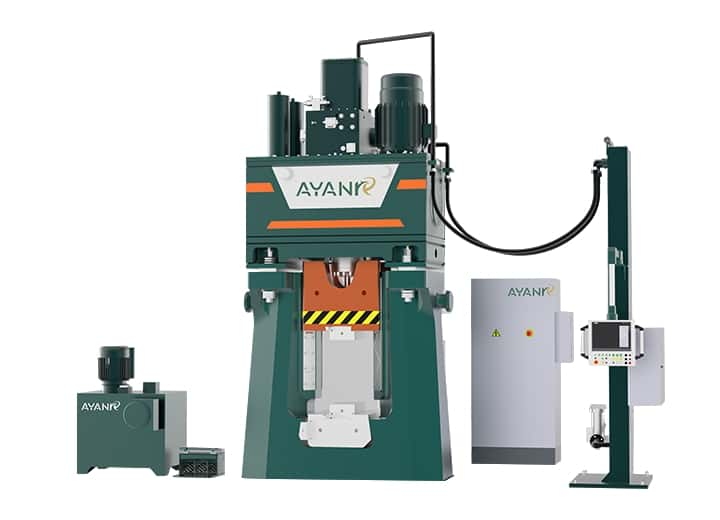
- The C86YA is handle-controlled. One die stays in the machine for weeks, the operator sets each blow by feel, and the machine is the simpler and cheaper of the two. That suits a shop running a narrow family of parts on long runs.
- The C92KA is CNC. Blow energy, blow count and the order of the blows are a stored program, which suits frequent die changes, thin-wall cavities that need a different energy on each blow, and a hammer that has to sit inside an automatic line.
- Neither is right for one-off, large or open work — that belongs on an open die hammer such as the C66YA double-arm or the C61YA single-arm, or on an open die press such as the Y13KA.
A second distinction is worth clearing before a quotation: impact against squeeze. A hammer fills a thin rib because the energy lands before the metal chills; a die forging press holds a load long enough for metal to flow into a deep cavity and holds tolerance better on a thick section. Parts that need both usually run two operations rather than one machine.
To compare the C86YA against the rest of the field rather than just the C92KA — feature comparison and structural diagrams side by side — see how to choose a die forging hammer.
Price, Lead Time and Ordering
There is no public price list, because a C86YA is configured to your requirements. The frame comes in 10 standard capacities; the die package, the control arrangement and the electrical specification are set per project. Here is what moves the price:
- Strike energy and frame size — from 25 kJ to 630 kJ, and with it the hammer mass, the rail spacing and the number of pumps
- Die seat and die package — the die seat runs 550/700 mm to 2,200/2,300 mm, and whether the dies come from us or from your toolroom changes the scope
- Automation and ancillaries — die lubrication and cooling, a transfer, and the guarding the line needs
- Electrical specification — 55 kW on one pump up to ten 75 kW motors, at your voltage, phase and frequency
- Foundation, anvil block and erection scope — a hammer foundation is a different structure from a press foundation, and it is the item most often under-estimated
- Spare parts package and shipping terms — which spares you keep for the first year, and whether the quote is ex-works or delivered
To move from a range to a firm number, send five things: a drawing or a clear photo of the forged part, the material grade, the forging weight or the largest projected area, the die drawing with its closed height and block size, and your annual output. If the hammer goes into a line, say what sits on either side of it.
What comes back is a capacity recommendation with the reasoning, a quotation against your specification, the foundation load drawing, and the power and utility requirements for that machine. Lead time is quoted per order, because the capacity and the scope both move it: the hammer is scheduled into production once the configuration is confirmed, so the date comes with the quotation rather than being guessed in advance.
C86YA Die Forging Hammer FAQ
What does 630 kJ mean, and how does it relate to tonnage?
630 kJ is the work one blow delivers. Where a buyer quotes tonnage instead, it is the steam-air equivalent at roughly 35 kJ per tonne, so the 630 kJ frame sits in the 18 ton class. Hammer mass, 25,000 kg on that model, is a separate figure — it is the falling weight, not a tonnage.
What is minimum closed die height, and why does it matter?
It is the shortest die stack the hammer can close — 220 mm on the 25 kJ, 500 mm on the 400 kJ and above. If your die is shorter than that, the ram runs out of stroke before the blow lands, and moving up a size makes it worse because the minimum grows. Check the die drawing against this row before the energy row.
Why does the strike frequency drop on the larger models?
Because the falling mass rises faster than the pump capacity does. 55-70 blows per minute holds up to the 125 kJ, then eases to 35-40 at the 500 and 630 kJ, where the ram weighs 20,000 to 25,000 kg. The pumps are added to keep the blow energy, not to keep the blow rate.
C86YA or C92KA — how do I choose?
By control, not capacity — the ranges overlap from 25 to 625 kJ. The C86YA is handle-controlled, simpler and cheaper, and suits one die running for weeks. The C92KA stores blow energy and blow count as a program, which suits frequent die changes and automatic lines.
Can it forge thin walls without sticking in the die?
That is what the fast return stroke is for. A hydraulic ram lifts as soon as the blow is delivered, without the exhaust delay of a steam or air hammer, so the part is not left sitting in the cavity while the die cools around it. Thin sections still need the die designed for them, but the hammer is not the limiting factor.
How much power does it need?
One 55 kW motor on the 25 kJ, rising to ten 75 kW motors on the 450 kJ and above — a connected load of about 750 kW at the top of the range. Each motor drives its own oil pump, so the supply is sized for the total rather than for a single motor.
Can it run inside an automatic forging line?
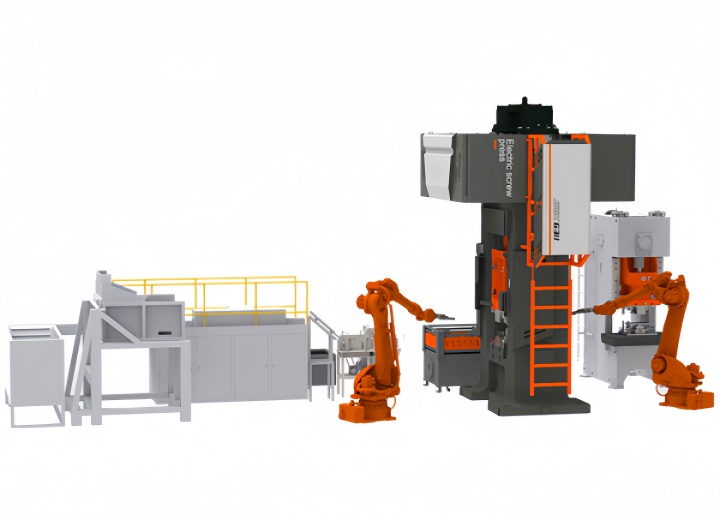
Yes, with the ancillaries that make it repeatable — die lubrication and cooling, a transfer or robot, and guarding. What it does not have is a stored program: the blow is still set by the operator, so the line needs a fixed part family. If the line has to change parts often, the CNC version is the better fit.
Is the C86YA a fixed model, or configurable to my requirements?
Configurable. The 10 capacities are standard frame sizes; the die seat, the die package, the ancillaries and the electrical specification are set per project. That is also why there is no published price, and why the delivery date comes with the quotation rather than off a table.