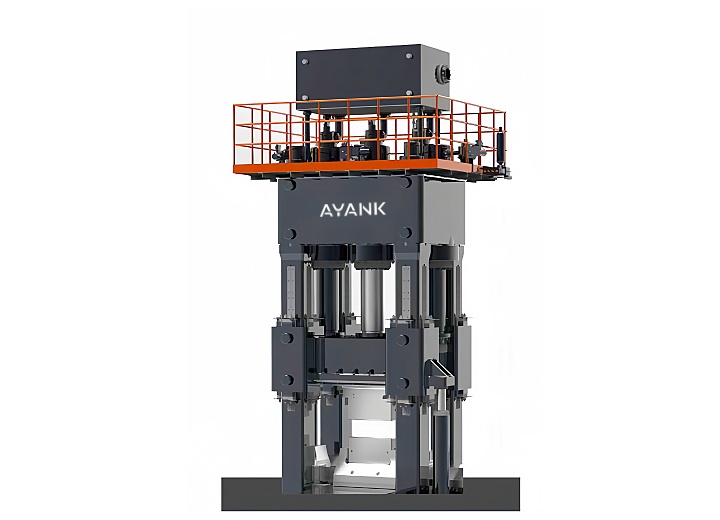
A rapid open die forging hydraulic press is an open-die press built for forging frequency as much as for force. The difference shows up in the heat: a billet that is worked quickly stays inside its forging window, and one that is worked slowly does not.
I. Basic Information of the Rapid Open Die Forging Hydraulic Press
1.1 Product Name
Y13A Series Rapid Open Die Forging Hydraulic Press.
1.2 Functions
The AYANK FORGING rapid open die forging hydraulic press performs the full range of open-die forging processes:
Upsetting, drawing out and punching.
Ring expanding, twisting, bending and offsetting.
Cutting.
It runs in full-automatic, semi-automatic, manual and linkage modes, with easy switching between them, and it comes with a complete set of auxiliary devices.
1.3 Specifications and Models
The Y13A series covers 800 to 16,000 tons in thirteen specifications. The representative model of the large-tonnage range is the Y13A-16000.
Y13A rapid open die forging hydraulic press: the thirteen specifications. Configurable to your requirements.
Core advantages against a traditional open-die hydraulic press: faster forging frequency, higher production efficiency, higher precision, energy saving and lower environmental load, a higher degree of automation, and the ability to meet a wider spread of process requirements.
II. Core Advantages of the Rapid Open Die Forging Hydraulic Press
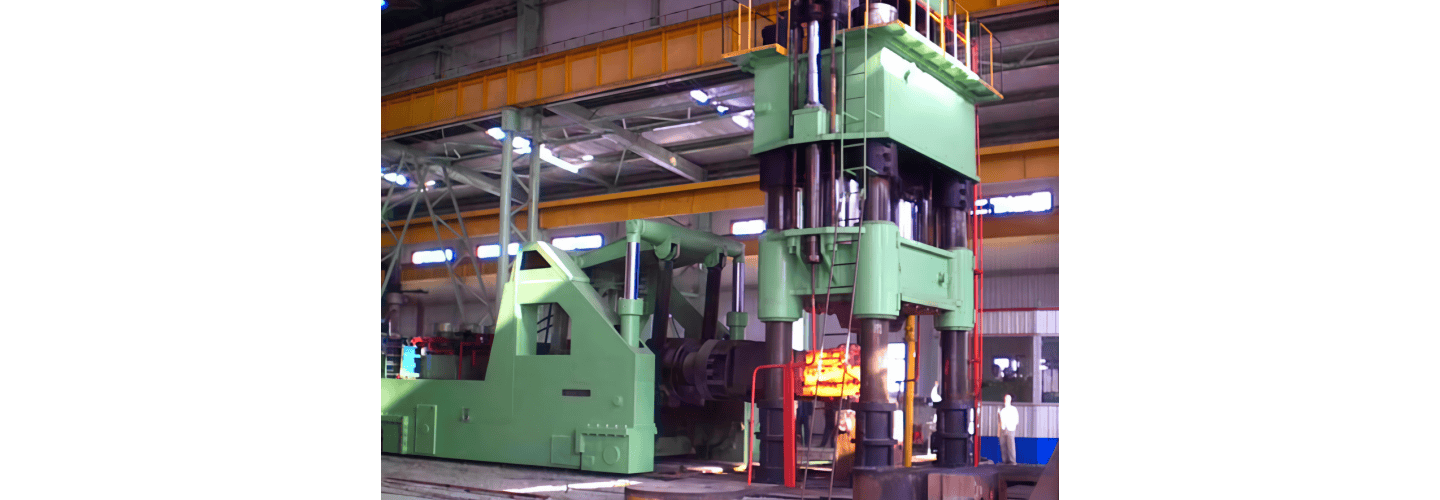
A 4,000-ton Y13A on site, with the manipulator alongside.
2.1 Core Advantages
High precision, high frequency, intelligent linkage, safety and stability, and enough adaptability for the open-die forging requirements of medium-to-large forgings across several industries. That combination is what makes it core equipment for high-end open-die forging rather than a general-purpose press.
2.2 Differentiated Features
High speed with high precision: against traditional open-die equipment it forges faster and to tighter precision at the same time, so efficiency and quality are not a trade-off.
Strong intelligent linkage: 1+1 linkage between the press and the manipulator, with online control and real-time monitoring - a level of automation a traditional press does not reach. How the two machines are matched is set out on the CNC forging manipulator page.
Safety and stability: a multi-stage pressure relief system plus comprehensive safety detection devices, on a frame with strong rigidity and resistance to eccentric loading, running without vibration.
High operational convenience: remote indoor control and human-machine interaction, with low labour intensity. One operator can run the coordinated linkage through the whole sequence.
III. Core Features of the AYANK FORGING Rapid Open Die Forging Press
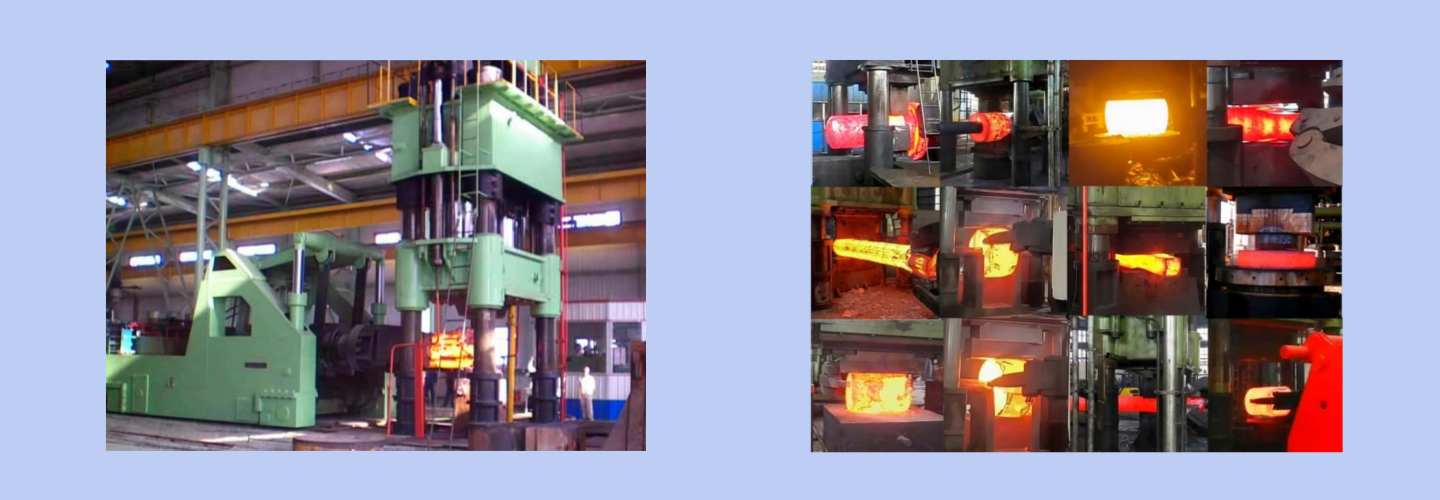
The 4,000-ton press with its manipulator, and the open-die operations it covers.
3.1 Intelligent Control System
Control configuration: human-machine interface for input and display, PLC control, and a two-level system built on PLC plus industrial computer. It carries a single-operator interactive interface and a fault diagnosis system.
Control functions: 1+1 linkage between press and manipulator, plus manual adjustment, manual operation and semi-automatic operation selection. Idle stroke, working stroke, return and ejection are all available as press actions.
Operation method: the joystick switch reaches downward movement, upward movement, forging, pressure holding and ejection without effort, and the console can sit indoors - which is a better place for the operator to spend a shift.
Monitoring: multi-directional real-time monitoring gives the operator production-process and equipment-status information at several levels, live.
3.2 Hydraulic Integrated Control System
System configuration: a two-way cartridge valve integrated control system, with two-stage control on oil inlet and outlet.
Pressure relief advantage: the main cylinder and the system pipeline unload through a three-stage hydraulic-electrical combined high-speed method, with unloading time of 0.3 seconds.
Operation effect: the press works quickly, smoothly and without vibration, which is what holds forging precision and equipment stability together.
3.3 Quick Anvil Change Device
The anvil uses a T-slot hanging method, so upper anvil blocks of different specification swap quickly. A worktable moving device and an anvil transverse moving device come with it, which is where the gain in production-line efficiency comes from: the press spends its time forging rather than being re-tooled.
3.4 Multi-Point Multi-Stage Pressure Relief System
Pressure relief configuration: the two-way cartridge valve integrated control continues here, with two-stage control on oil inlet and outlet and three-stage high-speed unloading for the main cylinder and pipelines.
Fluid replenishment: zero-pressure replenishment using a large replenishment tank and a large filling valve built into the oil tank, so replenishment is fast and complete, safe, and free of leakage.
What it does: it is the main reason the machine holds its stability through a long shift, and it is what extends service life.
3.5 Comprehensive Safety Detection Devices
Detection devices: oil temperature, liquid level and cooling alarms, plus hydraulic system pressure detection.
Protection functions: integrated motor protection, loss-of-pressure protection, oil filter blockage alarm, liquid level alarm and oil temperature alarm, with automatic cooling. System voltage and current are monitored and recorded automatically, so both the machine and the operator are covered.
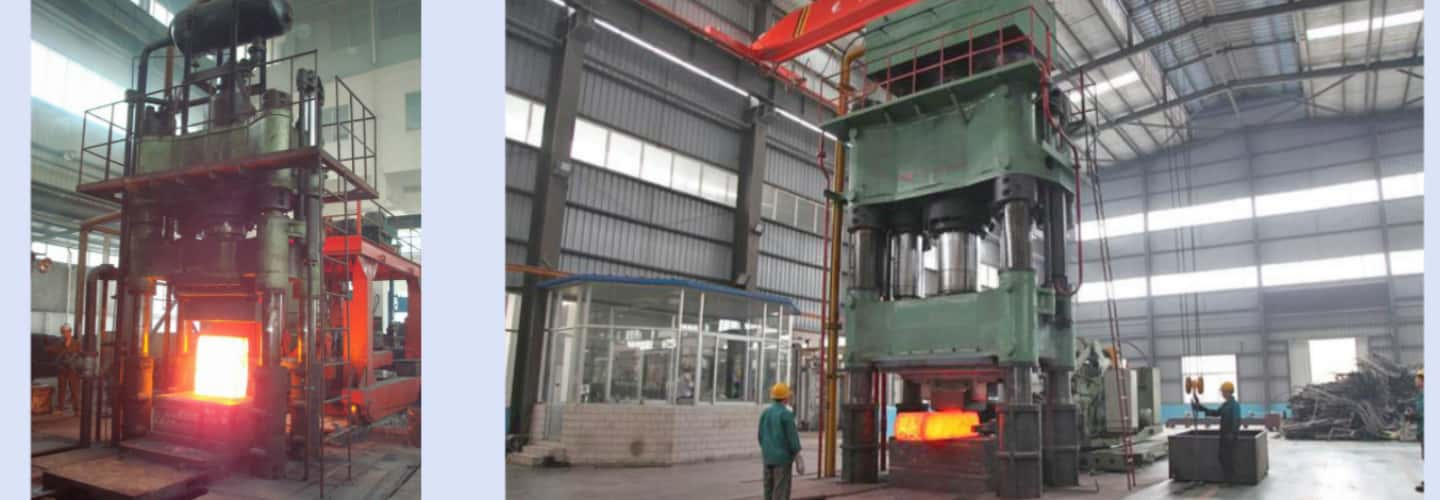
The Y13A press: four-column preset frame, with the main cylinders inside the crown.
IV. What Rapid Forging Changes on the Floor
Frequency is not a comfort feature. A billet comes out of the furnace with a finite amount of heat in it, and every action that is not a strike spends some of that heat. Where the press cycles slowly, the billet cools between blows, the last passes have to be forced, and the heat is often finished with a reheat - which costs furnace time and costs metal to oxidation scale.
Three things on this machine attack that directly. The 0.3 second three-stage unloading shortens the dead time between strokes. The quick anvil change with its worktable and anvil traverse keeps the press working instead of being re-tooled. And the 1+1 linkage lets the manipulator turn and advance the billet on program while the press cycles, so the handling that used to eat the heat happens inside the cycle instead of between cycles.
What that buys in practice is fewer reheats per forging, more of the deformation done inside the window where the metal wants to move, and a part that arrives at the next operation closer to size - which is where the machining allowance comes down.
V. What to Send for a Model Recommendation
Six things settle the model, and none of them is the tonnage alone:
The forging drawing or 3D model, with the largest section and the finished weight.
The starting billet or ingot - weight and size, since that is what the manipulator has to hold.
The material, because it sets the forging temperature window and how many passes the part needs.
The largest forging you will ever make on the machine, not the average one.
Output per shift, which decides between one press and a linked line.
Whether a manipulator is already in place, since an existing machine fixes the rail layout and the linkage interface.
Frequently Asked Questions
What tonnage range does the Y13A rapid press cover?
800 to 16,000 tons across thirteen specifications, from the Y13A-800 to the Y13A-16000. The Y13A-16000 is the representative model of the large-tonnage range.
Which forging processes can it perform?
Upsetting, drawing out, punching, ring expanding, twisting, bending, offsetting and cutting - the full open-die set. It runs full-automatic, semi-automatic, manual and linkage modes, with easy switching between them.
What does 1+1 linkage mean?
One press plus one manipulator, coordinated by the control system. The manipulator turns and advances the billet while the press cycles, so handling happens inside the forging cycle instead of between cycles, and one operator can run the pair from the console.
How fast is the unloading?
0.3 seconds, through a three-stage hydraulic-electrical combined high-speed unloading method on the main cylinder and the system pipeline. That short dead time between strokes is where the forging frequency comes from.
What does the quick anvil change consist of?
A T-slot hanging method for the upper anvil blocks, plus a worktable moving device and an anvil transverse moving device. Different anvil specifications swap quickly, so the press spends less time being re-tooled.
What does the safety package monitor?
Oil temperature, liquid level and cooling, plus hydraulic system pressure. Protection covers the motor, loss of pressure, oil filter blockage and the level and temperature alarms, with automatic cooling, and system voltage and current are recorded automatically.