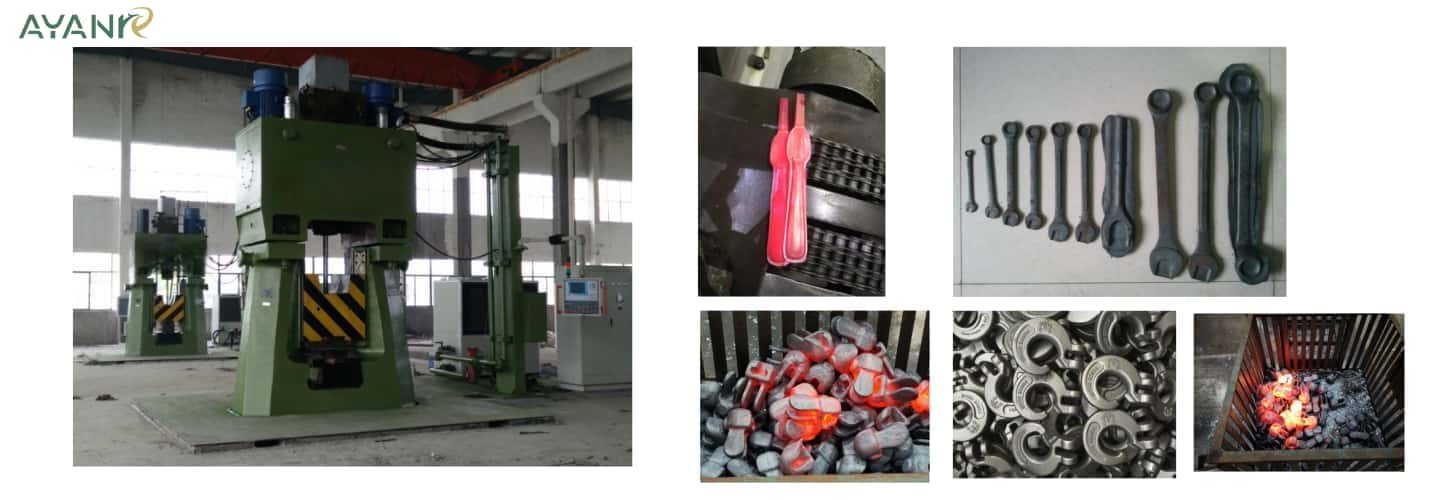
The C92KA is built around digital precision control: blow energy holds to ±1.5% repeat accuracy, strike frequency and throughput run high, the frame stays stable under eccentric load, and service runs across the whole machine life. That combination is what lets one hammer cover precision forging across a wide range of parts.
Four points carry the case. Blow accuracy matches the German equivalent standard. The large-tonnage end reaches 625 kJ, the top of the range. The company has been building forging equipment for over 70 years. And machine selection, installation, commissioning and spares are handled as one package rather than sold off separately.
The core features of a CNC forging machine come down to this list: high forging precision, high production efficiency, stable forging quality, stable comprehensive performance, energy saving and environmental protection, a digital intelligent system, and multiple safety protections. Each one is set out below with the mechanism behind it and what it changes on the shop floor.
Core support: A unique striking valve system controls valve closure time precisely, which holds repeated blow energy within ±1.5% - beyond the national standard and at the German equivalent level. The mechanical structure is an integral "U"-shaped body with high rigidity and strong resistance to eccentric load. The guide rails use a wide X-shaped structure with adjustable clearance.
Core value: The hammer delivers the energy the forging needs and no extra impact kinetic energy, which extends the service life of the hammer rod, hammer head and dies. Dies of different heights are handled by adjusting the blow start point, so energy consistency and accuracy hold across a die set change. Precision at this level suits multi-cavity forging, with dimensional error within 0.2 mm, weight error within 0.3% and a high surface finish.
Core support: A spool-type control valve (Patent No. 201220657007.7) works together with a large-hammer-head, short-stroke structure. The return stroke is hydraulic, acting like a hydraulic spring, with millisecond-level control time for quick response and a smooth direction change. The lower chamber of the main cylinder stays connected to an accumulator, so once the upper chamber depressurises the ram lifts fast and the next blow follows quickly.
Core value: Strike frequency is more than double that of an ordinary die forging hammer, which lifts the throughput of the whole forging line rather than just the hammer. Short-stroke striking and die vibration are both available, so multi-process continuous production runs with less manual intervention.
Core support: The forging process and the blow energy are controlled through a programmable controller that stores and recalls multiple sets of forging parameters, so a repeat run holds its accuracy. Blow energy is digitally adjustable from 0% to 100% in single-percent steps. Position and energy feedback both run closed loop.
Core value: The first-time forming rate rises because quality no longer depends on how the operator happens to strike that shift. Complex, irregular-shaped forgings that are hard to hold by hand are where the gain is largest, and the scrap rate falls with them.
Core support: Blow energy is controllable to a fine degree and blanking precision is high, so the flash around the forging comes out uniform. High forging precision also removes the mismatch between upper and lower dies.
Core value: Uniform flash and matched dies are the two conditions for minimal or no machining, which cuts material waste, improves material utilisation, lowers what the bar stock costs per part, and shows up in the overall economics of the job.
Core support: Contact time between hammer head and die is short, and precise energy control keeps the blow at what the cavity needs, so die wear drops. The integral "U"-shaped body has no joint between upper and lower frames, which removes frame bounce and keeps scale out of the joint - scale ingress is what deforms the frame and costs precision over time. The oil tank is sealed and runs a two-stage filtration system, giving the hydraulic system strong resistance to contamination.
Core value: Die service life is extended by more than double. Equipment performance stays stable, the failure rate is low, maintenance cost falls significantly and the service life of the machine as a whole is longer.
Core support: Precise energy control removes energy that would otherwise be spent on blows the forging does not need, and system oil temperature stays low. GERB vibration isolators combined with the no-excess-energy strike design keep both vibration and noise down.
Core value: Power draw is significantly lower than a traditional forging hammer. The drop in noise and vibration changes what the workshop is like to work in, reduces the safety exposure that comes with sustained noise and vibration, and lowers occupational injury.
Core support: High ram speed and a fast strike rate make up for lower single-blow energy, which lets a small frame take on work normally given to a bigger hammer. The hammer rod uses a flexible thin-rod structure that avoids over-constraint and die jamming. Forging at low temperature is possible, and the hammer handles a range of forging materials.
Core value: Thin-walled, irregular-shaped, thin-ribbed and tight-tolerance forgings are within reach, including the high-density irregular parts used in aerospace. The same machine covers multi-variety, high-volume work across several industries, and it can be tied into an automated forging line.
Core support: The ram rises and descends slowly on command, which makes die change and adjustment both convenient and safe and cuts die change time by more than 10 minutes. Forging parameters are stored and recalled. A three-position foot switch covers program step, ejection and extra blow for different production situations. After a die change, entering the die height sets the energy automatically.
Core value: The skill level an operator needs drops, and so does the cost of training one. Die change and parameter adjustment take less time, so unplanned downtime shrinks with them.
Core support: The control system uses high-end components from home and abroad, including Siemens PLC and touch screens, and the human-machine interface is built for daily use. Functions include online monitoring of equipment status, OEE data collection, automatic oil temperature control, fault detection, maintenance reminders, and remote control and remote maintenance.
Core value: Blow energy, stroke and step count are all controllable and adjustable, and programs are recalled rather than re-entered. Because the machine generates no heavy impact or vibration, robots and loading equipment can be mounted alongside it, which is what makes the step into a forging automation production line practical.
Core support: The main striking valve uses a spool structure that separates control from flow switching, which removes the effect of machining error and the risk of the spool sticking, so repeat accuracy stays under control. Every control valve is a standard design; only the striking valve is proprietary, and everything else is a standard part that is easy to source. The hoses are Austrian Semperit Grade 4 and 6, high-strength, steel-wire-reinforced, oil-resistant and rated to 35 MPa, with high pulse resistance for the duty cycle of a high-frequency hydraulic system. The fittings use a heavy-duty 24° cone form for reliable sealing and impact resistance.
Core value: Stable operation and blow energy that can be set precisely both push the yield rate up. Standard parts are easier to buy and quicker to replace, which lowers both the difficulty and the cost of maintenance.
Core support: The hydraulic station is built to prevent external leakage: the large valve blocks sit directly in the oil tank, so any seepage at a joint runs straight back into the tank instead of onto the floor. Imported core seals carry the sealing duty, and the machine is shorter overall as a result of the layout.
Core value: Hydraulic oil loss drops, seal replacement intervals stretch out, and the lower equipment height makes access easier. Maintenance is quicker and costs less.
Core support: Safety modules cover anti-misoperation, anti-leakage, anti-collision and jacking, and anti-loosening. An external buffer cylinder above the hammer rod provides throttling cushioning and flexible limiting. The accumulators sit at a low position, which cuts equipment height and lowers the risk they carry. Both control ends of the striking valve have buffer devices to prevent spool collision failure, and imported anti-loosening washers improve resistance to vibration. The hammer rod uses an extra-long piston structure with multiple imported sealing rings. A safety device on the lower rod seal stops high-pressure oil spray if the rod fractures.
Core value: Each of these closes off one route to a failure, so operator safety and the machine itself are protected and the risk of a major incident is reduced.
The twelve points are not independent claims. The valve, the short stroke and the accumulator produce the strike frequency; the closed loop and the programmable controller hold the energy; the U-shaped body and the X-guides hold the geometry that makes 0.2 mm possible. Take one away and the others lose part of their value - which is why the accuracy figure and the die life figure tend to arrive together on the same machine, and why a hammer specified on price alone rarely reproduces either.
Within ±1.5% of the set energy, held by the striking valve system, which controls valve closure time. The same accuracy is maintained across a die set change by adjusting the blow start point for the die height.
Dimensional error stays within 0.2 mm and weight error within 0.3%, with a high surface finish. That is what supports multi-cavity forging and the move to minimal or no machining.
Strike frequency is more than double that of an ordinary die forging hammer. The gain comes from the large-hammer-head, short-stroke structure, the hydraulic return stroke with millisecond-level control, and the lower chamber staying connected to an accumulator so the ram lifts as soon as the upper chamber depressurises.
Patent No. 201220657007.7, for the spool-type control valve. Only the striking valve is proprietary; every other control valve is a standard part.
35 MPa, on Austrian Semperit Grade 4 and 6 steel-wire-reinforced hoses with high pulse resistance, joined by heavy-duty 24° cone fittings.
Yes. Blow energy, stroke and step count are all programmable and controllable, programs are recalled rather than re-entered, and the machine produces no heavy impact or vibration, so robots and loading equipment can be mounted alongside it.
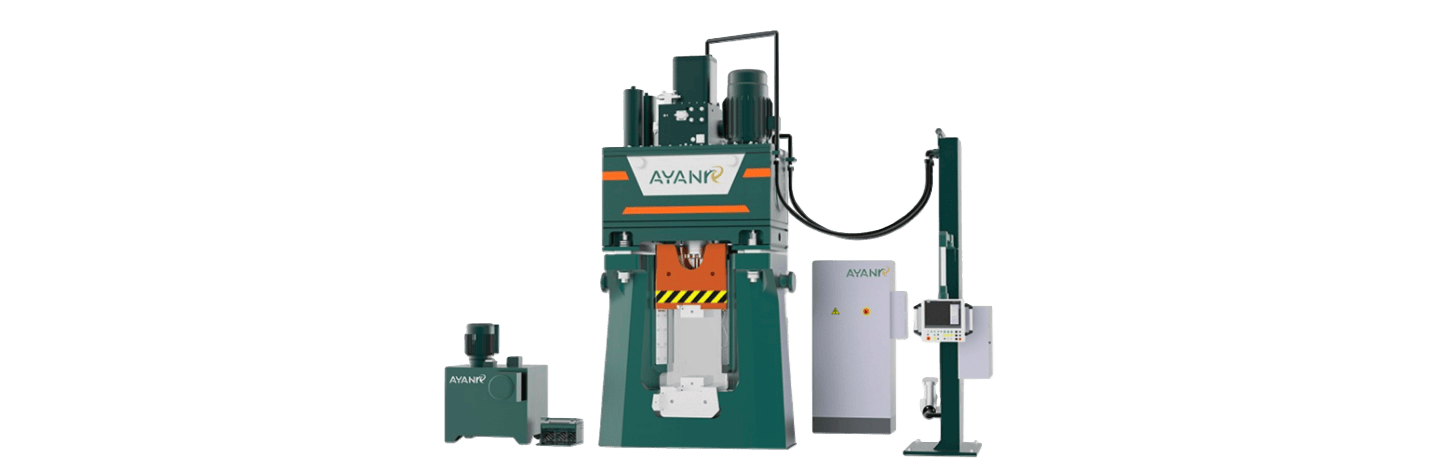
Send your forging drawing or part details — we will recommend the machine that fits and quote it.
Receive the news that you are interested in.
