A forging manipulator is the machine that holds the billet while a hammer or a press works on it. Without one, the job comes down to an overhead crane and a crew - and on a large forging that is where the time, the heat and the risk all go.
The CNC forging manipulator is an indispensable large-scale auxiliary machine in forging. Ultra-large forgings are both the foundation and the key bottleneck of the global heavy equipment industry, and they carry real weight for a country's economic development and its defense programs.
Forge a large forging with an overhead crane and the problems start immediately: the crane cannot turn the part quickly enough, so forging time stretches, the number of reheats climbs, and material loss climbs with it. It was against exactly that difficulty that the AYANK technical team developed the T31DYB series CNC forging manipulator and the T31 series forging manipulator.
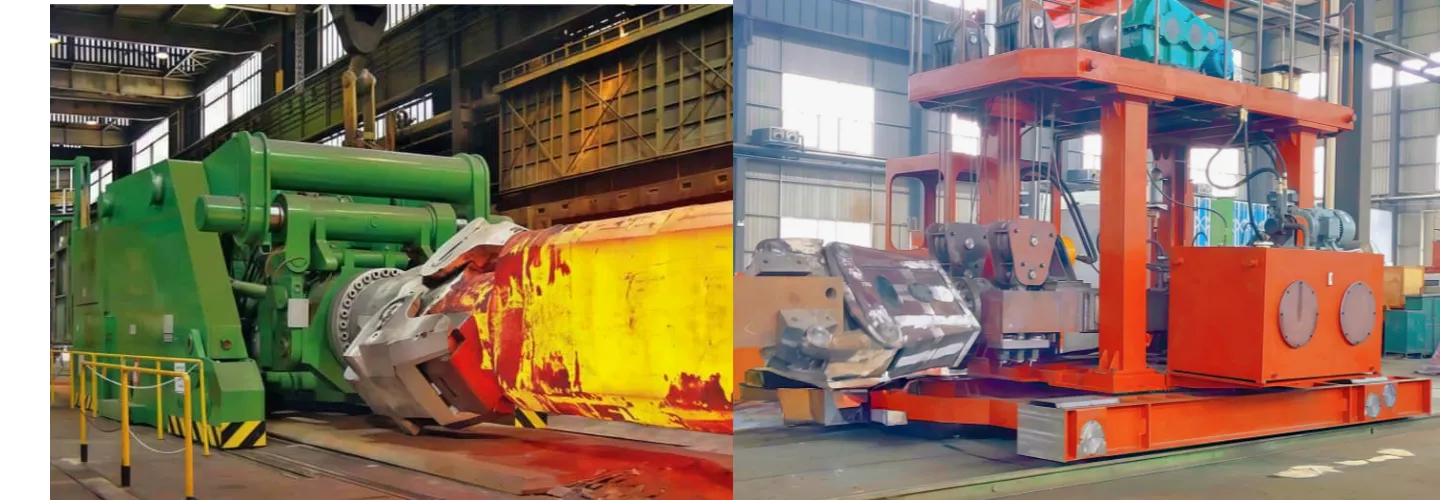
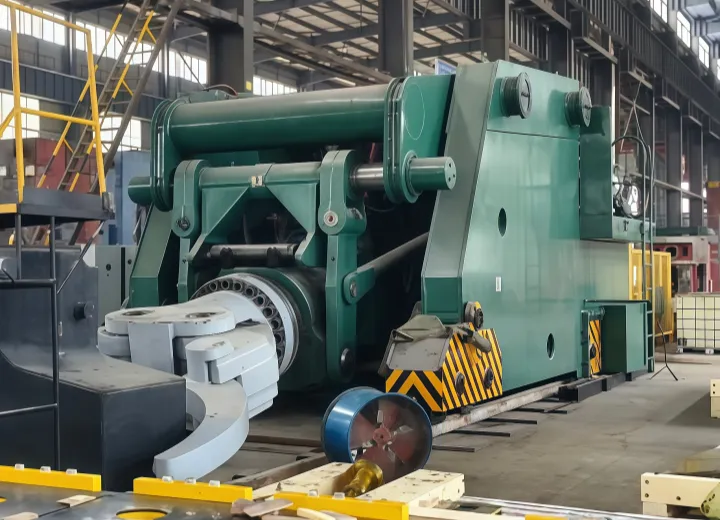
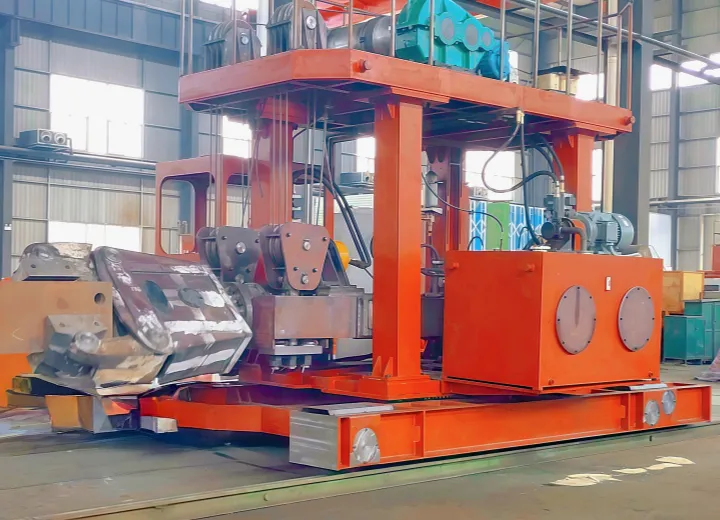
In the forging shop, the manipulator is the machine that handles the red-hot billet. It runs on wheels along a fixed rail, carries a cab for its own operator, and reaches forward with two large pincer arms that work as the machine's hands.
When a hot billet comes out of the circular furnace, hydraulic power closes the tongs on it, and the operator moves it forward or back, clamps or releases it, or turns it over. Working with a fully hydraulic open-die forging hammer or a hydraulic press, the manipulator positions the billet for each blow until it reaches the required shape and size.
Five mechanisms carry all of that movement, and each one answers a different question at the anvil:
Those five mechanisms produce five actions the operator uses continuously:
Forging is one of the main means of metal processing and holds a pivotal place in the equipment manufacturing industry - which is why the machine that feeds it matters as much as the hammer itself.
Traditionally an overhead crane lifts the rough blank, then turns it over and moves it. That is slow, and it is done close to a hot part hanging on a hook.
The manipulator turns the billet over and moves it under its own power, from an enclosed cab, with the operator kept away from the blank. It is safer, and it is considerably faster.
The manipulator sets the forging angle more precisely, so the hammer lands on the workpiece more evenly and the uneven force distribution of crane handling disappears.
The part can be adjusted at any moment during the sequence. Positioning the billet more flexibly is what the density and mechanical properties of the forging depend on, and mechanised positioning is more accurate than hand positioning - which shows up as consistent forgings and a smaller machining allowance.
A CNC manipulator can be tied to a control system and run as a fully automatic forging line together with a forging press. It also logs clamping force, rotation angle and motion path, which gives process improvement something to work from. Change the jaws and the same machine handles shafts, discs and rings, so utilisation stays high.
The T31DYB series CNC forging manipulator and the T31 series forging manipulator both use fully hydraulic and mechanical-hydraulic hybrid transmission, and both are designed for shaft forgings and large billets. Paired with an open-die forging hammer or an open-die forging press, they are what makes the advantages above real on a shop floor.
Both series are built for the same job at different scales. T31 covers the smaller end with seven models, T31DYB the larger end with eleven, and T31DYB adds hydraulic lateral shift plus manual, semi-automatic and automatic control modes, which is what makes it the one to specify for a linked line.
| Item | T31 series | T31DYB series |
|---|---|---|
| Models | 7, from T31-1 to T31-15 | 11, from T31DYB-8 to T31DYB-120 |
| Nominal load force | 10–150 kN | 80–1,200 kN |
| Max. holding torque | 20–300 kN·m | 200–3,000 kN·m |
| Clamp rotation speed | 15–25 r/min | 12–20 r/min |
| Travel speed | 15–40 m/min | 30 m/min |
| Rail distance | 2,236–3,200 mm | 2,500–5,700 mm |
| Clamp lateral shift | Not in the series table | ±150 to ±300 mm |
| Clamp swing | Not in the series table | ±8° |
The holding range of the T31 series runs from 60 mm to 1,030 mm across the seven models, and T31DYB covers a holding diameter of 170 mm up to 2,300 mm. Working oil pressure is 10–12 MPa on the smaller T31 models and 15 MPa from T31-5 upward, and on T31DYB throughout.
Four numbers decide the match, and none of them is the manipulator's size on its own:
Bring the billet size range, the part weight, the hammer or press capacity and the layout of the bay, and the model follows from those four.
Most manipulator faults trace back to four places, and all four are cheap to check:
It holds the red-hot billet while a hammer or press works on it, and it turns the part between blows. The machine runs on rails with its own operator in a cab, and its two pincer arms clamp the billet hydraulically and move it forward, back, up, down or round.
Because the crane is slow to turn a part, so forging takes longer, the billet cools, and it goes back to the furnace more often. Each reheat costs metal to oxidation scale and costs furnace time. The manipulator turns the part under power and stays in position, which shortens the cycle, cuts the reheats, and keeps the crew away from a hot load on a hook.
Match it to the billet. T31 covers seven models from 10 kN to 150 kN nominal load force with a holding range of 60 mm to 1,030 mm. T31DYB runs eleven models from 80 kN to 1,200 kN, holds 170 mm to 2,300 mm, and adds hydraulic lateral shift with manual, semi-automatic and automatic control - which is what a linked line needs.
On four numbers: the holding diameter against the largest billet, the holding torque against the blow, the nominal load force against billet weight at working reach, and the rail layout against the distance between furnace and hammer. Under-sizing the holding torque is the mistake that shows up first, as the part turning in the jaws.
10 to 12 MPa on the smaller T31 models, and 15 MPa from T31-5 upward and across the T31DYB series. Total motor power on T31 runs from 18.5 kW on T31-1 to 184 kW on T31-15, in line with the load each model carries.
The CNC manipulator can be linked with a forging press to form a fully automatic forging line, and it supports manual, semi-automatic and automatic modes. It also records clamping force, rotation angle and motion path, so the sequence for a given part can be repeated shift after shift rather than re-learned.
Send your forging drawing or part details — we will recommend the machine that fits and quote it.
Receive the news that you are interested in.
