-
Fast Forging Frequency, Energy Saving and Consumption Reduction
Utilizing a combination of high-flow fixed displacement pumps and servo variable displacement pumps for direct drive, along with high-frequency response proportional valve control technology, enables energy-efficient and rapid forging. The conventional forging working speed can reach 60-160 mm/s, and the fine rapid forging frequency is 60-100 times/min. This effectively shortens operation time, improves forging quality, while simultaneously reducing power loss and saving energy costs.
-
Strong Resistance to Eccentric Loading, High Press Reliability
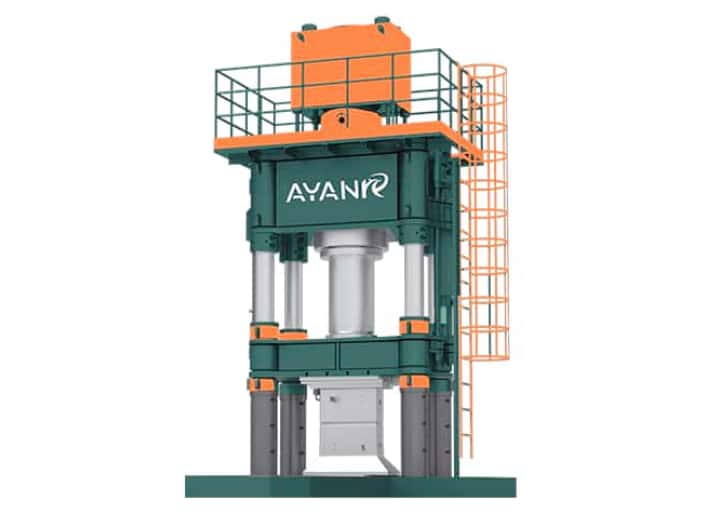
The prestressed frame employs hollow rectangular columns with a large cross-sectional moment of inertia, increasing the pre-tightening force of the tie rods. This integrates the upper and lower beams with the columns into a solid whole, significantly enhancing the press's resistance to eccentric loading. It strengthens the overall structural rigidity, stability, fatigue strength, and load-bearing capacity of the equipment, ensuring long-term stable operation.
-
High Forging Repeatability Precision, Superior Forging Quality
Equipped with a specially constructed extra-long guiding structure, an integral moving beam surrounding the column's cross-section, and a double-concave spherical-hinged short cylindrical rocker shaft adaptive loading system. After the press is loaded, the deformation of the column guiding surfaces on the high-stiffness frame is reduced, effectively minimizing the guiding clearance between the columns and the moving beam. This ensures the repeatability precision of forgings and improves product qualification rates.
-
High Forging Production Efficiency, Achieving Automated Operation
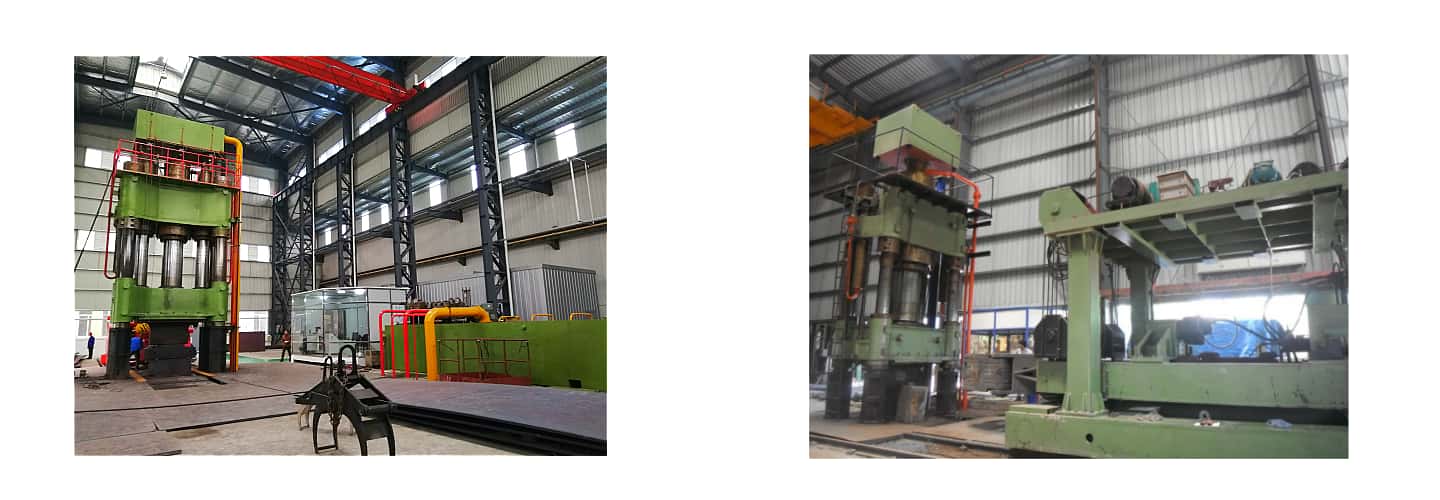
Supported by a comprehensive mechanization system, including a worktable moving device, a die block transverse moving device, a top die quick-clamping rotating device, and an ingot transport/rotating trolley. The workflow coordination between the two-die forging worktable, the die block transverse moving device, and the die holder is optimized. The tool configuration and deployment system can combine and call upper and lower dies according to programmed sequences, shortening auxiliary operation time, reducing physical labor, and realizing the automation and mechanization of open-die forging production, thereby greatly enhancing production efficiency.
-
Easy Operation, Reducing Labor Costs
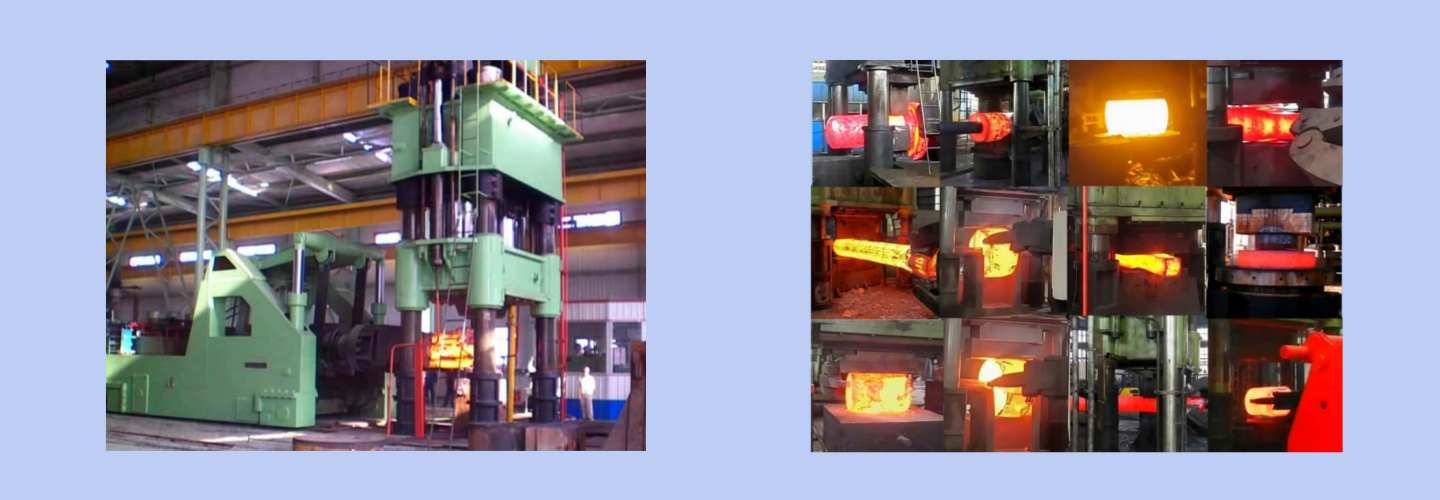
Supports single-operator control, allowing one operator to coordinately control the forging press, manipulator, and auxiliary equipment for synchronized operation. It can complete the entire forging process according to pre-programmed forging sequences. Simultaneously, the forging press can achieve online control and real-time monitoring with the accompanying fully hydraulic rail-bound forging manipulator. The manipulator employs proportional servo control, enabling high-precision automatic control of the tong head's advance/retreat, rotation, lifting, and translation for gripping the forging. It features tilting and lateral swinging functions, cooperating with the press to complete linked forging processes like ingot breaking down, drawing out, and rounding, thereby reducing manpower requirements and operational difficulty.
-
Intelligent Control System, Adaptable to Complex Processes
-
Program Control: Uses a pass schedule as the program forging control method, where one pass corresponds to one program. Complex processes can be decomposed into simple processes, which are then broken down into several passes. Parameters for each pass, such as forging feed amount, reduction amount, and manipulator arm rotation step amount, can be preset in the pass schedule. The computer scans the pass schedule to control all equipment for automatic forging, operating the unit in a press-priority control mode.
-
Exception Handling: If the forging bends, manual intervention is possible, and the program forging can be restarted from that pass, ensuring production continuity.
-
Database Function: The program forging software includes a built-in process parameter database containing parameters like ingot material, initial forging temperature, final forging temperature, and post-forging heat treatment. Data newly generated each time can be stored in the database, supporting subsequent processing and review of process and production data.