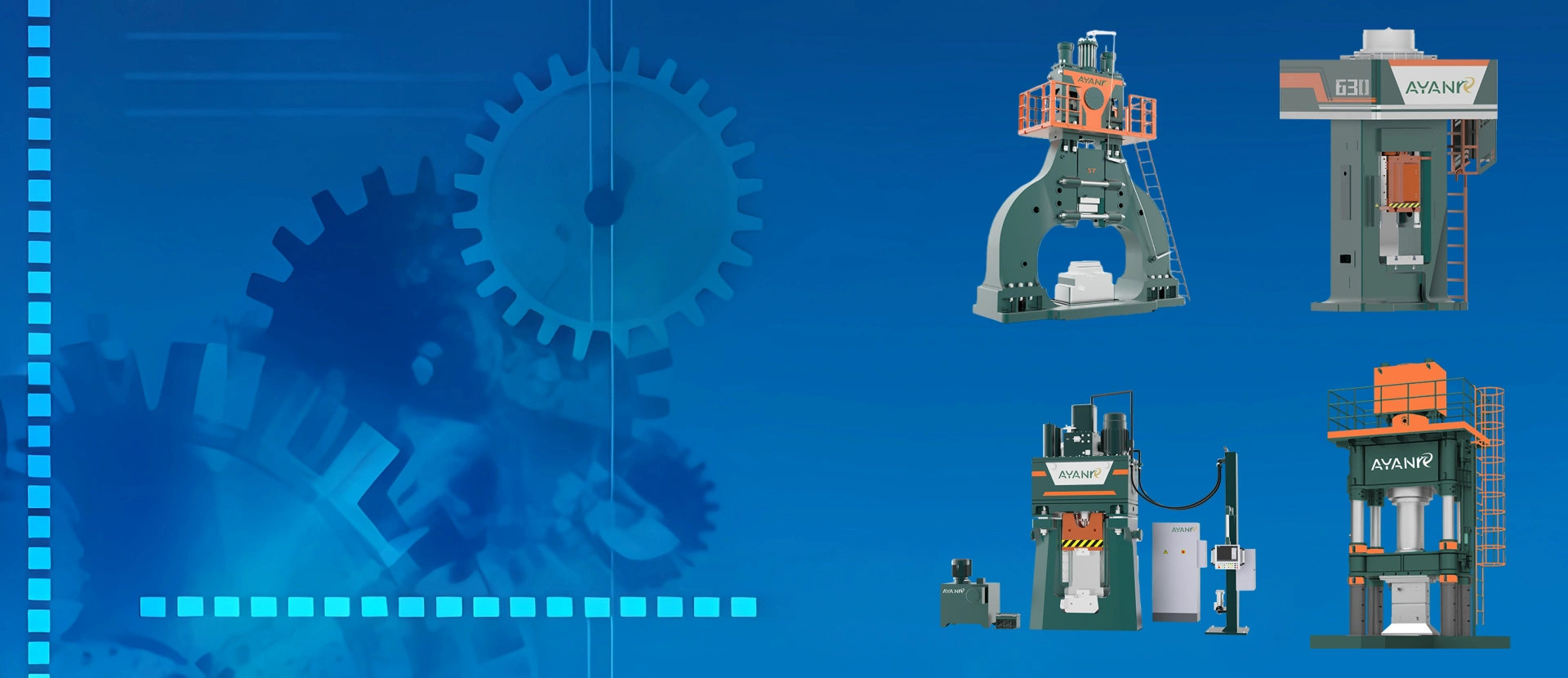
The AYANK FORGING forging charging machine is the core equipment for automated material transfer in a forging workshop. It grips high-temperature billets from the furnace and carries them accurately to the forging press.
A hydraulic-mechanical hybrid drive lets it combine clamping, lifting, rotating, telescoping and traversing in one pass, which is what removes the safety risk of handling hot billets by hand. Three gripping modes, clamp, support and fork, cover billets and forgings of different shapes, so material transfer time drops and the line keeps its continuity.
| Item | Unit | 1T | 1.5T | 2T |
|---|---|---|---|---|
| Nominal load capacity | T | 1 | 1.5 | 2 |
| Clamping diameter range | mm | 50-700 | 50-800 | 80-900 |
| Minimum height of clamp arm | mm | 550 | 650 | 6500 |
| Lifting height of clamp arm | mm | 1600 | 1600 | 1600 |
| Tilting angle range of clamp arm (upward / downward) | ° | 6/12 | 6/12 | 6/12 |
| Rotating angle of clamp arm | ° | 360 | 360 | 360 |
| Distance from clamp arm front end to front wheel centre | mm | ≥3800 | ≥3800 | - |
Read the table as three capacities of the same machine rather than three different machines: lifting height, tilting and rotation are identical across the range, and what changes is the load, the clamping diameter and the height at which the clamp arm sits. If a value is missing for the model you need, ask for the current datasheet rather than working from the blank cell.
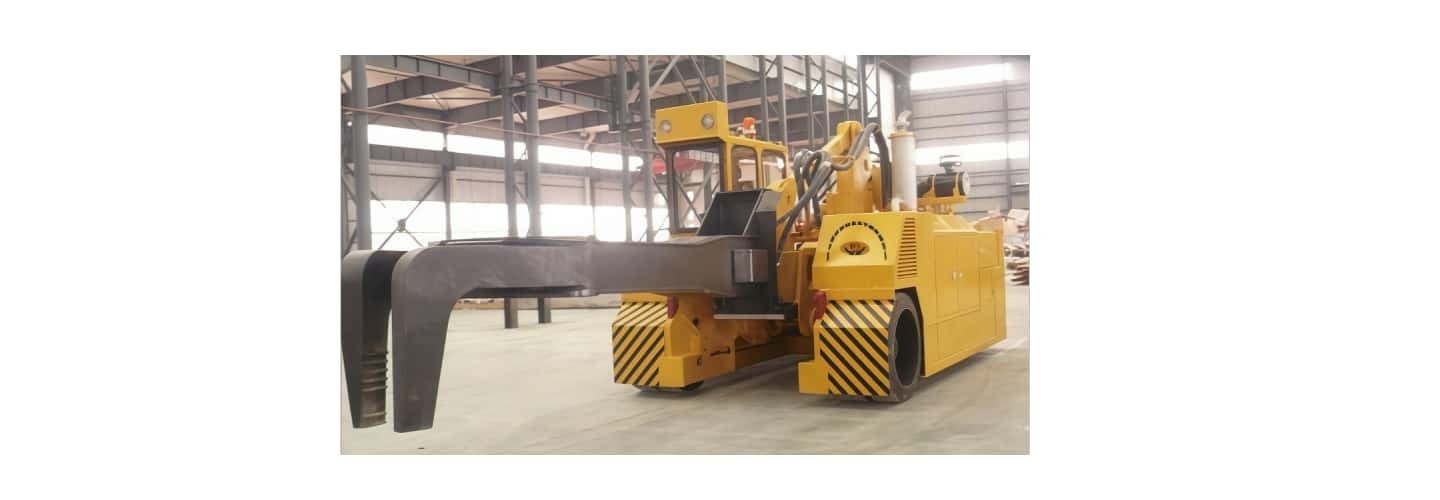
The trackless forging charging machine is a hydraulically driven, wheeled charging and handling machine powered by an internal combustion engine. It loads and unloads billets from furnaces in forging workshops, and it handles, places, flips and manipulates dies for forging hammers. It can also carry out simple forging operations on non-shaft type workpieces at presses.
The machine performs six movements, and it is the combination of them, rather than any single one, that makes it useful at the furnace door:
Free of track constraints, the machine can work at any workstation in the workshop and travel to any location a vehicle can reach. That is what raises its utilisation: a rail-bound unit is idle whenever the one press it serves is down, while this one moves to the next furnace or the next hammer.
Used for furnace loading and unloading, it also changes the job itself. Worker conditions improve, labour intensity falls, hot material is extracted faster, and the heating furnace works more efficiently because the door is open for less time.
The clamp frame can be built in more than one configuration, and it can be changed quickly, which is how one machine serves several jobs:
The choice follows the work: if the job needs the billet turned over between blows, specify the reversible or jaw type; if the job is pure transfer of bar stock, the embracing head gives a more secure hold.
Three numbers decide it. The nominal load capacity has to cover the heaviest billet you actually lift, not the average one. The clamping diameter range has to cover both the smallest bar and the largest die block, because the range narrows at the bottom as capacity rises: 50 mm on the 1 T and 1.5 T, 80 mm on the 2 T. And the minimum height of the clamp arm has to clear the furnace sill and the press bed you work from, which is why the figure rises from 550 mm to 650 mm between the two smaller models.
Where the largest die or the heaviest ingot is close to the limit, go up a size. The lifting height and the reach are fixed, so an undersized machine cannot be stretched later; the cost of the next capacity is small against a machine that cannot lift the job.
The machine is a vehicle, so the workshop has to fit it as much as the machine has to fit the work. Four checks settle most of the risk:
None of these need a survey to estimate, but all of them are cheaper to check before the order than after the machine arrives.
This machine is built around transfer, die handling and light press work. Where a long shaft has to be held and turned through a full sequence of reductions under the hammer, the work belongs to a rail-bound forging manipulator with a continuous grip and a travel axis matched to the hammer. Buying the trackless unit for that job leads to a machine that is always at the limit of what its clamp frame was designed to do.
A wheeled, engine-powered, hydraulically driven machine that grips hot billets at the furnace and carries them to the press, and that also handles and flips dies in a forging workshop. It runs without rails, so it can serve several workstations.
Dies for forging hammers, which it can handle, place, flip and manipulate, and non-shaft type workpieces at presses, where it can perform simple forging operations.
Six: travel, turning, gripper clamping, gripper head rotation, parallel lifting and lowering of the clamp arm, and tilting of the clamp arm upward or downward.
Yes, with the single-arm reversible frame or the manipulator-style jaw. The dual-arm embracing head grips rod, bar and block material securely but cannot flip it.
Because the machine can move to any workstation or vehicle-accessible point in the bay. Utilisation rises, hot material is extracted faster, and the furnace door is open for less time.
Size on the heaviest billet and the largest die block, then check the clamping diameter range and the minimum clamp arm height against your furnace sill and press bed. The range is 1 T, 1.5 T and 2 T.
Receive the news that you are interested in.
