
Open die forging covers a wide range of heavy and low-volume parts, yet the process itself is decided by a small number of variables: how the billet is heated, how the workpiece is turned between blows, and how much reduction each pass takes. This guide explains the process, the equipment that performs it, the part types it suits, and what buyers should verify before placing an order.
Quick Answer
Open die forging is a hot metal forming process in which a heated billet is shaped between flat or simply contoured dies. There is no enclosing die cavity: the workpiece is rotated, repositioned and struck repeatedly until it reaches the required section. Because the tooling does not define the part geometry, open die forging is used for large, heavy or low-volume components — shafts, discs, blocks, hollow bodies and rings — where the cost of a closed die could not be recovered by production volume.
- Tooling: flat or simple dies, no machined cavity, so tooling cost stays low.
- Size ceiling: set by ingot weight and machine capacity, not by die size.
- Precision: looser than impression die forging; a machining allowance is normally required.
- Best fit: single pieces up to a few thousand units per year, particularly heavy parts.
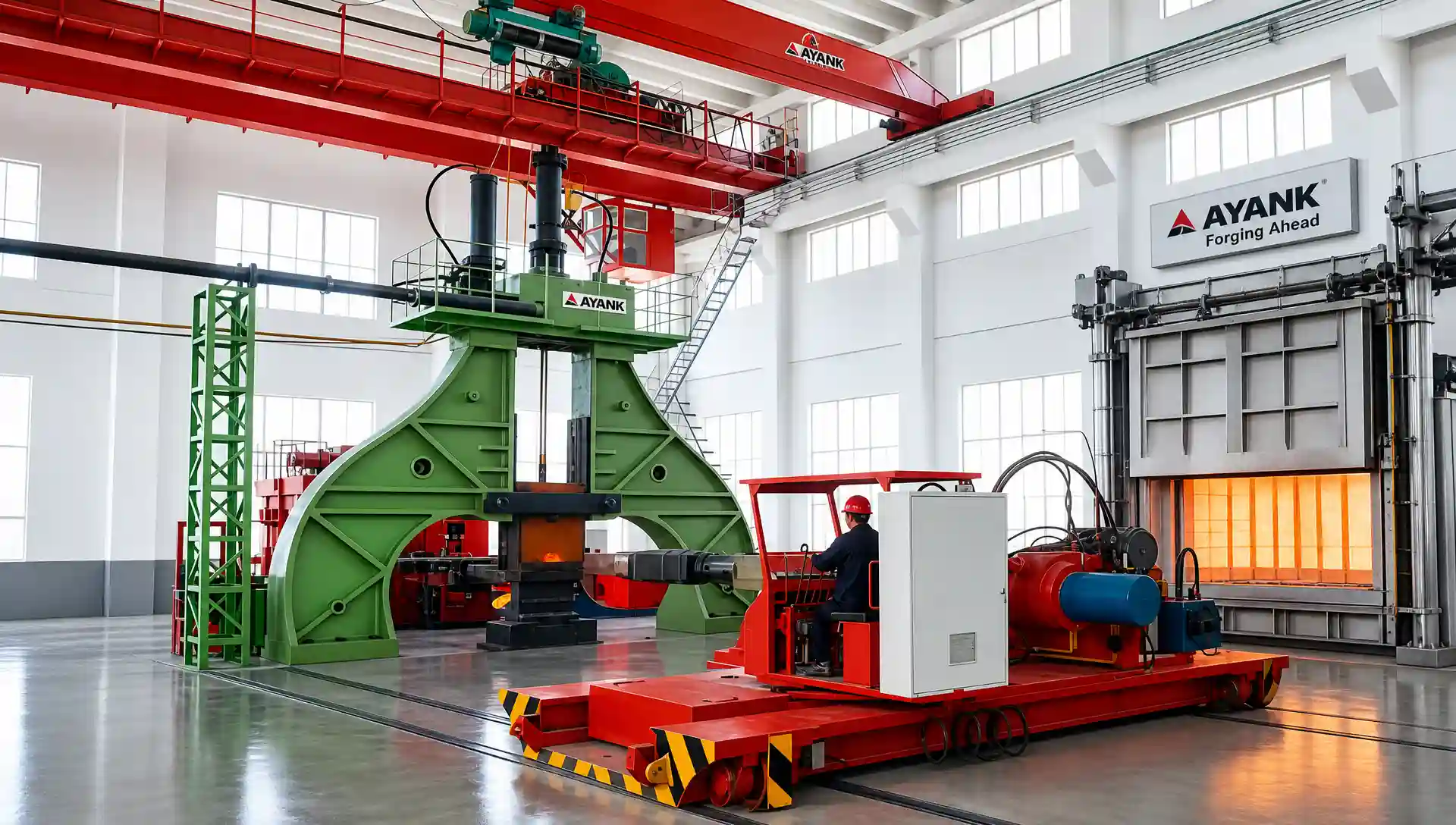
- Equipment: hydraulic forging hammers and open die forging presses, usually with a rail-bound manipulator.
What Is Open Die Forging?
In open die forging, also referred to as free forging in some regions, the dies are flat platens or carry only shallow contours. The final geometry comes from the sequence of operations and from how the operator or manipulator presents the workpiece to the dies — not from a machined cavity. Each blow reduces the section locally; the workpiece is then turned, advanced or replaced before the next blow.
This is the oldest form of industrial forging and remains the standard route for parts that are too large, too heavy or too few in number for impression dies. A 12-tonne shaft, a 3-metre ring blank or a single replacement forging for an ageing press is normally produced this way. For a broader view of how forging compares with casting and machining, see what forging is and where it is used.
Key characteristics of the open die process
- Deformation is local and sequential. Only the area under the die is reduced per pass, which is why reduction ratios and pass sequences have to be planned rather than simply repeated.
- Grain flow follows the deformation. Material is displaced along the part profile instead of being cut away, which is the main reason forged shafts and discs outperform machined-from-bar equivalents in fatigue and impact service.
- Dimensional consistency depends on the setup. Manipulator accuracy, die condition and operator judgement all affect straightness, concentricity and the allowance left for machining.
- Heat management is a constraint, not a detail. Small sections lose temperature quickly between passes; large sections retain heat but are difficult to cool uniformly during heat treatment.
What open die forging is not
It is not a net-shape process. Tolerances are wider than in closed die forging, and surfaces normally require machining. It is also not the economical route for small parts in high volume: once annual quantities reach the thousands and the part fits inside a die block, an impression die or a die forging hammer will usually produce a cheaper part. Open die work is chosen when size, weight or batch size makes a cavity die impractical — not because it is simpler to run.
The Open Die Forging Process, Step by Step
The process is best understood as a sequence of controlled reductions rather than a single forming step. The exact route differs by part, but the same five stages appear in almost every open die job.
Step 1 — Billet preparation and heating
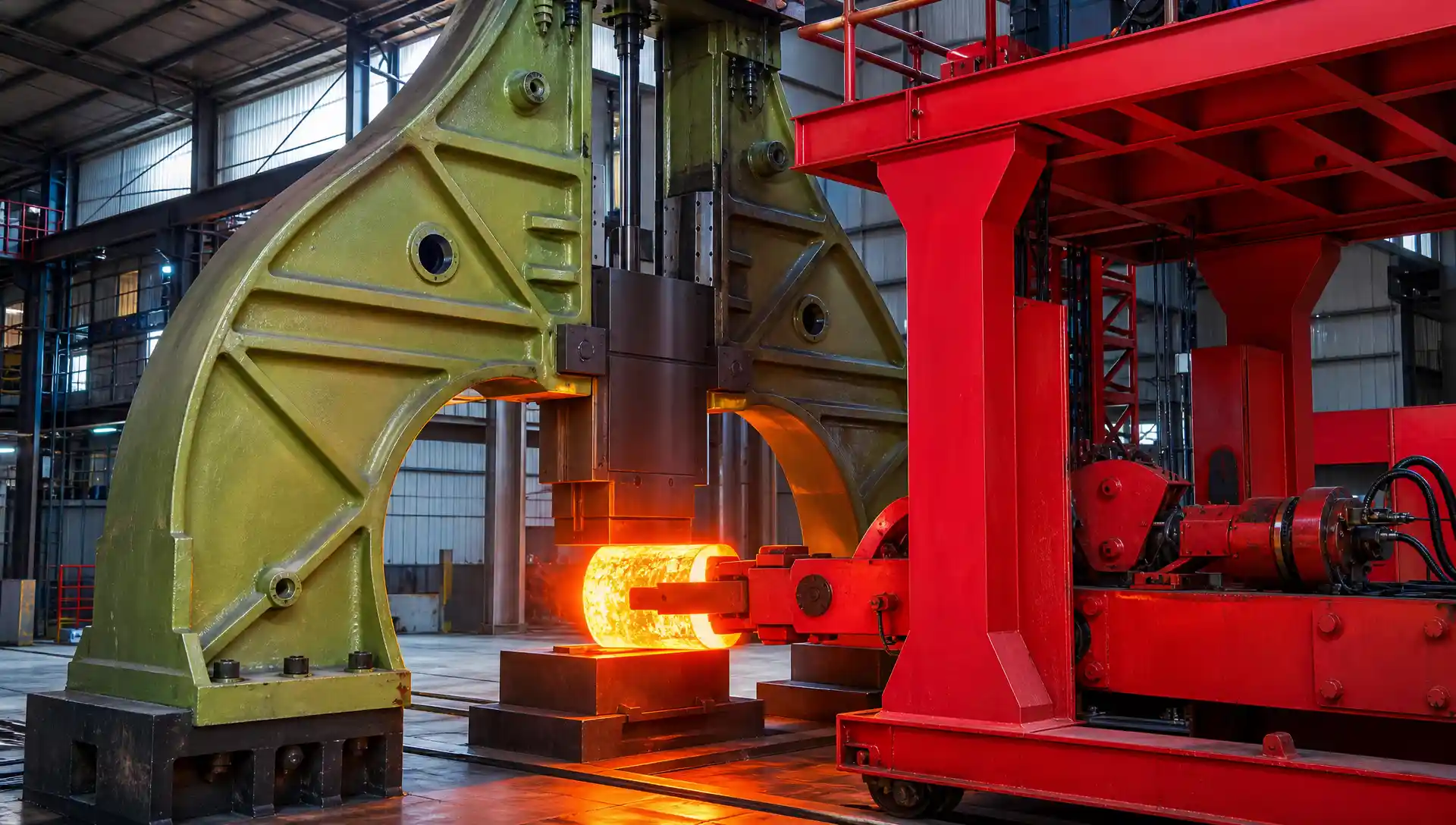
The billet is cut to weight, inspected for surface defects and charged into a furnace. Heating is governed by section size: a heavy billet needs a slow ramp and a soak period long enough for the centre to reach forging temperature, otherwise the core remains stiff while the surface deforms. Surface defects such as seams or cracks are usually ground out before heating, because they open up under the first blows and cannot be closed later.
Step 2 — The forging operations
Most open die parts are built from a small vocabulary of operations. The sequence, and the reduction taken at each stage, decides both the final shape and the internal soundness of the part.
| Operation | What it does | What has to be controlled |
|---|---|---|
| Upsetting | Reduces height and increases cross-section | Flatness, barrelling, avoidance of longitudinal folds |
| Drawing out | Reduces section and extends length | Reduction per pass, feed rate, axial alignment |
| Cogging | Converts an ingot into a sound billet or blank | Total reduction ratio, consolidation of the centre |
| Piercing | Opens a hole for hollow parts | Punch alignment, concentricity of the bore |
| Mandrel forging | Elongates a hollow body over a mandrel | Wall thickness uniformity, mandrel temperature |
| Straightening | Corrects bend and twist after forming | Straightness tolerance, residual stress |
Two variables matter more than any other at this stage. The first is the total reduction ratio from ingot to finished section: too little reduction leaves the cast structure only partly broken down. The second is the temperature at which the last passes are taken, since finishing too cold raises the risk of internal cracking in alloy steels.
Step 3 — Inspection and heat treatment
After forming, the part is straightened, rough-machined if required, and heat treated — usually normalising, annealing or quench and temper depending on the grade and the service requirement. Inspection typically combines dimensional checks with ultrasonic testing to detect internal discontinuities, and hardness testing to confirm the heat treatment response. For critical parts, grain size and microstructure are also verified on a test coupon taken from the same heat.
Materials and Part Types Suited to Open Die Forging
Materials commonly forged
The process works with most wrought grades that can be heated without unacceptable scaling or hot shortness. Typical production covers carbon steels, alloy steels for shafts and gears, stainless steels for corrosion-resistant components, tool and die steels, and — in smaller volumes — nickel-based alloys and titanium, both of which demand tighter temperature windows and faster transfer times.
Material selection is usually driven by the service condition rather than by the forging process. A buyer specifying a part should state the grade and the required mechanical properties, because the same geometry forged from a different grade may need a different reduction sequence and a different heat treatment.
Typical open die forgings
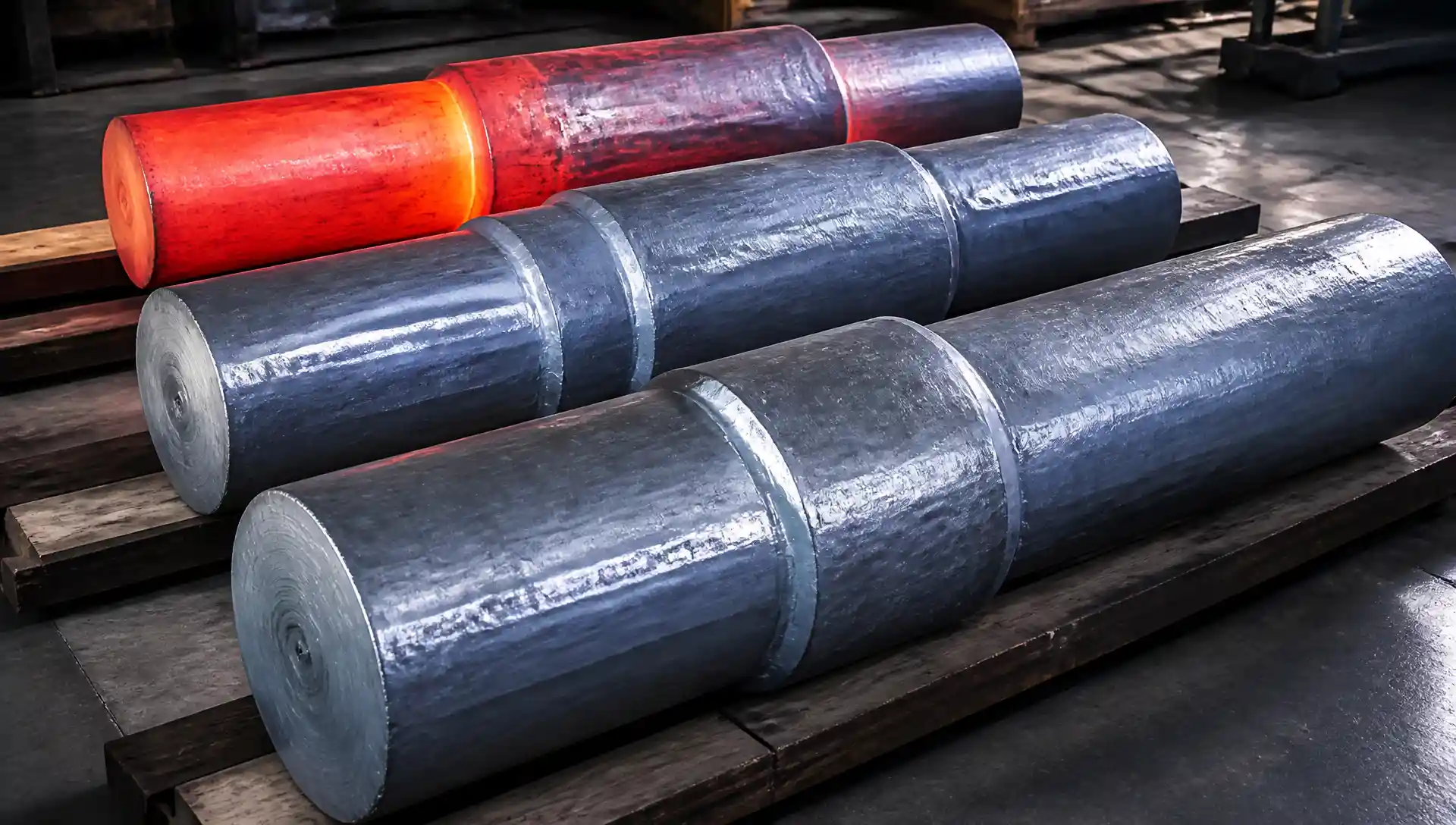
- Shafts and step shafts — turbine, roll, marine and general transmission shafts.
- Discs and flanges — tube sheets, blind flanges, coupling discs.
- Blocks and bars — die blocks, tooling blanks, heavy section bar stock.
- Hollow bodies — shells, sleeves, pressure vessel components produced by piercing and mandrel forging.
- Ring blanks — preforms that are subsequently ring rolled to final profile.
Each of these part families places a different demand on the equipment. A long shaft needs working length and a manipulator that can rotate and advance the workpiece accurately; a large disc needs upsetting capacity and a press bed wide enough to take the blank; a hollow body needs piercing capacity and a mandrel arrangement. That is why equipment selection for open die work starts from the workpiece rather than from a tonnage figure — a point covered in detail in our guide to choosing between a forging hammer and a forging press.
Open Die Forging Equipment: Hammers and Presses
Two machine families perform open die work, and the choice between them is the single decision that most affects part quality, cycle time and operating cost. A forging hammer delivers energy in a blow; a forging press applies force through a controlled stroke. The two are not interchangeable at the extremes of size or precision, but they overlap across a wide middle range — which is why equipment selection has to start from the workpiece.
Hydraulic open die forging hammers
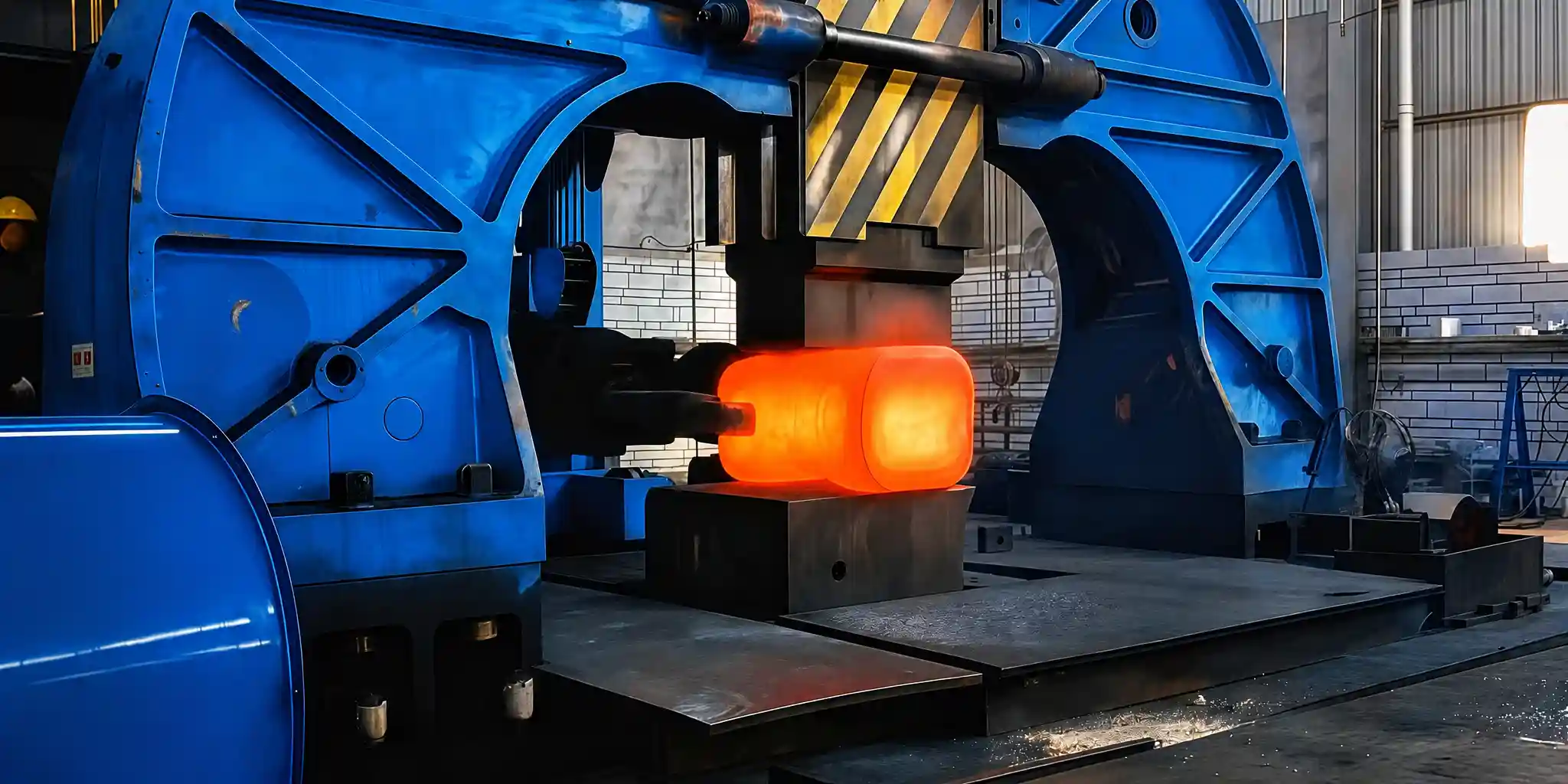
A hydraulic hammer stores energy in a falling mass and releases it in a controlled blow. Because the blow is short and local, the deformation stays close to the die contact area, which suits drawing out long sections and working with repeated rotations of the workpiece.
The C66YA full hydraulic open die forging hammer covers 13 strike-energy capacities from 35 kJ to 875 kJ, with falling mass from 1,300 kg to 28,000 kg and a maximum stroke of up to 2,600 mm. The specification quotes a repeatable striking accuracy of ±1.5% and an energy saving of over 60% against the conventional drive it replaces. The range is described in detail on the C66YA full hydraulic open die forging hammer page.
For smaller sections, the C61YA single-arm design covers 30 kJ to 350 kJ, with a working arrangement that gives the operator more freedom around the anvil — useful where parts are short and the sequence changes frequently. See the C61YA hydraulic open die forging hammer for the model table.
Both ranges are available with rail-bound manipulators and remote striking controls, which matter more than they appear to: on a 20-tonne workpiece the manipulator sets how accurately the next blow lands, and therefore how much machining allowance has to be carried on the finished forging.
Open die forging presses
A press applies force over a longer, controlled stroke. Deformation penetrates deeper into the section, thickness is easier to hold, and the hydraulic control loop can be programmed for a fixed reduction per pass. That makes presses the better choice for large discs, thick blocks, hollow bodies and any part where flatness or wall thickness has to be held tightly.
The Y13A full hydraulic open die forging press is offered from 800 t to 16,000 t and covers free forging as well as loose-tool forging, where simple tooling is used inside an open frame to produce a semi-finished profile. Where cycle time dominates — repeated short strokes on medium sections — the Y13KA fast variant is the appropriate machine. Both are described under hydraulic open die forging presses.
Matching the machine to the workpiece
Machine size follows from the workpiece, not the other way round. The table below shows the decision logic used when a forging project is evaluated; the final energy or tonnage figure is calculated from billet weight, material grade, reduction per pass and the number of heats available.
| Workpiece characteristic | Machine type that usually fits | Reason |
|---|---|---|
| Long shaft, needs repeated rotation and advance | Hydraulic hammer with rail-bound manipulator | Short local blows suit incremental drawing out |
| Large disc or thick block, flatness critical | Open die forging press | Controlled stroke holds thickness across the face |
| Hollow body produced by piercing and mandrel work | Press, or hammer with mandrel arrangement | Piercing force and wall uniformity are easier to control |
| Wide mix of small and medium shapes, low volume | Hammer | No die change between shapes; fast re-setup |
| Crack-sensitive alloy, narrow temperature window | Press preferred | Strain rate can be limited and held repeatable |
| Maximum single-piece weight is the constraint | Set by falling mass (hammer) or tonnage (press) | Both are capped by the largest ingot the plant can handle |
Where the part sits near the boundary between the two families, the decision usually comes down to three practical questions: how many pieces per year, how much machining allowance the customer can absorb, and whether a manipulator is available. A hammer without a manipulator on a heavy part is limited by crane time; a press without a proper handling system is limited by the same constraint.
Open Die Forging vs Closed Die Forging
The two processes are often compared as if one were better. They serve different commercial conditions, and the deciding factor is almost always volume against tooling cost.
| Factor | Open die forging | Closed die forging |
|---|---|---|
| Tooling | Flat or simple dies; low tooling cost | Machined cavity dies; significant upfront cost per part |
| Economic batch size | One piece to a few thousand per year | Thousands to hundreds of thousands per year |
| Part weight ceiling | Set by ingot and machine capacity | Limited by die block size and press capacity |
| Dimensional precision | Wider tolerance; machining allowance required | Near-net shape; less machining |
| Geometry flexibility | Any shape the operations can build | Fixed by the die cavity |
| Lead time to first part | Short — no die to cut | Long — die design, machining and trials |
A useful rule of thumb: if the part fits inside a die block and the annual quantity justifies the die, closed die forging will normally deliver a cheaper part. If the part is large, the quantity is small, or the design is still changing, open die work avoids a tooling investment that may never be recovered. Our closed die forging hammer range covers the volume end of that split.
What Drives the Cost of an Open Die Forging
Buyers comparing quotations often find a wide spread between suppliers for what looks like the same drawing. The difference is rarely the hourly rate; it is usually one of the following.
| Cost driver | Why it moves the price | Where buyers lose money |
|---|---|---|
| Machining allowance | Every extra millimetre of allowance is metal that is paid for and then cut away | Specifying a generous allowance "to be safe" |
| Ultrasonic testing requirement | Higher acceptance classes mean more scanning, more rejects and slower release | Copying a class from another project without checking the service requirement |
| Number of heats | A part that cannot be finished in one heat needs reheating and re-setup | Designing a section the available furnace cannot soak through |
| Single-piece weight against machine limit | Approaching the capacity limit slows the cycle and raises risk | Assuming the largest machine in a plant is always available |
| Material grade | Alloy and stainless grades cost more, and some need slower heating and cooling | Over-specifying the grade when a carbon steel would serve |
| Heat treatment route | Quench and temper with property testing costs more than normalising | Not stating the required properties, so the supplier quotes the cheapest route |
The practical consequence is that the cheapest quotation is often the one with the least scope defined. A drawing that states grade, mechanical properties, ultrasonic acceptance class and allowed allowance will produce comparable prices; a drawing that states only geometry will not.
How to Choose an Open Die Forging Supplier
Supplier selection for open die work is a capability question before it is a price question. A plant that cannot handle the ingot size, or cannot heat treat the section, will either decline the job or subcontract the part that decides its quality.
Capability checklist
- Maximum ingot weight and maximum finished forging weight actually produced — not catalogue figures
- Hammer falling mass or press tonnage available, and whether a manipulator is used
- Furnace size relative to your section, and whether multiple heats are practical
- In-house heat treatment capacity, including quench and temper for your grade
- Ultrasonic testing capability and the acceptance classes routinely worked to
- Rough machining capacity — whether the supplier can deliver a pre-machined forging
- Experience with your part family, which shows up in how they quote the allowance
Documentation and traceability
For industrial buyers the paperwork is part of the product. Ask for the material certificate with the heat number, the ultrasonic test report, the heat treatment record including furnace charts, and the dimensional report. A supplier that issues these as standard is easier to audit than one that produces them on request.
Seven questions to ask before sending a drawing
- What is the heaviest forging you produce, and on which machine?
- Will this part be forged on a hammer or a press, and why?
- What machining allowance do you normally leave, and to which standard?
- Which ultrasonic acceptance class do you work to as standard?
- Is heat treatment in-house, and what records come with the part?
- What is the realistic lead time for a first article, including material?
- If a defect appears after machining, how is the heat traced back?
The answers are more informative than a price. Two suppliers quoting the same number can be quoting entirely different scopes, and the seven questions expose which is which before the purchase order is issued.
Common Defects and How to Specify Against Them
Most open die rejections come from a small group of defects. Each can be controlled in the technical specification rather than discovered at final inspection.
| Defect | Usual cause | How to specify against it |
|---|---|---|
| Longitudinal folding | Excessive reduction per pass on a barrelled surface | Agree reduction schedule; require dressing between passes |
| Internal porosity or pipe | Insufficient reduction ratio from ingot | State a minimum total reduction ratio and an ultrasonic acceptance class |
| Decarburisation | Long furnace time or oxidising atmosphere | Set a maximum decarburisation depth on the finished surface |
| Grain coarsening | Finishing above the normalising temperature | Require a final forging temperature limit and a normalising step |
| Dimensional deviation | Manipulator positioning and die wear | Define allowance and straightness tolerance on the forging drawing |
None of these clauses is unusual, and none adds significant cost when it is written into the enquiry. They add cost when they are discovered after machining, which is the point at which the forging has already absorbed the most value.
Where AYANK Fits
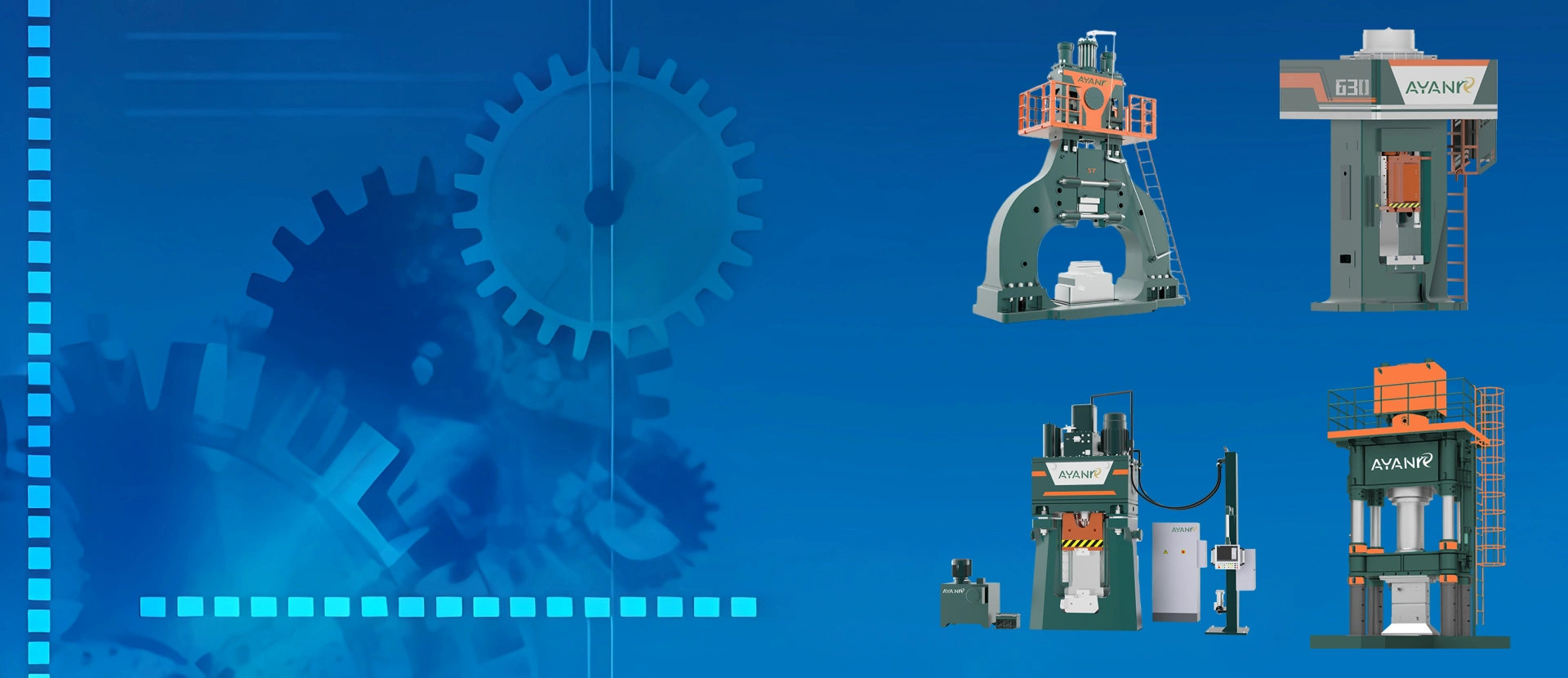
AYANK manufactures forging equipment rather than forgings, which shapes the perspective behind this guide: the process variables above are the same ones that determine machine selection. The product range covers hydraulic open die forging hammers, die forging hammers, pneumatic hammers, open die forging presses, electric screw presses, roll forging and ring rolling machines, and automated forging lines.
For open die work specifically, the relevant machines are the C66YA and C61YA hammer ranges and the Y13A and Y13KA press ranges, together with rail-bound manipulators and chargers. Selection is normally done from the workpiece drawing: billet weight, material grade, reduction per pass and target cycle together determine whether a hammer or a press fits, and at what capacity.
Planning a New Forging Project?
Send AYANK the workpiece drawing, material grade, billet dimensions and weight, target output per shift, and any automation or layout constraints. Equipment selection and capacity sizing are carried out against those inputs rather than against a tonnage figure alone.
Buyers preparing an enquiry usually find it useful to include the following, since each one changes the machine recommendation:
- Final part drawing, with machining allowance marked
- Material grade and required mechanical properties
- Billet dimensions and billet weight
- Finished forging weight and expected yield
- Forging temperature range, if already established
- Target pieces per shift or per month
- Existing process and equipment, if this is a replacement or expansion
- Automation requirement — manipulator, charger, or full line integration
- Factory layout constraints and available power supply
- Installation country, for voltage and documentation requirements
Frequently Asked Questions
What is the difference between open die forging and closed die forging?
Open die forging shapes the workpiece between flat or simple dies, so the geometry comes from the sequence of operations rather than from a die cavity. Closed die forging uses a machined cavity that the metal fills, producing a near-net-shape part. Open die work suits large or low-volume parts because tooling cost is low; closed die work becomes cheaper once volume justifies the die.
What is the largest part that can be open die forged?
The limit is set by the largest ingot the plant can melt and handle, and by the capacity of the hammer or press. There is no universal figure: a supplier that can forge a 20-tonne shaft may be unable to handle a 40-tonne ingot, and the constraint is often the crane, furnace or heat treatment pit rather than the forging machine itself. Always ask for the heaviest forging a supplier has actually produced.
Is open die forging more expensive than closed die forging?
Per piece, open die forging is usually more expensive because more machining is required. Per project, it is often cheaper, because there is no die to design, cut and trial. The crossover point depends on part size and annual quantity: small parts in high volume almost always favour closed die, while large parts or short runs favour open die.
Which materials can be open die forged?
Most wrought steels are suitable, including carbon steels, alloy steels, stainless steels and tool steels. Nickel-based alloys and titanium are also forged, but they require tighter temperature control and faster transfer between furnace and anvil. The grade should be specified together with the required mechanical properties, because the heat treatment route depends on both.
How much machining allowance should be left on an open die forging?
Allowance depends on part size, section, tolerance required and the supplier's process capability, so it should be agreed rather than assumed. The practical approach is to ask the supplier what allowance they can hold on a comparable part, and to fix that figure on the drawing. Overspecifying allowance increases cost without improving the finished part.
What information should I send to get an open die forging quote?
Send the finished part drawing with machining allowance, the material grade and required properties, billet dimensions and weight, finished forging weight, target output, and any automation or installation constraints. A drawing that states only geometry will usually produce quotations that are not comparable, because each supplier fills the gaps with its own assumptions.