
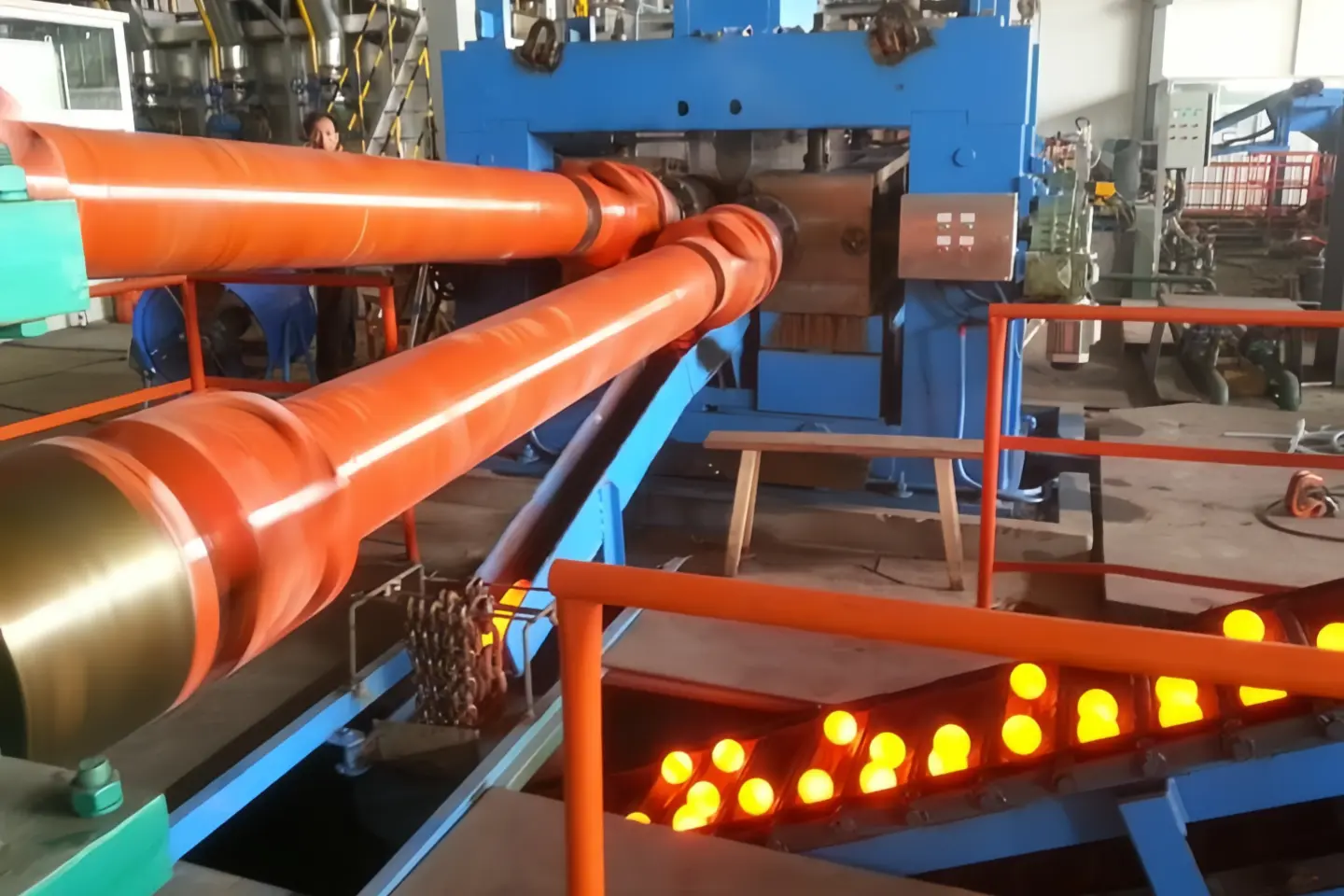
A steel ball production line is an integrated manufacturing system that turns steel bar into grinding media for mining, cement, power generation and other industrial applications. Choosing the right line requires more than comparing machine prices: buyers have to weigh the forming process, target ball diameter, annual output, material grade, heat treatment, energy demand and total operating cost together.
Quick answer: A steel ball production line produces balls of 20–120 mm at 40–100 pieces per minute. Start with the required diameter range, annual saleable output and material specification, then size the skew rolling machine, billet heating system, heat treatment equipment, handling system and inspection process as one production system. Compare suppliers on expected cost per saleable ton, not on equipment price.
1. What Is a Steel Ball Production Line?
A steel ball production line is a set of matched machines that manufacture steel balls to a specified diameter, material composition and performance requirement. Depending on the process and the application, it includes billet cutting, induction heating, skew rolling, heat treatment, cooling, inspection and packaging equipment.
For a buyer evaluating a grinding media ball production line, the question is not whether one machine can form a ball. It is whether the whole line can hold product quality and output, shift after shift, at the tonnage the business plan assumes.
1.1 The Four Main Production Stages
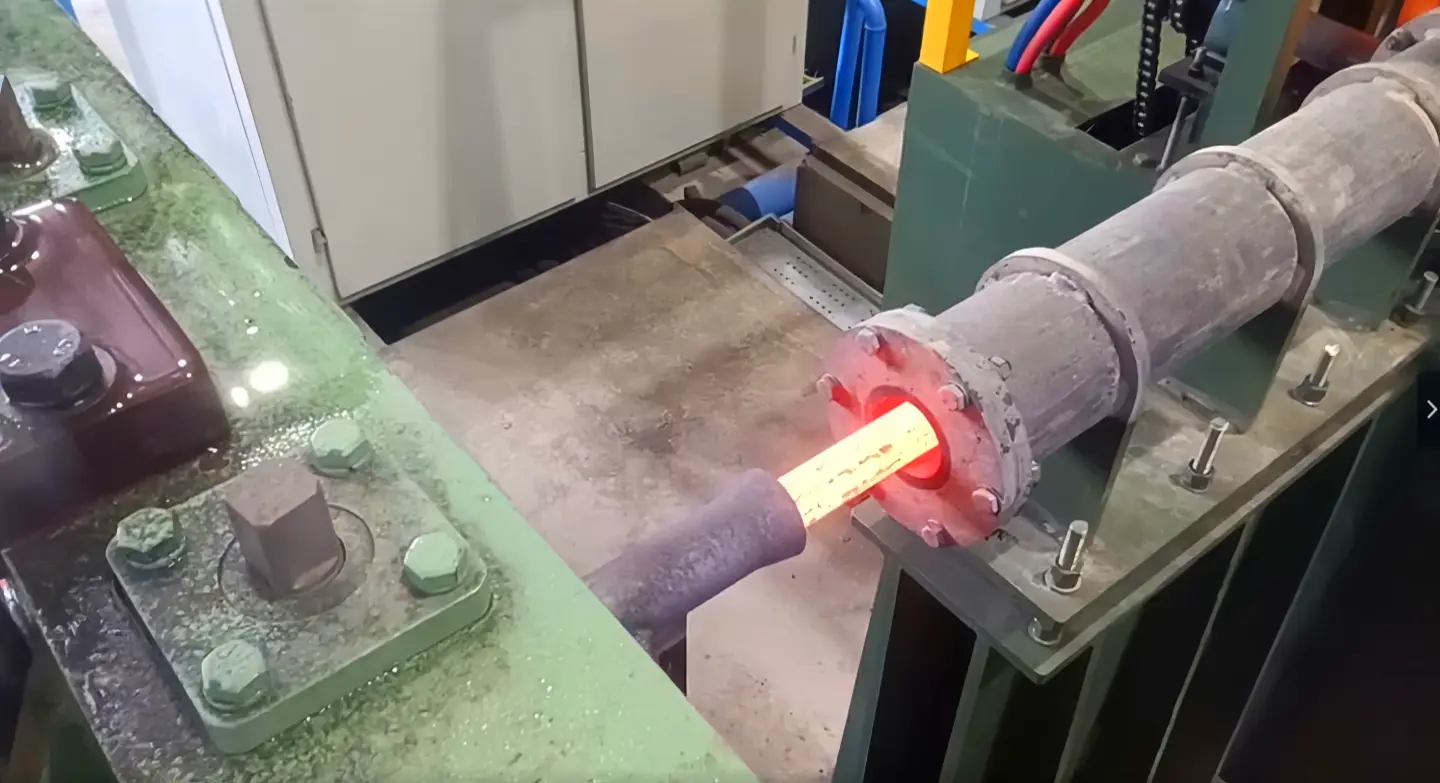
- Billet preparation and heating: Steel bar is cut to length and brought to forming temperature in an induction furnace. Temperature uniformity here decides dimensional tolerance and roll life.
- Skew rolling: Profiled rolls continuously form the heated bar into balls. The metal fibre follows the ball contour instead of being cut across it, which is why a rolled ball carries load better than a machined one.
- Heat treatment: Quenching and tempering set the surface hardness and the gradient toward the core.
- Inspection and finishing: Diameter, roundness, surface defects, hardness and breakage behaviour are checked against agreed acceptance criteria before packing.
These stages have to be matched, because the slowest one sets the output of the whole production line. A mill rated at 70 pieces per minute will not deliver those pieces if the furnace can only heat enough bar for 55, or if the quench tank cannot cool what arrives. Buyers who compare only the mill's headline figure find the bottleneck after commissioning.
1.2 Ball Diameter and End-Use Requirements
Diameter drives almost every downstream decision. A 60 mm ball and a 120 mm ball differ by a factor of eight in mass, so they need different roll profiles, different motor power and different handling.
Before requesting a quotation, prepare a target product range rather than a single nominal size: the sizes you run most often, the share of output each represents, and the material grades involved. If the line will switch between four sizes, say so early — changeover time and roll configuration decide whether the quoted capacity is reachable in practice.
1.3 Industries Using Grinding Media Balls
- Mining and mineral processing: Grinding ore and other mineral materials. The largest demand, and the most demanding on wear resistance and breakage rate.
- Cement production: Clinker and raw meal grinding, typically mid-size balls, with a heavy premium on hardness consistency because a broken ball damages the mill lining.
- Power generation: Coal pulverising mills, where ball size distribution affects fineness and mill power draw.
- Chemical and other process industries: Smaller volumes, often with material or contamination constraints.
Each application sets its own balance of wear resistance, hardness distribution, impact performance and service life. That balance, not the catalogue, should decide both the equipment and the heat-treatment recipe.
2. How the Skew Rolling Process Works
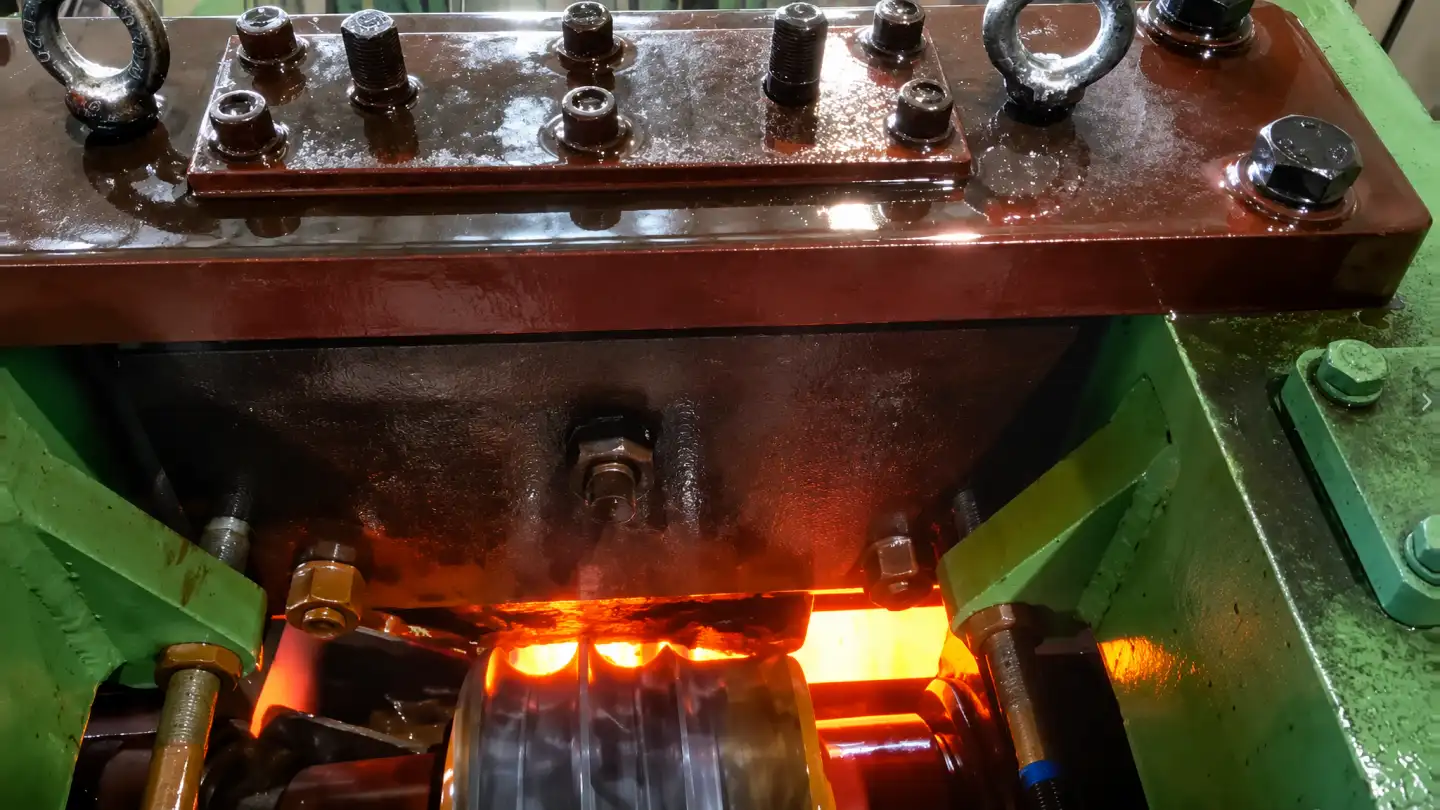
Skew rolling is the forming stage of a steel ball production line, and it is the stage buyers understand least. Two rolls with helical grooves rotate in the same direction while their axes are skewed relative to the bar. The bar is drawn in, reduced and separated into balls by the groove geometry, with no die and no press stroke.
The practical result: output runs three to ten times higher than a forging line making the same ball, noise and vibration are lower, and the ball leaves the mill with continuous grain flow instead of a cut one.
2.1 Billet Heating
Steel has to arrive at the rolls inside a narrow temperature window. Too cold and the rolls slip or the groove wears; too hot and the ball oversizes and the surface decarburises. Induction heating gives the control a coal or gas furnace cannot, which is why every line we build pairs the mill with a heater sized to the mill's actual consumption.
2.2 Continuous Skew Rolling
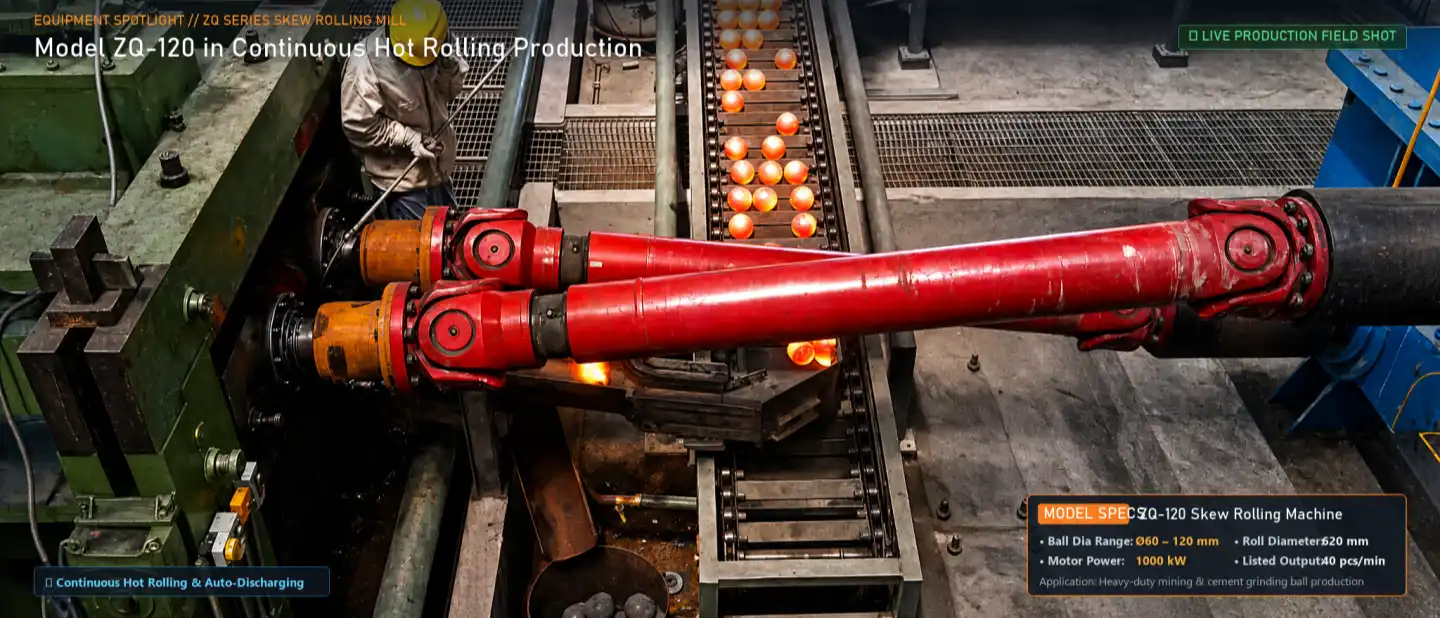
Roll diameter, groove profile and inclination angle are chosen together for the target ball size. On the ZQ series, roll diameter rises from 220 mm on the ZQ-30 to 620 mm on the ZQ-120, and inclination widens from 0–6° to 0–7° as balls get larger.
Two models can overlap on paper and still behave differently. A 60 mm ball sits inside the range of both the ZQ-60 and the ZQ-80, but the ZQ-60 runs at 70 pieces per minute and the ZQ-80 at 65. You buy the ZQ-80 when the product mix reaches 80 mm, not because it is faster.
2.3 Heat Treatment and Cooling
Forming does not set hardness; heat treatment does. After rolling, balls pass through quenching and tempering to reach the specified surface hardness and a controlled gradient toward the core. We target a surface-to-core difference under 5 HRC, because a steep gradient is what produces shelling and early breakage in a mill.
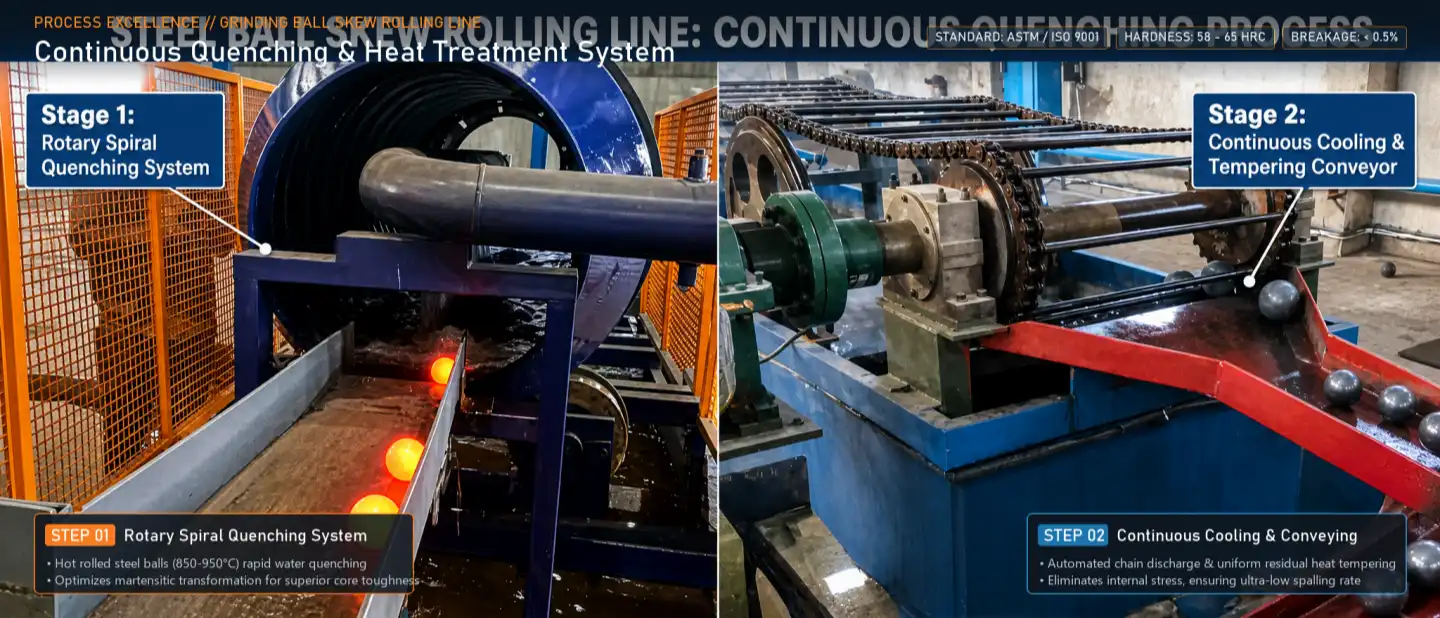
This is where a cheap line reveals itself. Two suppliers can quote the same mill and the same furnace and still ship different balls, because the quench curve and the tempering time differ. Forming equipment alone never guarantees hardness or wear life.
2.4 Quality Inspection
Inspection has to be defined before the order, not after the first shipment. Agree on where hardness is measured (surface, core, or a defined section), how many balls per lot, which breakage test, and what happens to a lot that fails. A hardness figure without a sampling procedure is not a guarantee.
When comparing suppliers, ask for a sample inspection report on a sectioned ball rather than a surface reading, and make the acceptance criteria part of the contract.
3. Grinding Media Ball Production Line: Applications and Production Economics
Grinding media is a consumable for the plant that uses it, not a capital good. A concentrator grinding a few million tons of ore a year wears through thousands of tons of balls, and the annual media bill usually dwarfs the price difference between two equipment quotes. That is the frame a grinding media ball production line has to be judged in.
3.1 Estimate Annual Demand Before Choosing Equipment
Start with the quantity of finished balls the business expects to sell each year, split by diameter, material grade and customer specification. If several sizes share one line, estimate the proportion of output assigned to each.
A line designed around one high-volume diameter will not deliver the same tonnage when it switches between four sizes. Changeover time, roll configuration, heating conditions and downstream handling all eat into effective capacity.
3.2 Buy a Production Line or Build Capacity in Stages?
A complete line makes sense when demand is defined and the process has to be coordinated from billet heating through finishing. A staged investment makes sense when demand is uncertain, or when existing furnaces, cranes or buildings can carry part of the load.
The decision is arithmetic. Take annual media consumption in tons, multiply by the delivered price per ton you pay today, and compare that with the annualised cost of ownership: capital recovery, power, labour, billet, rolls, maintenance. Below a few thousand tons a year, purchasing usually wins because the fixed cost is spread over too few tons. Above that, the gap widens every year in favour of producing.
3.3 Why Saleable Output Matters More Than Theoretical Output
Machine productivity figures are not annual saleable tonnage. Actual output depends on operating hours, interruptions, product mix, yield, maintenance, changeovers and the capacity of connected equipment.
Saleable output = rated output × operating hours × OEE × yield
OEE here is the honest number: heating interruptions, roll changes and quench maintenance all sit inside it. Plan with 70–80% for a well-run line and you will not be surprised at month three.
4. Capacity and Model Selection: Sizing the Line to Your Tonnage
Selection runs in one direction: maximum ball diameter picks the model family, then annual tonnage confirms whether that model has enough hourly output. Get the order wrong and you either buy a machine that cannot make your largest ball, or one that idles for half the shift.
4.1 Compare the ZQ Series Models
The table below summarises the ZQ series parameters. Confirm the configuration against the final technical agreement before using these figures for procurement.
| Model | Steel Ball Diameter (mm) | Roll Diameter (mm) | Roll Inclination | Listed Productivity (pcs/min) | Motor Power (kW) |
|---|---|---|---|---|---|
| ZQ-30 | 20–30 | 220 | 0–6° | 100 | 37 |
| ZQ-40 | 30–40 | 260 | 0–6° | 85 | 90 |
| ZQ-50 | 35–50 | 300 | 0–6° | 75 | 132 |
| ZQ-60 | 40–60 | 340 | 0–6° | 70 | 200 |
| ZQ-80 | 40–80 | 450 | 0–6° | 65 | 450 |
| ZQ-100 | 60–100 | 520 | 0–7° | 50 | 630 |
| ZQ-120 | 60–120 | 620 | 0–7° | 40 | 1000 |
Full equipment description: steel ball skew rolling machine production line.
4.2 How to Estimate Required Production Capacity
Take a buyer targeting 10,000 metric tons of saleable balls a year, with 5,000 production hours available. The average output required is 2 t/h:
10,000 t/year ÷ 5,000 h/year = 2 t/h
Tons per hour only becomes a machine decision once it is converted into pieces. A 60 mm steel ball weighs about 0.89 kg (113 cm³ × 7.85 g/cm³), so 2 t/h equals roughly 2,250 balls per hour, or 37 pieces per minute:
2,000 kg/h ÷ 0.89 kg = 2,247 pcs/h = 37 pcs/min
At a realistic 75% OEE the line needs a rated capacity near 50 pieces per minute. The ZQ-60, rated at 70 pieces per minute and covering 40–60 mm, sits at the centre of the shortlist. If the mix later reaches 70–80 mm, the ZQ-80 covers it at 65 pieces per minute.
Two caveats belong in the plan. First, 75% OEE is a target, not a given. Second, the calculation uses saleable output, so scrap and rejects have to be added on top.
4.3 Why Larger Ball Diameters Need Careful Evaluation
Mass grows with the cube of diameter. A 120 mm ball weighs about 7.1 kg, eight times a 60 mm ball, so the mill must form eight times the material per piece. Roll diameter grows to keep the bite angle workable, and motor power on the ZQ series climbs from 37 kW to 1,000 kW for exactly this reason.
This is also the honest limit of the technology: below roughly 20 mm, rolled balls compete with forged and cast alternatives on cost, and above 120 mm the economics shift toward forging.
For a reliable quotation, provide the diameter range, material grade, annual saleable tonnage, operating schedule and quality criteria.
5. Hot Rolled vs. Forged vs. Cast: Cost per Ton
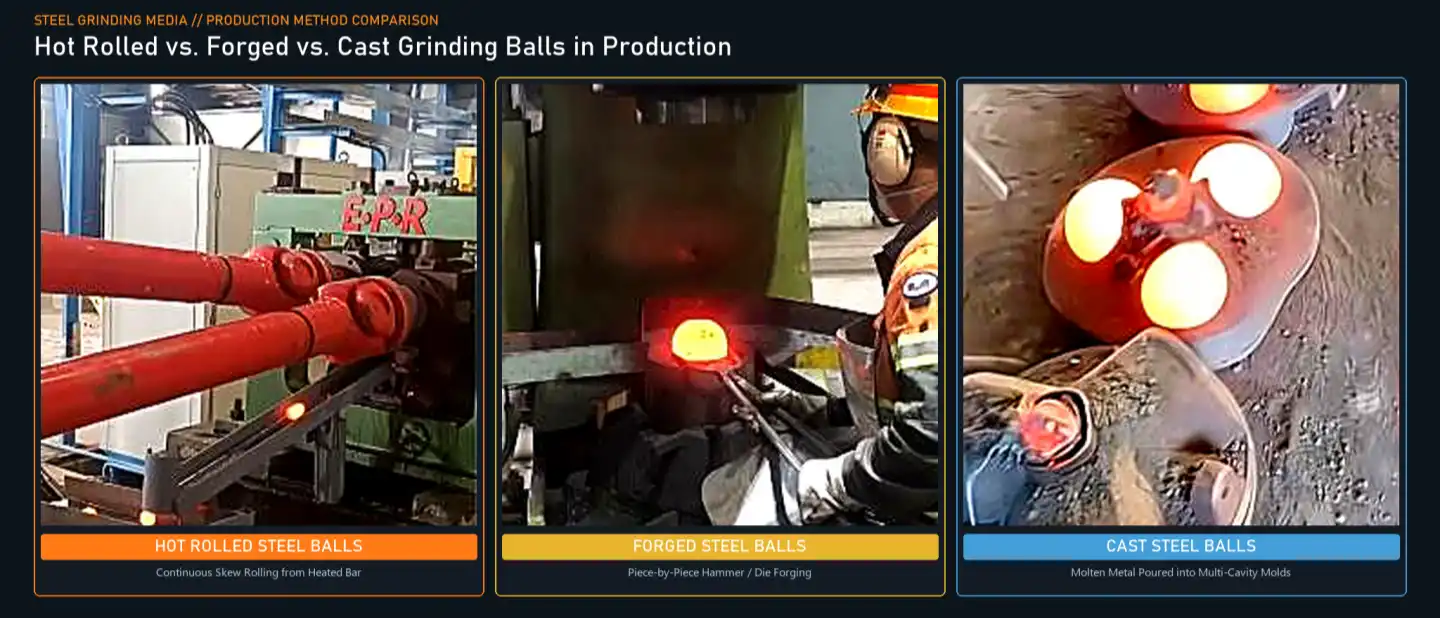
All three routes make a round steel object. They do not make the same grinding media, and the price per piece tells you almost nothing about which is cheaper to run. A steel ball production line that rolls its own media competes with purchased forged or cast balls on cost per ton ground, not on price per piece.
| Evaluation Factor | Hot Rolled Steel Balls | Forged Steel Balls | Cast Steel Balls |
|---|---|---|---|
| Typical process | Continuous rolling from heated bar | Piece-by-piece forging from cut billet | Molten metal poured into molds |
| Production considerations | Highest output, 40–100 pcs/min on the ZQ range; set by line configuration | Lower output, limited by stroke rate and billet handling | Set by melting and mold cycle; slower per piece than rolling |
| Quality considerations | Even hardness through the section, typically under 5 HRC surface-to-core | Hard surface with a steeper gradient toward the core | Widest hardness scatter; defects depend on casting control |
| Cost comparison | Lowest cost per ton at volume; highest entry cost | Higher cost per ton; flexible batch size | Lowest price per piece; highest consumption per ton ground |
| Best-fit process | 20–120 mm media at volume | Large diameters and high-impact duty | Low-abrasion, low-impact, price-sensitive duty |
A cast ball can cost half as much per piece and still cost more per ton of ore, because it wears faster and breaks sooner. That comparison — cost per ton of media consumed, not price per ball — is the only one that survives contact with a mill.
5.1 Hardness, Wear Resistance and Breakage
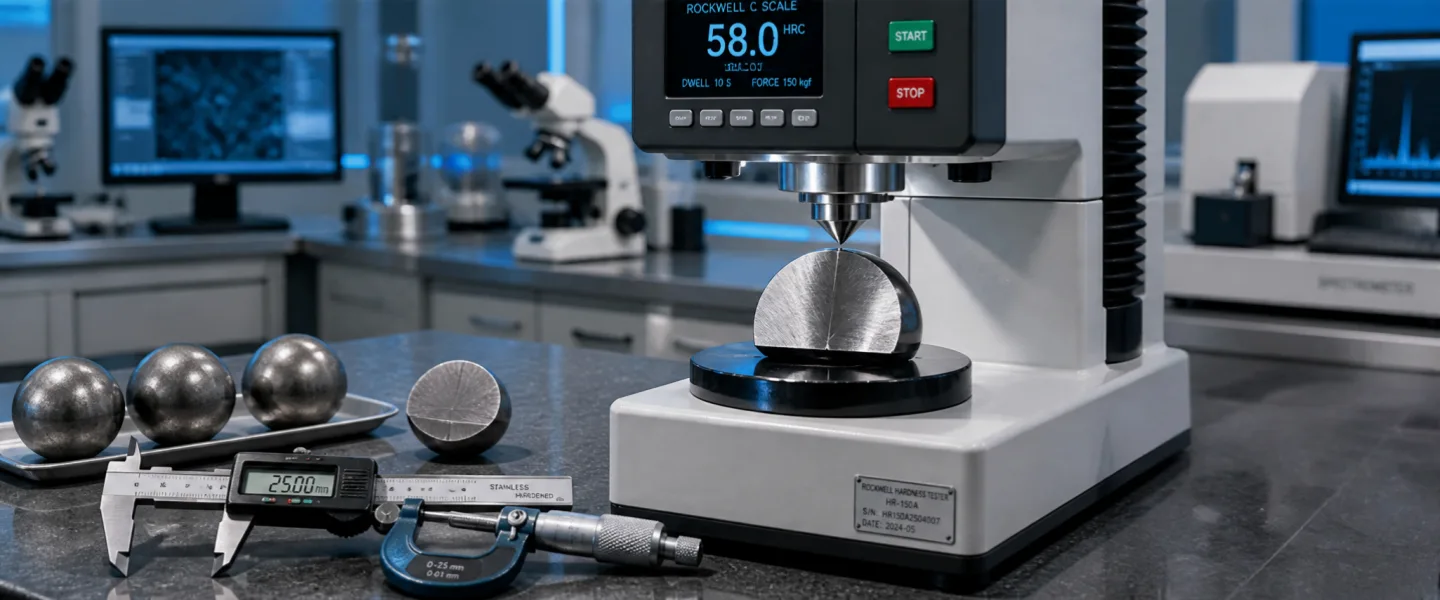
Hardness is necessary and insufficient. A ball reading 58 HRC at the surface and 45 HRC at the core will shell in service, because the working surface and the supporting core deform at different rates. That is why we specify a gradient rather than a single number, and why the test location matters as much as the value.
If you currently buy forged grinding balls and are considering rolled media, ask for the surface-to-core difference on a sectioned ball, not a surface reading.
5.2 Compare the Cost per Ton of Saleable Product
Put both routes on the same basis:
Operating cost per saleable ton = total operating cost during the period ÷ saleable tons produced during the same period
Include billet, power, labor, rolls and tooling, maintenance, scrap and rework. Leave capital cost out of this figure and evaluate it separately, otherwise a cheap machine with high roll consumption looks better than it is.
The lowest purchase price does not produce the lowest cost per saleable ton. Realistic output, yield, energy use, quality and maintenance decide that — and the comparison is in our casting, forging and rolling compared guide.
6. Steel Ball Production Line Cost: What Buyers Should Include
There is no list price. Two lines built around the same mill can differ by a factor of two once heating, heat treatment, automation and installation scope are included. What can be compared is the structure of the cost, and a supplier who will not break the quotation into those blocks is not giving you a comparable number.
6.1 Main Investment Cost Components
- Skew rolling machine: The forming equipment selected for the target diameter and output. Roll sets are consumables and belong in a separate line with a wear-life estimate.
- Heating system: Induction furnace and controls, sized to the mill's consumption. Under-sizing here is the most common cause of a line that never reaches rated output.
- Heat-treatment system: Quench and temper equipment, often the largest item after the mill and the one most often cut in cheap offers.
- Material handling: Feeding, transfer and collection equipment for the proposed layout.
- Electrical and control systems: Cabinets, PLC, wiring and instrumentation within the supplier's scope.
- Installation and commissioning: Supervision, alignment, hot commissioning and operator training.
- Infrastructure: Foundations, building preparation and utility connections on the owner's side.
- Logistics and import costs: Packing, freight, insurance, duties and local handling.
6.2 Operating Cost per Saleable Ton
Power dominates. The mill motor runs 37–1,000 kW depending on model, and induction heating adds a comparable load; a line is an industrial electrical customer, not a workshop machine. Billet yield, roll life and labor follow.
- Raw-material price and material yield
- Electricity and other energy consumption
- Labor and shift arrangements
- Rolls, tooling, consumables and maintenance
- Scrap, rework and quality-related losses
- Production interruptions and equipment availability
Ask for the connected load of the complete scope, not the mill motor rating. The two are routinely confused, and the difference decides whether your transformer is adequate.
6.3 Check the Factory's Power Supply
Confirm voltage, frequency, phase arrangement, total connected load and the capacity the site can actually deliver. If the local supply cannot carry the line, the fix is a transformer upgrade, and that is a project in itself. We ask for kVA at the quotation stage for this reason, and the quotation should state whether cabinets, cables and transformers are inside or outside the scope.
6.4 Compare Quotations on the Same Basis
Two prices are comparable only when the scope matches. Ask each supplier to state the model, assumed product range, output basis (theoretical or saleable), included auxiliary equipment, exclusions, delivery terms, commissioning scope and warranty. An offer that omits the quench unit is not cheaper; it is incomplete.
Get a line configuration, not a brochure
Send your ball diameter range, annual tonnage and available transformer capacity. We return a model recommendation, the connected load and a cost breakdown by equipment block within 48 hours.
7. How to Select a Steel Ball Production Line Supplier
Most suppliers can show a mill running. Far fewer can show a line running at rated output on a customer site, two years after commissioning, with the original roll sets still in service. That difference is what you are buying.
7.1 Eight Checks Before Placing an Order
- Product range: The proposed configuration covers every ball diameter and material on your list, not only the largest.
- Production capacity: Output is quoted against a defined OEE and product mix, so acceptance testing has a number to hit.
- Process integration: Heating, rolling, heat treatment, handling and inspection are specified as one line, with the bottleneck identified.
- Product quality: Acceptance criteria are written down, including where hardness is measured and how a lot is sampled.
- Energy and utilities: Connected load, heating demand and utility requirements are stated for the complete scope.
- Installation requirements: Layout, foundation, site preparation and connection drawings are provided before shipment.
- Technical support: Commissioning, training, documentation, spare parts and response time are defined in writing.
- Commercial terms: Scope, delivery schedule, payment milestones and warranty responsibilities are unambiguous.
7.2 What Information to Include in an RFQ
A useful request for quotation lets the supplier recommend a configuration instead of quoting a machine on guesswork:
- Target ball diameters and the share of output per size
- Material grades and applicable standards
- Annual saleable output and planned operating hours
- Required hardness, dimensional tolerances and acceptance criteria
- Available power (kVA), floor space and crane capacity
- Preferred automation level and existing equipment to integrate
- Site country and target commissioning date
7.3 Review the Complete Equipment Scope
Confirm whether heating, heat treatment, material handling, electrical controls, installation supervision and operator training are included or quoted separately. Suppliers use different definitions of a "complete production line", and the gap between those definitions is usually the quench and temper unit.
Our own rolling and roll forging machines are built alongside the wider forging equipment range on the same site, which matters when a line needs integration rather than a single machine.
8. Installation, Commissioning and Lead Time
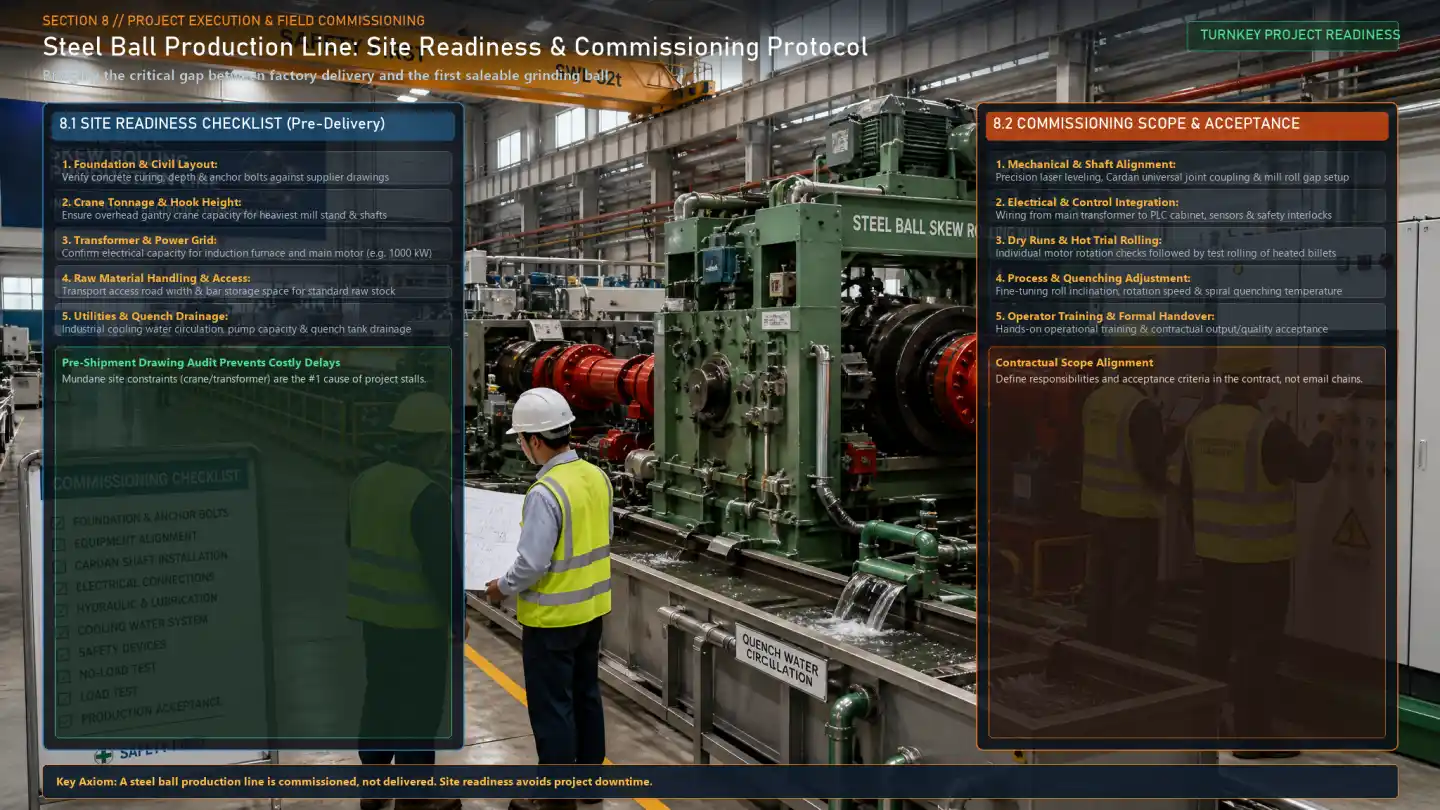
A steel ball production line is commissioned, not delivered. The gap between arrival and the first saleable ball is where most projects lose money, and it is almost always a site-readiness problem rather than an equipment problem.
8.1 Prepare the Site Before Delivery
Confirm the layout, foundation, transport access, lifting arrangements, electrical connections and utilities before shipment, against the supplier's approved drawings. The checks that actually stop a project are mundane: transformer capacity, crane tonnage, bar length, building height, drainage at the quench tank.
8.2 Confirm the Commissioning Scope
Agree in writing who handles mechanical installation, electrical connections, initial testing, process adjustment, operator training and production acceptance. Record the responsibilities and the acceptance criteria in the contract, not in an email chain.
8.3 Typical Project Milestones
Build the schedule around named milestones with owners, and tie payment to them rather than to calendar dates:
- Technical discussion and confirmation of product requirements
- Equipment configuration, quotation and contract
- Manufacturing and preparation of technical documentation
- Site preparation and coordination of utilities
- Shipment, delivery and mechanical installation
- Cold test, first hot ball, acceptance run, operator training
Define the acceptance run in tons and quality terms before signing. An unqualified delivery estimate is not a schedule.
9. Frequently Asked Questions
What is a steel ball production line?
An integrated set of machines that turns steel bar into finished grinding balls: billet cutting and induction heating, skew rolling, quenching and tempering, handling and inspection. The stages are matched so the slowest one does not cap the output of the rest.
How does a steel ball skew rolling machine work?
Two rolls with helical grooves rotate in the same direction while their axes are skewed to the bar. The bar is drawn in, reduced and separated into balls by the groove geometry, with no die and no press stroke. The ZQ series covers 20–120 mm at 40–100 pieces per minute.
How do I choose the right ZQ series skew rolling machine?
Let the largest ball diameter pick the model family, then check annual tonnage against hourly output at your expected OEE. A 60 mm product at 10,000 t/year over 5,000 hours needs about 50 pcs/min, which points to the ZQ-60 rather than the ZQ-80.
How much does a steel ball production line cost?
Cost is driven by model, capacity, heating and heat-treatment scope, automation and installation. Ask for a breakdown by equipment block — mill and roll sets, induction heater, quench and temper unit, handling and controls, commissioning, owner-side scope — because two totals with different scopes are not comparable.
How do I calculate the required production capacity?
Divide annual saleable tonnage by planned production hours to get tons per hour, divide by the unit weight of one ball to get pieces per hour, then apply your expected OEE. For 10,000 t/year of 60 mm balls over 5,000 hours, that is about 50 pcs/min at 75% OEE.
Is the machine's rated motor power the same as total line power consumption?
No. Rated motor power describes one motor; total connected load covers the whole scope, including induction heating and auxiliary drives. Actual consumption per ton also depends on output and process efficiency, so a transformer sized on the motor rating alone will usually be too small.
What should I compare when evaluating hot rolled, forged and cast steel balls?
Compare hardness distribution, breakage rate and cost per ton of media consumed — not price per piece. Rolled balls hold the most even hardness across the section and the lowest breakage rate at 20–120 mm; forged suits large diameters and high-impact duty; cast suits low-abrasion, price-sensitive work.
What information should I send when requesting a quotation?
Ball diameters with the output share per size, material grades, annual saleable tonnage, operating hours, required hardness and tolerances, available power in kVA, floor space, crane capacity and target commissioning date.
Discuss Your Steel Ball Production Requirements with AYANK
Planning a grinding media ball production line means matching forming equipment to your ball sizes, material specifications, output requirements and downstream processes. AYANK FORGING builds forging and rolling equipment on a 60,000 m² site with 400+ employees, and exports to more than 80 countries.
Before requesting a quotation, prepare your diameter range, annual saleable tonnage, material grade and factory utility data. That is enough for us to recommend a configuration instead of a catalogue page.
Explore the AYANK steel ball skew rolling machine production line and send your requirements through the contact form.