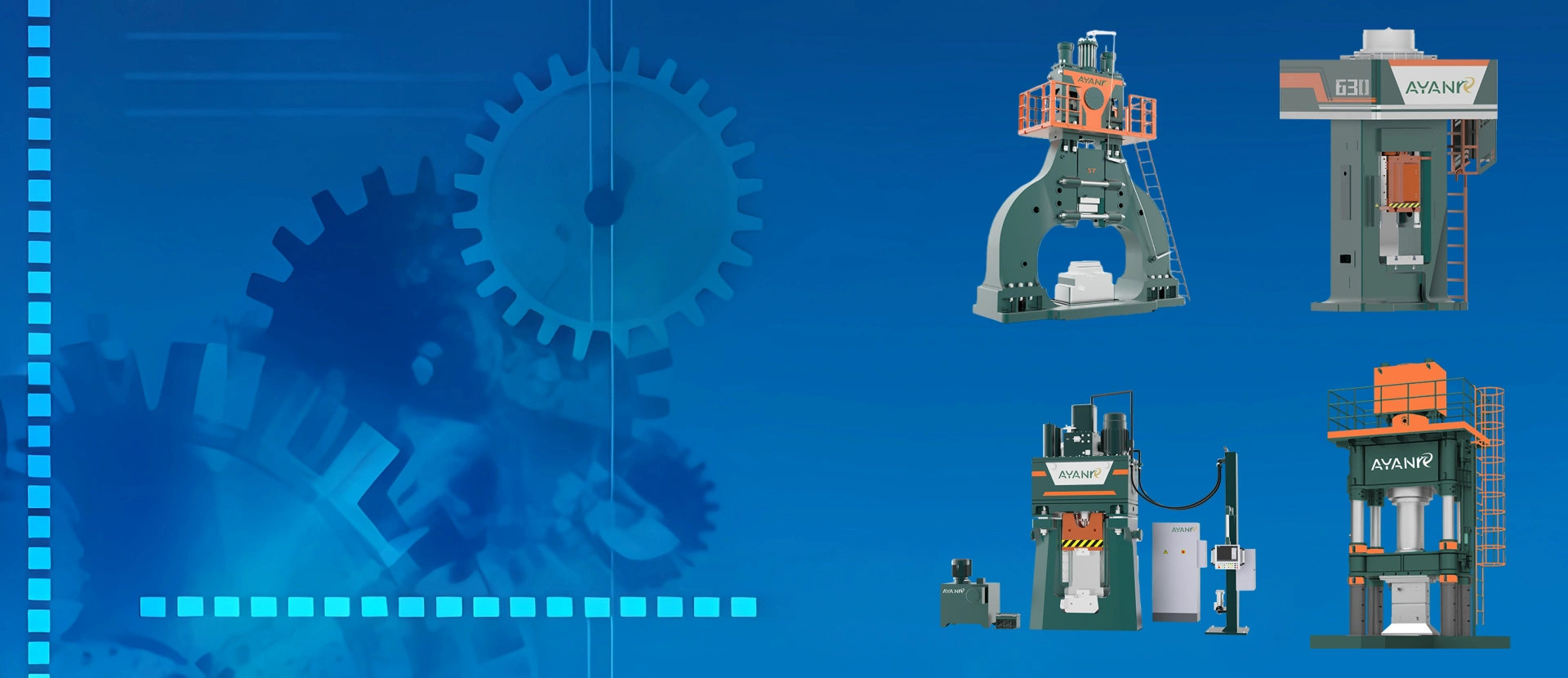
Open-die forging workshops preparing an upgrade run into the same three walls: the old hydraulic press is too slow, skilled operators are hard to recruit, and the existing manipulator no longer matches the machine. New projects carry a second problem, which is budget. The Y13A forging hydraulic press costs less, but the buyer worries that capacity will run out; the Y13KA fast forging hydraulic press is fast, but the buyer worries there will not be enough orders to keep it busy.
Both machines are open-die free forging hydraulic presses, so the question is not whether they can forge. The question is how fast they forge, whether they link to a manipulator, and whether they support batch production. Everything below is built on that distinction, using the published specification of each series.
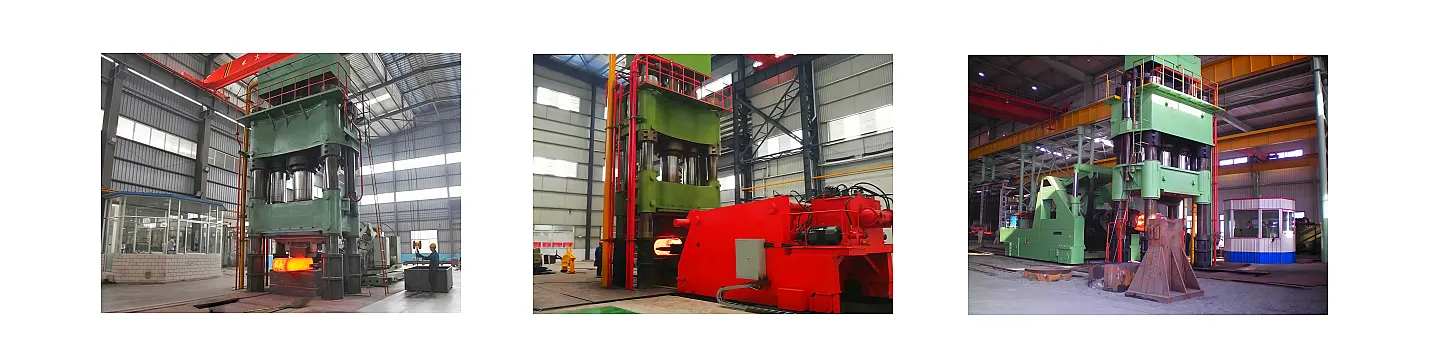
The Y13 series free forging hydraulic presses are divided into an ordinary type and a ring rolling blank dedicated type. The ordinary free forging hydraulic press is suitable for free forging and die forging of metal materials, with fast forging, normal forging and pressure holding functions, covering upsetting, drawing out, punching, expanding, bending and offsetting.
The ring rolling blank dedicated press carries an automatic billet centring device and a swing arm punch device, so it can complete upsetting and punching quickly. It is mainly used together with CNC radial-axial ring rolling machines.
| Item | Unit | Y13A-800 | Y13A-1250 | Y13A-1600 | Y13A-2000 | Y13A-2500 | Y13A-3150 | Y13A-4000 | Y13A-5000 | Y13A-6300 | Y13A-8000 | Y13A-10000 | Y13A-12500 | Y13A-16000 | ||
|---|---|---|---|---|---|---|---|---|---|---|---|---|---|---|---|---|
| Nominal pressure | MN | 8 | 12.5 | 16 | 20 | 25 | 31.5 | 40 | 50 | 63 | 80 | 100 | 125 | 160 | ||
| Clearance distance | mm | 2300 | 2600 | 2900 | 3100 | 3300 | 3800 | 4000 | 4600 | 5300 | 6000 | 6600 | 7200 | 7800 | ||
| Slide stroke | mm | 1000 | 1200 | 1400 | 1500 | 1600 | 1800 | 2000 | 2200 | 2500 | 2800 | 3200 | 3600 | 4000 | ||
| Column center distance | mm | 1900×1100 | 2200×1300 | 2600×1400 | 2800×1500 | 3200×1600 | 3600×1900 | 4400×2100 | 4600×2200 | 4700×2300 | 4800×2400 | 5100×2600 | 5500×2800 | 6000×3000 | ||
| Forging speed | Down speed | mm/s | 300 | 300 | 300 | 300 | 250 | 250 | 250 | 250 | 250 | 250 | 250 | 250 | 250 | |
| Working speed | Level 1 [nominal pressure] | mm/s (MN) | 68 [8] | 68 [12.5] | 180 [6] | 160 [8] | 172 [10] | 164 [12.5] | 152 [16.5] | 186 [16.5] | 183 [21] | 183 [27] | 183 [33] | 180 [41] | 180 [53] | |
| Level 2 [nominal pressure] | mm/s (MN) | / | / | 108 [10] | 105 [12] | 102 [15] | 104 [19] | 104 [23.5] | 93 [33.5] | 92 [42] | 92 [53] | 92 [67] | 90 [84] | 90 [107] | ||
| Level 3 [nominal pressure] | mm/s (MN) | / | / | 68 [16] | 63 [20] | 64 [25] | 64 [31.5] | 62 [40] | 62 [50] | 61 [63] | 61 [80] | 61 [100] | 60 [125] | 60 [160] | ||
| Return speed | mm/s | 300 | 300 | 300 | 300 | 250 | 250 | 250 | 250 | 250 | 250 | 250 | 250 | 250 | ||
| Slider bottom surface | Rapid forging | Level 1 | strokes/min | 60-70 | 60-70 | 60-70 | 60-70 | 60-70 | 55-65 | 50-60 | 45-55 | 40-50 | 35-45 | 30-40 | 25-30 | 20-25 |
| Standard forging | Level 3 | strokes/min | / | / | 25-35 | 25-35 | 25-35 | 20-30 | 20-30 | 20-30 | 15-25 | 10-20 | 7-15 | 5-10 | 3-6 | |
| Travelling worktable | Distance | mm | 2700×1300 | 3200×1500 | 3500×1600 | 3700×1700 | 5000×2000 | 5000×2300 | 6000×2500 | 6000×2800 | 7000×3000 | 7000×3200 | 8000×3500 | 9000×4000 | 12000×4500 | |
| L&R stroke | mm | ±1000 | ±1400 | ±1600 | ±1800 | ±2000 | ±2500 | ±2500 | ±3000 | ±3000 | ±3000 | ±3250 | ±3500 | ±4000 | ||
| Dimensional accuracy | mm | ±1 | ±1 | ±1 | ±1 | ±1 | ±1 | ±1 | ±1.5 | ±1.5 | ±1.5 | ±2 | ±2 | ±3 | ||
| Total power | kW | 700 | 1050 | 1400 | 1600 | 2050 | 2500 | 3200 | 3800 | 4800 | 6200 | 7500 | 9500 | 12000 | ||
| Height above floor | mm | ≤6800 | ≤8000 | ≤8500 | ≤9000 | ≤9500 | ≤10000 | ≤11000 | ≤13000 | ≤14500 | ≤16000 | ≤17500 | ≤19000 | ≤22000 | ||

The Y13KA series fast free forging hydraulic press uses advanced control systems and detection devices, and offers fully automatic, semi-automatic, manual and linked operating modes with convenient switching, easy operation and complete auxiliary device integration. It performs the free forging processes of upsetting, drawing out, punching, expanding rings, twisting, bending, offsetting and cutting.
Compared with conventional free forging equipment, its advantages are fast forging frequency, high production efficiency, high precision, energy saving and environmental protection, and a high degree of automation.
| Item | Unit | Y13KA-800 | Y13KA-1250 | Y13KA-1600 | Y13KA-2000 | Y13KA-2500 | Y13KA-3150 | Y13KA-4000 | Y13KA-5000 |
|---|---|---|---|---|---|---|---|---|---|
| Nominal force | t | 800 | 1,250 | 1,600 | 2,000 | 2,500 | 3,150 | 4,000 | 5,000 |
| Nominal force, graded | MN | 8 | 12.5 | 6/9/16 | 8/11/20 | 8/16/25 | 10/20/31.5 | 16/24/40 | 20/30/50 |
| Max. daylight opening | mm | 2,250 | 2,600 | 2,900 | 3,100 | 3,700 | 3,900 | 4,200 | 4,600 |
| Max. working stroke | mm | 1,000 | 1,250 | 1,400 | 1,500 | 1,600 | 1,800 | 2,000 | 2,200 |
| Distance between columns | mm | 2,200×1,200 | 2,200×1,400 | 2,600×1,400 | 2,800×1,500 | 3,200×1,700 | 3,800×1,900 | 4,500×2,200 | 4,900×2,300 |
| Moving table size | mm | 2,500×1,400 | 3,200×1,500 | 3,500×1,600 | 3,700×1,700 | 5,000×1,900 | 5,000×2,300 | 6,000×2,400 | 6,000×2,800 |
| Moving table stroke | mm | 1,500 (L/R) | 1,500 (L/R) | 1,600 (L/R) | 1,800 (L/R) | 2,000 (L/R) | 2,500 (L/R) | 2,500 (L/R) | 3,000 (L/R) |
| Lateral tilt table stroke | mm | 2,000 | 2,600 | 2,900 | 3,200 | 3,600 | 4,200 | 4,600 | 5,200 |
| Forging speed | mm/s | 0-90 | 0-95 | 0-90 | 0-90 | 0-85 | 0-105 | 0-90 | 0-90 |
| Moving table speed (adjustable) | mm/s | 0-250 | 0-250 | 0-250 | 0-250 | 0-150 | 0-150 | 0-150 | 0-150 |
| Lateral tilt table speed (adjustable) | mm/s | 0-250 | 0-250 | 0-250 | 0-250 | 0-150 | 0-150 | 0-100 | 0-100 |
| Fast forging frequency (stroke ≤ 20 mm) | times/min | ≤100 | ≤80 | ≤80 | ≤80 | ≤70 | ≤90 | ≤90 | ≤90 |
| Forging control accuracy | mm | ±1 | ±1 | ±1 | ±1 | ±1 | ±1 | ±1 | ±1 |
| Installed power | kW | ~800 | ~1,300 | ~1,580 | ~1,900 | ~2,300 | ~3,500 | ~3,800 | ~4,600 |
| Dimension | Y13A Open-Die Forging Hydraulic Press (Standard Type) | Y13KA Fast Free Forging Hydraulic Press |
|---|---|---|
| Tonnage range | 8-160 MN (800-16,000 t) | 8-50 MN (800-5,000 t); the series is designed for fast speed, and higher tonnage is available |
| Equipment positioning | Workshop main force, cost-effective priority | High-efficiency mass production core, energy-saving priority |
| Frame structure | Three-beam four-column open-frame type | Three-beam four-column frame type, rigidity strengthened |
| Hydraulic line | Conventional main cylinder return | Fast return plus accumulator, fast approach and return speed |
| Forging frequency | Conventional hydraulic machine stroke | Fast stroke, frequency several times higher than the conventional type |
| Operator linkage | Mainly single machine, optional simple manipulator | Standard linkage with automatic servo, centralised control by main console |
| Anti-eccentric load capability | Standard four-column guide | Guide-to-frame structure, better deviation resistance for long forgings |
| Control system | PLC plus electro-hydraulic proportional, single machine semi-automatic | PLC plus intelligent program, multi-group memory, fully automatic |
| Applicable processes | Full-range free forging; independent completion of upsetting, drawing out, punching, piercing, bending, twisting, offsetting, cutting, full-ring forging, die forging and flat forging | High-efficiency free forging; upsetting, drawing out, punching, piercing, bending, twisting, offsetting, cutting, full-ring forging and rotary forging; suitable for high-temperature alloys, titanium alloys and special alloys |
| Typical applications | Single-piece forgings, repair forgings, non-standard replacements; farm machinery small shafts, flange transmission gears, hardware tool blanks | Mass batch forgings such as farm machinery semi-shafts and engineering vehicle axles; large batch orders such as flanges and bearing races; high-grade forgings |
| Applicable materials | Carbon steel, alloy steel and other common metal materials | Carbon steel, alloy steel, special alloys and high-deformation-resistance materials |
| Price level | Entry level, high cost-performance ratio | Mid-to-high level, payback period within one year |
Read the two specification tables side by side and the gap is not uniform. The table below puts the published figures together at matching tonnages, so the trade-off becomes concrete.
| Capacity | Y13A rapid forging (strokes/min) | Y13KA fast forging, stroke ≤ 20 mm (times/min) | Y13A total power (kW) | Y13KA installed power (kW) |
|---|---|---|---|---|
| 800 t | 60-70 | ≤100 | 700 | ~800 |
| 1,250 t | 60-70 | ≤80 | 1,050 | ~1,300 |
| 1,600 t | 60-70 | ≤80 | 1,400 | ~1,580 |
| 2,000 t | 60-70 | ≤80 | 1,600 | ~1,900 |
| 2,500 t | 60-70 | ≤70 | 2,050 | ~2,300 |
| 3,150 t | 55-65 | ≤90 | 2,500 | ~3,500 |
| 4,000 t | 50-60 | ≤90 | 3,200 | ~3,800 |
| 5,000 t | 45-55 | ≤90 | 3,800 | ~4,600 |
Three things follow from those numbers. First, the frequency advantage is largest at the small and the large ends: at 800 t the Y13KA reaches up to 100 times per minute against 60-70 strokes, and at 5,000 t it stays at 90 while the Y13A falls to 45-55 as tonnage grows. In the middle of the range, around 1,600 to 2,500 t, the two series come much closer, and that is exactly where buyers most often hesitate.
Second, the figures are not measured on identical terms. The Y13A column is rapid forging at Level 1 with the slider bottom surface as the reference; the Y13KA column is fast forging frequency at a stroke of 20 mm or less. Use each column to compare models inside its own series, and treat the cross-series gap as directional rather than exact.
Third, the fast series carries a higher connected load at every size, from roughly 100 kW more at 800 t to about 1,000 kW more at 3,150 t. The accumulator and fast return are what buy the cycle time, and that is also why the fast machine is described as energy saving: the saving has to be judged per tonne forged over a shift, not per connected kilowatt.
Both series serve the same heavy-forging map. Typical open-die work includes:
The frame structures are not interchangeable, so it cannot be upgraded through simple modification. Select the correct model at one time based on current needs. If there are future expansion plans, consider the Y13KA directly.
The Y13KA. It has a higher number of blows per minute and a standard manipulator linkage function, which makes it more suitable for batch production.
The delivery time is the same. Please confirm the actual schedule with the sales manager.
Share the forging dimensions, the output volume and the material, and we will recommend a model based on the required capacity and the forging material.
No. The Y13A figure is rapid forging at Level 1; the Y13KA figure is fast forging frequency at a stroke of 20 mm or less. Compare models inside one table, and read the gap between the two series as a direction rather than an exact ratio.
No, but linkage is its standard configuration. The Y13KA is specified with automatic servo linkage and main console control; the Y13A is mainly a single machine with an optional simple manipulator.
Because the accumulator and the fast return need a larger connected load. The saving belongs to the cycle: shorter approach, return and idle time per blow, measured per tonne forged. Judge it against output from the same shift, not against the nameplate figure alone.
Receive the news that you are interested in.
