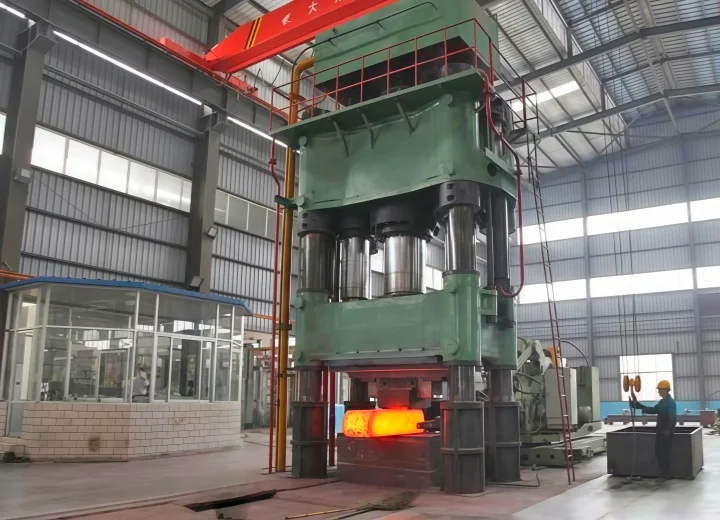
The Y13KA is an open die press, so it ends up wherever heavy sections have to be reduced before machining: heavy machinery, power generation, shipbuilding, oil and gas, metallurgy and general engineering.
Drawing out, upsetting, punching, mandrel work and preforming all run on the same table, which is what makes one press usable across a mixed order book.
Reading the Y13KA Specifications
The table above has fourteen rows, and six of them carry the decision. Two of those six are usually misread, so they are worth taking first.
- Nominal force (t) — 800 to 5,000 t of pressing force. Force, not weight: the machine does not weigh 5,000 t, and the figure is not comparable to a hammer's tonnage.
- Nominal force, graded (MN) — three pressure stages rather than one, from the 1,600 t frame upward. The 1,600 t frame runs at 6, 9 or 16 MN, which is 600, 900 or 1,600 t depending on the stage selected. The 800 and 1,250 t models are single-stage.
- Fast forging frequency — quoted at stroke ≤ 20 mm, so 70 to 100 strokes per minute is a short-stroke figure, not a rate you get at the full 2,200 mm stroke.
- Max. daylight opening and working stroke — 2,250 to 4,600 mm of opening, with 1,000 to 2,200 mm of stroke. Together they are the height budget for your bottom tool, your workpiece and your top tool.
- Distance between columns and moving table — the clear window is 2,200 × 1,200 to 4,900 × 2,300 mm, and the table itself runs 2,500 × 1,400 to 6,000 × 2,800 mm. A ring wider than the window does not go in, whatever the force says.
- Installed power — about 800 kW on the 800 t rising to about 4,600 kW on the 5,000 t. On the large capacities this is a site question before it is a machine question.
The graded-force row is the one that explains the machine. A single-stage press of 1,600 t can only push at 1,600 t, so every approach, every light pass and every return stroke is paid for at full pressure. On the Y13KA the same frame can drop to 600 t or 900 t, run the shallow passes quickly at the lower stage, and switch to the full 16 MN only where the reduction needs it. That is where the cycle time comes from — not from a bigger motor.
| Capacity |
Graded force |
Fast forging (≤20 mm stroke) |
Daylight opening |
Installed power |
| Y13KA-800 |
8 MN |
≤100 /min |
2,250 mm |
~800 kW |
| Y13KA-1250 |
12.5 MN |
≤80 /min |
2,600 mm |
~1,300 kW |
| Y13KA-1600 |
6/9/16 MN |
≤80 /min |
2,900 mm |
~1,580 kW |
| Y13KA-2000 |
8/11/20 MN |
≤80 /min |
3,100 mm |
~1,900 kW |
| Y13KA-2500 |
8/16/25 MN |
≤70 /min |
3,700 mm |
~2,300 kW |
| Y13KA-3150 |
10/20/31.5 MN |
≤90 /min |
3,900 mm |
~3,500 kW |
| Y13KA-4000 |
16/24/40 MN |
≤90 /min |
4,200 mm |
~3,800 kW |
| Y13KA-5000 |
20/30/50 MN |
≤90 /min |
4,600 mm |
~4,600 kW |
*Figures are taken from the parameter table above. Forging control accuracy is ±1 mm across the range. The part, its material and the reduction per pass decide the capacity — the table is the start of the conversation, not the answer.
Two mechanisms produce the cycle time. The first is the servo pump with accumulator assistance: the pump delivers oil at the rate the pass demands and the accumulator covers the peaks, so there is no oil going over a relief valve while the ram waits. The second is the moving table with its lateral tilt. The table shifts 1,500 to 3,000 mm left and right and tilts through 2,000 to 5,200 mm, which means the bottom tool can be brought to the part instead of the part being re-rigged to the tool.
The frame is either a prestressed type or a four-column eight-guide-rail type. In both cases the ram is guided on more than one plane, so a load that lands off the centre line does not cock the slide; that is what keeps the ±1 mm repeatable when the workpiece is not sitting dead centre.
What a Fast Open Die Press Is For
A conventional open die press takes long, slow bites. This machine takes many shallow ones. On a shaft that has to be drawn out over a series of passes, shallow passes held at a fast rate keep the section in the working temperature window instead of letting it cool between heavy squeezes — and a part that stays hot needs fewer reheats.
Work usually routed to this press:
- Shafts and stepped shafts — short passes along the length, with the table shifting to follow the work
- Discs, hubs and flanges — upset on a flat bottom tool, faster cycle than a single-stage press of the same force
- Ring blanks and hollow parts — worked over a mandrel, turned between passes
- Blocks, slabs and preforms — including near-net preforms that go on to a closed die hammer or press
- Long bars worked with a manipulator — the tilt table and the manipulator together cover a length no single table can
Materials: carbon and low-alloy steels, medium-carbon alloy steels such as 42CrMo, tool and die steels, stainless and high-temperature alloys. The high-frequency behaviour matters most on the last two — an alloy that loses temperature quickly is the one that benefits from many short passes rather than a few heavy ones.
Three numbers size the machine, and they are not interchangeable: the ingot or billet weight you start from, the largest section you must reduce in one pass (that is nominal force), and the largest workpiece that has to sit between the columns (that is column distance, table size and daylight). Send a drawing with the ingot weight and we size from those three. The process side is covered in more depth on our open die forging process page.
Y13KA or Y13A: Two Open Die Presses, Two Jobs
Both are open die forging presses from 800 t upward, so the choice is not "small or large" — it is what the press is asked to do.
- The Y13KA runs to 5,000 t in 8 capacities, with three-stage force from 1,600 t up, 70–100 strokes per minute at short stroke and a moving tilt table. It is the one for cycle time on shafts, discs and preforms.
- The Y13A runs to 16,000 t in 13 capacities, up to 160 MN, with a daylight opening to 7,800 mm and table sizes to 12,000 × 4,500 mm. Stroke rates are lower, 20–70 per minute, because the parts are heavier.
Decide on the ingot and the section first, then on cycle time. If your largest part sits inside 5,000 t and the daylight opening of 4,600 mm, the Y13KA will usually finish it in fewer passes and fewer reheats. If the section needs more than 50 MN, or the part is taller than the frame will open, the work belongs on the Y13A open die forging press. Shops running both sizes split the work exactly that way: the fast press on shafts and preforms, the heavy press on the ingot breakdown.
If the part is a repeating shape made in volume rather than a one-off, neither press is the right answer — that work belongs on a closed die machine: C86YA, C92KA, or a die forging press. For the hammer route instead of the press route, the matching open die hammers are the C66YA double-arm and the C61YA single-arm.
Price, Lead Time and Ordering
There is no public price list, because a Y13KA is configured to your requirements. The frame comes in 8 standard capacities; the table, the tilt stroke, the control package and the electrical specification are set by your plant and your workpiece. Here is what moves the price:
- Capacity and force stages — a three-stage 1,600 t frame is not a single-stage 1,600 t frame, and the difference is in the pump and valve package
- Table size and tilt stroke — a 6,000 × 2,800 mm moving table with a 5,200 mm lateral tilt changes the frame, not just the plate
- Control package and manipulator linkage — program forging, parameter recall and press-manipulator synchronization are a control and valve package, not a software switch
- Electrical specification and installed power — 800 kW to 4,600 kW depending on capacity, at your voltage, phase and frequency
- Foundation and erection scope — whether the foundation drawing, anchor bolts and erection supervision are in your scope or ours
- Spare parts package and shipping terms — which spares you keep for the first year, and whether the quote is ex-works or delivered
To move from a range to a firm number, send five things: a drawing or clear photo of the forged part, the material grade, the ingot or billet weight, the maximum section you have to reduce, and your annual output. Tell us the available power supply at the same time — on the 3,150 t and above it decides the pump package before anything else.
What comes back is a capacity recommendation with the reasoning, a quotation against your specification, the foundation load drawing, and the power and utility requirements for that machine. Lead time is quoted per order, because the capacity and the scope both move it: the press is scheduled into production once the configuration is confirmed, so the date comes with the quotation rather than being guessed in advance.
Send the part drawing and we will size the press and quote it.
Y13KA Fast Forging Press FAQ
What does the graded force figure mean?
It means the press can work at more than one pressure. On the 1,600 t model the stages are 6, 9 and 16 MN — 600, 900 and 1,600 t. The lower stages run the shallow passes quickly and the top stage is used where the reduction needs full force, which is what makes the fast cycle possible without a larger motor.
Why is the forging frequency quoted at 20 mm stroke?
Because that is the condition the fast cycle is designed for. At 20 mm stroke the press returns and strikes again in a fraction of the time it needs for a 2,200 mm working stroke, so 70 to 100 strokes per minute is a short-stroke figure. Read it as the rate for light, repeated passes — not as the rate at full stroke.
Y13KA or Y13A — how do I choose?
By the ingot and the section, then by cycle time. The Y13KA reaches 5,000 t with a 4,600 mm opening and a fast short-stroke cycle; the Y13A reaches 16,000 t and 160 MN with an opening to 7,800 mm. Inside 5,000 t the Y13KA usually finishes the part in fewer passes; above it, the work goes to the Y13A.
What accuracy can it hold?
±1 mm across all 8 capacities, on a ram guided by a prestressed frame or a four-column eight-guide-rail structure. Plan your machining allowance from ±1 mm rather than from a tolerance you have seen on a smaller press.
Does the tilt table replace a forging manipulator?
No — it reduces how often the part has to be repositioned. The table shifts 1,500 to 3,000 mm left and right and tilts 2,000 to 5,200 mm, so the bottom tool can be brought to the work. For long shafts you still want a manipulator turning and advancing the billet; see the T31 forging manipulator for the matching sizes.
How much power does it need?
Installed power runs from about 800 kW on the 800 t to about 4,600 kW on the 5,000 t. Check it against your site supply early: above 3,150 t it changes the pump and accumulator package rather than just the cable size.
Open die or closed die — which one do I need?
Open die shapes the workpiece between flat or simple tools and suits one-off parts, shafts and preforms. Closed die uses a machined cavity and suits a repeating part made in quantity. The Y13KA is open die; for closed die see the C86YA, the C92KA or a die forging press.
Is the Y13KA a fixed model, or configurable to my requirements?
Configurable. The 8 capacities are standard frame sizes; the table size, the tilt stroke, the control package and the electrical specification are set per project. That is also why there is no published price, and why the delivery date comes with the quotation rather than off a table.