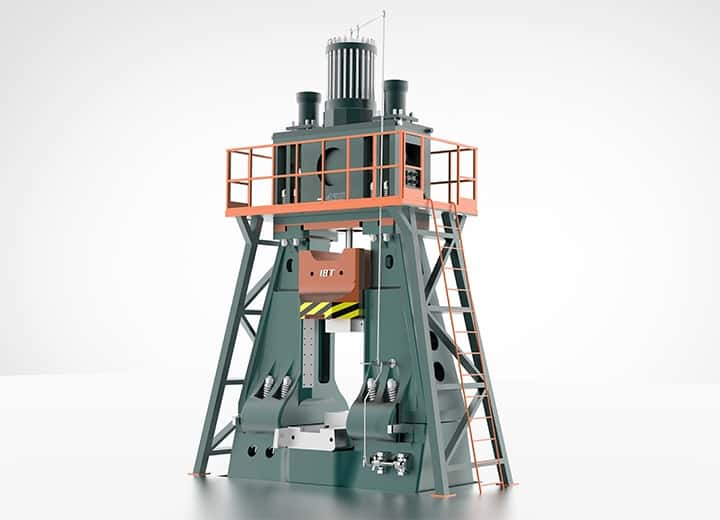
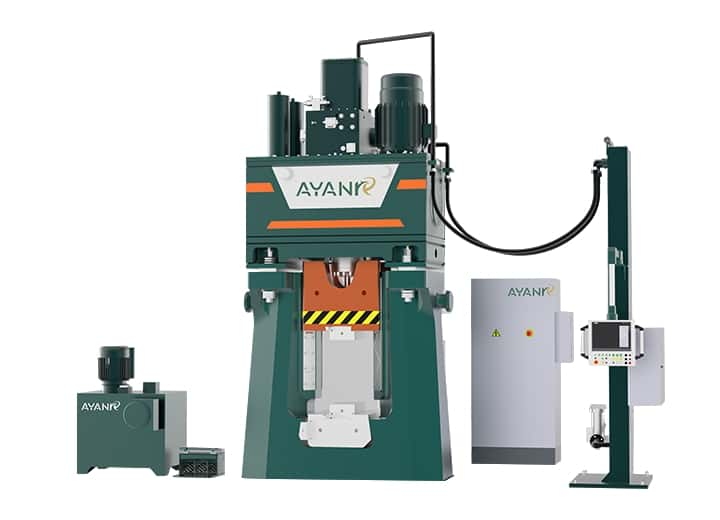
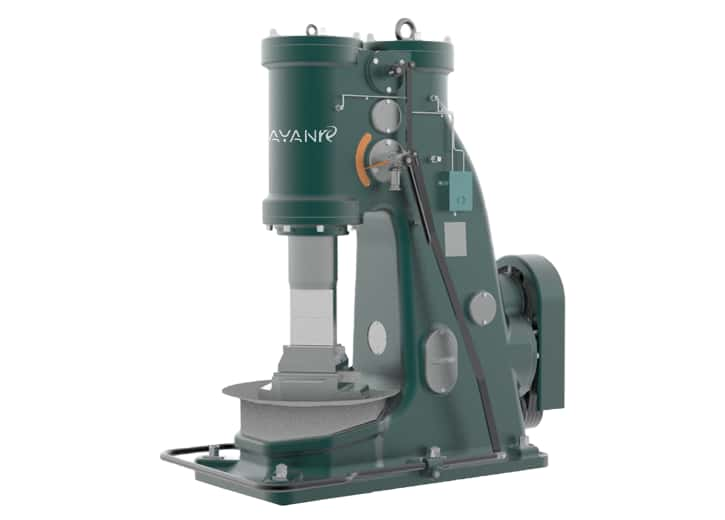
Product parameters
| Item |
Unit |
Y13A-800 |
Y13A-1250 |
Y13A-1600 |
Y13A-2000 |
Y13A-2500 |
Y13A-3150 |
Y13A-4000 |
Y13A-5000 |
Y13A-6300 |
Y13A-8000 |
Y13A-10000 |
Y13A-12500 |
Y13A-16000 |
| Nominal pressure |
MN |
8 |
12.5 |
16 |
20 |
25 |
31.5 |
40 |
50 |
63 |
80 |
100 |
125 |
160 |
| Clearance distance |
mm |
2300 |
2600 |
2900 |
3100 |
3300 |
3800 |
4000 |
4600 |
5300 |
6000 |
6600 |
7200 |
7800 |
| Slide stroke |
mm |
1000 |
1200 |
1400 |
1500 |
1600 |
1800 |
2000 |
2200 |
2500 |
2800 |
3200 |
3600 |
4000 |
| Column center distance |
mm |
1900×1100 |
2200×1300 |
2600×1400 |
2800×1500 |
3200×1600 |
3600×1900 |
4400×2100 |
4600×2200 |
4700×2300 |
4800×2400 |
5100×2600 |
5500×2800 |
6000×3000 |
| Forging speed |
Down speed |
mm/s |
300 |
300 |
300 |
300 |
250 |
250 |
250 |
250 |
250 |
250 |
250 |
250 |
250 |
| Working speed |
Level 1[Nominal pressure] |
mm/s(MN) |
68[8] |
68[12.5] |
180[6] |
160[8] |
172[10] |
164[12.5] |
152[16.5] |
186[16.5] |
183[21] |
183[27] |
183[33] |
180[41] |
180[53] |
| Level 2[Nominal pressure] |
mm/s(MN) |
/ |
/ |
108[10] |
105[12] |
102[15] |
104[19] |
104[23.5] |
93[33.5] |
92[42] |
92[53] |
92[67] |
90[84] |
90[107] |
| Level 3[Nominal pressure] |
mm/s(MN) |
/ |
/ |
68[16] |
63[20] |
64[25] |
64[31.5] |
62[40] |
62[50] |
61[63] |
61[80] |
61[100] |
60[125] |
60[160] |
| Return speed |
mm/s |
300 |
300 |
300 |
300 |
250 |
250 |
250 |
250 |
250 |
250 |
250 |
250 |
250 |
| Slider bottom surface |
Rapid forging |
Level 1 |
min⁻¹ |
60-70 |
60-70 |
60-70 |
60-70 |
60-70 |
55-65 |
50-60 |
45-55 |
40-50 |
35-45 |
30-40 |
25-30 |
20-25 |
| Standard forging |
Level 3 |
min⁻¹ |
/ |
/ |
25-35 |
25-35 |
25-35 |
20-30 |
20-30 |
20-30 |
15-25 |
10-20 |
7-15 |
5-10 |
3-6 |
| Travelling worktable |
Distance |
mm |
2700 * 1300 |
3200 * 1500 |
3500 * 1600 |
3700 * 1700 |
5000 * 2000 |
5000 * 2300 |
6000 * 2500 |
6000 * 2800 |
7000 * 3000 |
7000 * 3200 |
8000 * 3500 |
9000 * 4000 |
12000 * 4500 |
| L& R stroke |
mm |
±1000 |
±1400 |
±1600 |
±1800 |
±2000 |
±2500 |
±2500 |
±3000 |
±3000 |
±3000 |
±3250 |
±3500 |
±4000 |
| Dimensional accuracy |
mm |
±1 |
±1 |
±1 |
±1 |
±1 |
±1 |
±1 |
±1.5 |
±1.5 |
±1.5 |
±2 |
±2 |
±3 |
| Total power |
kW |
700 |
1050 |
1400 |
1600 |
2050 |
2500 |
3200 |
3800 |
4800 |
6200 |
7500 |
9500 |
12000 |
| Height above floor |
mm |
≤6800 |
≤8000 |
≤8500 |
≤9000 |
≤9500 |
≤10000 |
≤11000 |
≤13000 |
≤14500 |
≤16000 |
≤17500 |
≤19000 |
≤22000 |
*Note:Above parameters are standard parameters and no announce if there are any changes.
Reading the Y13A Specifications
The table above has twenty rows, but six of them carry the decision:
- Nominal pressure (MN) — the force the press can deliver. It is the model number converted: Y13A-800 is 8 MN, which is 800 tonnes of force.
- Clearance distance (mm) — 2,300 to 7,800 mm. With slide stroke added, this is what decides whether your ingot and your bottom tool actually fit.
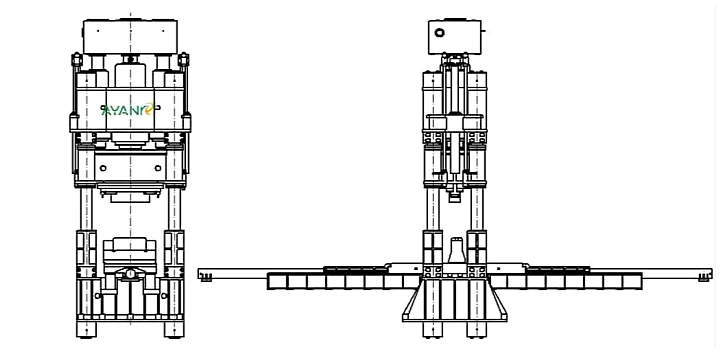
- Column centre distance (mm) — the clear window between the columns. A ring that is wider than this cannot go in, whatever the tonnage says.
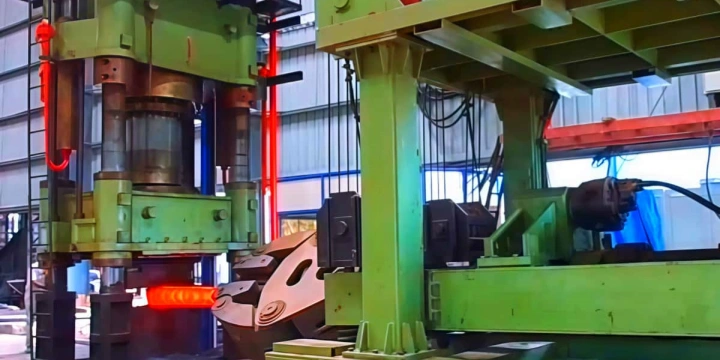
- Travelling worktable and L&R stroke — table size from 2,700 × 1,300 mm to 12,000 × 4,500 mm, shifting ±1,000 to ±4,000 mm to move the bottom tool out for a change.
- Dimensional accuracy (mm) — ±1 mm up to the 4,000 t machine, then ±1.5, ±2 and ±3 as the press gets bigger. This is the number that decides how much you leave for machining.
- Strokes per minute — 60-70 at the bottom of the range for rapid forging, down to 20-25 on the 16,000 t, with standard forging roughly a third of that.
One point about the tonnage figure: on a press, tonnes means force, not weight. Y13A-16000 delivers 160 MN — it does not weigh 16,000 t, and it is not comparable to a "16,000 kg hammer". Press capacity and hammer capacity are measured on different scales, which is why the two are compared by what they can deform rather than by the number on the nameplate.
| Capacity |
Nominal pressure |
Accuracy |
Strokes/min (rapid) |
| Y13A-800 |
8 MN |
±1 mm |
60-70 |
| Y13A-1250 |
12.5 MN |
±1 mm |
60-70 |
| Y13A-1600 |
16 MN |
±1 mm |
60-70 |
| Y13A-2000 |
20 MN |
±1 mm |
60-70 |
| Y13A-2500 |
25 MN |
±1 mm |
60-70 |
| Y13A-3150 |
31.5 MN |
±1 mm |
55-65 |
| Y13A-4000 |
40 MN |
±1 mm |
50-60 |
| Y13A-5000 |
50 MN |
±1.5 mm |
45-55 |
| Y13A-6300 |
63 MN |
±1.5 mm |
40-50 |
| Y13A-8000 |
80 MN |
±1.5 mm |
35-45 |
| Y13A-10000 |
100 MN |
±2 mm |
30-40 |
| Y13A-12500 |
125 MN |
±2 mm |
25-30 |
| Y13A-16000 |
160 MN |
±3 mm |
20-25 |
*Accuracy and stroke rate are the figures from the parameter table above. The part, its material and the reduction per pass decide the capacity — the table is the start of the conversation, not the answer.
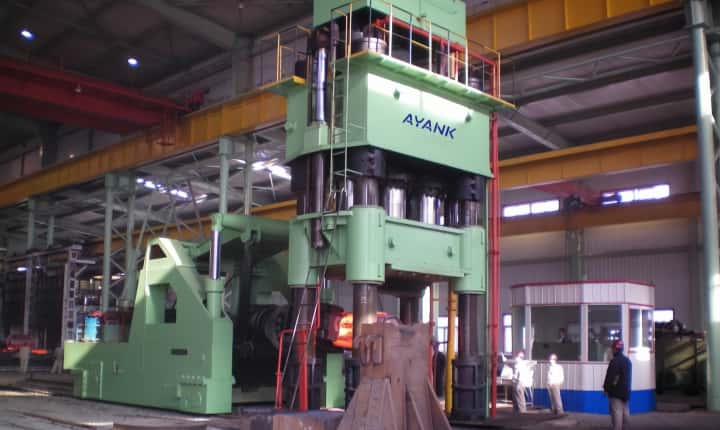
Two mechanisms explain why the numbers behave as they do. The first is the three-stage forging speed: level 1 is the slow, full-pressure pass at nominal force, level 2 and 3 trade force for speed, so a drawing-out pass can run at 180 mm/s on the smaller machines while a final sizing pass drops to 60 mm/s at full tonnage. The second is the prestressed frame — the columns are pre-loaded in compression, so an off-centre load does not open a gap and the slide stays parallel to the table.
Total power is the row most often missed when a buyer first checks the drawing: from 700 kW on the 800 t to 12,000 kW on the 16,000 t. That is a site question as much as a machine question, and it is worth settling before the foundation drawing is made.
What an Open Die Forging Press Forges
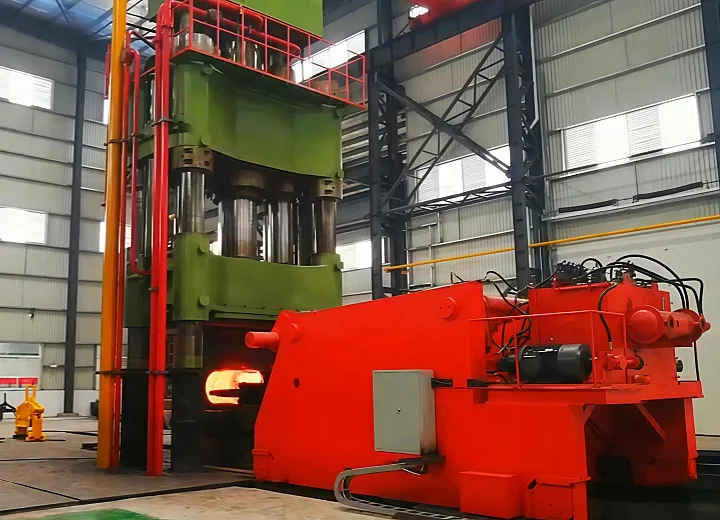
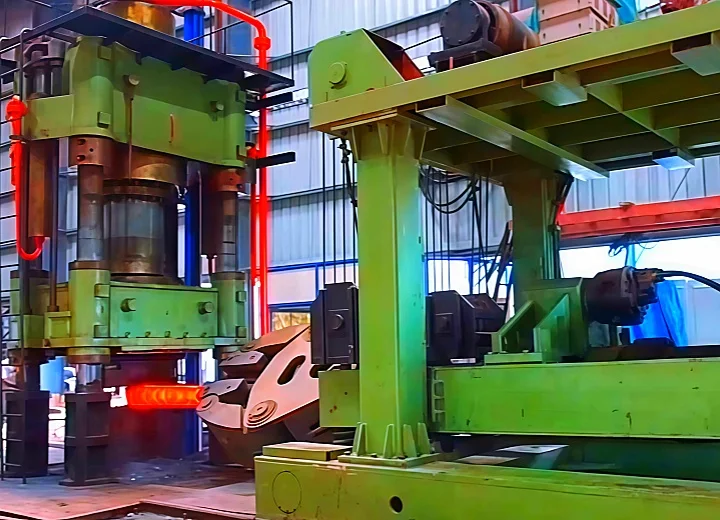
A press squeezes where a hammer strikes. Because the load is applied slowly and held, the deformation penetrates to the centre of the section instead of staying at the surface — which is why a press is chosen for large ingots, tall sections and alloys that crack under impact. The operator still turns and advances the workpiece between passes; what changes is how the metal flows inside.
Work usually routed to this machine:
- Large shafts and stepped shafts — including long forgings worked with a manipulator at one end
- Discs, hubs and flanges — upset from ingot or cut billet on a flat bottom tool
- Ring blanks and hollow parts — pierced and forged over a mandrel
- Blocks, slabs and heavy preforms — including preforms for later closed die finishing
- Tube and shell sections — drawn out over a mandrel, turned between passes
Materials: carbon and low-alloy steels, medium-carbon alloy steels such as 42CrMo, tool and die steels, stainless and high-temperature alloys. For the last two groups the slow squeeze is not a preference but a requirement — an impact blow on a segregation-prone alloy is how cracking starts.
Three numbers pick the capacity, and they are not interchangeable: the maximum ingot or billet weight you start from, the largest section you must reduce in one pass (that is nominal pressure), and the largest workpiece that has to fit between the columns (that is column centre distance and clearance). Send a drawing with the ingot weight and we size from those three. The process side is covered in more depth on our open die forging process page.
Press or Hammer: Which One for Your Part
This is the question buyers ask before they ask about price, and the two answers lead to different machines. A hammer delivers energy in a blow; a press delivers force over a stroke. In practice:
- Take the press when the ingot is large, when the section has to be worked through to the core, when the alloy is sensitive to impact, or when the shop cannot carry a hammer foundation
- Take the hammer when the work is small to medium, when the operator needs to feel the blow and adjust by hand, when the batch is short and the shapes vary, or when capital cost dominates the decision
- Both is a normal answer for a shop running mixed work — a press for the heavy draw-out and a hammer for the finishing passes
Do not compare the two by the number on the nameplate. A 16,000 t press and a 25 ton hammer are not two sizes of the same thing, and the tonnage scales do not convert. Compare them by what they do to your part: a press reduces a section in passes with a controlled force; a hammer reduces it in blows with a controlled energy.
The matching hammers are on the C66YA double-arm hammer and the C61YA single-arm hammer pages, using the same parameter format. For a repeating part made in volume, neither is right — that work belongs on a closed die machine: C86YA or C92KA.
Price, Lead Time and Ordering
There is no public price list, because a Y13A is configured to your requirements. The frame comes in 13 standard capacities; the table, the stroke, the controls and the electrical specification are set by your plant and your workpiece. If you have been searching for an open die forging press for sale, the honest answer is that the configuration is set by your part — so here is what moves the price:
- Capacity and nominal pressure — the 800 t and the 16,000 t are different classes of equipment, and everything between scales with it
- Table size and L&R stroke — a travelling table sized to your largest tool changes the frame and the hydraulics
- Control package and manipulator linkage — program forging and press-manipulator synchronization are a control and valve package, not a software switch
- Electrical specification and total power — 700 kW to 12,000 kW depending on capacity, at your voltage, phase and frequency
- Foundation and erection scope — whether the foundation drawing, anchor bolts and erection supervision are in your scope or ours
- Spare parts package and shipping terms — which spares you keep for the first year, and whether the quote is ex-works or delivered
To move from a range to a firm number, send five things: a drawing or clear photo of the forged part, the material grade, the ingot or billet weight, the maximum section you have to reduce, and your annual output. Tell us the available power supply at the same time — on the large capacities it decides the hydraulic package before anything else.
What comes back is a capacity recommendation with the reasoning, a quotation against your specification, the foundation load drawing, and the power and utility requirements for that machine. Lead time is quoted per order, because the capacity and the scope both move it: the press is scheduled into production once the configuration is confirmed, so the date comes with the quotation rather than being guessed in advance.
Y13A Open Die Forging Press FAQ
What does "800 t" mean on this press?
It is force, not weight. Y13A-800 delivers 8 MN, which is 800 tonnes of pressing force; the machine itself weighs a fraction of that. The same rule runs up the range — Y13A-16000 is 160 MN and does not weigh 16,000 t.
Press or hammer — how do I choose?
By what has to happen inside the metal. A press squeezes slowly and the deformation reaches the core, which suits large ingots, tall sections and alloys that crack under impact. A hammer delivers energy in a blow and suits small to medium work where the operator steers the shape by hand. Mixed shops run both.
What dimensional accuracy can I expect?
±1 mm up to the 4,000 t machine, ±1.5 mm on 5,000 to 8,000 t, ±2 mm on 10,000 and 12,500 t, and ±3 mm on the 16,000 t. Plan your machining allowance from those figures rather than from the smallest one in the table.
Can the press be linked with a forging manipulator?
Yes. Ordered with the linkage package, the press and manipulator run from one control: program forging, remote operation, and synchronization so the manipulator turns and advances the billet between passes. See the T31 forging manipulator for the matching sizes.
How much power does it need?
Total installed power runs from 700 kW on the 800 t to 12,000 kW on the 16,000 t. That is the first thing to check against your site supply, because above a certain capacity it changes the hydraulic package rather than just the cable size.
Open die or closed die — which one do I need?
Open die shapes the workpiece between flat or simple tools and suits one-off parts, large shafts and preforms. Closed die uses a machined cavity and suits a repeating part made in quantity. The Y13A is open die; for closed die see the C86YA or the C92KA.
Is the Y13A a fixed model, or configurable to my requirements?
Configurable. The 13 capacities are standard frame sizes; the table, the L&R stroke, the control package and the electrical specification are set per project. That is also why there is no published price — the number depends on the configuration you choose.
How long does delivery take?
It is fixed on the quotation rather than read off a table, because the capacity and the scope both move it. The press is scheduled into production once the configuration is confirmed, and the date you are given is tied to that schedule — ask for it with the quotation so you are comparing the same basis.