Steel Ball Skew Rolling Mill Production Process for Steel Balls
Mines (iron ore, copper ore, gold ore, etc.), cement plants, power plants (coal powder preparation), chemical raw material crushing.
Stage 1: Before the 1970s in China, there was hardly any process to speak of; simple and crude.
Stage 2: 1971–1983: Mainly production of iron-cutting balls; the process was backward and crude.
Stage 3: 1983–1990: Began to recognize the importance of science, gradually moving toward scientific development, but the breakage rate of steel balls remained high. During this period, the significance of internal stress in steel balls was not fully understood.
In the first three stages, especially the first and second, ball mills above 6 meters were just emerging, and the mining industry was gradually rising. Therefore, after 2000, the real stage of demanding both output and quality for steel balls began.
Stage 4: 1991–2004: Processing technology gradually matured, products entered the world market. Research on carbon steel, alloy structural steel, and even bainitic steel balls began, entering the market with systematic quenching processes for steel balls.
Stage 5: 2005–2010: Driven toward industrial-scale production to increase output. Chinese steel balls gradually gained recognition from large mines worldwide, entering the global market and beginning a scientific approach.
Stage 6: 2010 to present: Very rapid development, continuous optimization of materials, increasing size of grinding mills used in mines, and ever-higher requirements for steel balls.
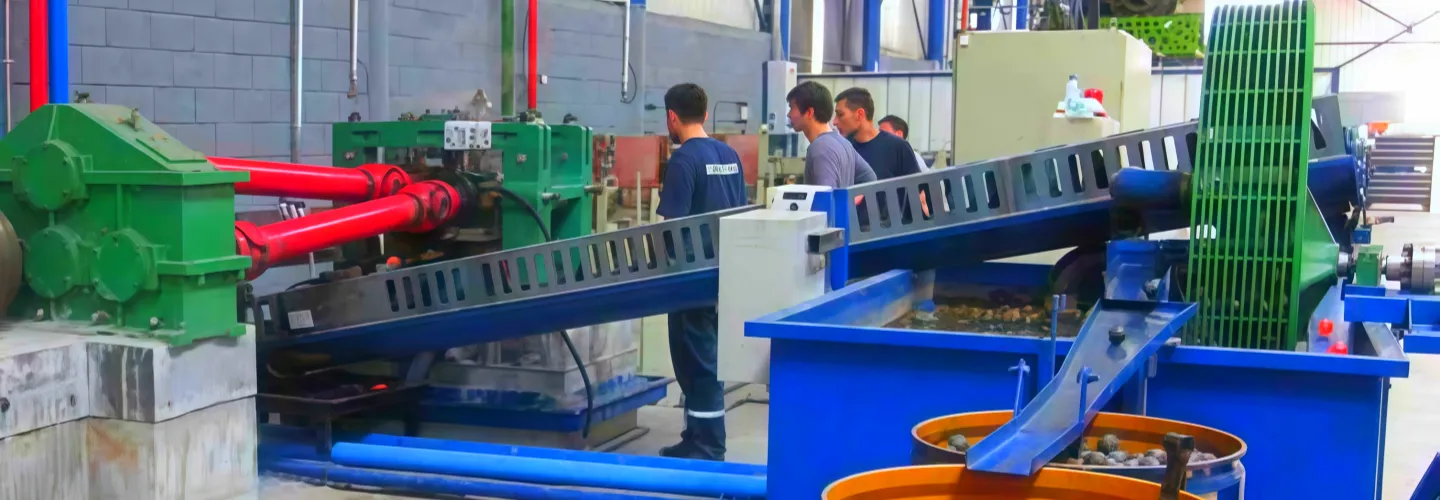
The steel ball skew rolling mill is a specialized equipment that uses spiral pass molds and the skew rolling forming process to produce steel balls and other rotary parts. Its working principle is: two rolls with spiral passes have their axes intersecting at a certain angle. The rolls rotate in the same direction, driving the bar to rotate in the opposite direction and advance. Under the action of the spiral passes, the bar gradually forms into spheres, the connecting necks between spheres become thinner and finally break, thus obtaining steel balls. Structure and working principle of AYANK Steel Ball Forging Equipment – Steel Ball Skew Rolling Mill: The roll spiral pass consists of a forming section and a finishing section. The forming section performs the biting of the bar and rolls it into spheres; in the finishing section, the spherical workpieces are finished and separated from the bar.
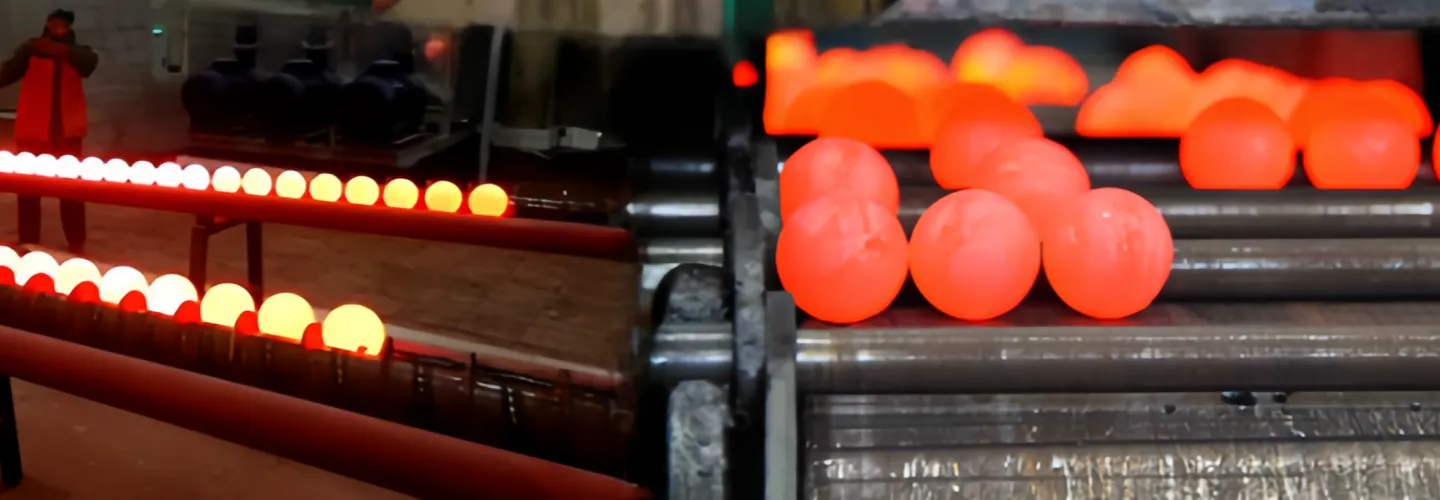
Bearing steel balls are mainly produced by extrusion, casting, forging, rolling, and other processing methods, followed by heat treatment, polishing, and lapping to obtain finished products. Wear-resistant steel balls are mainly produced by casting, forging, and rolling, followed by quenching and tempering to obtain finished products. Compared with cast balls and forged balls, rolled balls represent a completely new production process. Hot-rolled steel balls produced by AYANK have consistent surface hardness and core hardness, excellent wear resistance, high impact toughness, and no cracking or breaking.
1.Integral roll box design, good rigidity;
2.Simple adjustment, easy operation;
3.Quick and efficient guide plate replacement.
According to the specifications and types of grinding steel balls to be rolled, AYANK FORGING Machinery Industry Co., Ltd. has developed, designed, and manufactured a series of hot-rolled grinding steel ball production lines, including ZQ20, ZQ30, ZQ40, ZQ50, ZQ60, ZQ70, ZQ80, ZQ100, ZQ120 complete hot-rolled grinding steel ball production lines, capable of producing φ20~120mm grinding steel balls of various specifications as well as various steel segments. The guide plate replacement of AYANK FORGING Machinery Industry Co., Ltd.'s steel ball skew rolling mill is quick and convenient, ensuring stable, efficient, and high-quality operation of the steel ball rolling production line, meeting the requirements of different users.
The steel ball rolling mill is a skew rolling mill for producing steel balls. Steel ball rolling is a process developed from the former Soviet Union, also known as the steel ball skew rolling process. Skew rolling equipment mainly consists of two rolls whose axes are not parallel but cross each other, rotating in the same direction around their own axes during operation. The principle relies on the contact friction between the rolls and the workpiece to drive the workpiece to rotate and advance. This rolling method is also called helical rolling. The rolling materials are medium-carbon steel, low-alloy steel, and medium-alloy steel. Advantages include good stability of continuous rolling production, high workpiece quality, high yield, and high production efficiency.
Compared with cast balls and forged balls, rolled balls represent a completely new production process. Hot-rolled steel balls produced by AYANK FORGING Machinery Industry Co., Ltd. have consistent surface hardness and core hardness, good wear resistance, high impact toughness, and no cracking or breaking.
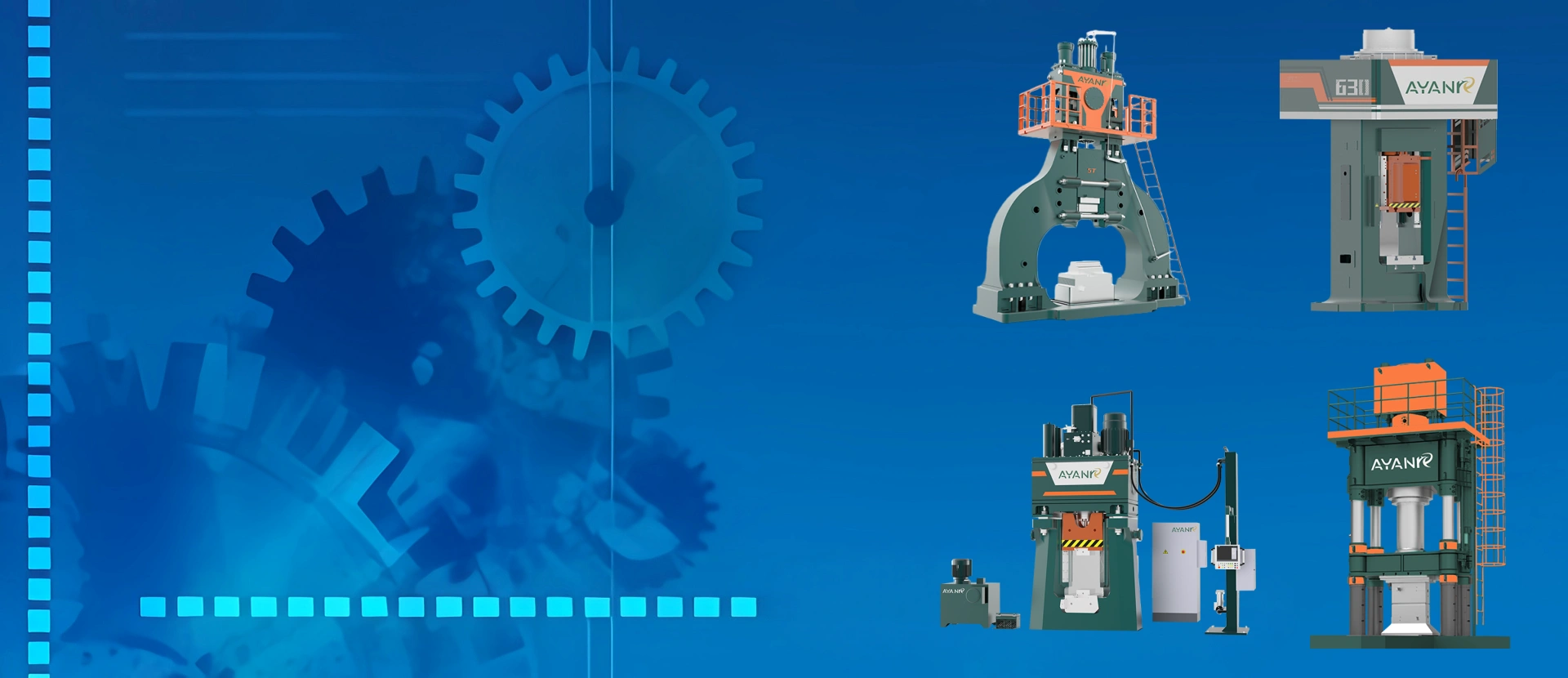
AYANK FORGING is an enterprise designated by the former Ministry of Machinery Industry to produce air hammers. The air hammers produced by our company have won the highest quality award in the national machinery industry. Prior to this, steel balls with higher quality requirements were basically forged by air hammers, but the production efficiency was limited. To break through the bottleneck of low production efficiency of forged balls, our company established a professional R&D team, studied and absorbed domestic and foreign theoretical research results in this field, and after years of accumulation, finally transformed this research achievement into productivity – the automatic steel ball rolling mill production line, which has been exported to Turkey, Vietnam, Indonesia, and other countries, receiving unanimous praise from customers.
What are the differences between the various processes for producing steel balls?
Receive the news that you are interested in.