How are track links produced? Currently, there are mainly two processes to produce track links: one is casting, and the other is forging using a full hydraulic die forging hammer.
Track links are important components of excavators. It is precisely because of the existence of excavator track links that large-sized excavators can "walk". If there is a problem with the excavator track links during operation, the entire excavator will be very difficult to operate. Therefore, the quality of track links directly affects the use of excavators.

The casting process for track links involves melting the material into a liquid state, then pouring it into a pre-made mold cavity in the shape of a track link, and waiting for it to solidify to form a complete track link. However, the casting workshop has high temperatures, and melting materials easily produces waste fumes, resulting in a very poor environment. This not only affects the health of employees but also pollutes the environment. Cast track links also have defects such as loose structure, coarse grains, and internal shrinkage cavities, porosity, and blowholes. At the same time, cast track links are relatively poor in hardness and wear resistance. To increase hardness and wear resistance, chromium (Cr) element needs to be added, but the price of chromium is very high, which increases the cost of the wrench. Based on the above reasons, the market share of cast track links has been declining year by year.
The forging process for track links involves heating the bar stock, then placing it on the die of a CNC full hydraulic die forging hammer for forging. Through pre-forging and finish forging, the track link can be directly forged into shape. The CNC full hydraulic die forging hammer operates at high speed, resulting in a high degree of deformation of the forged track link, which fully changes the internal structure of the track link, increases the density of the forging, and does not produce defects such as loose structure, coarse grains, or internal shrinkage cavities, porosity, and blowholes. Therefore, track links forged with a CNC full hydraulic die forging hammer have higher hardness and stronger wear resistance.
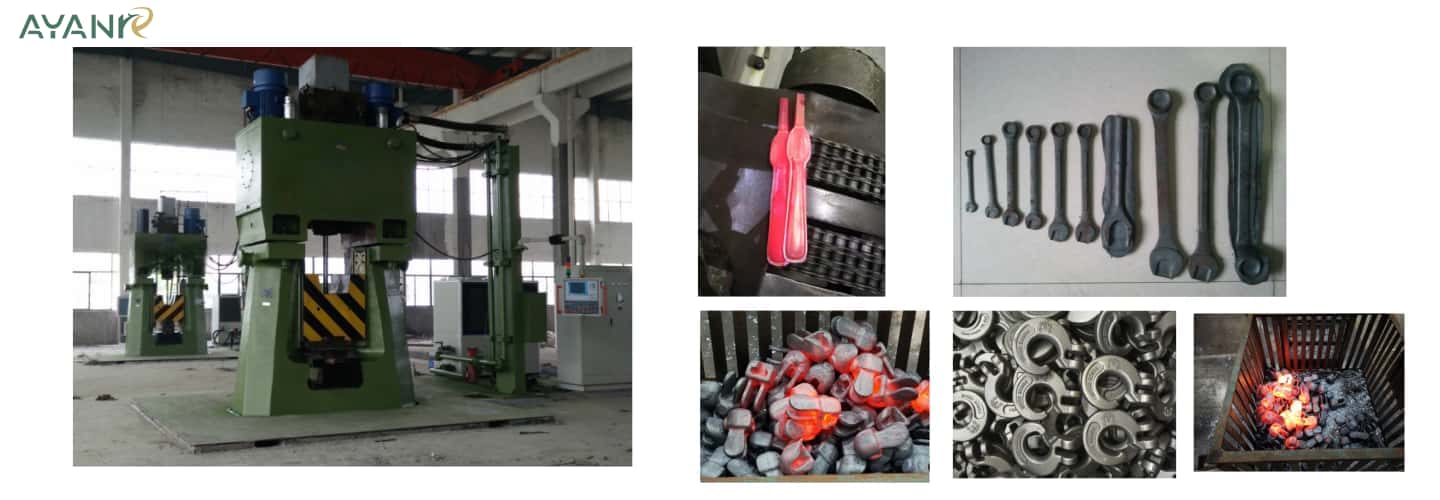
A Vietnamese customer company purchased three CNC full hydraulic die forging hammers from our company within two years to produce track links and other forgings.
125KJ CNC full hydraulic die forging hammer forging track links in Vietnam
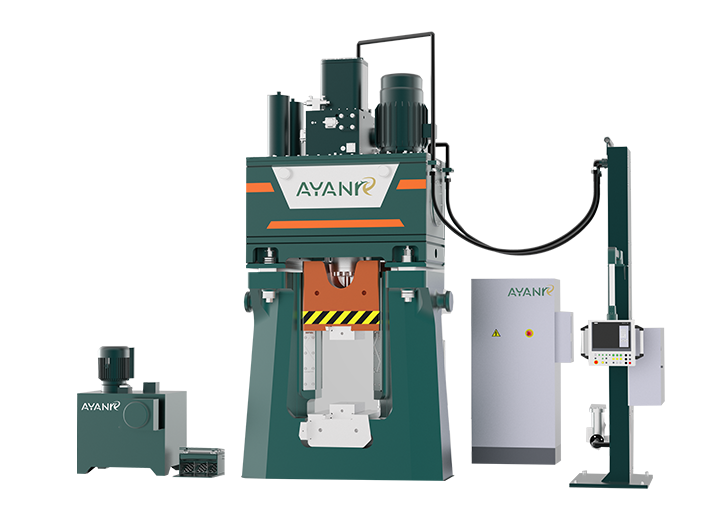
The CNC full hydraulic die forging hammer is a modern programmed precision forging equipment, controlled by PLC, with high striking accuracy; the forging energy can be digitally controlled. It is the main forging equipment for a series of precision forgings such as automobiles, aerospace, aviation, hand tools, motorcycles, etc. The CNC die forging hammer can also be combined with robots to form a fully automatic production line, reducing labor costs, saving costs for enterprises, and making forgings more competitive in the market.
AYANK FORGING CNC full hydraulic die forging hammer has its unique advantages in the field of precision forging:
1.Unique striking valve system ensures extremely high repeatability of striking energy;
2.Forging striking achieves "CNC" programming, and the CNC system can be connected to the internet, enabling remote control;
3.U-shaped frame + X-shaped guide rail ensures extremely high precision of forgings and allows multi-cavity forging;
4.High striking frequency makes production more efficient;
5.The hammer head can be raised and lowered slowly at any time, making it more convenient, faster, and safer to change or adjust molds;
6.Short stroke striking function, mold vibration function, and anti-misoperation safety module are exclusive technologies of AYANK Company;
7.Can achieve automation
Receive the news that you are interested in.