
A Closed Die Forging Hammer is a forging machine used to shape heated metal between dies containing the desired component geometry. By applying controlled impact energy, the hammer forces the workpiece to fill the die cavity and produce near-net-shape forged components. This guide explains how closed die forging hammers work, their applications, advantages, and the key factors to consider when selecting equipment.
Quick Answer
A closed die forging hammer is a forging hammer designed for producing components with dies that enclose and control the shape of the heated workpiece. The process is also commonly called closed-die forging or impression-die forging.
Compared with open-die forging, closed-die forging provides much greater control over the final component geometry and is commonly used for repeat production of automotive, machinery, hand-tool, and industrial components. When selecting a closed die forging hammer, buyers should consider forging material, component weight, die dimensions, required energy, production volume, automation requirements, and available factory space.
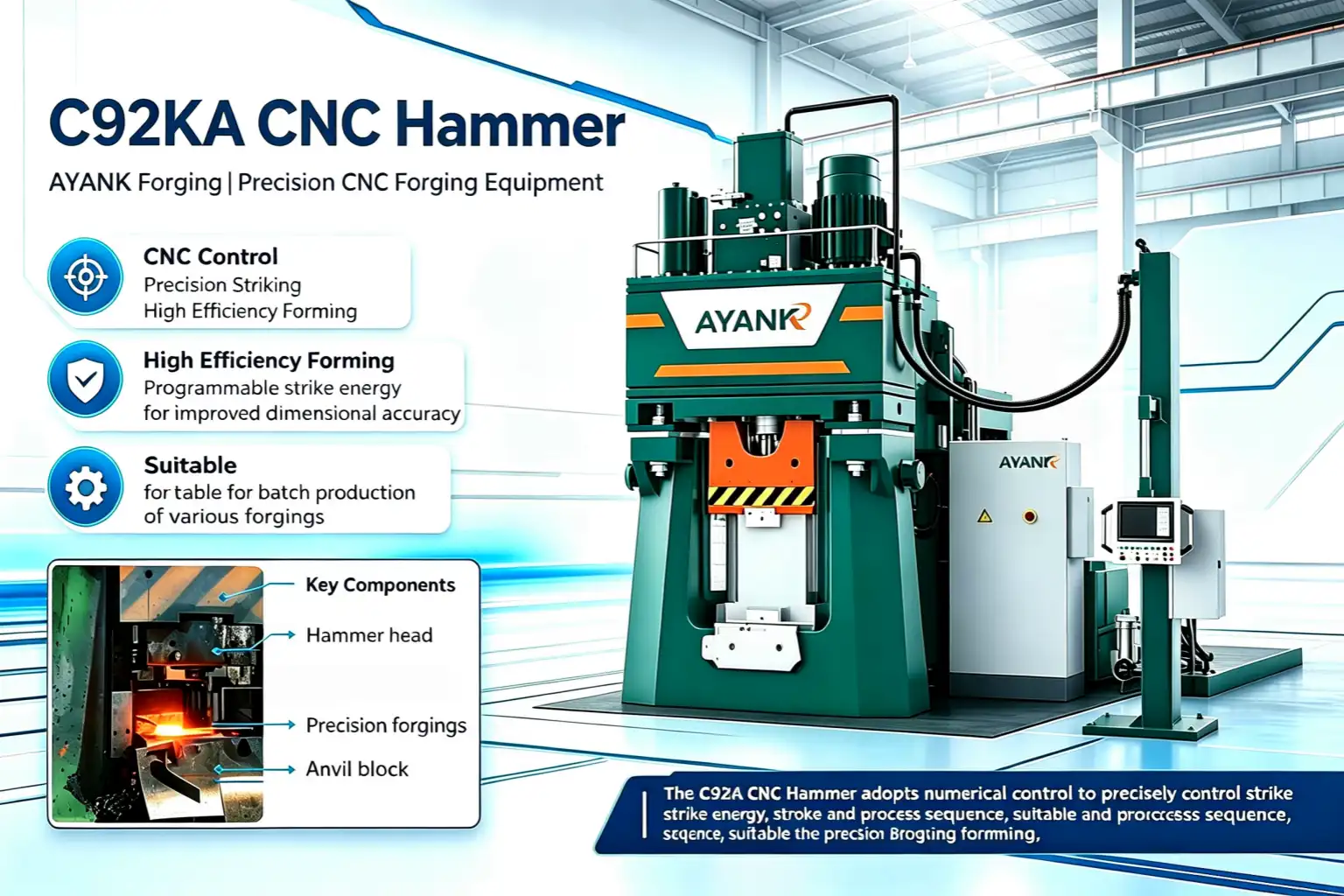
What Is a Closed Die Forging Hammer?
A closed die forging hammer is a type of forging equipment used to manufacture metal components by applying repeated impact forces to a heated workpiece positioned between shaped dies.
Unlike open-die forging, where the workpiece is generally compressed between relatively simple die surfaces, closed-die forging uses dies with cavities that define the required component geometry.
During the forging operation, the heated billet or preform is placed into the lower die. The upper die then moves downward under the force generated by the hammer, causing the metal to flow and fill the die cavity.
The term closed die forging hammer describes the combination of the forging process and the equipment used to perform it. Closed-die forging itself is a forming process and can also be performed using forging presses.
Other Names for Closed Die Forging Hammer
Depending on the manufacturer and industry, you may encounter several related terms, including:
- Closed die forging hammer
- Closed-die forging machine
- Die forging hammer
- Impression die forging hammer
- Impression forging hammer
- Hydraulic closed die forging hammer
- CNC closed die forging hammer
These terms may describe closely related equipment, but buyers should always confirm the actual machine configuration, energy rating, die dimensions, automation system, and forging capacity with the manufacturer.
How Does a Closed Die Forging Hammer Work?
The basic principle is straightforward: a heated metal workpiece is positioned between shaped dies and subjected to controlled hammer blows until the material fills the required die cavity.
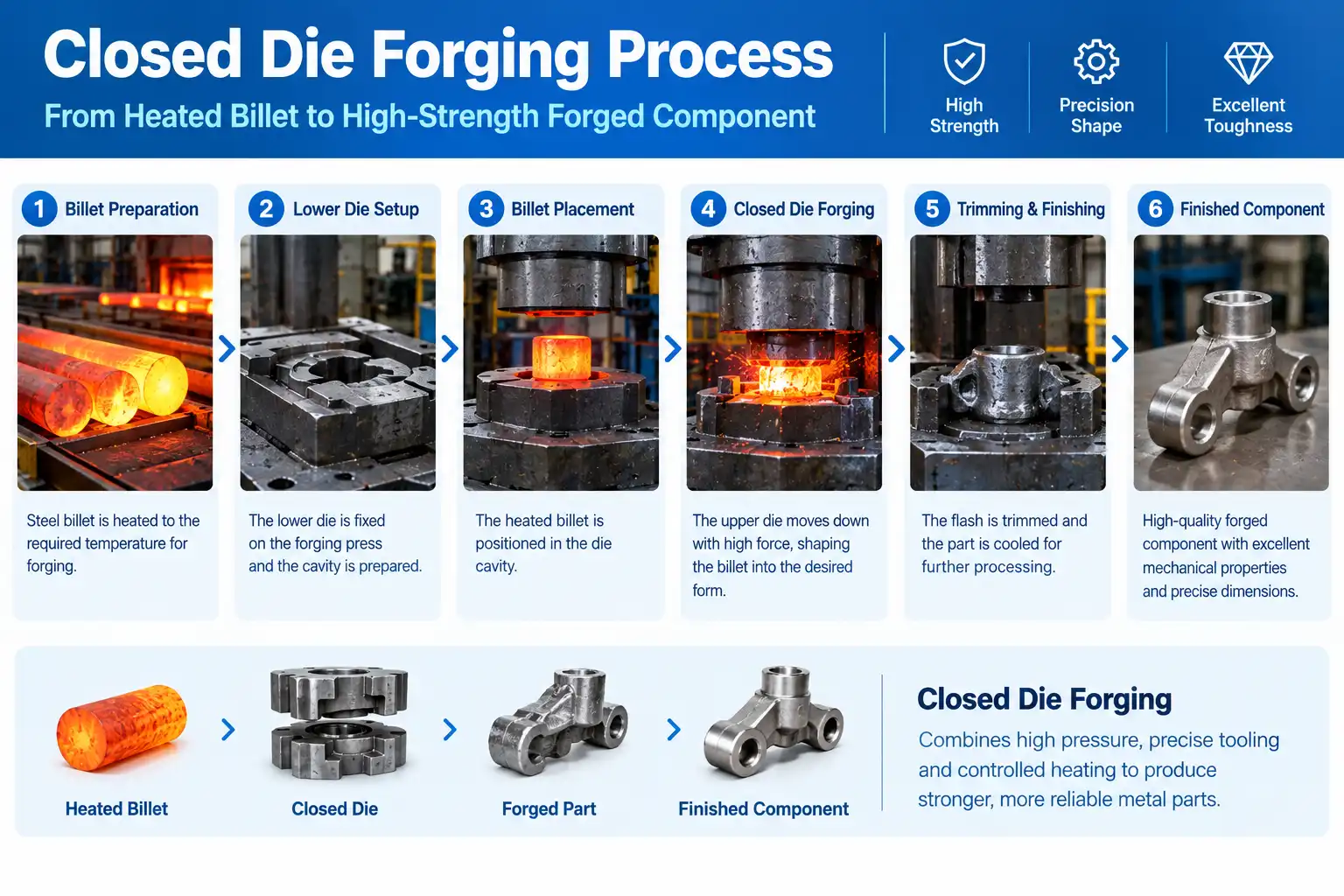
Step 1: Billet Preparation
The process starts with a metal billet, bar, slug, or preform prepared according to the required component size and material.
The initial billet dimensions are important because the amount of material must be sufficient to fill the die cavity while allowing for material flow during forging.
Step 2: Heating the Workpiece
The workpiece is heated to an appropriate forging temperature for the selected material.
The required temperature depends on factors such as material composition, forging method, component geometry, and production requirements. Proper temperature control is important because insufficient heating can increase forming resistance, while excessive heating can affect material properties and surface quality.
Step 3: Preparing the Forging Dies
The upper and lower dies contain the geometry required for the forged component. Before production begins, the dies must be correctly installed, aligned, and prepared for the forging operation.
Die design is one of the most important factors in closed-die forging because it directly affects material flow, dimensional accuracy, die life, and the number of forging operations required.
Step 4: Positioning the Heated Billet
The heated billet is transferred to the lower die and positioned correctly.
For automated production lines, transfer systems or manipulators can be used to move workpieces between heating, forging, trimming, and other operations.
Step 5: Applying Hammer Blows
The forging hammer applies impact energy through the upper die. The repeated blows progressively deform the heated metal.
Unlike a single compression stroke, hammer forging can use a series of controlled impacts to gradually form complex geometries.
Step 6: Filling the Die Cavity
As the hammer continues to apply energy, the metal flows into the available die cavity.
The objective is to achieve the required component geometry while maintaining appropriate material flow and avoiding defects caused by improper die filling.
Step 7: Flash Formation
In many conventional impression-die forging processes, excess material can flow outside the main die cavity and form flash.
Flash can play an important role in controlling material flow and helping the die cavity fill completely. Depending on the component and process design, the flash is subsequently removed during trimming.
Step 8: Trimming and Finishing
After forging, excess material such as flash may be removed using trimming equipment. Additional operations can include heat treatment, shot blasting, machining, inspection, or other finishing processes depending on the final component requirements.
Closed Die Forging Hammer vs Open Die Forging Hammer
Closed-die and open-die forging use impact or compression forces to deform metal, but their tooling concepts and typical applications are different.
| Feature | Closed Die Forging Hammer | Open Die Forging Hammer |
|---|---|---|
| Die configuration | Shaped cavities control the component geometry | Generally uses simpler die surfaces |
| Component geometry | Suitable for repeatable, defined shapes | Suitable for simpler or larger geometries |
| Production volume | Often suitable for repetitive production | Often suitable for smaller batches and flexible production |
| Tooling | Requires dedicated forging dies | Generally requires less complex tooling |
| Dimensional control | Higher control over component geometry | More dependent on operator/process control |
| Typical applications | Automotive, tools, machinery and industrial components | Large shafts, rings, bars and large structural components |
The best choice depends on the component being produced. A closed-die forging hammer is not automatically better than an open-die hammer; the correct equipment depends on geometry, production requirements, material, forging weight, and tooling strategy.
What Can a Closed Die Forging Hammer Produce?
Closed-die hammer forging is commonly used when manufacturers need repeatable production of components with defined shapes and mechanical properties.
Automotive Components
Applications can include selected automotive drivetrain, suspension, steering, and other forged components where the required geometry is suitable for impression-die forging.
Industrial Machinery Components
Closed-die forging can be used to manufacture various machinery and industrial components that require controlled geometry and reliable mechanical performance.
Hand Tools
Forged hand-tool components are another common application. Products such as selected wrench, plier, hammer, and other tool components can be produced using dedicated dies.
Hardware and Engineering Components
Depending on the material and component geometry, closed-die forging can also be used for a wide range of engineering and hardware components.
Advantages of Closed Die Hammer Forging
1. Repeatable Component Geometry
Because the dies define the component shape, closed-die forging can provide consistent geometry across repeated production cycles when the process is properly controlled.
2. Efficient Material Flow
The die cavity guides the deformation of the heated workpiece, allowing manufacturers to produce complex shapes that would be difficult to achieve using simple open dies.
3. Suitable for Repetitive Production
Once the correct dies and process parameters have been established, closed-die forging can be suitable for repeated production of the same component.
4. Reduced Machining Requirements for Some Components
Forging can produce a shape that is relatively close to the final component geometry. Depending on dimensional requirements, this may reduce the amount of subsequent machining required.
5. Strong Forged Components
Forging changes the shape and flow of the metal through controlled plastic deformation. When the process is correctly designed and controlled, forged components can provide desirable mechanical characteristics for demanding applications.
Hydraulic vs Mechanical Closed Die Forging Hammer
When selecting a closed die forging hammer, buyers may encounter different machine configurations and drive systems. The important consideration is not simply whether a machine is hydraulic or mechanical, but how its energy delivery, control system, die capacity, production rate, and maintenance requirements match the intended application.
| Consideration | Hydraulic Forging Hammer | Mechanical Forging Equipment |
|---|---|---|
| Control | Can provide precise control of operating parameters | Depends on machine design and mechanical system |
| Energy delivery | Hydraulic system controls hammer movement and impact | Mechanical system transfers stored or generated energy |
| Automation | Can be integrated with modern control systems | Can also be integrated with automated production systems |
| Maintenance | Requires hydraulic system inspection and maintenance | Requires inspection of mechanical transmission components |
| Best choice | Depends on required control, capacity and production conditions | Depends on production requirements and machine configuration |
For this reason, equipment should be evaluated based on actual forging requirements rather than choosing a machine only because of its drive technology.
How to Choose the Right Closed Die Forging Hammer
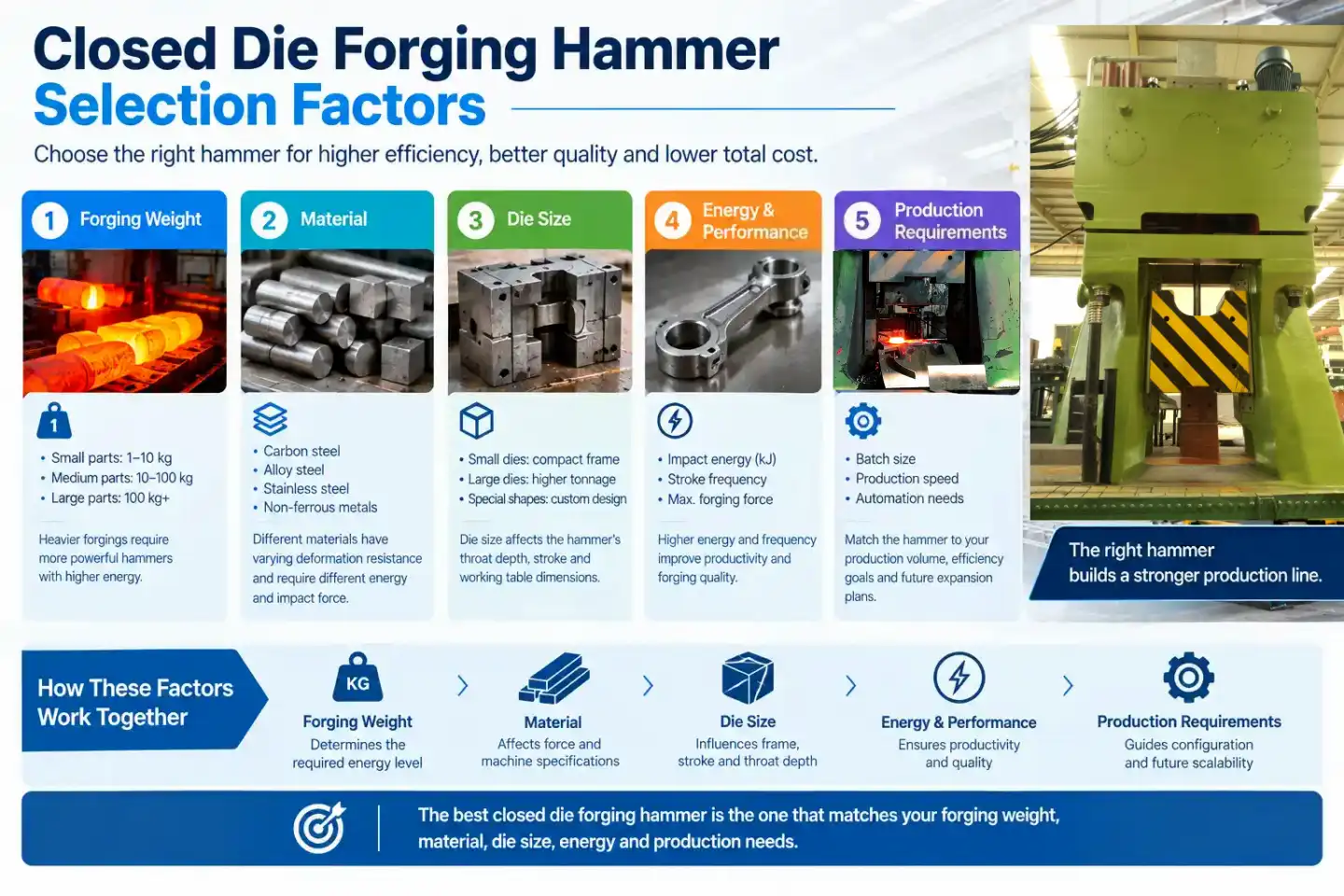
Choosing the correct forging hammer requires more than comparing nominal machine weight. The machine should be matched to the actual component, material, die, production volume, and manufacturing process.
1. Forging Material
Start with the material you intend to forge. Carbon steel, alloy steel, stainless steel, aluminum alloys, and other materials can have significantly different deformation resistance and forging temperature requirements.
2. Forging Weight
Determine the approximate finished forging weight and starting billet weight. This information helps the manufacturer evaluate the required machine capacity.
3. Component Size and Geometry
Component dimensions and geometry affect die design, material flow, required energy, and machine working space.
4. Required Forging Energy
The hammer must provide sufficient energy for the intended forging operation. Machine selection should therefore be based on the actual forging process rather than relying only on nominal specifications.
5. Die Dimensions
Confirm the required die dimensions and available die space. The forging hammer must accommodate the planned upper and lower dies while providing appropriate working clearance.
6. Production Volume
A machine for low-volume production may have different requirements from equipment intended for continuous industrial production.
7. Automation Requirements
For higher production volumes, buyers should consider billet heating, material handling, manipulators, trimming, lubrication, transfer systems, and other automation requirements.
8. Factory Space and Foundation
Installation requirements should be evaluated before purchasing equipment. Consider machine dimensions, working area, foundation requirements, crane access, auxiliary equipment, and operator access.
Closed Die Forging Hammer Buying Checklist
| Parameter | What the Buyer Should Confirm |
|---|---|
| Forging material | Steel, stainless steel, aluminum alloy or other material |
| Finished forging weight | Approximate weight of the final component |
| Billet size | Starting billet dimensions and weight |
| Component dimensions | Maximum length, width and height |
| Die dimensions | Required upper and lower die size |
| Required energy | Energy required for the specific forging process |
| Production volume | Pieces per hour, shift or year |
| Automation | Manual, semi-automatic or automated production |
| Installation | Factory space, foundation and auxiliary equipment |
| After-sales support | Installation, commissioning, spare parts and technical support |
Closed Die Forging Hammer Manufacturer: What Should Buyers Ask?
When purchasing a closed die forging hammer, technical specifications are only one part of the evaluation. Buyers should also assess the manufacturer's experience and ability to support the complete forging process.
Before requesting a quotation, consider asking the manufacturer:
- What hammer capacity is recommended for our component?
- Can the machine handle our forging material?
- What die dimensions can the machine accommodate?
- What forging weight range is recommended?
- What automation options are available?
- Can the manufacturer assist with machine installation and commissioning?
- What spare parts are available?
- Can the manufacturer provide technical support after installation?
- Can the machine be customized according to our production requirements?
Providing the manufacturer with your component drawings, material information, billet dimensions, forging weight, target production volume, and existing equipment will usually result in a more useful machine recommendation.
Closed Die Forging Hammer vs Forging Press
A closed-die forging process does not necessarily require a hammer. Forging presses can also be used to form metal inside shaped dies.
| Feature | Forging Hammer | Forging Press |
|---|---|---|
| Force application | Impact blows | Controlled compression |
| Deformation method | Progressive impact deformation | Progressive or continuous compression |
| Process characteristics | Suitable for impact-based forging processes | Suitable for controlled press forming |
| Equipment selection | Depends on component and forging requirements | Depends on component and forging requirements |
The choice between a hammer and a press should be based on component geometry, material, production volume, required deformation, tooling, automation, and the overall production process.
Common Mistakes When Buying a Closed Die Forging Hammer
Mistake 1: Choosing a Machine Only by Hammer Weight
A larger nominal hammer does not automatically mean it is the correct machine. Energy, forging weight, die dimensions, material, and component geometry must all be considered.
Mistake 2: Ignoring the Die Design
The forging hammer and forging die work as a system. A suitable machine cannot compensate for an unsuitable die design.
Mistake 3: Focusing Only on Machine Price
The initial machine price is only one part of the total cost. Buyers should also consider installation, dies, heating equipment, manipulators, trimming equipment, spare parts, maintenance, energy consumption, and operator requirements.
Mistake 4: Not Providing Component Information
A manufacturer cannot accurately recommend a machine based only on a general request such as "I need a closed die forging hammer." Component drawings and material information can significantly improve the equipment selection process.
Frequently Asked Questions About Closed Die Forging Hammer
What is a closed die forging hammer?
A closed die forging hammer is a forging machine that uses impact energy to deform heated metal inside shaped forging dies. The dies define the desired component geometry.
Is closed die forging the same as impression die forging?
The terms are often used to describe closely related forging processes. Impression-die forging uses shaped die impressions to control the geometry of the workpiece, and closed-die forging is commonly used as a related term.
What is the difference between a closed die and open die forging hammer?
A closed die forging hammer uses shaped dies to define the component geometry, while open-die forging generally uses simpler die surfaces and provides greater flexibility for larger or less geometrically defined workpieces.
What materials can be forged using a closed die forging hammer?
The suitable material depends on the machine and process design. Common forging materials can include carbon steels, alloy steels, stainless steels, and selected non-ferrous alloys. The manufacturer should confirm machine suitability for the specific material.
How do I choose the right closed die forging hammer?
Consider the forging material, finished forging weight, billet size, component dimensions, die dimensions, required forging energy, production volume, automation requirements, and factory installation conditions.
Can a forging press be used for closed die forging?
Yes. Closed-die forging is a process concept rather than a single machine type. Both forging hammers and forging presses can be used depending on the component and production requirements.
Do closed die forgings always produce flash?
Not necessarily. Traditional impression-die forging processes can produce flash, which may subsequently be removed by trimming. The exact result depends on the die design and forging process.
Choosing the Right Closed Die Forging Hammer for Your Application
Selecting a closed die forging hammer should begin with the component rather than the machine. The material, forging weight, billet dimensions, component geometry, die design, production volume, and required output all influence the appropriate equipment configuration.
If you are planning a new closed-die forging line or replacing existing forging equipment, prepare your component drawing and basic production information before contacting a manufacturer. This allows the supplier to evaluate the required hammer capacity, die configuration, automation, and auxiliary equipment more accurately.
Looking for a Closed Die Forging Hammer?
We provide forging equipment solutions for industrial applications. Send us your component drawing, forging material, forging weight, billet dimensions, and production requirements, and our technical team can evaluate the suitable forging hammer configuration for your application.