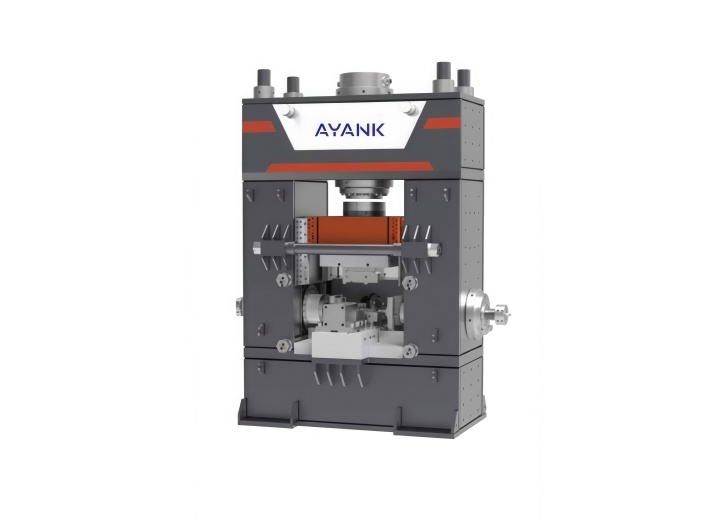
How to read the parameters above
Four numbers in that table move together as you go up the range, and understanding the relationship between them is most of the selection work.
Cutting force against diameter. Nominal cutting force rises from 1,600 kN at Φ65 to 16,000 kN at Φ200. Force scales with the sheared cross-section, so a larger bar is not simply a slower cut, it is a heavier machine.
Strokes against size. Small models run 50 strokes a minute, the largest run 16. Blade mass and moving mass both grow with diameter, so each cycle takes longer. Throughput per hour has to be checked against the specific model, never assumed from the diameter.
Cutting length range. Most models cover 50 to 350 mm. Q42-800 and Q42-1000 extend to 500 and 1,000 mm, Q42-1250 covers 700 to 2,400 mm, and Q42-1600 is built to the customer's length requirement.
Installed power. Main motor power climbs from 15 kW to 160 kW. That number drives your electrical supply and your energy cost per cut, and it is worth checking against site transformer capacity before the machine is ordered.
How to size the machine to your bar
Sizing a billet shearing machine against your bar comes down to four questions, asked in order. Each one eliminates models before you ever discuss price.
- Bar diameter and material. The diameter sets the minimum model; the material grade sets the margin you need on top of it. Alloy and stainless grades need more cutting force than mild carbon steel of the same diameter, so state the grade, not just the size.
- Cut length and tolerance. The length range rules out models at both ends. If your slugs run longer than 350 mm, the smaller models are out regardless of diameter.
- Pieces per hour. Divide the requirement by the stroke rate of the candidate model, then allow for loading and feeding time. A model cutting at 16 strokes a minute will not match one at 50.
- Line layout. Decide whether the shear feeds a furnace directly, a buffer table or a container. That sets the loading and discharge arrangement, and it changes the floor space you must reserve.
Shearing against sawing and abrasive cutting
Three methods compete for the same job, and each wins in a different production pattern.
Billet cutting methods compared
| Method |
Cut face |
Material loss |
Cycle |
Fits best when |
| Shearing (Q42) |
Flat face, slight taper; cold section taper ≤ 3° |
No kerf; a short end drop per bar |
1.2–3.75 s per cut (16–50 strokes/min) |
One bar size, high piece counts, line-linked feeding |
| Bandsaw |
Square, machined-quality face |
Kerf lost on every cut |
Slow on solid bar above 100 mm |
Mixed sizes, cold stock, small batches |
| Abrasive saw |
Burr and a heat-affected edge |
Wider kerf than a bandsaw |
Moderate |
Hard or heat-resistant grades, low volume |
| Laser / plasma |
Smooth, narrow cut |
Minimal |
Falls away as section grows |
Sheet, tube and thin sections, not solid billet |
For die forging and for feeding a reheating furnace, shearing is normally the cheapest per piece: no kerf, no consumable wheel, and a cycle measured in seconds. The trade-off is a slightly tapered cut face, and the bar must be round or square stock of a consistent size.
Matching the shear to the rest of the line
The shear is the first machine in a chain, and it is judged by how the station after it performs. Cut billets usually go to a reheating furnace, then to a forging manipulator and the hammer or press. Where scale control matters for the finished part, the line also needs a descaling machine between furnace and forging station.
When several of these units are specified together, the layout is planned as one forging production line rather than as separate machines, so the stroke rate of the shear matches the heating capacity and the hammer cycle. It is also the point at which the auxiliary range, from shears to manipulators, is quoted as a set — see forging auxiliary machines.
Accuracy that carries downstream
Two tolerances on this machine matter more than the rest. Billet weight error within ±1.5% decides how much metal arrives in the die: too heavy and flash thickness grows, too light and corners fail to fill. Cut-face taper of 3° or less decides how the billet sits in the first impression, and on an automated line it decides whether the feeder grips the slug cleanly.
Length repeatability itself is governed by the sizing stop and the feed system. If your process needs a tighter length tolerance than the standard arrangement delivers, state it in the enquiry so it can be quoted as a specific requirement instead of being assumed.
Blades, maintenance and uptime
Three maintenance items account for most unplanned stops on a billet shearing machine.
- Blade gap and edge condition. Side draw-out blades turn replacement into a short job rather than a frame strip-down. Read edge wear from the cut face: a rising taper or a burr on one side usually points to blade clearance before it points to cutting force.
- Clutch and brake adjustment. The pneumatic friction clutch and brake set where the blade stops. A blade that over-travels or stops late is a brake adjustment issue first, and a safety issue second.
- Lubrication and automatic shut-down protection. Both are part of the base machine. Treat a shut-down alarm as information rather than as a nuisance to be bypassed.
What to put in your enquiry
Six items are enough for an accurate quotation and a correctly sized billet shearing machine:
- Bar diameter and material grade, with the condition (cold bar, or hot from the furnace)
- Cut length range and the tolerance you actually need
- Required pieces per hour or per shift
- How billets leave the machine: furnace, buffer table or container
- Power supply available at site
- Whether the shear is part of a new line or replaces an existing unit, and the space available
Send those six and the model comes back sized, not guessed.
Frequently asked questions
Is a billet shearing machine the same as a billet cutter?
Yes. Billet cutter, bar shear and billet cutting machine describe the same equipment. Ask for the cutting force, maximum diameter and cut length range rather than relying on the name.
Can the Q42 series cut alloy and stainless bar?
It can, but the required force rises with the shear strength of the material. Give the grade when you enquire so the model is chosen with the right margin instead of at the limit for carbon steel.
What cut lengths are available?
From 50 mm on the smaller models up to 2,400 mm on Q42-1250. Q42-1600 is built to the customer's length requirement.
How accurate is the billet weight and length?
Weight error is within ±1.5%, and cold shearing section taper is within 3°. Length repeatability depends on the sizing stop and feed system, so a tighter tolerance should be stated in the enquiry.
Why does the stroke rate fall on the larger models?
Blade mass and cutting force both rise with diameter. Q42-160 runs 50 strokes a minute; the 800 kN model and above run 16. Hourly output should always be checked against the specific model.
Does it cut cold bar or hot bar?
The Q42 series is normally used to cut cold bar ahead of the furnace, and the published section taper of ≤3° is a cold shearing figure. To cut bar straight from the furnace, tell us the temperature so blade material and configuration can be confirmed.
How are the blades changed?
Blades are side draw-out units, so they are replaced from the side of the frame without dismantling the machine.
What automation comes with the machine?
Automatic loading, feeding, sizing, cutting, counting and lubricating, plus automatic shut-down protection.
Send your forging drawing or part details We will recommend the machine that fits and quote it.