What the radial and axial rollers actually do
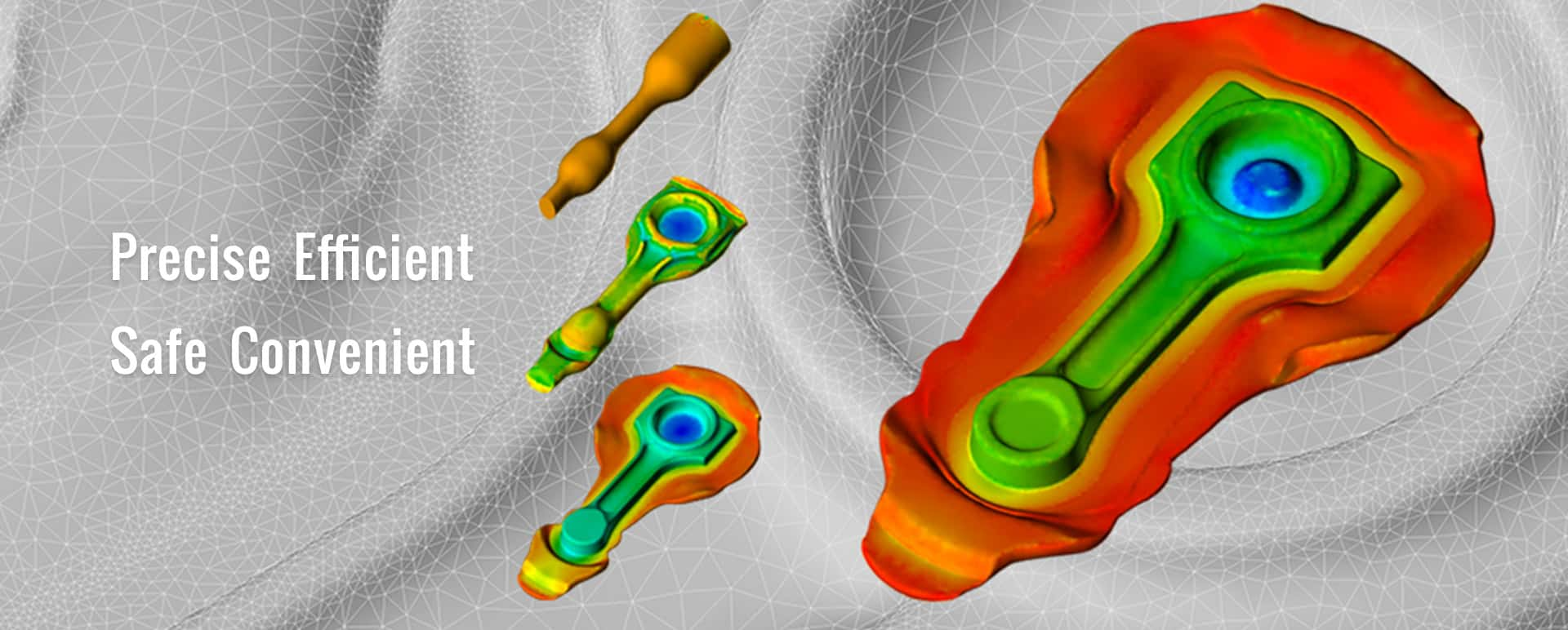
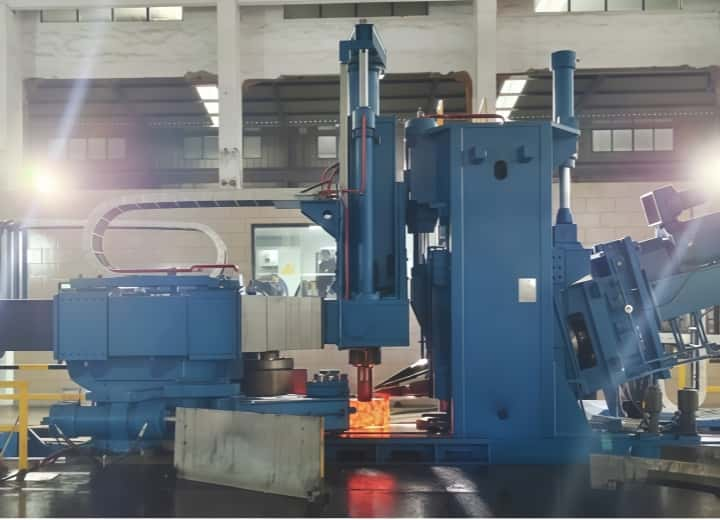
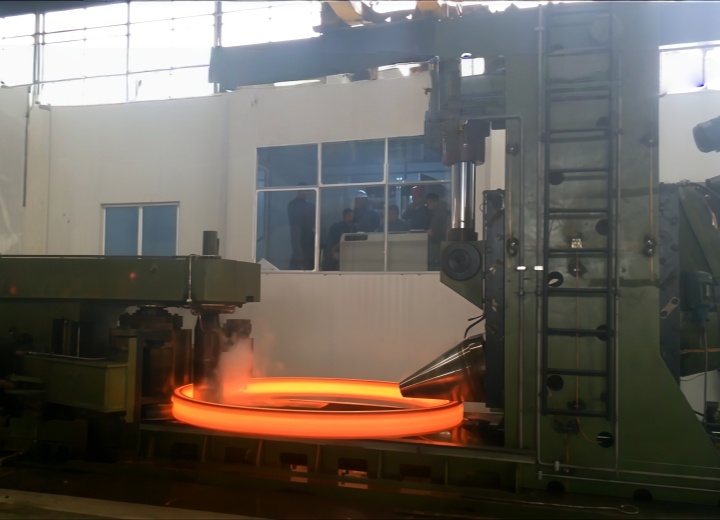
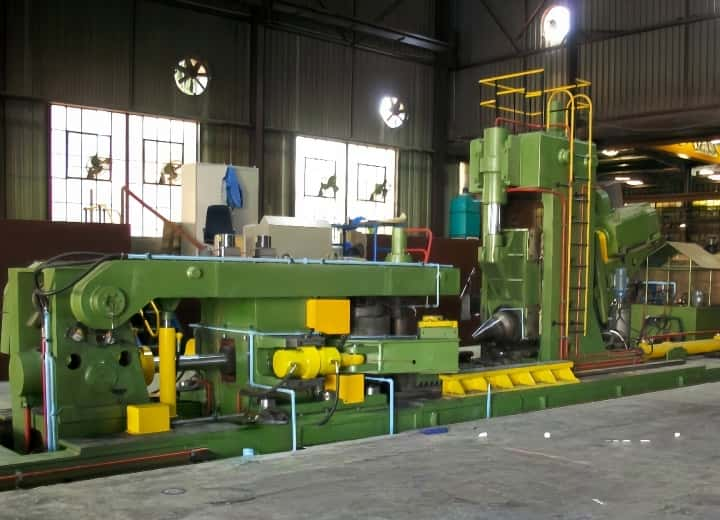
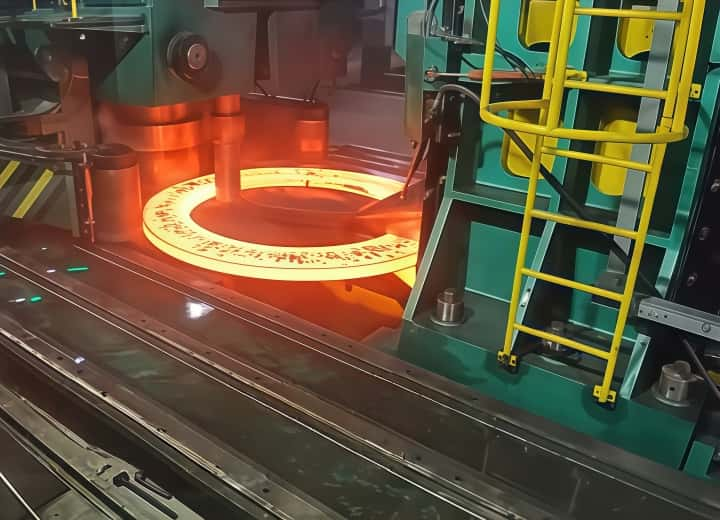
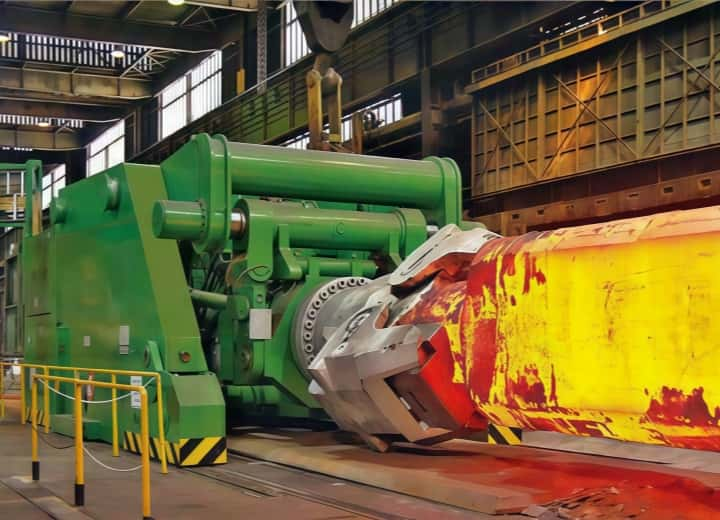
A ring rolling machine does not press a shape into metal. It takes a pierced, donut-shaped blank and grows its diameter while thinning its wall, by squeezing that wall between a rotating main roller and a rotating mandrel. The deformation is continuous and local, so material is displaced around the circumference instead of being pushed out as flash.
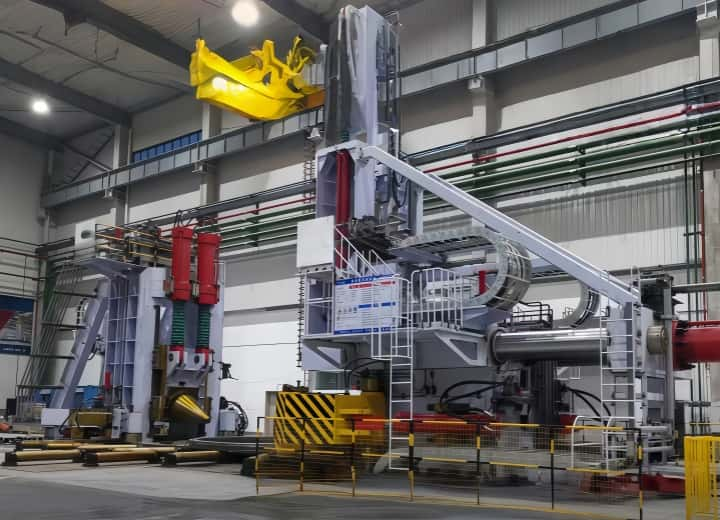
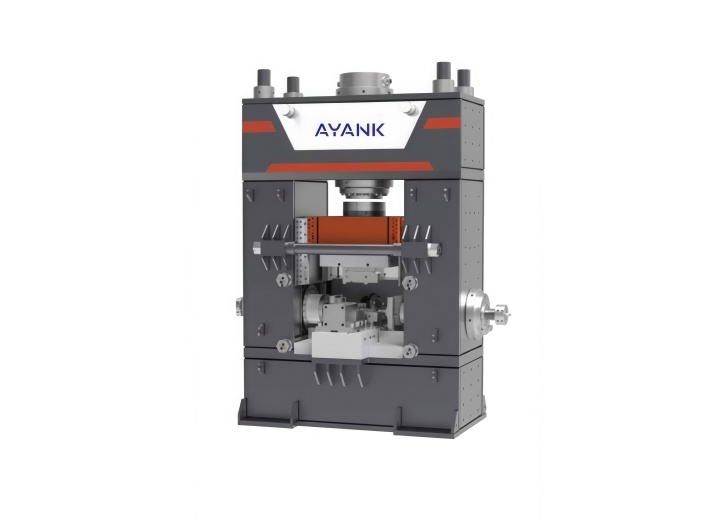
The D53KA series adds a second set of tools. Axial taper rollers close on the top and bottom faces of the ring while the radial pair works the wall. Diameter, wall thickness and height all change inside the same cycle, and that is what separates a radial-axial machine from a purely radial one.
Radial, axial or radial-axial: which one fits your part
Three ways to form a ring
| Type |
Tools in contact |
What it controls |
Typical part |
| Radial only |
Main roller + mandrel |
Outside diameter, wall thickness |
Small and medium rings, flat or profiled section, high piece counts |
| Radial-axial |
Main roller + mandrel + axial taper rollers |
Outside diameter, wall thickness, ring height |
Large rings where height must be held, thick-walled rings |
| Press or hammer |
Closed dies |
The whole shape in one blow |
Discrete parts, not ring-specific |
A radial-only machine is fast and simple, and it is the right answer for rings up to about 1,000 mm outside diameter where height is not critical — that is the range covered by the radial ring rolling machine. As the ring gets larger and the height tolerance starts to matter, the axial rollers stop being optional: without them, height can only be set by the blank, and the wall tends to spread as the diameter grows.
How to read the parameters above
Rolled ring OD. The eleven models run from a 400–800 mm window up to 1,500–12,000 mm. The ranges overlap, so the model is chosen by the upper bound you actually need, not by the middle of the range.
Radial and axial force. Radial rolling force spans 800 to 16,000 kN, axial force 630 to 8,000 kN. Force is consumed by wall thickness, by the section being squeezed and by the grade: a thick wall at the low end of the temperature window needs more of it.
Blank and finished thickness. Maximum blank thickness runs 180 to 1,200 mm, maximum finished thickness 110 to 700 mm. The gap between those two figures is the reduction the machine has to achieve in the cycle, and it is a better guide to the required force than the ring diameter alone.
Rolling line speed. Every model in the series is listed at 1.5 m/s. Speed is a process setting rather than a model differentiator, so what changes as you go up the range is force, tooling size and machine mass, not rolling speed.
Motor power. Radial drive runs from 200 kW on the smallest model to 2 × 2,000 kW on D53KA-12000; the axial drive from 2 × 110 kW to 2 × 1,300 kW. The axial drive is twin-motor across the whole series, while the radial drive becomes twin-motor from D53KA-2000 upward. These figures decide your transformer capacity and your energy cost per ring, so check them against site supply early.
Footprint. Machine length grows from 10,500 mm to 47,000 mm, width from 2,300 mm to 10,000 mm, and height above floor from 3,500 mm to 11,500 mm. On the larger models this is a building decision as much as a machine decision — foundation, crane clearance and the space needed to change a mandrel all have to be planned before the order.
From cut billet to finished ring
The rolling machine is one station in a chain, and the stations on either side set what it can achieve.
- Cut the billet to a weight and length that matches the finished ring plus scale loss. Billet weight error arrives in the ring as wall or height error, so this step is a tolerance step, not a preparation step.
- Heat the billet to a uniform forging temperature. A cold spot rolls out as an eccentric wall.
- Upset and pierce the billet into a donut blank. The pierced hole sets the mandrel size and the starting wall.
- Load the blank on the mandrel and start the radial pass; the axial rollers come in as the ring opens up.
- Roll to size under CNC control, with diameter, wall and height forming together.
- Unload, cool and, where the drawing calls for it, machine the faces and bore.
Matching the machine to your part
Five answers decide the model, and they are worth settling before any price discussion.
- Finished outside diameter and height. These two set the model directly. A large diameter with a modest height and a large diameter with a tall wall are different machines.
- Wall thickness and section. A rectangular section rolls predictably; a profiled section needs dedicated tooling and usually a larger force margin.
- Blank thickness and reduction. The reduction per cycle, not the ring size, is what the force has to deliver.
- Material grade. Alloy and stainless grades resist deformation more than carbon steel at the same size, so state the grade rather than "steel".
- Batch pattern and power supply. Continuous production and job-shop changeover put different demands on tooling and on the electrical installation.
Tooling, changeover and uptime
Every ring profile needs its own main roller, mandrel and axial taper rollers. The taper roller angle is set per model between 30° and 40°, and it is the parameter that decides how the axial rollers bite into the top and bottom faces. Changeover is therefore a tooling change rather than a machine change, and the practical questions are how long it takes and how much crane access it needs.
Three items account for most unplanned stops: mandrel wear at the bore contact, axial roller alignment drifting out of parallel, and scale build-up on the tooling faces. All three show up first as a wall-thickness drift or a height taper, not as an alarm, which is why dimensional checks on the first ring of each batch matter more than checks at the end.
What carries into the finished ring
Rolling deforms the material along the circumference, so the grain flow follows the ring instead of being cut across it. That is the reason a rolled ring carries better fatigue and burst behaviour than the same section machined from plate, and it is the argument to make when a drawing allows either route.
The second gain is material utilization. There is no flash to trim and no kerf to lose, and the bore that is pierced out becomes the mandrel opening rather than scrap. The third is dimensional consistency: with the radial gap and axial position under CNC control, the hundredth ring is formed the same way as the first, which is what a downstream machining line needs.
Where these machines are used
The large end of the range exists because of wind power: tower flanges and slewing bearing rings are large-diameter, moderate-height rings where the axial rollers hold the face flat. Bearing rings, from the small end right up through large slewing rings, are the second main family. Pipe flanges and weld-neck flanges come off the same principle, and ball valve bodies use the thick-wall capability of the higher-force models.
Across all of them the reason to roll rather than machine is the same: the ring is formed with a continuous grain flow, with far less material turned into chips. The other rolling and roll forging options on the same platform are listed under rolling and roll forging machines.
What to put in your enquiry
Send these six and the model comes back sized rather than guessed:
- Forging drawing or a sketch of the ring section, with finished OD, height and wall
- Material grade and the forging temperature you work at
- Blank dimensions, or the billet size you intend to start from
- Output required, in rings per shift or per month
- Available power supply at site
- Building constraints: floor space, foundation depth, crane capacity
Frequently asked questions
What is the difference between a radial and a radial-axial ring rolling machine?
A radial machine works only on the ring wall, so it controls outside diameter and wall thickness. A radial-axial machine adds axial taper rollers that work the top and bottom faces, so it also controls ring height within the same cycle. Radial-axial is used where height must be held on large rings.
How large a ring can the D53KA series roll?
The range covers 400–800 mm outside diameter on D53KA-800 up to 1,500–12,000 mm on D53KA-12000, with maximum rolled ring height from 300 mm to 2,000 mm across the series.
Why is the rolling line speed the same on every model?
Line speed is a process setting rather than a capacity rating. What changes with model size is rolling force, tooling dimensions and installed power, not the surface speed at which the ring is rolled.
Can it roll profiled sections, not just rectangular ones?
Yes, with dedicated tooling. A profiled section needs its own main roller and mandrel, and it usually needs more force margin than a rectangular section of the same wall.
What blank does the machine start from?
A pierced donut blank produced by upsetting and piercing a cut billet. Maximum blank thickness runs from 180 mm to 1,200 mm depending on model, and the reduction from blank to finished thickness is what the rolling force has to deliver.
How much floor space is required?
Machine length runs from 10,500 mm to 47,000 mm and width from 2,300 mm to 10,000 mm depending on model, with height above floor up to 11,500 mm. Reserve additional space for mandrel change and crane access.
Does the machine include CNC control?
Yes. The D53KA series is CNC controlled, with the radial gap and the axial roller position driven through the cycle so that diameter, wall and height are formed to the programmed values.
Send your forging drawing or part details We will recommend the machine that fits and quote it.