Ring Rolling: How the Process Works, What It Makes, and How to Choose a Machine
2026-11-13
Ring rolling makes a seamless ring out of a pierced blank. The blank goes over a mandrel, a driven main roller presses it from outside, and the wall gets thinner as the diameter grows. Nothing is trimmed off afterwards, and there is no weld anywhere in the part. This page follows the stages in the order they happen, then looks at the ring types the process handles and the ones it does not, and at the points that decide between a radial and a radial-axial machine.
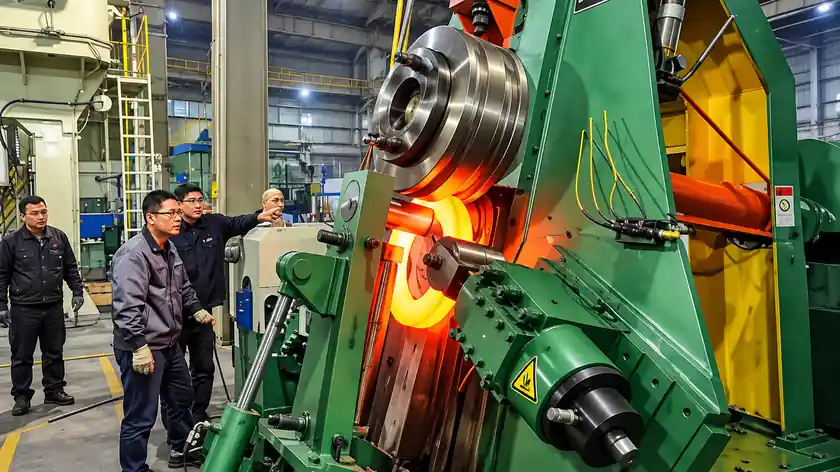
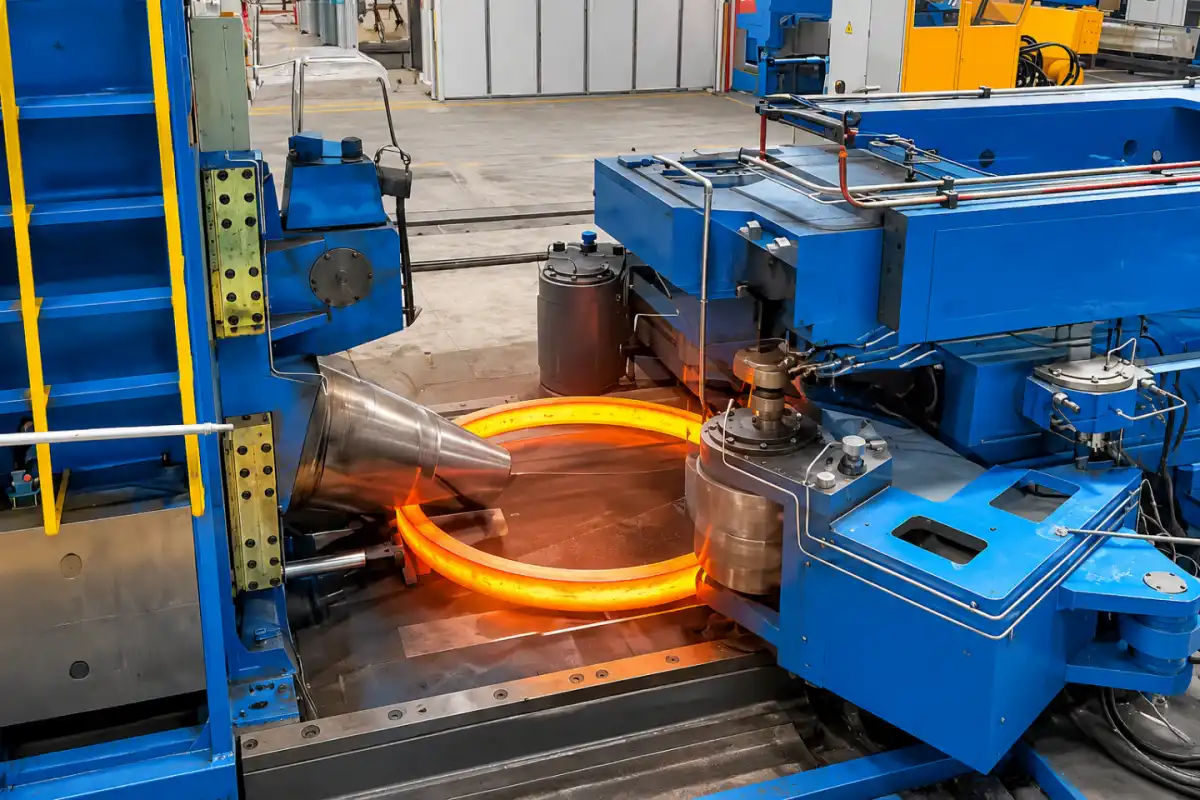
A ring part way through the radial pass. Wall thickness falls as the outside diameter opens up.
Quick Answer
Process. A pierced blank is expanded between a driven main roller on the outside and a mandrel through the bore. The wall is reduced, the diameter grows, and ring height is either carried from the blank or formed by axial taper rollers.
Output. Seamless rings for bearings, gears, flanges and valves, plus wind turbine flanges and slewing rings. AYANK's two series cover about 200 mm to 12,000 mm outside diameter between them.
Why shops use it. Grain flow runs round the circumference instead of being cut off at a flash line. No flash to trim, no kerf to lose, and the hundredth ring comes out like the first.
What decides the model. Finished outside diameter and ring height first. Then wall thickness, section, material grade, output, power supply and floor space.
Radial or radial-axial. If height can come from the blank, a radial machine is quicker and takes less floor. If height has to be held, or the ring is big enough for the wall to spread while rolling, you need the axial pair.
What is ring rolling?
Ring rolling is a rotary forming process for parts that are symmetric about their bore. A blank with a hole through it, made by upsetting and piercing a cut billet, is placed over a mandrel and pressed against a driven main roller. The ring turns, the gap between roller and mandrel closes, the wall is reduced, and the metal pushed out of the wall goes into diameter.
The deformation is continuous and local, which is where the ring rolling process differs from a hammer or a press. Material is worked progressively round the circumference rather than in a single blow. And because the ring closes on itself, the grain runs uninterrupted through the full 360 degrees instead of stopping at a flash line.
Other names for ring rolling
Suppliers and drawings use several names for the same operation: rolled ring forging, seamless rolled ring production, rotary ring rolling, and radial-axial ring rolling when the axial rollers are in play. If a catalogue page talks about "seamless rolled rings" or "rolled ring forgings", the process behind it is ring rolling.
The name matters less than the route. A company that rolls rings starts from a pierced blank and works the wall. A company that machines rings starts from plate and cuts the bore out as chips. Those two suppliers can quote the same drawing and mean very different things.
How does ring rolling work?
The ring rolling process runs in eight stages. The first four usually happen outside the rolling machine, and they are where most dimensional problems get created before the ring ever reaches a mandrel.
Step 1: Cutting the billet
Billet weight sets ring weight. Cut it long and the extra metal turns up as excess height or excess wall. Cut it short and the ring cannot be brought to size at all. The cut face needs to be square as well, because a slanted cut leaves an off-centre blank once the piece is upset and pierced, and that offset is difficult to roll out afterwards.
This is why the shear or saw ahead of the furnace belongs to the process rather than sitting outside it. Where the weight has to hold to a tolerance, a billet shearing machine is the usual tool, and the tolerance it can hold is worth asking about before the rolling machine is specified.
Step 2: Heating the billet
A billet heated unevenly rolls out unevenly. A cold patch resists deformation, so the wall on that side stays thick and the ring comes off the mandrel oval rather than round. Soak time and furnace atmosphere matter as much as the set temperature. Too little time leaves a cold core. Too much produces scale, and the scale ends up as surface defects on the ring.
Step 3: Upsetting the billet
Upsetting turns the cylinder into a pancake of the diameter the blank needs. It also works the metal in a direction the rolling pass will not, which matters when the stock is cast or continuously cast and the as-supplied structure is directional.
Step 4: Piercing the blank
A punch drives a hole through the upset pancake to make the donut blank. The bore has to match the mandrel that will pass through it, and the punch has to sit centred. An off-centre pierce leaves one side of the blank with more wall than the other before rolling has started, and rolling will not put that right.
Step 5: Loading the blank on the mandrel
The blank goes over the mandrel and the main roller advances until it touches the outside diameter. Centring guides hold the ring in place as it starts to turn. From here on the machine is working from the starting wall it has just measured, and every later pass refers back to that number.
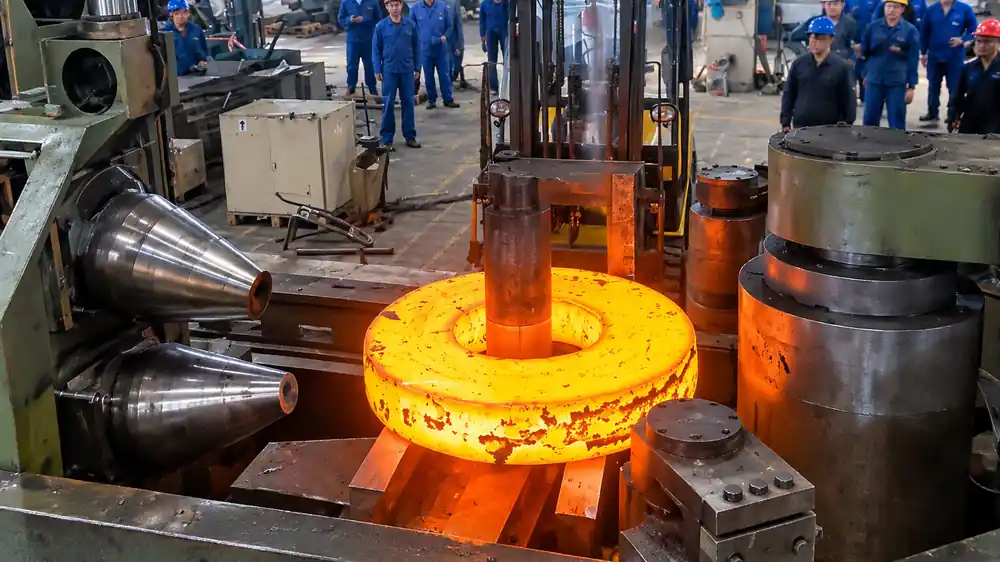
The blank on the mandrel before the main roller advances. Bore diameter here sets which mandrel can be used.
Step 6: Radial rolling
The main roller closes on the mandrel and reduces the wall. Diameter grows as the wall thins, because the volume of the ring does not change. Feed rate is the setting that decides whether this goes well. Feed too fast and the ring goes oval, the surface tears, or the drive stalls. Feed too slowly and the ring cools before it reaches size.
Step 7: Axial rolling
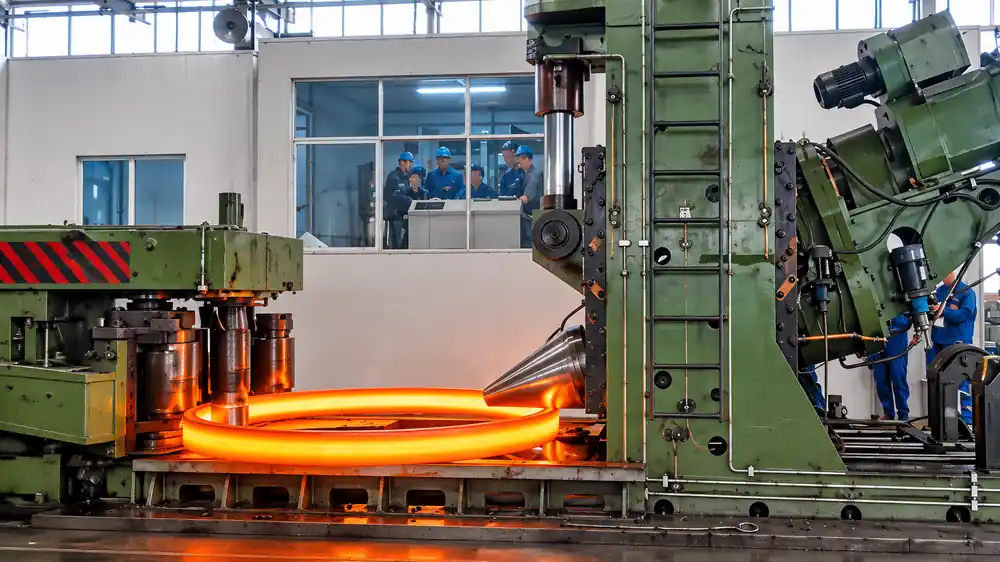
Axial taper rollers close on the top and bottom faces while the radial pair keeps working the wall. On a radial-axial machine this is the stage that fixes ring height, keeps the two faces parallel, and takes out the slight concave or fish-tail profile that a radial-only pass tends to leave. On a radial-only machine there is no such stage, and height is whatever the blank was cut and upset to.
Axial taper rollers on the ring faces. This is the stage that holds height and keeps the faces parallel.
Step 8: Sizing, unloading and cooling
The final gap is set to the finished wall, the ring is measured, and the mandrel is withdrawn. Cooling then has to be managed. A ring cooled unevenly down one side comes back oval once it is cold, and heavy sections carry residual stress into machining. Defects that show up at this point, such as height taper, diameter overshoot or wall variation, usually trace back to one of the seven earlier steps rather than to the machine.
Ring rolling vs closed die forging
Both are hot forging, and buyers often put the same drawing in front of both. They are not interchangeable. They solve different geometry problems.
Factor
Ring rolling
Closed die forging
Part geometry
Symmetric about the bore, ring or ring-like section
Any three-dimensional shape, usually with draft
Working tools
Main roller, mandrel, and axial taper rollers on radial-axial machines
Upper and lower dies cut to the part
Flash
None
Forms at the parting line and is trimmed off
Grain flow
Continuous round the circumference
Follows the die cavity, stops at the flash line
Size limits
Machine capacity and handling; AYANK's radial-axial range reaches 12,000 mm outside diameter
Symmetry is the test. If the finished part is a ring with a bore on its axis, rolling gets there with less material and a better grain structure. If the part has bosses, webs, or a working axis that is not the bore, it belongs in a die. Plenty of shops run both, with the rolling machine taking the ring family and the hammers and presses taking everything else.
What can a ring rolling machine produce?
Anything symmetric about its bore is a candidate. Ring rolling applications fall into five families that make up most of the work, and each one loads the machine in a different way.
A large-diameter flange ring. Diameter is easy to reach; keeping the two faces flat is the harder part.
Wind power rings
Tower flanges and slewing bearing rings are the reason the big end of the range exists at all. They are large in diameter and moderate in height, so the load falls on the axial rollers. The faces have to come off flat and parallel, because a flange that is not flat will not bolt up on site no matter how good the diameter is.
Bearing rings
Bearing races are the highest-volume family and the least forgiving on wall tolerance. The rolled ring is a near-net blank for grinding, so whatever wall variation is left after rolling has to sit inside the machining allowance. Bearing grades also resist deformation more than plain carbon steel, which means a ring that looks small on the drawing can still ask for more force than expected.
Flanges and valve bodies
Pipe flanges, weld-neck flanges and slip-on flanges are plain rolled rings, and they are what most people mean when they search for a flange rolling machine. Valve bodies sit at the other end of the scale. A ball valve body is a thick-walled ring, and thick walls are where the radial force rating decides the model rather than the diameter rating.
Gear blanks
A gear blank with a hub is a profiled section, and a profiled section needs its own main roller and mandrel. The profile also has to be formable without trapping metal between the tools, and it usually needs more slide stroke than a rectangular ring of the same outside diameter.
Aerospace and nuclear rings
Casing rings, seal rings and structural rings for these sectors tend to be modest in size and heavy on paperwork. Rolling parameters, material certificates and blank traceability count as much as the machine does, so the questions to put to a supplier here are about records rather than tonnage.
Where the process stops is just as useful to know. It will not form a part whose working axis is not the bore. It will not produce an axial boss or a radial branch in one pass. And it is a poor choice for very thin-walled rings at large diameter, because the ring loses roundness or buckles before it reaches size. Those parts belong in a die or on a machining centre.
Advantages of ring rolling
When a shop sets the ring rolling advantages against the route it uses today, the same five points come up.
1. Continuous grain flow along the circumference
The metal is worked around the ring rather than across it, so the grain follows the direction the part is loaded in service. A ring machined from plate has its fibres cut through at the bore. The difference shows up in fatigue and burst behaviour long before it shows up in a dimensional check.
2. No flash and no kerf
A die-forged ring carries flash that has to be trimmed and scrapped. A machined ring turns its bore into chips. Rolling does neither. The pierced bore becomes the mandrel opening instead of waste, and the outside diameter is formed rather than cut away. Material utilisation is usually the reason a part gets moved from machining to rolling in the first place.
3. Repeatable dimensions from the first ring to the last
With the radial gap and the axial position under program control, ring one hundred is formed the same way as ring one. That lets the machining line set its allowances once and leave them, instead of inspecting every blank that arrives.
4. Less material left for machining
The rolled ring is a near-net blank. The closer the rolled section sits to the finished part, the less metal is turned into chips later, and the less the shop pays for both stock and cutting time. Profiled tooling is what buys that margin.
5. Large rings formed in one piece
Past a certain diameter the alternatives become welding, segmenting, or machining from a very thick plate. Rolling delivers the ring as one continuous piece with no seam to inspect and no weld procedure to qualify. That is why wind and slewing ring work sits almost entirely in this process.
Radial and radial-axial ring rolling machines
The one decision that reshapes the machine is whether the axial pair is there. A radial machine has a single working pair, main roller and mandrel. A radial-axial machine adds axial taper rollers that work the top and bottom faces in the same cycle. Older plant documentation sometimes calls either of them a ring rolling mill, so check which configuration a used machine actually is before pricing it.
Consideration
Radial machine
Radial-axial machine
Ring outside diameter
200 to 1,000 mm on AYANK's D51A series
400 to 12,000 mm on AYANK's D53KA series
Height control
Carried from the pierced blank and held by the tooling
Formed by axial taper rollers inside the cycle
Face quality
Depends on how the blank was prepared
Faces formed flat and parallel, concave profile taken out
Output
Up to 600 pieces per hour at the small end
Lower piece rate, because ring mass drives the cycle
Installed power
Main motor 30 to 110/132 kW
Radial drive 200 kW to 2 x 2,000 kW; axial drive 2 x 110 kW to 2 x 1,300 kW
Best section
Rectangular, plus profiled sections with dedicated tooling
Thick-walled and tall rings where height must be held
Height tolerance is the dividing line. While the finished height can be carried from the blank, a radial machine makes the same ring with a shorter cycle and a smaller footprint, which is what the radial ring rolling machine is built for on rings up to 1,000 mm. Once the ring is large enough for the wall to spread as the diameter grows, or the drawing puts a tolerance on both faces, the axial pair stops being optional. That is the case the radial-axial ring rolling machine exists for.
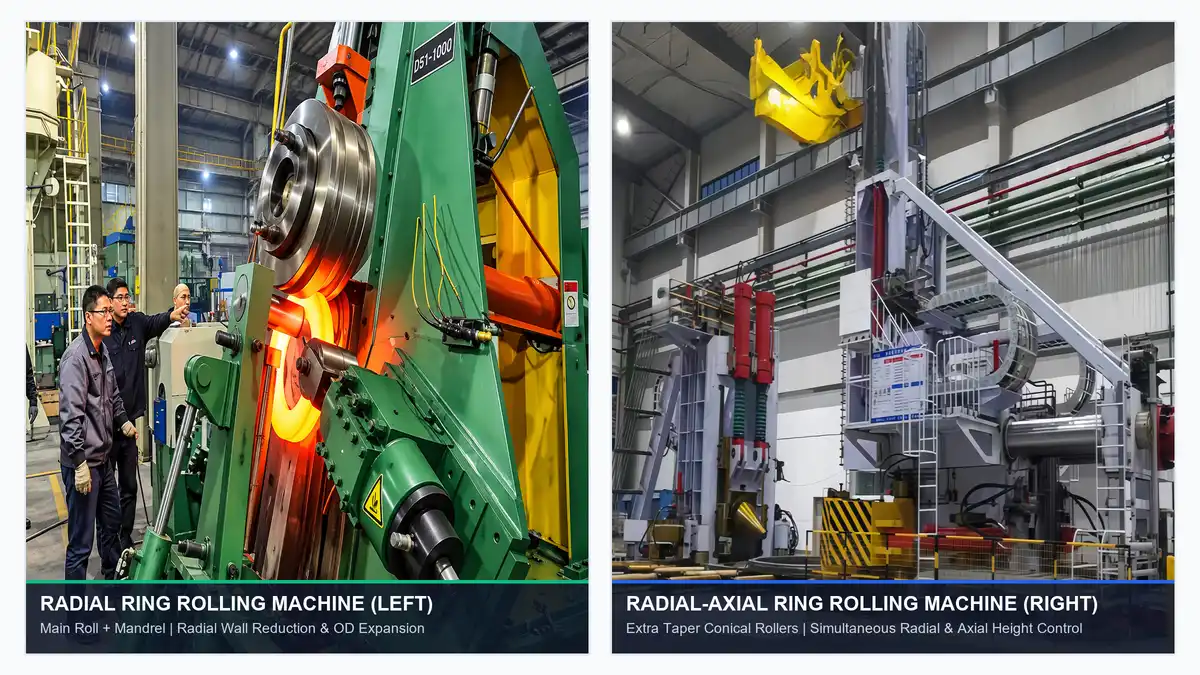
A radial machine on the left, a radial-axial machine on the right. The extra set of taper rollers is the visible difference.
How to choose a ring rolling machine
Eight variables settle the model, and they work best in this order because each one narrows the field for the next.
1. Ring outside diameter and height
These two together set the machine size. A wide ring of modest height and a wide ring with a tall wall are not the same purchase. Sizing on diameter alone is the most common way to end up with the wrong model. Work from the largest ring you will actually roll, not from the middle of the catalogue range.
2. Wall thickness and section
A rectangular section rolls predictably with simple tooling. A profiled section, whether that is a hub, a groove or a raised face, needs its own roller and mandrel profiles, and it generally wants a larger force margin and a longer stroke.
3. Blank size and reduction
The gap between blank wall and finished wall is the work the machine has to do in one cycle. That gap predicts required force better than the ring diameter does. A blank already sitting close to finished wall leaves little to work on inside the section.
4. Material grade
Alloy and stainless grades resist deformation more than plain carbon steel at the same size, and bearing grades more again. Put the actual grade on the enquiry rather than writing "steel", because the answer changes with it.
5. Required output
Output does not scale linearly with size. Piece rate falls away sharply as ring mass and wall thickness climb, so divide your requirement by the rated output for your actual ring, then add time for loading, unloading and tooling checks.
6. Available power supply
At the top of the range the installed power runs into thousands of kilowatts. That decides transformer capacity and the energy cost of each ring, and it is cheaper to check against the site supply before the layout is drawn than afterwards.
7. Floor space, foundation and crane capacity
On the large models the machine runs to tens of metres in length, and the ring has to be handled in and out by crane. Foundation depth, pit dimensions, crane clearance and the room needed to change a mandrel are building decisions, and they arrive with the machine order whether or not anyone planned for them.
8. Control and automation requirements
Decide early whether the machine runs standalone with an operator or as a station inside a line with automatic handling, remote monitoring and logged process data. Adding control and data logging after installation costs more than specifying it on the order.
Ring rolling machine buying checklist
Before the purchase order goes out, get each of these confirmed in writing rather than agreed over a call.
The ring you will roll most often, with outside diameter, bore, height and wall. Not only the largest ring the machine will take.
Blank route and weight tolerance, including who supplies the billet and how its weight is held.
Tooling scope: how many roller and mandrel sets are in the price, and what a second profile costs.
Acceptance test definition: which dimensions get measured, on how many rings, at what point in the cooling cycle.
Installed power and utilities, checked against the supply you actually have.
Foundation drawing and load data, issued before the civil work starts.
Commissioning scope: installation, alignment, operator training, first production batch.
Wear parts position: mandrels and axial taper rollers, lead time and price.
Spare parts and service response for the country the machine is going to.
Ring rolling machine manufacturers: what should a buyer ask?
Most ring rolling companies can quote a machine against a diameter. Fewer can answer the questions that decide whether rings come out right in your shop. These six sort one group from the other.
What can they show you before the order? Ask for evidence on a section close to yours: a sample ring from an earlier job, a reference installation you are allowed to call, or process data from a comparable part. A supplier who rolls rings but can show nothing on your section is asking you to carry the risk on a drawing.
Who owns the tooling? Main rollers, mandrels and axial taper rollers are ring-specific. Confirm what is included, whether the drawings transfer to you, and whether replacement sets can be made locally.
Is the axial drive part of the machine design or added on? On a radial-axial machine the axial pair has to be coordinated with the radial gap through the control system. Ask how the two axes are synchronised, then ask to see it running.
What is the acceptance test? Fix the measurement method before shipment: which dimensions, on how many rings, measured hot or cold. Wall thickness and height taken hot and taken cold are not the same number, and the gap becomes an argument at commissioning.
What is the wear part and spare part position? Mandrels wear at the bore contact and axial rollers drift out of parallel. Ask what replacement interval is seen in service and what the lead time to your country is, then judge whether you can live with it.
What exactly is inside the commissioning scope? Installation, alignment, first-heat support, operator training and process parameter setting are separate line items. A quotation that includes commissioning is a different price from one that does not, and the difference only appears once the machine is on your floor.
AYANK builds both types discussed above: the D51A radial series for smaller rings at high piece rates, and the D53KA radial-axial series for rings from 400 mm to 12,000 mm outside diameter. Both are built to the ring, so the machine is sized from your drawing rather than picked from a list.
Ring rolling vs machining from plate
The comparison most buyers actually face is not rolling against another forging process. It is rolling against cutting the ring out of plate on a machining centre. That decision turns on material, volume, and how the part is loaded in service.
Factor
Rolled ring
Machined from plate
Material use
Bore is pushed outward into diameter, not removed
Bore and outside diameter are both cut away as chips
Grain flow
Continuous round the circumference
Runs straight and is cut through at the bore
Cost structure at volume
Tooling paid once, then low material loss per ring
No tooling, but material loss and machine time on every ring
Strongest at
Repeated ring sizes, medium to large diameter
One-offs, very small quantities, non-ring shapes
Dimensional outcome
Near-net blank with an allowance for finishing
Finished directly, but from a solid block
Size ceiling
Machine capacity and handling
Plate thickness and what the mill can supply
The break-even sits where saved material and saved machining time overtake the tooling cost. For a ring rolled once a year, cutting from plate wins without argument. For the same ring every month, the numbers flip quickly, because the metal that is not turned into chips gets paid for once instead of on every part.
Common mistakes when buying a ring rolling machine
Most of the machines that never settle into production were bought with one of these four in the specification.
Mistake 1: Choosing by maximum diameter alone
The catalogue headline is outside diameter, so the purchase decision follows it. But a machine sized for the largest ring in a brochure can be wrong for the rings you roll every day, and it can be under-powered for a thick wall at the small end of its own range.
Mistake 2: Ignoring how ring height is controlled
Buyers accept a radial-only machine for a part whose drawing carries a height tolerance, assuming the blank will deliver it. It does not, reliably. During radial reduction the wall tends to spread, and the ring comes off with height taper or slightly concave faces. If height appears on the drawing, the axial pair belongs in the specification.
Mistake 3: Buying the machine as a standalone purchase
A rolling machine that arrives into a shop with no controlled billet weight, no piercing press and no crane arrangement will run below its rated capability from the first shift. The steps either side of the machine set what it can hold, and they are cheaper to fix before the order than after.
Mistake 4: Paying for force the part will never use
Force margin is not free. It arrives with installed power, foundation load, floor space and price. A shop that buys two steps above its real requirement pays for that capability every month in electricity and floor area, and never switches it on.
Frequently asked questions about ring rolling
What is ring rolling?
Ring rolling is a hot forming process that expands a pierced blank into a seamless ring. The blank sits over a mandrel, a driven main roller presses it from outside, and the gap between the two closes. The wall thins, the outside diameter grows, and ring height is either carried from the blank or formed by axial taper rollers in the same cycle.
Is ring rolling the same as rolled ring forging?
Practically, yes. Rolled ring forging and seamless rolled ring both describe this process from the buyer's side. What matters is the route behind the name. One supplier starts from a pierced blank and works the wall. Another starts from plate and machines the bore out as chips.
Can ring rolling produce a seamless ring?
Yes. The ring closes on itself and is deformed continuously round the circumference, so there is no seam, no flash line and no weld to inspect. The grain runs unbroken through 360 degrees, which is the structural reason rolling competes with welding or segmenting at large diameters.
What is the difference between radial and radial-axial ring rolling?
A radial machine works the wall only, using a main roller and a mandrel. It controls outside diameter and wall thickness, while height comes from the blank. A radial-axial machine adds axial taper rollers that work the top and bottom faces, so height is formed inside the same cycle. Radial suits small and medium rings at high output. Radial-axial suits large rings where height has to be held.
What sizes and materials can be ring rolled?
Size depends on machine capacity. AYANK's D51A radial series covers 200 to 1,000 mm outside diameter at up to 600 pieces per hour. The D53KA radial-axial series covers 400 to 12,000 mm, with rolled heights from 300 mm to 2,000 mm and radial force from 800 kN to 16,000 kN. Carbon steel, alloy steel, stainless and bearing grades are all rolled. The grade changes the force and the temperature you need, not whether the part can be rolled.
Is ring rolling cheaper than machining from plate?
It depends on volume and on how much the machined route wastes. Rolling carries a tooling cost per profile and then a small material loss per ring. Machining carries no tooling cost but pays for the bore, the outside diameter and the machine time on every part. For a ring you produce regularly, rolling usually wins on material and cycle time. For a one-off, machining usually wins on setup.
What should I send with a ring rolling enquiry?
Send the finished ring drawing with outside diameter, bore, height and wall, the material grade, the blank size or billet you plan to start from, the output you need in rings per shift or per month, the power supply available at site, and the floor space and crane capacity you have. Those items are enough to size the machine and to say whether a radial or radial-axial configuration fits.
Choosing the right machine for your ring
Work back from the ring rather than forward from the catalogue. Fix the finished outside diameter, bore, height and wall. Decide whether height has to be held in the cycle or can come from the blank. Then check the reduction from blank wall to finished wall. Those four answers set the series and the model, and the rest, meaning power supply, floor, crane and automation, sets the configuration around it.
If two models both fit on diameter, take the one whose force and stroke suit the section you roll most often, not the one that reaches furthest into a size you will rarely use.
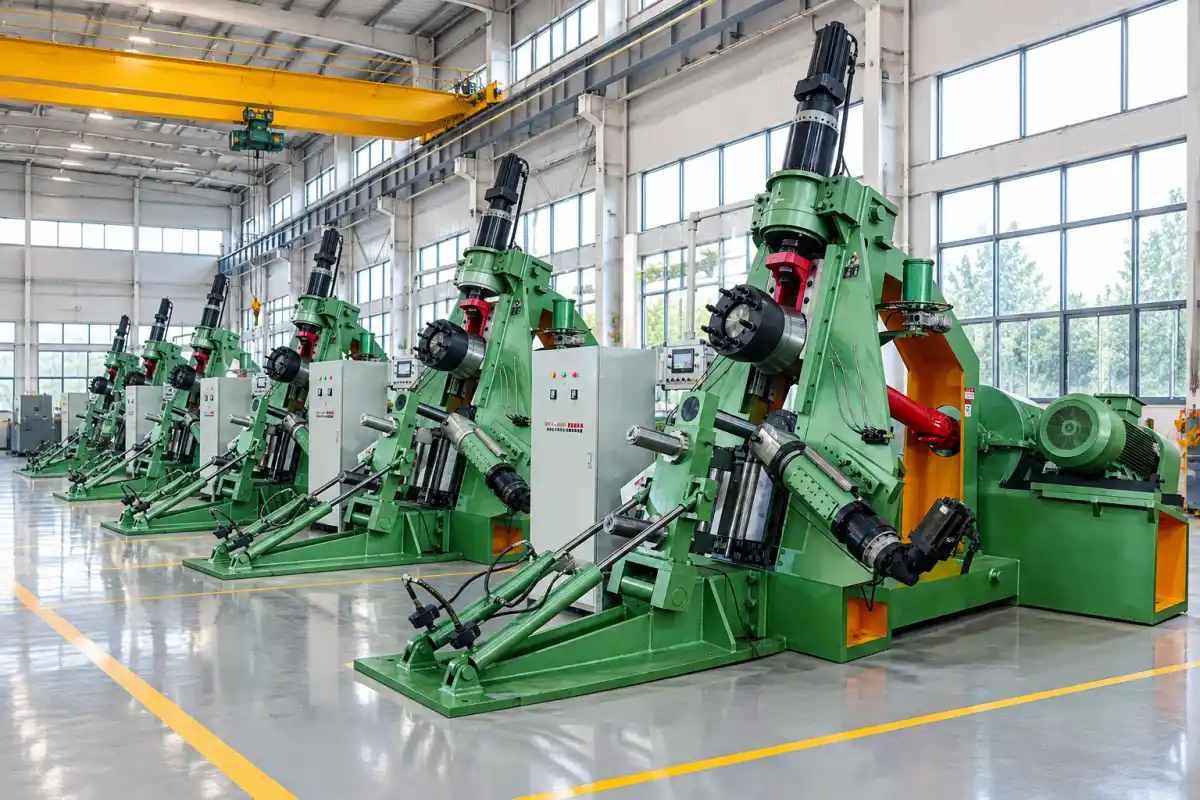
Machines in the assembly bay before dispatch. Foundation drawings and load data are issued from this stage of the build.
Looking for a ring rolling machine?
Send the ring, not the catalogue number
Send AYANK your finished ring drawing, material grade, blank dimensions, required output and site power supply. We will size the machine against your part, tell you whether a radial or radial-axial configuration fits, and quote the configuration that does the job, including tooling and commissioning scope.