AYANK FORGING is committed to the mission of making forging greener, more efficient, and easier. Our upgrade plan for legacy hydraulic hammers starts from one observation: most of the machine is usually still good. We keep investing in technology development and work in step with national programmes for large-scale equipment renewal, so that older forging plant can be converted rather than scrapped, and the industry as a whole moves towards cleaner, more intelligent production.
Forging equipment is one of the fundamental equipment types in industry: its applications are wide and its service life is long. A large number of older machines are still in service. Many AYANK customers have run their hammers continuously for decades, and we have watched businesses grow from a single air hammer into full forging shops through the years when "the sound of the forging hammer signified prosperity". As environmental requirements tighten and as energy and labour costs rise, the pressure to upgrade that equipment keeps growing. AYANK FORGING has always offered modernisation services for forging equipment, and this page sets out one of them in detail: converting an air hammer into a fully hydraulic electro-hydraulic hammer.
Why an air hammer reaches the end of its working life
The installed base of air hammers is large, and many of those machines have been in service far beyond their design life. Some are already standing idle. The problems follow a predictable chain. Prolonged, frequent operation wears the cylinder bore, and an enlarged bore no longer seals: air leaks past the piston, so lifting and striking both lose force until the hammer will barely strike at all. The follower ring fractures repeatedly. Clearances open up across the transmission parts, which then have to be replaced more and more often, and every replacement is another stoppage. In the worst cases the frame itself cracks and the machine cannot be run at all.
Yet the most expensive part of the machine is often still sound. The foundation and the anvil block are usually in good condition, because they were built to carry load rather than to move, and in many cases the frame is still serviceable as well. That is the economic case for conversion: the civil works and the heavy mass stay in the ground, and only the parts that actually wore out are replaced.
Two ways to convert an air hammer into an electro-hydraulic hammer
Both routes keep the original foundation and the anvil block. They differ in how much of the original machine is retained above the anvil, and that difference decides the scope, the schedule and the price.
Item
Option 1
Option 2
Original foundation
Reused as installed
Reused as installed
Anvil block
Reused
Reused
Frame
Replaced with a new frame
Original frame reused
Drive and control
New electro-hydraulic power pack system
New electro-hydraulic power pack system
Best suited to
Frames that are cracked, distorted or worn beyond economical repair
Frames that are still in good condition
Option 1: new frame and new power pack
Use the original air hammer's foundation and anvil system, and add a new frame plus an electro-hydraulic hammer power pack system. This is the route for machines whose frame has already cracked, distorted or worn to the point where repairing it costs more than replacing it.
Option 2: original frame retained, new power pack
Use the original air hammer's foundation, anvil system and frame, and add an electro-hydraulic hammer power pack system. When the frame is still sound this is the smaller project: less steel to buy, less site work to do, and the machine keeps the stiffness it has been running with for decades.
The choice between the two is settled by inspection rather than preference. Measuring the foundation and anvil, checking the frame for cracks and distortion, and reviewing what the hammer has to produce decides whether the frame can stay. We then quote the route that fits, together with the power pack that matches the required striking energy. Both routes are part of our equipment upgrade and renovation work.
What changes on the shop floor after conversion
Striking becomes electrically controlled. The converted hammer allows remote electric control of strikes and automatic continuous striking, so the blow sequence is set at the control panel instead of being worked out by hand on a valve. Each pass then follows the same rhythm, which is what makes output repeatable from one heat to the next.
The operator station changes too. Using an aviation-style control pendant, the operator can work alongside the manipulator on the same platform, moving with the work instead of standing at a fixed lever. This not only saves labour, it significantly improves collaboration between the hammer and the manipulator: one person coordinates both machines, and the heavy handling and the striking stay in step.
The machine itself improves as well. The conversion not only increases striking energy, it also enhances overall equipment stability and improves the working environment. The pneumatic exhaust that used to carry oil mist and noise out of the drive is gone, so the area around the hammer is cleaner and quieter to work in, and less of the maintenance burden falls on the air system.
What the conversion saves
Because the existing air hammer foundation is used, no new foundation has to be built. Because the anvil block section is reused, the heaviest and most expensive piece of the machine does not have to be bought again. Because the site programme no longer includes demolition and re-pouring, the machine is back in production sooner. Taken together, the result is cost reduction, efficiency gains and productivity improvement, at a lower capital cost than a comparable new installation, with the same floor space and the same crane and handling arrangement around it.
How a conversion is scoped and carried out
Every conversion is specified around the machine that is actually standing on the floor, so the following sequence is confirmed item by item after the survey rather than assumed in advance.
Site survey. Record the hammer model, the foundation drawing if it still exists, the condition of the anvil and its seating, and the electrical supply available beside the machine.
Condition assessment. Check the cylinder bore, the frame for cracks and distortion, the foundation bolts and the anvil block, and confirm which parts can be kept.
Route selection. Decide between Option 1 and Option 2 on the evidence from the assessment, and agree the scope in writing.
Scope, drawings and quotation. Fix the power pack, the control system, the piping, the electrical cabinet and the site work, and quote against the required striking energy.
Execution on site. Strip the pneumatic drive, install the new head or frame, set and align the assembly, run the hydraulic piping and the electrical work.
Commissioning and handover. Blow test, check striking energy and control response, train the operators on the pendant and on automatic continuous striking, then hand the machine over.
Standards, experience and the new power pack
AYANK FORGING has been manufacturing air hammers for more than 70 years, and our air hammers have been awarded the National Silver Prize for Quality. We are also a drafting unit for the current national standards for electro-hydraulic hammers: GB/T 25718-2010 "Electro-hydraulic hammer - Types and basic parameters" and GB/T 25719-2010 "Technical conditions for electro-hydraulic hammers". We hold strictly to those standard requirements and manufacturing processes, which is what keeps converted equipment stable in performance and strong in comprehensive cost-effectiveness over its second working life.
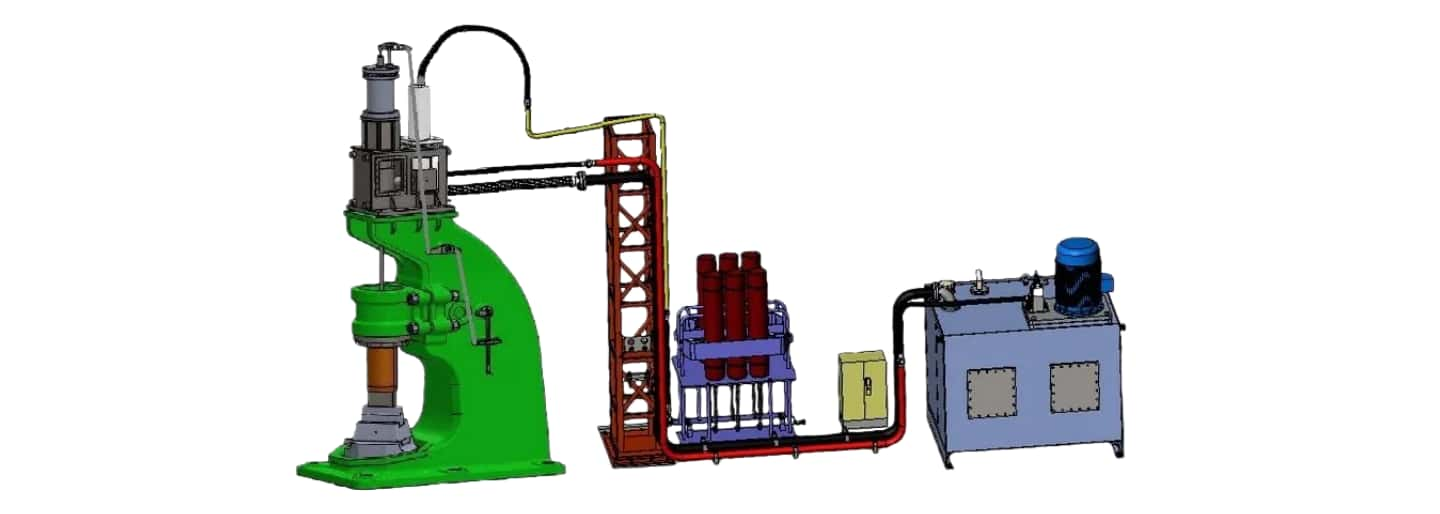
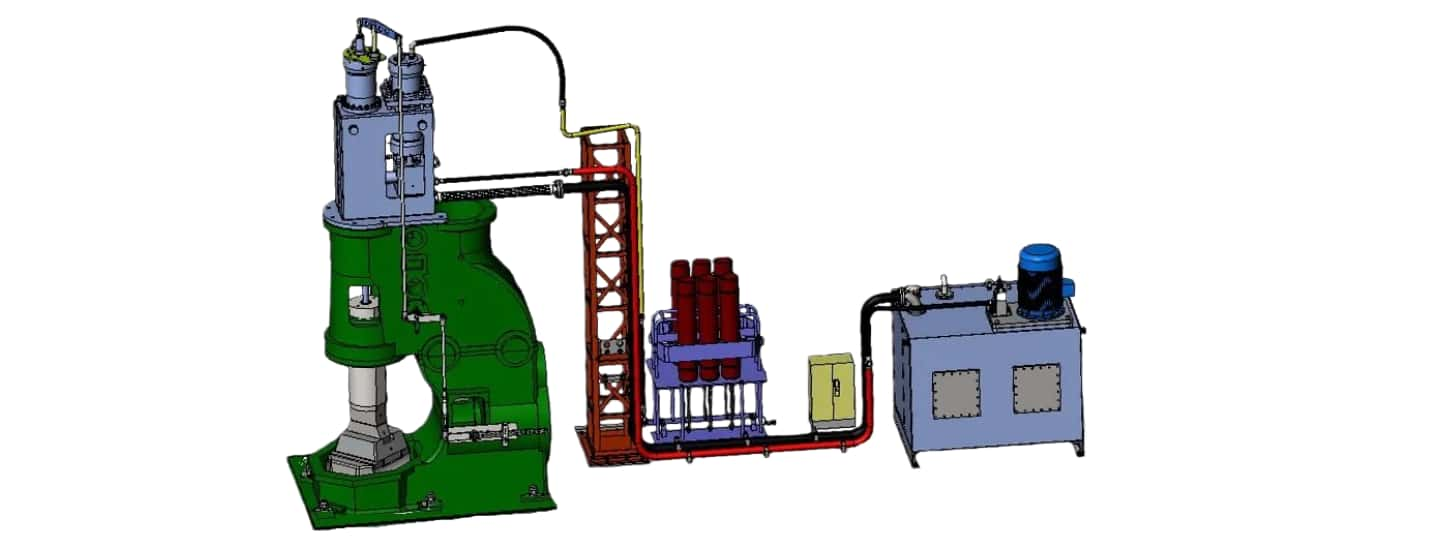
The power pack is the heart of the conversion, and in both routes it is supplied as a separate unit. As the layout drawings above show, it consists of an accumulator bank on its own frame, a hydraulic power pack with its motor and tank, the piping that carries pressure up to the cylinder head on the hammer frame, and an electrical control cabinet. Because the pack stands beside the hammer instead of being built into it, it can be placed where the existing floor has room and serviced without climbing the machine.
Where a plant needs a completely new machine rather than a conversion, the same engineering carries over to our CNC fully hydraulic die forging hammers, and the pendant-controlled working method matches the CNC forging manipulator range used alongside it.
Service scope for forging plants
Deeply rooted in the forging industry, AYANK FORGING has accumulated its experience by serving customers and by learning what actually stops a forge from running. Equipment maintenance has always been a priority, and a dedicated team of dozens of professionals covers a complete service suite:
forging equipment health inspection and maintenance;
major repair and transformation of existing equipment;
equipment relocation, installation and commissioning;
rapid supply of spare parts;
assessment and maintenance of used forging equipment;
remote operation and maintenance support.
The purpose is to address the pain points and challenges that cost forging plants production time, and to provide fast, efficient and worry-free service. Whether the answer to a worn hammer is a conversion, a major repair or a replacement, we would rather give the customer an honest recommendation than sell the largest option.
Frequently Asked Questions
Can any air hammer be converted to an electro-hydraulic hammer?
The foundation, the anvil block and the frame decide it. The foundation and anvil are usually reusable and the frame is often serviceable; where the frame is cracked, distorted or worn past economical repair, Option 1 replaces it. A site inspection settles the question for a specific machine.
Do I need to build a new foundation?
No. Both options reuse the original air hammer foundation and anvil system, and that reuse is where a large part of the cost saving comes from.
What is the difference between Option 1 and Option 2?
Option 1 uses the original foundation and anvil system plus a new frame and a new electro-hydraulic power pack system. Option 2 also reuses the original frame, so only the power pack system and the conversion work are new.
Will the converted hammer strike harder than the old air hammer?
Yes. The conversion increases striking energy, in addition to improving equipment stability and the working environment. The exact figure depends on the machine and on the power pack selected, and is confirmed in the quotation.
Can the converted hammer work with a forging manipulator?
Yes. The aviation-style control pendant lets the operator work alongside the manipulator on the same platform, which saves labour and improves collaboration between the two machines.
Does the retrofit include automatic striking?
Yes. The converted hammer supports remote electric control of strikes and automatic continuous striking, so the blow sequence is set from the control panel rather than by hand.
What support is available after the conversion?
The same service team covers health inspection and maintenance, major repair and transformation, relocation and commissioning, rapid supply of spare parts, assessment of used forging equipment, and remote operation and maintenance.
Which standards does the converted equipment follow?
AYANK is a drafting unit for GB/T 25718-2010 "Electro-hydraulic hammer - Types and basic parameters" and GB/T 25719-2010 "Technical conditions for electro-hydraulic hammers", and builds converted equipment to those requirements.