Reading the C61YA Specifications
Five rows in the table above carry the decision, and they are the five buyers most often mix up:
- Strike energy (kJ) — the work one blow delivers. The model number is the energy: C61YA-175 strikes at 175 kJ.
- Falling mass (kg) — what actually comes down, 1,300 kg to 12,000 kg across the range. It sets how deep a blow bites; it is not a tonnage figure.
- Nominal tonnage (t) — the conventional equivalent to a steam-air hammer of the same size, at roughly 1 t = 35 kJ. Converted in the table below.
- Strike frequency (min-1) — strokes per minute: 65-120 up to the 140 kJ machine, falling to 40-70 at 350 kJ.
- Rail spacing and operating space — the two numbers that decide whether your workpiece, and the manipulator holding it, actually fits between the columns.
One row in that table looks wrong until you know the rule: 30 kJ is called the 1 ton machine because 30 ÷ 35 rounds up, while 280 kJ is exactly 8 ton and 350 kJ is exactly 10 ton. Tonnage and falling mass are different quantities throughout — the first is an equivalent size, the second is a weight.
| Capacities |
Strike energy |
Falling mass |
Nominal tonnage |
| C61YA-30 |
30 kJ |
1,300 kg |
1 ton |
| C61YA-70 |
70 kJ |
2,600 kg |
2 ton |
| C61YA-105 |
105 kJ |
3,800 kg |
3 ton |
| C61YA-140 |
140 kJ |
4,700 kg |
4 ton |
| C61YA-175 |
175 kJ |
5,250 kg |
5 ton |
| C61YA-210 |
210 kJ |
6,400 kg |
6 ton |
| C61YA-280 |
280 kJ |
7,800 kg |
8 ton |
| C61YA-350 |
350 kJ |
12,000 kg |
10 ton |
*Tonnage is the nominal equivalent size, rounded. Your part, its material and the reduction you need per blow decide the capacity — the table is the start of the conversation, not the answer.
How those rows behave in production matters as much as what they say. Because the PLC sets the energy for each blow instead of relying on a fixed ram stroke, the ±1.5% repeatability holds from the first piece to the last: a sizing blow and a drawing-out blow can follow each other without touching the setup.
The energy figure is not a cleverer motor — it is two losses that disappeared. A steam-air hammer pays for a boiler and for a compressed-air line before the blow is struck; on the C61YA both are gone and what is left is the oil circuit. That is where the 60% sits, and the 40-120 blows per minute range shows it is not bought with a slower cycle.
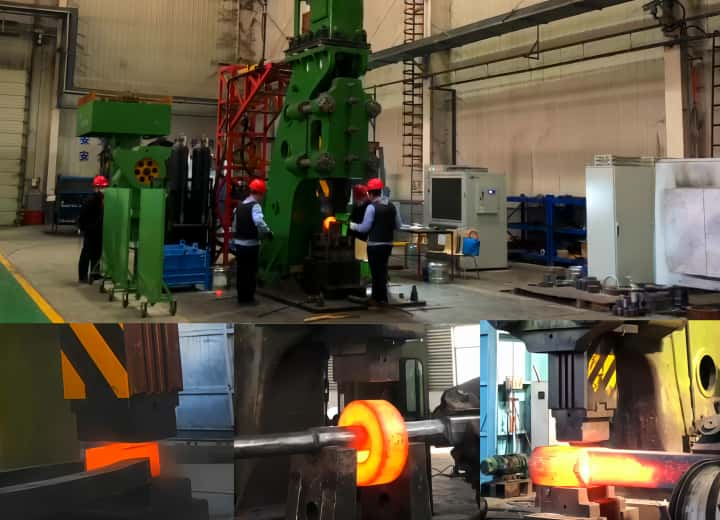
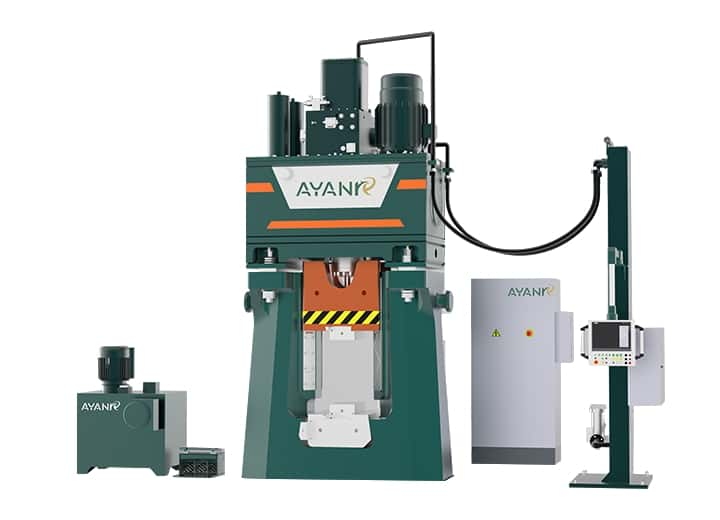
On durability, the ram is guided by X-type rails and the whole drive is hydraulic, so the failure points that normally retire an air hammer — the air circuit and the air-driven piston — are not there to fail. On operation, single-lever control is standard, an aviation-grade joystick remote is optional, and either version can be synchronized with a forging manipulator.
What a Single-Arm Hammer Forges
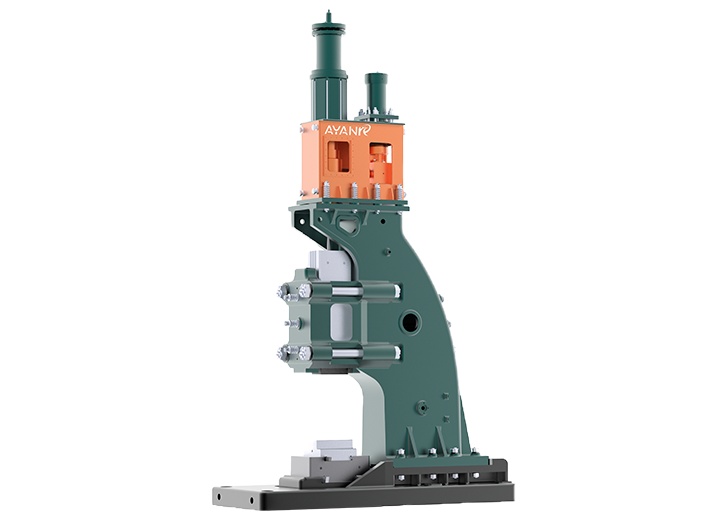
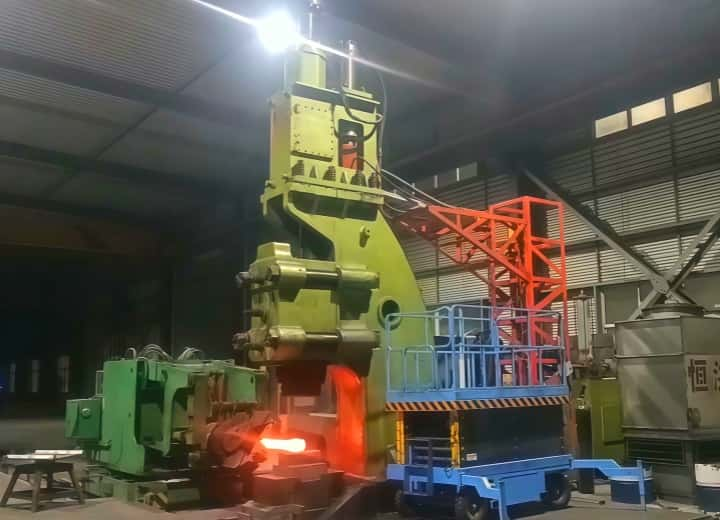
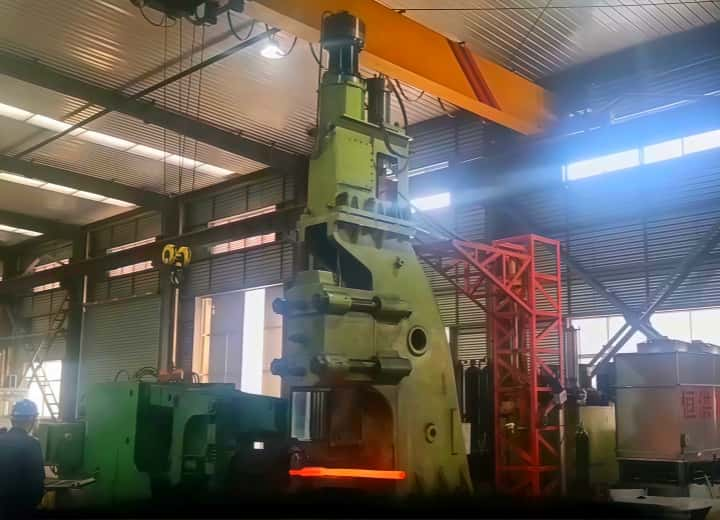
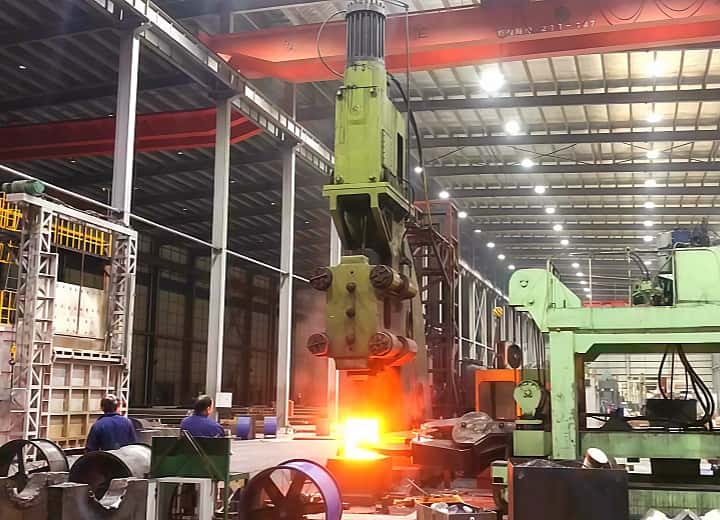
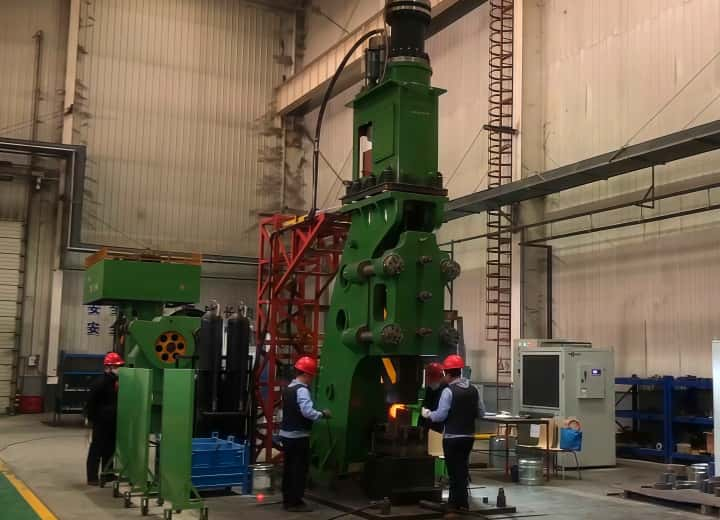
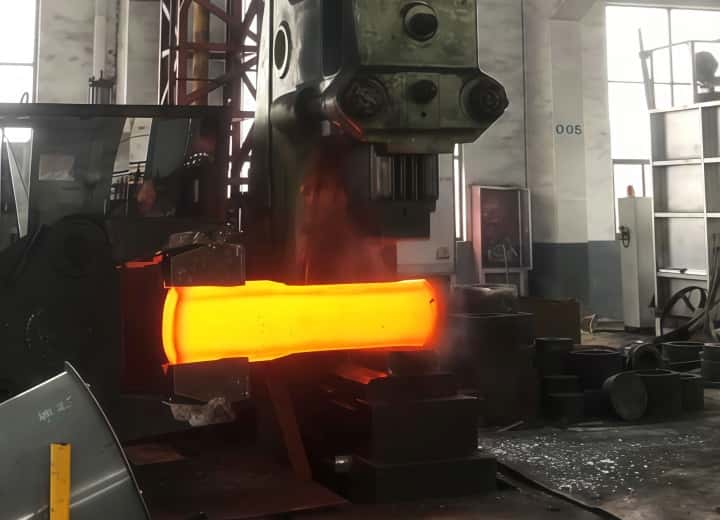
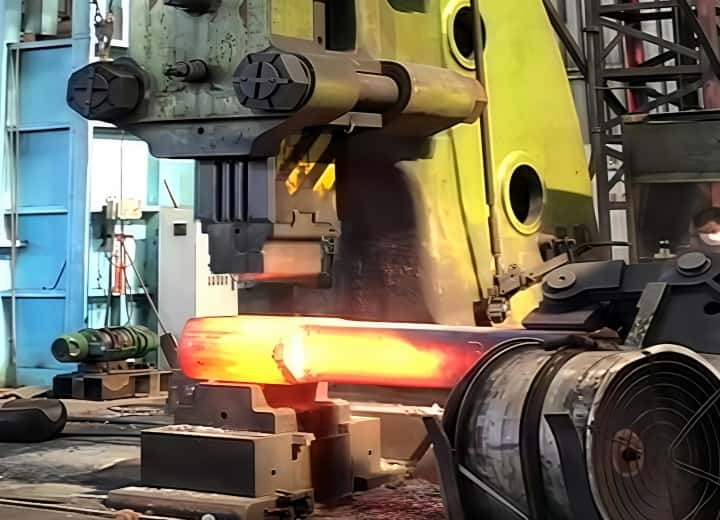
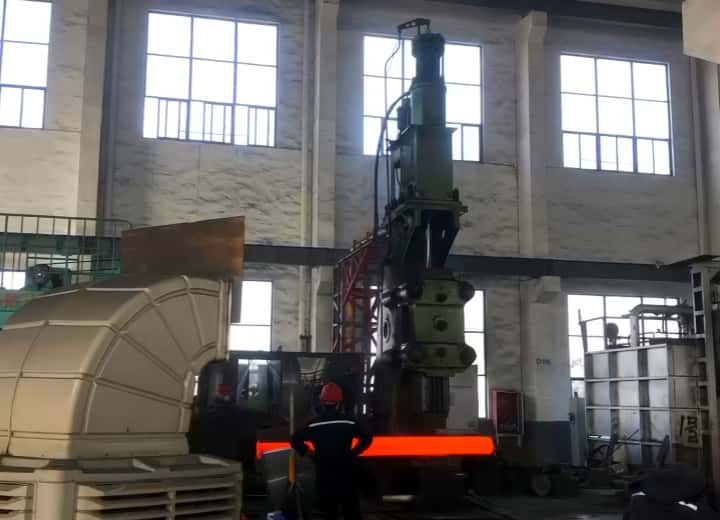
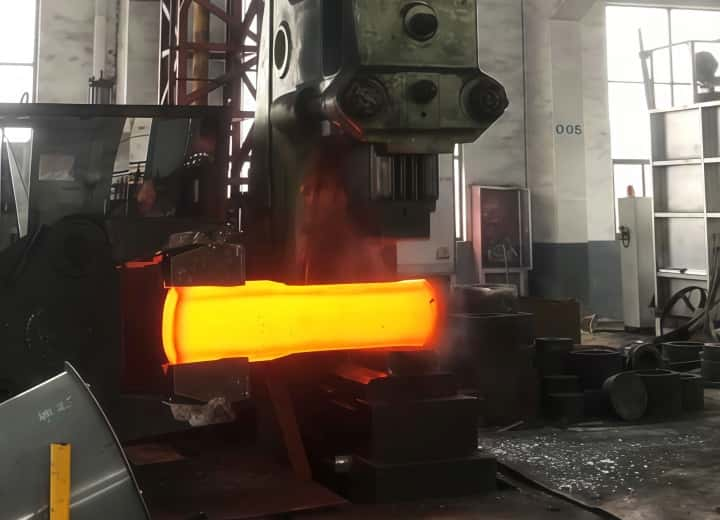
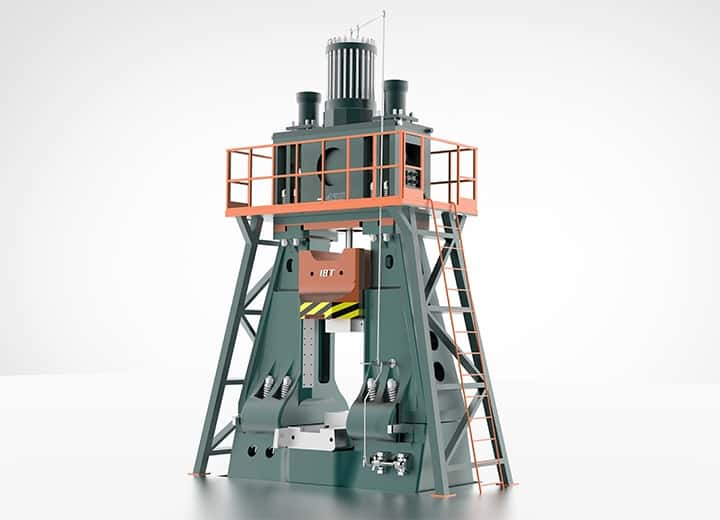
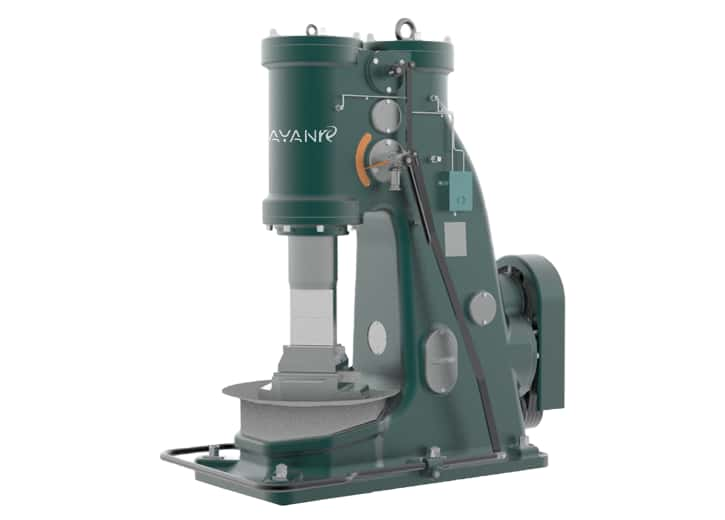
Open die hammer forging is a sequence of blows the operator steers by eye and by hand, and on a single-arm frame the hammer is open on three sides: billet in from the front, tongs or a manipulator from the side, and no column between the operator and the anvil. That layout is the reason this machine is chosen for work that will not fit a closed frame — long stepped shafts, off-centre sections, and parts that have to be turned between blows while still hot.
Forgings it is normally tooled for:
- Stepped and plain shafts — including long bars worked with a manipulator at one end
- Discs, hubs and flanges — upset from cut billet on a flat bottom tool
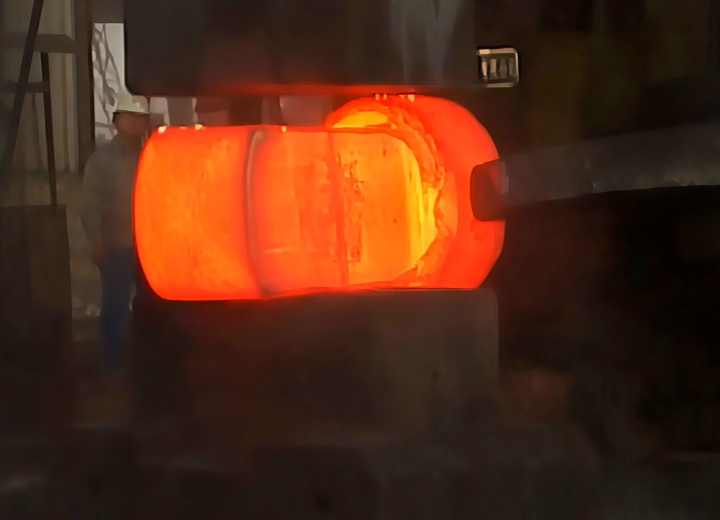
- Ring blanks and hollow parts — forged over a mandrel, turned between blows
- Blocks, square bars and preforms — including preforms that go on to a closed die hammer or press
Materials: carbon and low-alloy steels, medium-carbon alloy steels such as 42CrMo, tool and die steels, and high-temperature alloys. The last group is where the open frame and the hydraulic drive combine — the workpiece can be turned without unclamping, and the blow energy can drop from full to light between passes.
Two numbers pick the capacity: the largest billet section you must reduce per blow (strike energy), and the largest workpiece the anvil and manipulator have to carry (rail spacing, operating space, anvil size). Send a drawing and we size it from those two, then check it against your annual output. The process side is covered in more depth on our open die forging process page.
Single-Arm or Double-Arm: Which Frame Fits Your Work
The two hammers overlap between 30 kJ and 350 kJ, so inside that band capacity does not decide it — access does. The C61YA is open on three sides and stops at 350 kJ. The C66YA double-arm hammer guides the ram from both sides and runs from 35 kJ to 875 kJ, up to 25 ton.
Take the single-arm frame when the workpiece has to come in from the side, when it is long or awkward enough that a column would be in the way, or when 10 ton covers everything you forge. Take the double-arm frame when you need 420-875 kJ, when two-sided guiding matters for straightness on long shafts, or when the hammer sits in a fixed line under a manipulator and the working space is defined by the line rather than by the operator.
If your part is a repeating shape made in volume, neither frame is right — that work belongs on a closed die machine. See the C86YA closed die forging hammer or the C92KA CNC die forging hammer.
Price, Lead Time and Ordering
There is no public price list, because a C61YA is configured to your requirements. The frame comes in 8 standard capacities; the anvil, the foundation scope, the controls and the electrical specification are set by your plant and your workpiece. If you have been searching for a hydraulic forging hammer for sale, the honest answer is that the configuration is set by your part — so here is what moves the price:
- Capacity, sized to your workpiece — the 30 kJ and the 350 kJ are different machines, chosen from the section you must reduce per blow
- Anvil block and foundation scope — whether the anvil, foundation bolts and load drawings are in your scope or ours
- Control type — single-lever manual control as standard, or the aviation-grade joystick remote package
- Manipulator integration — synchronized control with a forging manipulator changes the valve and control package
- Electrical specification — voltage, phase and frequency for your plant
- Spare parts package and shipping terms — which spares you keep on hand for the first year, and whether the quote is ex-works or delivered
To move from a range to a firm number, send five things: a drawing or clear photo of the forged part, the material grade, the billet size and weight, your target tonnage or strike energy, and your annual output. If a manipulator is going into the same line, say so — the layout affects the anvil and foundation drawing.
What comes back is a capacity recommendation with the reasoning behind it, a quotation against your specification, the foundation load drawing, and the power and utility requirements for that machine. Lead time is quoted per order, because the capacity and the scope both move it: the machine is scheduled into production once the configuration is confirmed, so the date comes with the quotation rather than being guessed in advance.
C61YA Open Die Forging Hammer FAQ
What does "5 ton" mean on this hammer?
The machine is named by strike energy, and the tonnage is the conventional equivalent to a steam-air hammer of the same nominal size at roughly 1 t = 35 kJ — so 175 kJ is the 5 ton machine, 280 kJ is 8 ton and 350 kJ is 10 ton. Falling mass is a separate figure (5,250 kg on the 175 kJ) and should not be read as tonnage.
Single-arm or double-arm — how do I choose?
Decide on access first, capacity second. The single-arm C61YA is open on three sides and reaches 350 kJ; the double-arm C66YA guides the ram on both sides and reaches 875 kJ. Above 350 kJ there is no choice, and below it the question is whether a column would be in the operator's way.
Is a hydraulic forging hammer the same as an electro-hydraulic hammer?
In our range, yes. Electro-hydraulic and full hydraulic both mean the ram is driven by a hydraulic power unit with an electric motor, rather than by steam or compressed air. If you already run air hammers and want to keep the frame, we also convert existing machines — see old pneumatic hammers retrofitted into electro-hydraulic hammers.
Can this hammer work with a forging manipulator?
Yes, and the open frame makes it the easier of the two to pair. Ordered with the joystick remote package, the C61YA reproduces the manual lever movements and can be synchronized with a manipulator so the two machines work as one line. See the T31 forging manipulator for the matching sizes.
Open die or closed die — which one do I need?
Open die shapes the workpiece between flat or simple tools and suits one-off parts, large shafts and preforms. Closed die uses a machined cavity and suits a repeating part made in quantity. The C61YA is open die only; for closed die, use the C86YA or the C92KA.
How much energy does it save compared with a steam-air hammer?
The figure we quote for this range is over 60% less energy than a steam-air hammer of the same nominal size, because there is no boiler to fire and no compressed-air line to leak. The exact number depends on your cycle time and part mix, and it can be worked out from your existing hammer's steam or air consumption per shift.
Is the C61YA a fixed model, or configurable to my requirements?
Configurable. The 8 capacities are standard frame sizes; the anvil, the foundation scope, the control package and the electrical specification are set per project. That is also why there is no published price — the number depends on the configuration you choose.
How long does delivery take?
It is fixed on the quotation rather than read off a table, because the capacity and the scope both move it. The machine is scheduled into production once the configuration is confirmed, and the date you are given is tied to that schedule — ask for it with the quotation so you are comparing the same basis.