How to Maintain a Pneumatic Hammer: A Step-by-Step Checklist
2026-03-12
How to Maintain a Pneumatic Hammer
Proper pneumatic hammer maintenance is what decides how long the machine serves and whether it keeps performing consistently. Most of what goes wrong on these machines is not a design failure - it is a lubrication point that ran dry, a bolt that worked loose, or a guide clearance that was never checked back to spec.
Seven Key Maintenance Tips for Your Pneumatic Hammer
Check the gearbox oil level regularly. The gearbox sits below the piston cylinder, and the gears depend on that oil to stay lubricated through the working day.
Use standard lubricating oil. Expensive specialty oils are unnecessary; what matters is selecting the viscosity to suit the ambient temperature, because the same oil will not serve a cold shop and a hot one.
Keep the oil pump filled above the minimum mark. Before starting the hammer, work the pump handle ten times by hand to circulate oil into the cylinder - those ten strokes are what stop the first minute of running from being a dry start.
Inspect the oil lines for leaks periodically. Check the sight glass on top of the oil pump cup to confirm the oil is actually dripping at the right rate rather than merely being present in the tank.
Before forging, check every component for looseness - the anvil block and the guides in particular, since those carry the blow.
After forging, re-check all exposed bolts and tighten any that have worked loose. A hammer loosens its own fasteners faster than any other machine in the shop.
Change the gearbox oil every three to six months, depending on how hard the machine is used.
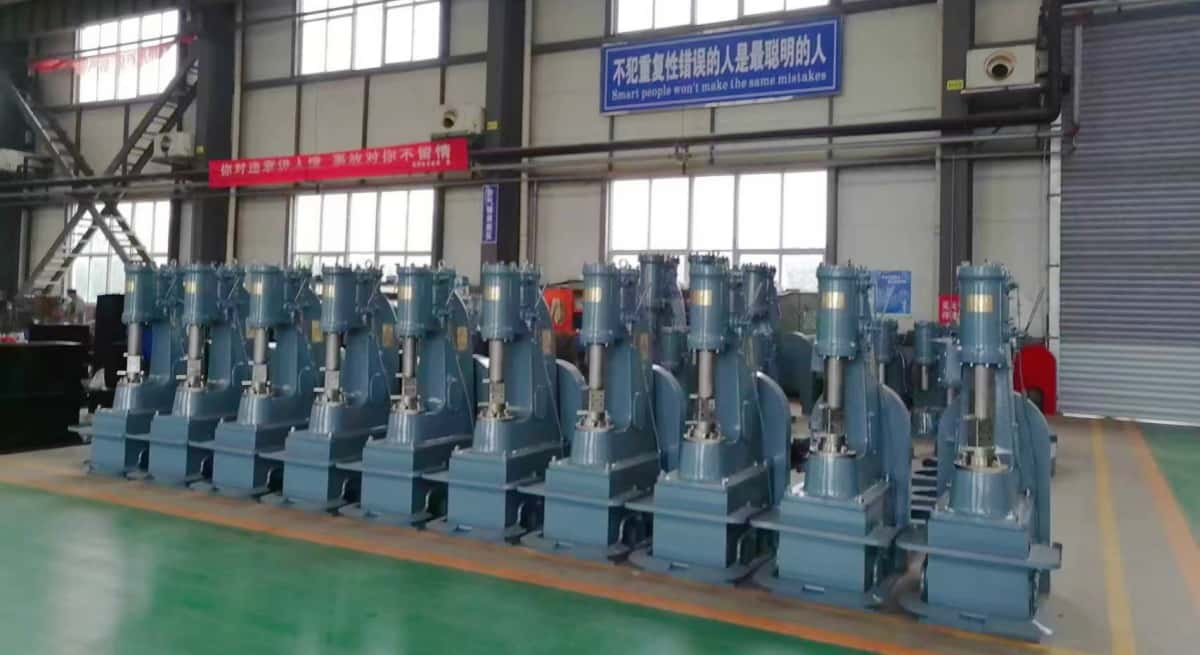
C41A small pneumatic hammers in the assembly shop.
Fifteen Operational Guidelines
These are written around a 150 kg pneumatic hammer, but the principles apply across the range.
Operators must know the hammer's structure and performance in order to run it correctly and prevent accidents.
Keep to the recommended service intervals and perform the regular inspections. Replace damaged parts promptly so one failure does not take the next component with it.
If abnormal noise appears during operation, stop the hammer immediately for inspection and repair.
Check the oil level in the lubrication cups frequently, and confirm the oil meets specification - flash point, impurities and viscosity.
Pay consistent attention to the lubrication of every moving part.
Maintain the specified clearances between the anvil face and the hammer guides, and between the lower anvil and the ground. Verify those distances regularly to prevent machine damage.
Inspect the spherical valve in the buffer mechanism periodically, so the hammer does not damage the upper cylinder cover.
In winter, insulate the oil cups so the oil does not freeze and obstruct lubrication.
Before operation, confirm that all control levers move freely and smoothly.
During regular maintenance, clear all air passages so the hammer runs at full efficiency.
Keep the motor clean. Clean it internally once a year, and do not use kerosene or gasoline on the coils - that damages the insulation.
Do not forge cold or insufficiently heated metal.
Do not leave the hammer in the raised position for more than a minute, which overheats it, wastes energy and shortens service life.
Only experienced operators should run the hammer, especially for single strikes, which require real technique.
Always disconnect the power supply after use.
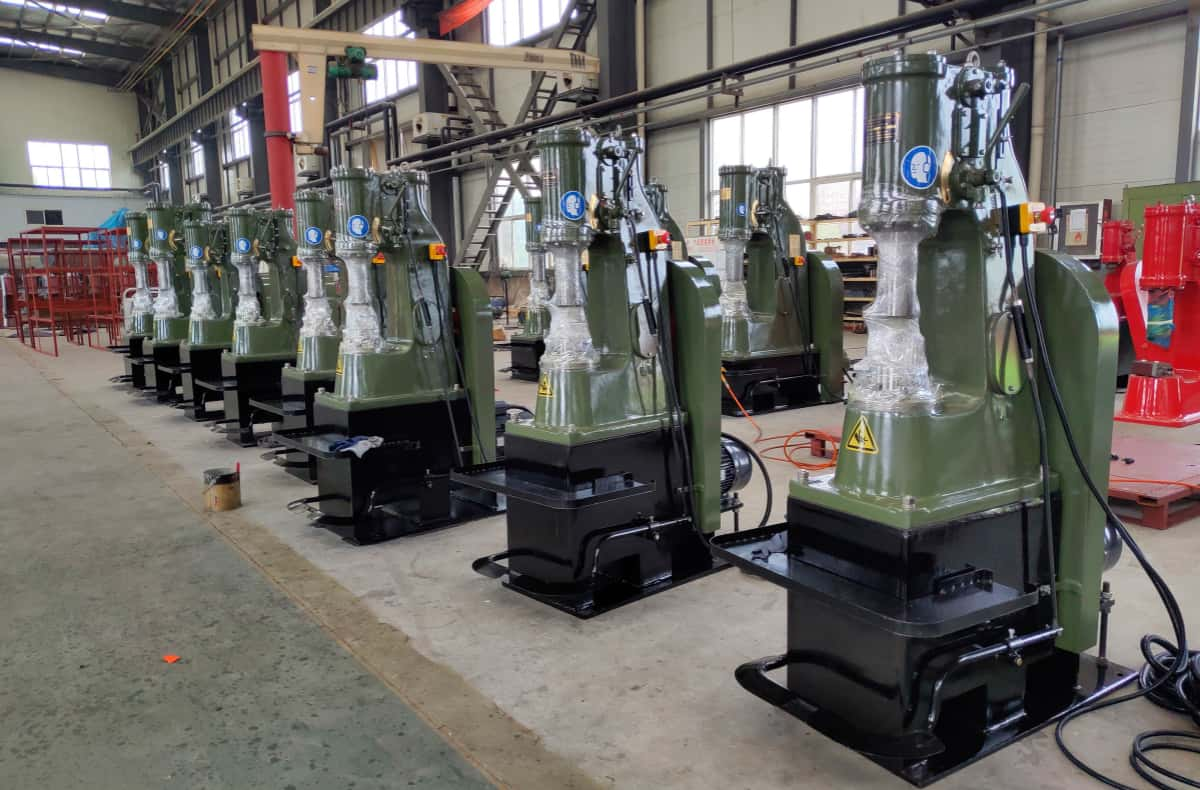
C41A pneumatic hammers with their drive motors and belt guards.
Why Lubrication Is the One That Matters Most
Read the seven tips and the fifteen guidelines together and one theme dominates: oil. Four of the seven tips and three of the fifteen guidelines are about lubrication, and there is a reason for that. A pneumatic hammer's failure modes run in a predictable order, and the first three - a dry gearbox, a starved cylinder, a blocked oil line - all come from the lubrication chain rather than from the machine's design.
That chain has three links, and each one fails differently. The gearbox is a level problem: it drains slowly and nobody notices until the gears are noisy. The cylinder is a delivery problem: the pump has to put oil where it is needed before the first blow, which is why the ten manual strokes exist. The oil lines are a visibility problem: a sight glass that nobody looks at tells you nothing at all. Check the three in that order and most of the other checks become confirmations rather than discoveries.
Advantages of AYANK Pneumatic Hammers
Expertise: more than 70 years of experience in pneumatic hammer manufacturing, and a drafting unit for China's national standards.
Robust and durable: built from superior materials, roughly 20% heavier than average, which is what the stability and the longevity come from.
Precision craftsmanship: attention to detail in visible and hidden areas alike.
Comprehensive heat treatment: critical components such as the hammer head and the anvil base are fully quenched through the manufacturing process.
End-to-end quality control: a dedicated quality team inspects at every stage, from casting and machining through to final assembly.
Reliable after-sales service: a professional support team available 24/7.
Minimised downtime: a full safety stock of common spare parts is held for all models, so repairs do not wait on a part.
Complete product range: the C41 series runs from 15 kg to 2000 kg across more than ten specifications.
Pneumatic Hammer Parameter Tables
15 kg to 75 kg
C41A pneumatic hammer, 15 kg to 75 kg: eleven parameters, model by model.
Item
Unit
C41A-15
C41A-25
C41A-40 (two pieces)
C41A-40 (one piece)
C41A-55 (one piece)
C41A-75 (two pieces)
C41A-75 (one piece)
Weight of falling part
kg
15
25
40
40
55
75
75
Blow energy
kJ
0.16
0.27
0.53
0.53
0.7
1
1
Max. blow frequency
strokes/min
300
250
245
245
230
210
210
Working area height
mm
160
240
245
245
270
297
297
Distance from center line of hammer rod to frame
mm
140
200
235
235
270
280
280
Malleable blank, square
mm
30 × 30
40 × 40
52 × 52
52 × 52
60 × 60
65 × 65
65 × 65
Malleable blank, round
mm
Ø35
Ø48
Ø68
Ø68
Ø75
Ø85
Ø85
Motor model
/
Y100L1-4-B3
Y132S-6-B3
Y112M-4
Y132M1-6-B3
Y160M-6
Y132M-4
Y132M-4
Motor power
kW
2.2
3
4
4
7.5
7.5
7.5
Machine weight, frame
kg
270
720
710
860
1300
2300
2500
Machine dimensions
mm
1150 × 555 × 1515
1435 × 685 × 1725
1155 × 1200 × 1390
1615 × 765 × 1785
1830 × 845 × 1950
1570 × 930 × 1875
1570 × 1537 × 1875
150 kg to 2000 kg
C41A pneumatic hammer, 150 kg to 2000 kg: eleven parameters, model by model.
Item
Unit
C41A-150
C41A-250
C41A-400
C41A-560
C41A-750
C41A-1000
C41A-2000
Weight of falling part
kg
150
250
400
560
750
1000
2000
Blow energy
kJ
2.5
5.6
9.5
13.7
19
27
54
Max. blow frequency
strokes/min
180
140
120
115
105
95
80
Working area height
mm
370
450
530
600
670
800
1000
Distance from center line of hammer rod to frame
mm
350
420
520
550
750
800
950
Malleable blank, square
mm
130 × 130
145 × 145
220 × 220
270 × 270
270 × 270
290 × 290
350 × 350
Malleable blank, round
mm
Ø145
Ø175
Ø240
Ø280
Ø300
Ø320
Ø400
Motor model
/
Y180M-4
Y180L-4
Y200L-4
Y280S-6
Y280M-6
Y315S-6
Y315L2-6
Motor power
kW
18.5
22
30
45
55
75
132
Machine weight, frame
kg
3260
5000
8000
9800
17000
20000
48000
Machine dimensions
mm
2390 × 1085 × 2150
2639 × 1000 × 2540
2785 × 1100 × 2884
3464 × 1160 × 3157
3905 × 1370 × 3175
4020 × 1500 × 3652
5820 × 2140 × 4390
Frequently Asked Questions
How often should the gearbox oil be changed?
Every three to six months, depending on usage. The harder the hammer works, the closer to the three-month end of that range it should be.
Do I need expensive specialty oil?
No. Standard lubricating oil is sufficient - what matters is choosing the viscosity to suit the ambient temperature, and keeping the level where it should be.
Why pump the handle ten times before starting?
To circulate oil into the cylinder before the first blow. Without it the machine starts dry, which is where most of the avoidable wear happens.
What should I do if the hammer starts making an abnormal noise?
Stop it immediately and inspect. Abnormal noise is the earliest signal of a component that has loosened or failed, and continuing to run only spreads the damage.
Why should the hammer not stay raised for long?
Leaving it in the raised position for more than a minute overheats the machine, wastes energy and shortens its service life.
What is the most neglected check on a pneumatic hammer?
The sight glass on the oil pump cup. The tank can be full while the delivery has stopped, and the sight glass is the only place that shows the difference.