I.Description of the Technical Advancement and Rationality of the C92KA Series CNC Fully Hydraulic Die Forging Hammer
II.Description of AYANK FORGING's Manufacturing Capabilities
III.Quality Control in the Manufacturing Process of the C92KA CNC Fully Hydraulic Die Forging Hammer
IV. Description of Technical Documentation, Technical Services, and Technical Training
V. After-Sales Service Guarantee Measures
VI.Applicable Industries
VII. Unique Advantages
IX. Advantages and Innovations of AYANK FORGING's CNC Hammer (Programmable Hammer)
(1) The striking control system employs a precise control system, resulting in extremely high accuracy in striking energy control.
Due to the separation of the striking valve control system from the main system, the unique control system ensures more precise striking energy.
(2) The control valves adopt a standardized design, while minimizing the control stages for the striking valve.
Except for the striking valve, which is a proprietary technology valve, all other valves in AYANK FORGING's CNC hammer use standard valves, making it easier to ensure system accuracy and reliability. The control system for the striking valve is a single-stage control for CNC hammers ≤63 KJ, and a two-stage control for hammers >63 KJ.
(3) The slow ascent and descent function for the hammer head is very convenient to operate, making die replacement safer, more convenient, and faster.
By adding a specific drain valve to the hydraulic system, the hammer head can be slowly lowered or raised quickly in adjustment mode without needing to depressurize the system, reducing die change time by over 10 minutes. This eliminates the need to fully depressurize the system's hydraulic oil and rely solely on the hammer head's weight for a slow, unsafe descent, or the need to repressurize the system for lifting, waiting until pressure is sufficient. The old method resulted in sudden, jerky movements during slow descent/ascent, which was highly unsafe.
(4) The unique main striking valve ensures system reliability and stability.
The main striking valve of the CNC hammer plays a crucial role in forging operations. It employs a spool valve structure. This design separates the control function from the switching of various oil passages. The movement of the main spool is controlled by left and right pilot spools, with all three structurally independent, eliminating the impact of machining errors on the spool's precise movement. Furthermore, this structure allows the control circuit oil to intake for striking, eliminating the issue of spool sticking due to prolonged pressure maintenance in the control chamber, which affects striking energy repeatability. Repeat accuracy is thus controlled within ±3%. This spool valve structure offers advantages like compact size, rapid response, smooth and reliable directional change, low impact, and ease of machining. This enables accurate control of the CNC hammer's striking energy, significantly improves forging yield rates, and extends die life.
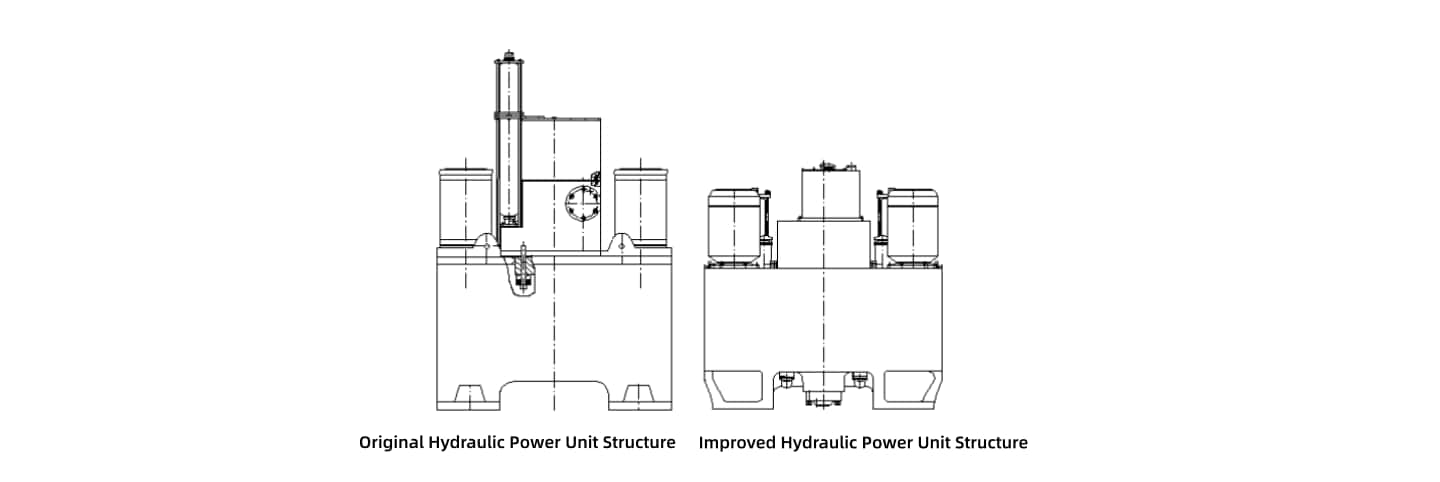
(5) The unique hydraulic power unit structure prevents external leakage, features excellent sealing, and is easy to maintain.
The most difficult component to disassemble in the hydraulic system is the large valve block. Therefore, the large valve block is directly seated inside the oil tank. If leakage occurs at the joint surface between the large valve block and the base plate, hydraulic oil flows directly back into the tank, preventing external leakage. Thison one hand reduces hydraulic oil loss, and on the other hand extends the seal replacement cycle while also lowering the overall equipment height.
(6) The hammer head buffer employs an externally connected structure, overcoming the unreliability of internally welded structures.
Because the buffer uses an externally connected structure, during the buffering process, only the tank base plate bears the force. This eliminates the risk of hydraulic oil leakage due to weld crack propagation.
(7) The accumulator adopts a low-position installation method, avoiding a sudden increase in equipment height due to an excessively tall accumulator.
Since the accumulator is the longest component on top of the hydraulic power unit, it is installed at a low position on the oil tank base plate. This achieves an aesthetically complete equipment look while reducing the overall machine height.
(8) The safety of the striking valve system is fully guaranteed.
Because both control ends of the striking valve are equipped with cushioning devices, it absolutely prevents a dangerous situation where, due to a control system failure, the striking valve spool impacts the valve cover, causing bolt fracture.
(9) Special bolt anti-loosening devices enhance system vibration resistance and safety.
The bolt anti-loosening devices use imported lock washers, completely preventing bolt loosening.
(10) Rational foot switch configuration.
Due to programmed settings, the hammer's cycle follows the program. However, variations in heating temperature and blank size deviation might cause the forging not to form as expected within the predetermined cycle. Therefore, based on the "two-position" foot switch, we added an "extra strike" switch position, making it a "three-position foot switch." That is, "Position One" is the switch for executing the programmed cycle, "Position Two" is the ejector switch, and "Position Three" is the "extra strike" switch. "Position Three" is an additional setting that does not interfere with the programmed cycle progression. For operator convenience, the three-position foot switch can also be set to correspond to three different energy levels.
(11) Automatic energy adjustment.
Since an automatic energy adjustment program is added to the PLC, after changing dies, simply inputting the die setting height parameter into the touchscreen allows for automatic energy adjustment. This ensures the accuracy of the striking energy.
(12) Reliable hammer rod sealing.
The working cylinder is divided into upper and lower chambers by the hammer rod piston. The sealing of the hammer rod is directly related to energy accuracy and system stability. Therefore, we use an extra-long piston structure and multiple imported sealing rings for sealing, thus ensuring sealing reliability.
(13) Reliable lower seal safety device.
A safety device is installed at the lower seal of the hammer rod. In case the hammer rod fractures at its midsection, it can immediately block the lower seal opening, avoiding the hazard caused by a high-pressure oil jet.
(14) Use of imported high-pressure hoses ensures system operational reliability.
Connections between the main pump, accumulator, and valve blocks use Austrian Semperit 4 and 6-layer high-strength steel wire oil-resistant ultra-high-pressure hoses, with a working pressure up to 35 MPa. They possess high pulse resistance, suitable for the high-frequency hydraulic system of the CNC die forging hammer. The connection interface uses a heavy-duty 24° cone form, offering reliable sealing and impact resistance, ensuring the reliable and stable operation of the working system.
Ninety-eight percent of the workers, inspectors, and assemblers involved in the production and assembly of the C92KA CNC fully hydraulic die forging hammer are skilled technicians. They have all participated in the company's electro-hydraulic hammer training program, understanding the structure, performance, and the importance of various components. Among front-line workers, vocational school graduates account for 68%, college graduates account for 30%, and others make up 10% (Note: Total exceeds 100% in the original; translation reflects the given figures). The company has successively provided over 600 units of high-quality products to customers nationwide.
The machining accuracy of the frame is crucial. Specifically, the symmetry of the 'X'-shaped guide rail surfaces and their perpendicularity to the dovetail surfaces directly affect assembly quality. To ensure this precision, process engineers formulate detailed machining plans and inspection methods. The relevant machining operations are completed on a large CNC floor-type boring and milling machine, meeting the drawing specifications.
The precision of the striking valve and its second-stage pilot valve is key to accurate energy control. All critical machining for these components is performed on CNC lathes.
The cylinder liner requires high precision, with strict tolerances for concentricity between the inner and outer diameters, cylindricity of the inner bore, and surface roughness, making it difficult to machine. Our company employs a process where it is first machined on a deep-hole boring machine, followed by finishing with an ultra-precision internal diameter rolling/burnishing head. This ensures both the accuracy of the bored hole and the surface strength. Finally, the outer diameter is finished on a grinding machine.
Components such as the hammer head and main valve block are machined on machining centers, guaranteeing the machining quality of the hammer head.
1. Quality Assurance System
On December 31, 2001, our company obtained the ISO9001:2000 Quality Management System Certification issued by the China Quality Certification Centre (CQC). The certificate number is 4100/200110088.
The primary documents of the Quality Management System are the Quality Manualand the Procedure Documents. The Procedure Documentsconsist of 19 documents, including the Document Control Procedure; Quality Record Control Procedure; Management Review Control Procedure; and Personnel Training, Assessment, and Employment Control Procedure.
2. Quality Policy and Quality Objectives
Quality Policy:
Quality First, Customer Supreme.
Premium Service, Technological Innovation.
Prevention Oriented, Continuous Improvement.
Quality Objectives:
First-time Inspection Pass Rate for Products (Complete Machine): 95%
Final Inspection Pass Rate for Products (Complete Machine) upon Delivery: 100%
Customer Feedback Information Processing Rate: 100%
3. Establishing Quality Control Points and Work Instructions for Key Components and Assembly Processes
The machining and assembly of all key components for the CNC fully hydraulic die forging hammer are distributed across four workshops. To ensure product quality, we have established 35 quality control points within these four workshops. Simultaneously, work instructions are compiled for each key component. The tolerance requirements for each process are tightened by one-third compared to the drawings. The machining and assembly of parts strictly adhere to the instruction requirements, with 100% of all requirements for key components meeting specifications.
4. Establishing Quality Record Archives for Key Components
For key components, we have established individual quality record cards according to document AD/AGC-4.0-02-2001.8. These are finally consolidated into the complete machine archive, facilitating inquiry and traceability.
5. Establishing Quality Record Archives for Major Components
All major components of the CNC fully hydraulic die forging hammer have quality record cards. Every requirement for each part must conform to the drawing specifications.
It is precisely because we have implemented the aforementioned measures that we have ensured a 98% first-time inspection pass rate for the sub-assembly, final assembly, and test run of our CNC fully hydraulic die forging hammers, and a 100% qualification rate for complete machines upon delivery or for on-site installation and test runs.
6. Inspection and Testing of Key Components
Our company's quality inspection system is as follows:
Raw Material Incoming Inspection → Process Machining Inspection → Semi-finished Product Warehouse Inspection → Assembly Inspection → Final Delivery Inspection.
Key dimensions (requirements) for key components have inspection methods within the processes, ensuring 100% inspection. This includes tempered/quenched hardness testing, surface roughness testing, non-destructive testing, etc.
Main inspection and testing instruments include: physical and chemical testing equipment, metallographic analysis equipment, Grade 2 calibrated Brinell and Rockwell hardness testers, surface roughness testers, ultrasonic flaw detectors, magnetic particle flaw detectors, etc
1. Technical Documentation:
Within 15 days after the contract becomes effective, provide the purchaser with the general equipment layout, foundation drawing, floor plan, and details regarding water/electricity consumption, interface locations, pipe diameters, etc., for the design institute to conduct factory planning.
Equipment drawings (general assembly drawing and main component drawings), hydraulic schematic diagram, electrical schematic diagram, electrical interconnection diagram, lubrication schematic diagram, operation and maintenance manual, software and programs, installation guide, manuals for purchased parts, certificates of conformity, and manufacturer names.
The operation and maintenance manual shall meet the requirements for use, maintenance, upkeep, operation, installation, and adjustment, and shall be neatly and standardly bound. Contents include: purpose and features, main technical parameters, structural overview, electrical system overview, lubrication system, installation and commissioning, troubleshooting, maintenance, and safety operating procedures.
Drawings appended to the manual: General assembly drawing, simplified drawings of main components, electrical schematic diagram, electrical interconnection diagram, electrical wiring diagrams (including main unit, electrical cabinet, operator panel), lubrication system schematic diagram, main pneumatic cylinder component drawings, etc.
2. Our company can provide users with the following technical support and services:
Responsible for on-site layout planning.
Responsible for designing foundation drawings for various parts.
Responsible for technical disclosure.
Responsible for on-site equipment installation and commissioning.
Responsible for free training of the user's operators and maintenance personnel.
Responsible for providing spare parts and wear parts at favorable prices.
Provide lifelong technical guidance.
3. Technical Training:
Training will be conducted during the processes of equipment installation, commissioning, and trial production. On-site engineers and technicians, including mechanical and electrical engineers, will serve as the main instructors.
The specific content of the technical training is as follows:
Learning the working principle of the CNC fully hydraulic die forging hammer.
Learning the operation method of the CNC fully hydraulic die forging hammer.
Learning the daily and periodic maintenance of the CNC fully hydraulic die forging hammer.
Learning the analysis and handling of common faults of the CNC fully hydraulic die forging hammer.
Learning the replacement methods for wear parts of the CNC fully hydraulic die forging hammer.
Learning the installation and fixing methods for dies of the CNC fully hydraulic die forging hammer.
V. After-Sales Service Guarantee Measures
In accordance with the spirit of Document No. 1 [1995] from the Chinese Ministry of Machinery Industry, "Notice on Strengthening Enterprise Quality Work and Initiating a New Phase in Machinery Industry Quality Work," and to enhance machine tool quality, strengthen after-sales service, and earnestly fulfill the principle of "Serving the User, Being Responsible to the User, and Satisfying the User," we, AYANK FORGING Company, as a specialized domestic manufacturer of electro-hydraulic hammers, hereby issue the following quality guarantee declaration to our users. Effective from the date of this declaration, we guarantee the following for our delivered machine products:
Products delivered are of high quality and reliability, with early failures eliminated within the factory.
If quality issues are discovered during the user's operation, we will respond within 48 hours of receiving user notification, or dispatch service personnel. Furthermore, our service personnel will not leave the site until the fault is resolved.
During the product warranty period, if a problem is confirmed to be due to product quality and our service personnel cannot resolve the fault within 10 days of arriving on site, compensation of 30 RMB per hour will be paid starting from the 11th day (calculated based on an 8-hour workday). If the product still fails to meet quality requirements after an additional two weeks of repair, substandard products will be taken back or replaced.
For heavy-duty and special-purpose machine tools, the system of user-supervised manufacturing and factory acceptance inspection is strictly implemented.
The enterprise guarantees the provision of maintenance spare parts for delivered products and will perform maintenance services in accordance with user requirements.
1.Increased Production Efficiency:
The design features a large hammer head and short stroke. The hammer head return uses a hydraulic return stroke, similar to a hydraulic spring, allowing the piston to retract rapidly after a strike.
The striking frequency is more than doubled compared to conventional die forging hammers.
This results in significantly improved production efficiency.
2.Energy Saving and Reduced Consumption:
Striking energy is adjustable between 0% and 100%. The accurate control of energy brings significant energy-saving benefits. Excess strikes not only consume more energy but also negatively impact the lifespan of the forging equipment and dies.
3.Improved Forging Quality:
High Precision: Capable of precisely controlling striking force and energy, which is conducive to the precision forming of complex workpieces.
Excellent Repeatability: The intelligent control system ensures consistent striking parameters for each blow, enhancing product uniformity. The repeatability is generally controlled within ±1.5%.
4.Extended Equipment Life and Low Maintenance Costs:
The integral U-shaped frame is heavy, offering high efficiency in converting striking energy. Its machining accuracy is easily ensured, guaranteeing consistency in guide rail clearance.
Compared to split-frame structures, the integral frame has no upper/lower section joint, eliminating concerns about bouncing. Split frames are prone to bouncing at the joint, which can allow scale and debris ingress, leading to accuracy loss and deformation, resulting in high maintenance costs.
The integral U-shaped frame has no friction between upper and lower sections, requiring minimal maintenance even during prolonged operation.
5.High Level of Intelligence and Automation:
Controllable and Adjustable Parameters: Key parameters like striking energy, stroke, and number of steps can be set and adjusted via the HMI (Touchscreen Human-Machine Interface).
Easy Integration into Automated Lines: The minimal impact and vibration allow seamless integration with robots and loading/unloading systems, enabling fully automated production.
6.High-Specification, High-Standard Production:
With over 70 years of deep expertise in forging equipment manufacturing, the CNC hammer project contributes to the formulation of national standards. The production adheres to more than 19 execution standards, incorporates 13 patents, and is certified under the ISO9001 Quality Management System among other integrated management system certifications.
The C92KA series CNC fully hydraulic die forging hammer, also known as a programmable hammer, is one of the world's most advanced die forging equipment. It is a forging device capable of digitally controlling striking energy and sequence, with a striking energy deviation within ±3%. It is suitable for high-variety, high-volume production in precision die forging industries such as automotive, motorcycle, construction machinery, hydraulic fittings, hardware tools, architectural hardware, daily-use hardware, medical devices, kitchen and bathroom hardware, agricultural tools, and cutlery. Furthermore, it is widely used in high-density, complex-shaped parts for industries like aerospace. It serves as the core equipment in automated precision forging production lines.
High forging precision: Forging dimensional error ≤ 0.2mm, forging weight error ≤ 0.3%, high surface finish.
Striking energy can be superimposed. During the forging process, if one blow is insufficient, multiple blows can be applied; a smaller hammer can handle larger workpieces.
Wide applicability. The CNC fully hydraulic die forging hammer can forge thin-walled forgings, complex-shaped parts difficult to fill the die cavity, forgings with thin ribs, and forgings with strict height tolerance requirements.
The CNC fully hydraulic die forging hammer (programmable forging hammer) offers high die life.
The CNC fully hydraulic die forging hammer (programmable forging hammer) has a fast striking frequency, resulting in high production efficiency.
The frame has high rigidity and strong resistance to off-center loads, making it suitable for multi-impression die forging.
The hammer rod features a flexible, slender structure, eliminating issues of over-constraint and die locking.
Capable of forging at low temperatures, producing forgings with high surface finish and stable chemical properties.
Striking energy can be precisely controlled via programming, with good repeat forging accuracy and stable forging quality.
The striking steps and the energy for each step can be controlled via programming.
High material utilization rate for die forgings.
Reduces the required skill level of operators for hammer operation.
The CNC fully hydraulic die forging hammer (programmable forging hammer) can be integrated with forging robots to form automated production lines.
Unique striking valve system ensures extremely high repeatability of striking energy.
Forging strikes achieve "CNC" programming; the CNC system is network-enabled, allowing for remote control.
U-shaped frame combined with X-shaped guide rails enables high forging precision and multi-impression die forging capability.
High striking frequency for more efficient production.
The hammer head can be slowly raised and lowered at any time, making die change or adjustment more convenient, faster, and safer.
Short-stroke striking function, die vibration function, and anti-misoperation safety module are proprietary technologies of AYANK FORGING.
Enables automation.
Key Advantages: Precise energy control, high forging precision, low vibration, and automation capability.
Receive the news that you are interested in.