Ring rolling machine price is not set by the ring size alone. It follows three published figures: the radial and axial rolling force, the installed motor power, and the machine length that force and power demand. The same figures that explain the cost are the ones that decide which ring rolling process window the machine can hold. Across the D53KA range those three figures rise by a factor of twenty from the smallest model to the largest, which is why two machines that both roll rings can sit in completely different budget brackets. This page sets out what moves the number, using the specifications published on the product pages, and what to send so that two quotations can actually be compared.
A ring rolling machine price follows capacity, and capacity is published as a number. A machine rated at 800 kN radial rolling force with a 200 kW radial motor belongs to a different class from one rated at 16,000 kN with two 2,000 kW motors. Everything else in a quotation, from tooling to foundation to commissioning, is added on top of that base. Read the rolling force and the motor power first, then the machine footprint, and the order of magnitude becomes visible before any supplier names a figure.
Three figures on the specification sheet carry most of the cost. They are worth reading in this order, and they explain more about a quotation than any single number on it.
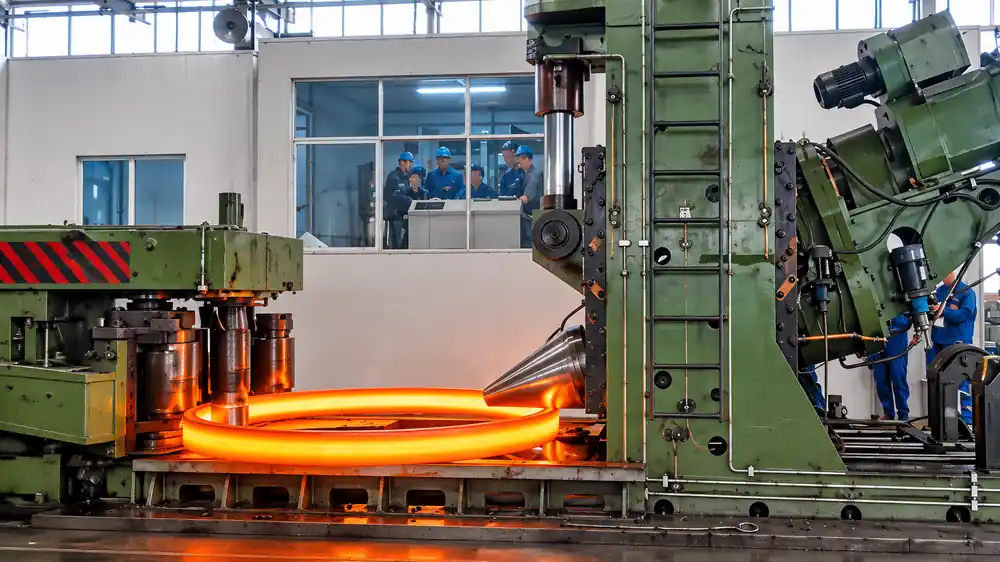
Rolling force sizes the structure. A frame built to carry 800 kN and a frame built to carry 16,000 kN differ in section, in the guideways, and in the housing that holds the main roll. The mandrel has to match, and so does the bearing arrangement behind it. Force is the first number to compare between two offers, because a model quoted for a 1,600 mm ring cannot be stretched to a 5,000 mm ring by changing the tooling.
Motor power is the second largest line item and it brings the electrical installation with it. On the D53KA range the radial motor runs from 200 kW on the 800 model to two 2,000 kW motors on the 12000 model, and the axial side adds two motors of 110 kW to 1,300 kW each. Switchgear, cabling and transformer capacity scale with that installed total, and on large models those items are frequently quoted as a separate package rather than inside the machine price. When two quotations look far apart, compare what each one includes for the electrical side before comparing the totals.
Machine length runs from 10,500 mm to 47,000 mm across the D53KA range, and width from 2,300 mm to 10,000 mm. Few quotations mention the building, but for a buyer starting from an empty bay the foundation, the pit, the crane capacity and the floor area often cost more than the difference between two machine sizes. A model that fits an existing bay can be the cheaper purchase even when its price is higher.
The table below is the published specification ladder, not a price list. Every step up in ring diameter forces a step up in force and in motor power, and the machine grows with them.
| Model | Radial force | Radial motor | Max. ring OD | Machine length |
|---|---|---|---|---|
| D53KA-800 | 800 kN | 200 kW | 400-800 mm | 10,500 mm |
| D53KA-1600 | 1,250 kN | 280 kW | 500-1,600 mm | 11,000 mm |
| D53KA-2000 | 1,600 kN | 2 x 200 kW | 600-2,000 mm | 13,500 mm |
| D53KA-2500 | 2,000 kN | 2 x 250 kW | 600-2,500 mm | 14,500 mm |
| D53KA-4000 | 2,000 kN | 2 x 315 kW | 700-4,000 mm | 19,000 mm |
| D53KA-5000 | 2,500 kN | 2 x 400 kW | 800-5,000 mm | 21,000 mm |
| D53KA-6300 | 4,000 kN | 2 x 500 kW | 900-6,300 mm | 25,000 mm |
| D53KA-8000 | 6,000 kN | 2 x 690 kW | 1,000-8,000 mm | 32,000 mm |
| D53KA-9000 | 8,000 kN | 2 x 900 kW | 1,100-9,000 mm | 36,000 mm |
| D53KA-10000 | 10,000 kN | 2 x 1,250 kW | 1,250-10,000 mm | 40,000 mm |
| D53KA-12000 | 16,000 kN | 2 x 2,000 kW | 1,500-12,000 mm | 47,000 mm |
Two readings matter here. The first is the span: from 800 kN to 16,000 kN is twenty times the force, and from 200 kW to a combined 4,000 kW is twenty times the power. The second is where the steps are uneven. Between the 2500 and the 4000 model the radial force stays at 2,000 kN while the motor grows from two 250 kW units to two 315 kW units, which tells you that this step is paid for in drive capacity rather than in structure. Ask a supplier to explain which of the three figures moved when their price changed, and the answer will show whether the model is right for the ring.
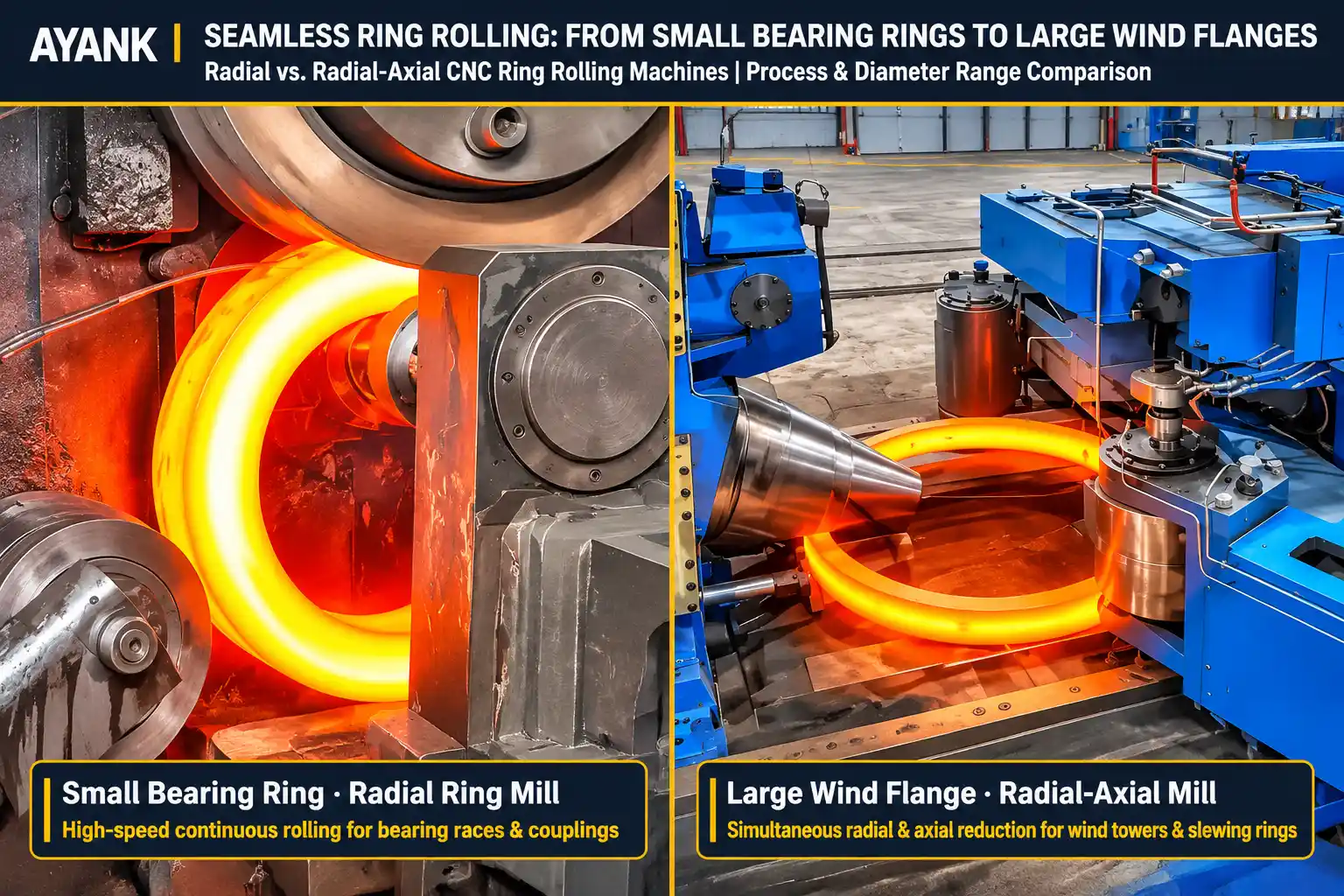
A radial machine carries one main drive and one pair of rolling tools, a main roll and a mandrel. There is no axial roller system, no axial drives and no housing to carry them, so at the same ring diameter the frame is simpler and the electrical load is smaller. Inside the family the number is set by ring diameter, wall thickness and the main motor, which runs from 30 kW on the 160E to 110 kW or 132 kW on the 800E and 1000E.
| D51A model | Max. ring OD | Main motor | Max. productivity |
|---|---|---|---|
| D51-160E | 200 mm | 30 kW | 600 pcs/h |
| D51-250D | 250 mm | 37 kW | 500 pcs/h |
| D51-350E | 350 mm | 90 kW | 120 pcs/h |
| D51-500E | 500 mm | 90 kW | 90 pcs/h |
| D51-800E | 800 mm | 110/132 kW | 60 pcs/h |
| D51-1000E | 1,000 mm | 110/132 kW | 50 pcs/h |
Read this table against a quotation the same way as the D53KA one: the model follows the largest ring in the mix, and the productivity figure follows that same size.
Cost rises with size, and output falls. In the table above the published productivity drops from 600 pieces per hour on the 160E model, rated for rings up to 200 mm outside diameter, to 50 pieces per hour on the 1000E model at 1,000 mm, while the main motor rises over the same span. The practical consequence is that a buyer paying more gets a machine that produces fewer pieces per hour. That is not a defect: a larger ring needs more rolling time, and the throughput figure is per machine, not per tonne. It does mean that the annual volume has to be checked against the model, because a machine chosen for the largest ring in the product mix will run below its capacity on every smaller ring. Where the mix is wide, the choice is usually between one large machine running slowly and two smaller machines splitting the range, and that comparison belongs in the quotation request rather than in the negotiation.
The D53KA family adds axial taper rollers that roll the ring height as well as its diameter, so its cycle times are set by two passes rather than one and its figures are published separately on the radial and axial ring rolling machine page. The radial-only D51A data sits on the radial ring rolling machine page. Compare figures within a family, never across the two. The full rolling machine range is listed by category if the choice is still open.
Once the model is fixed, four items decide the rest of the ring rolling machine price.
Two suppliers can quote the same ring and land far apart without either being wrong. The usual reasons are scope, not margin.
One quotation covers a machine, the other covers a machine with handling, transfer and line control. One includes tooling for the current ring only, the other includes a set for each size in the mix. One prices the electrical installation inside the machine, the other leaves switchgear and transformer capacity to the buyer. Delivery terms shift the number as well, since a price ex works and a price delivered and installed are not comparable figures.
The way to close that gap is to ask every supplier for the same breakdown: machine, tooling, automation, electrical scope, installation, commissioning, spares. Once the breakdown is on the table, the model comparison becomes meaningful and the difference usually resolves into one or two lines that can be negotiated on their own. Until that happens, a ring rolling machine price is a total without a boundary, and two totals with different boundaries cannot be ranked.
Six items are enough for a supplier to name a model and explain the choice instead of sending a catalogue.
| What to send | What to include | Why it changes the answer |
|---|---|---|
| Ring drawing | Outside diameter, wall thickness, height, tolerances on the rolled faces | Sets the rolling force and the tooling; diameter alone cannot size a machine |
| Material and blank | Steel grade, blank weight and thickness, heating method | Decides the force required and whether the blank fits the model |
| Product mix | Number of ring sizes, annual quantity per size, batch pattern | Decides between one large machine and two smaller ones, and how much tooling is needed |
| Output target | Pieces per hour required, shift pattern, annual tonnage | Checks the model against the productivity figure for the actual ring size |
| Site constraints | Available floor area, crane capacity, power supply, foundation limits | Can rule out a model that is otherwise the right size |
| Scope wanted | Machine only, machine with handling, or a complete line with heating | Prevents two quotations being compared on different scope |
We do not publish a figure, because the same ring diameter can be rolled on machines of different force and power depending on wall thickness, height and material. The ring rolling machine price follows the three specifications above: rolling force, installed motor power and machine length. Send the ring drawing and the annual quantity, and the quotation will name the model and state the scope it covers.
Usually because the scope differs. One may include tooling for several ring sizes, handling equipment or the electrical installation, while the other quotes the machine alone. Ask for the same cost breakdown from each supplier before comparing the totals.
Not automatically. A thin-walled ring of large diameter may need less force than a thick-walled ring of smaller diameter. Wall thickness and height decide the force, which is why a drawing is needed before a model can be named.
For the same ring diameter, yes. The radial-axial machine adds axial taper rollers, their drives and the structure to carry them, and it holds ring height actively rather than leaving it to the blank and the tooling. Where height has to be controlled, that capability is the reason to pay for it.
Foundation and pit work, crane capacity, electrical supply and transformer capacity, installation and commissioning labour, and consumable tooling beyond the agreed sets are commonly priced separately. So are freight and duties. Confirm each line before comparing two offers.
Sometimes. Control systems, handling equipment and tooling can be renewed on a machine whose structure and drives are still sound. Whether that is worth doing depends on the condition of the rolls, the frame and the main drives, which is a question for an inspection rather than a catalogue.
The six items listed above: ring drawing with tolerances, material grade and blank details, product mix and annual quantities, the output target, site constraints, and the scope you want quoted. With those, a supplier can name a model and explain the reasoning rather than sending a specification sheet.
Receive the news that you are interested in.