Closed die forging — also called impression die forging — shapes a heated billet inside two machined die halves, so the die, not the operator, sets the final geometry. It fits parts from about 0.1 kg to 50 kg, produced in runs of 500 pieces or more, where tolerance has to hold between ±0.3 mm and ±0.8 mm. This guide covers the four process decisions that drive your cost, what dies cost and how long they last, how closed die compares with open die forging, what moves the price of closed die forgings, and how to vet a supplier before you send a drawing.
Send Your Drawing for a Die Quote
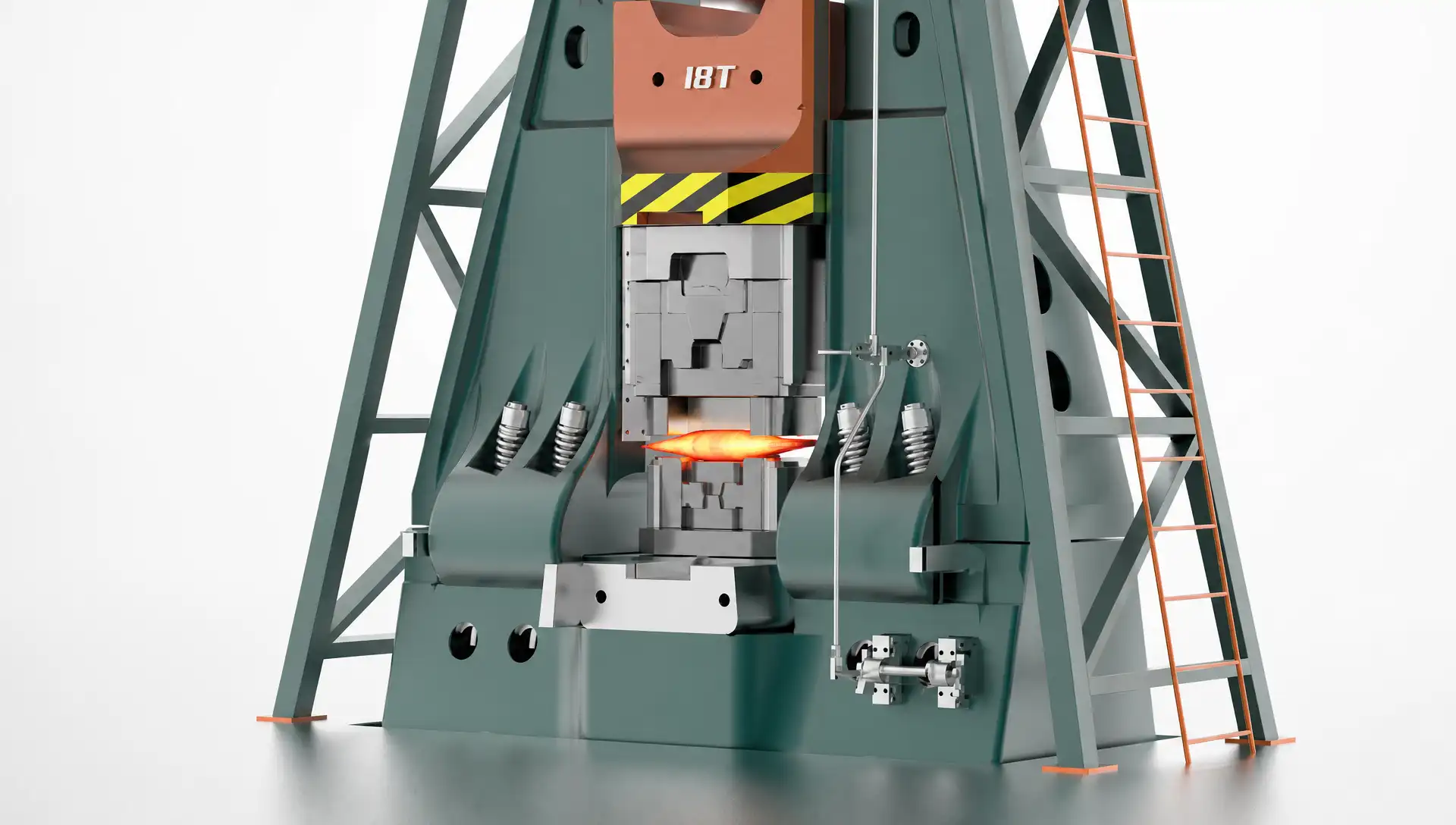
In closed die forging, a billet is cut to weight, heated to its forging range, placed in the lower die, and struck or pressed until the metal fills the die cavity. The cavity is a negative of the finished part, cut with an allowance for shrinkage, draft and machining. Whatever the cavity says, the part becomes.
That is the whole difference from open die forging, where two flat or simply contoured dies squeeze the billet and the shape comes from how the operator turns and feeds it. It is also the difference from casting: forged parts keep a continuous grain flow that follows the part contour, cast parts do not. If your drawing calls for fatigue life rather than just shape, that difference is the reason the part is forged at all.
North American buyers usually write impression die forging; European and Asian suppliers usually write closed die forging. It is one process, one set of rules, one kind of tooling. If a quotation arrives headed “impression die forging” and another headed “closed die forging”, you are comparing the same capability — compare energy, die size and inspection standard, not the label.
A forging hammer or press is general-purpose capacity: it can run any part that fits its die space. A die is dedicated — it exists for one part, and once that part stops running the die is scrap metal. That single fact explains almost everything else about closed die forging economics: why small batches are expensive, why design changes late in the programme hurt, and why suppliers ask about annual volume before they ask about anything else. Closed die forged steel parts are cheap at 50,000 pieces and expensive at 500.
Most process descriptions walk through eight steps and leave you no wiser about your quotation. The closed die forging process is better understood as four decisions, each of which moves money:
| Decision | What you choose | Cost impact | Failure symptom if wrong |
|---|---|---|---|
| Impressions | Blocker only, or blocker plus finisher | One die set or two | Part short of fill, laps, cracked corners |
| Parting line | Where the die halves split, and draft angle | Die machining hours | Galling on ejection, mismatch at the joint |
| Flash | Flash land width and gutter depth | Material yield, 3–8 % | Thin flash starves the cavity; thick flash wastes steel |
| Post-trim | Trim die, heat treatment, straightening | Often 10–20 % of piece price | Distortion out of tolerance, hardness scatter |
A simple part forges in one cavity. A part with a long material path, thin ribs or a deep pocket needs a blocker to distribute metal first, then a finisher to bring it to size. Two die sets mean roughly double the tooling, but a single-impression attempt on a part that needs two is the most common cause of a failed first article.
The parting line decides draft angle, and draft angle decides how much material you machine away afterwards. Put it where the part can be ejected cleanly with the least draft; move it and you usually pay twice — once in die cost, once in machining allowance.
Flash is not waste by definition. The flash land resists metal flow and forces the cavity to fill; cut it too thin and the part comes up short, too thick and you are buying steel that ends up on the floor as trim scrap. This is a die design variable, not something to squeeze at quotation stage.
Trimming, heat treatment and straightening are where tolerance quietly disappears. A part that measures perfectly off the die can be out of flatness after quenching. Ask whether straightening is included, and whether the first article report includes hardness after heat treatment or before. Furnace control counts as much as the machine here: the hot forging process is judged on temperature uniformity across the section, not on peak temperature.
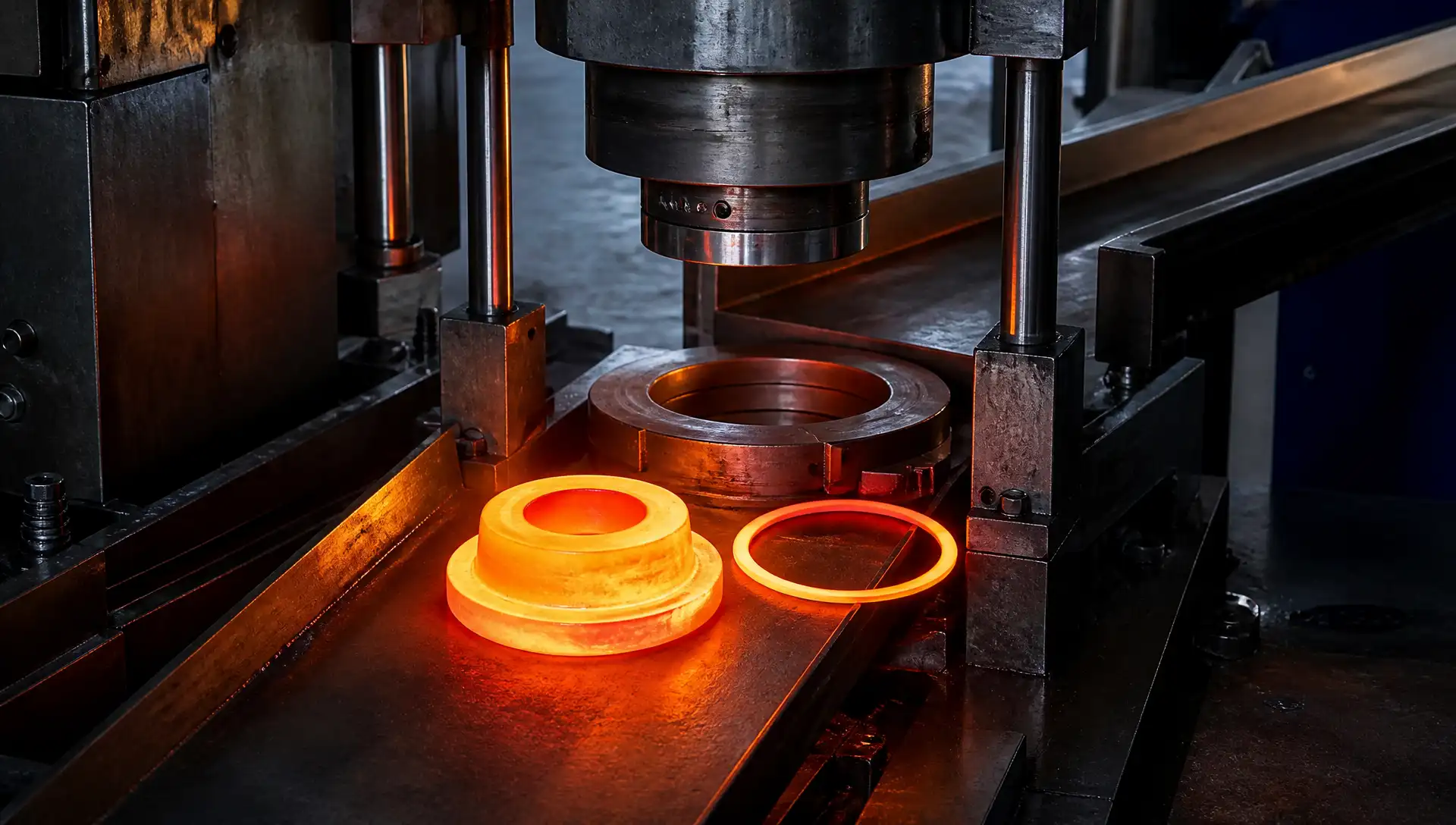
Tooling is the entry ticket for closed die forging, and the only reason small batches do not work. Four things set the price of a die:
Do not shop for a die price in isolation. Compare it as amortisation:
For closed die forged parts under about 5 kg, this number dominates early-stage decisions far more than machine hourly rate does.
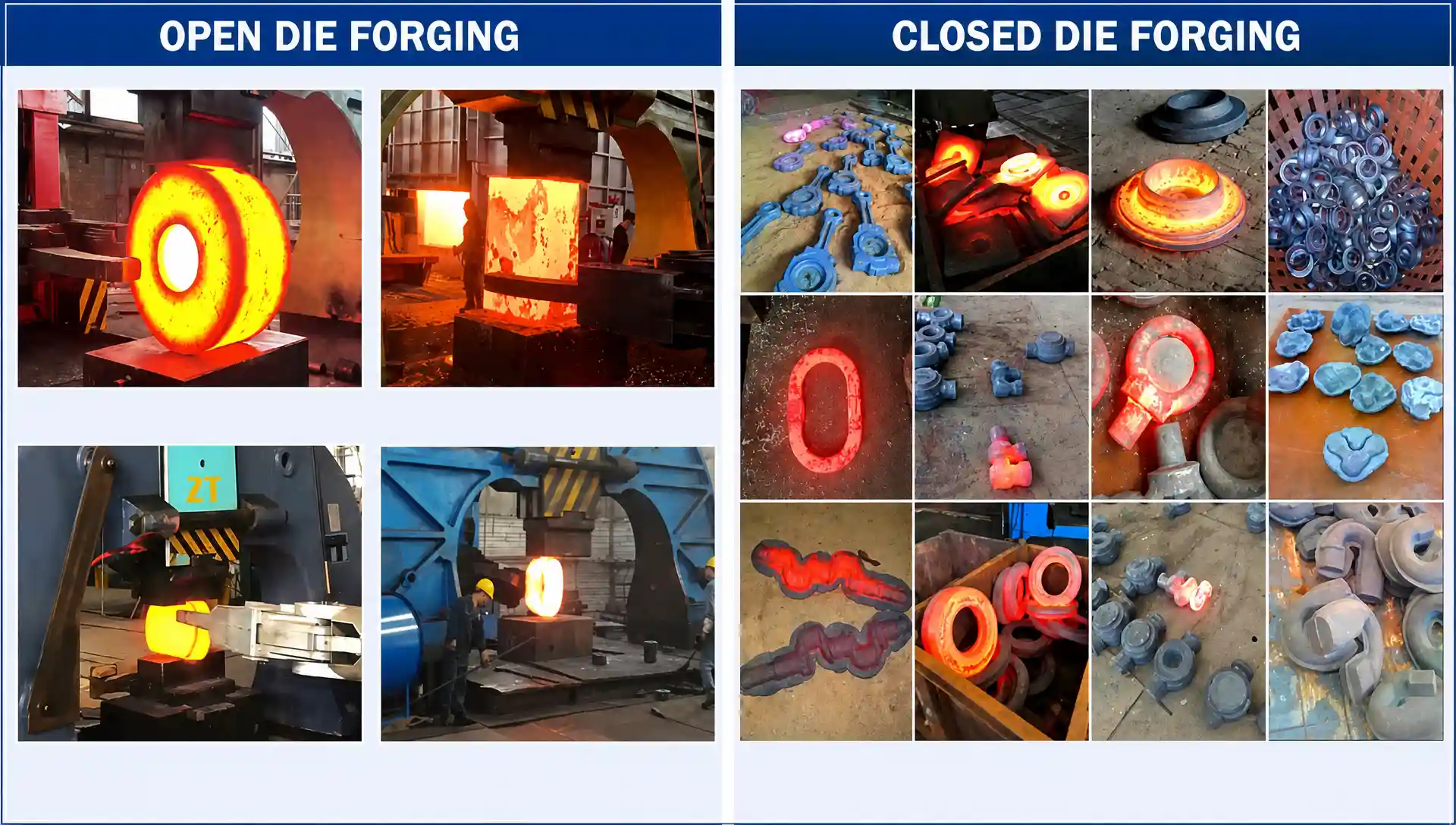
If you are weighing open die vs closed die forging, the short version is this: open die wins on large, simple, low-volume parts; closed die wins on smaller parts in volume, where tolerance has to repeat. Almost the entire difference between open die and closed die forging comes down to one question — does the geometry live in the die, or in the operator’s hands?
| Your part | Open die | Closed die | Why |
|---|---|---|---|
| Single piece over 500 kg | Yes | No | Die and machine tonnage become uneconomic |
| 0.1–50 kg, over 500 pcs per year | No | Yes | Tooling amortises, geometry repeats |
| Tolerance needs ±0.3–0.8 mm | No | Yes | Open die depends on operator and press stroke |
| Under 100 pcs per year | Yes | Rarely | Die cost cannot be recovered |
| Expensive alloy, tight yield | Case by case | Case by case | Closed die saves material but adds tooling |
As a starting filter: under 20 kg finished weight and over 500 pieces a year, price closed die first. Over that weight, or under that volume, price open die forging first. It is a filter, not a law — a 3 kg part ordered 300 times a year may still justify tooling if the alternative is machining from solid.
There is a third option most buyers never hear about. For medium-large parts at medium volume, the billet can be blocked on open dies first and finished in a closed die. Tooling is smaller and simpler than a full closed die set, and the finishing die still delivers the geometry. It only works when the two operations are planned together, so ask a supplier who runs both — that is exactly the open die and closed die forging combination a full-range manufacturer can quote.
Drop forging is closed die forging performed on a drop hammer, where a falling ram delivers the blow. The question buyers actually type — what is drop forged — has a plain answer: a part struck in a closed die on a drop hammer, rather than one rolled, cast or machined from solid. The tooling logic, the flash behaviour and the tolerance range are the same as any other closed die process; the difference is how the energy arrives. When a drawing or a legacy spec says “drop forged”, it usually means a part that was historically made on a hammer — hand tools, agricultural implements, rigging hardware, track links.
What matters for sourcing is not the name but the machine behind it. A modern closed die forging hammer delivers programmable blow energy with ±1.5 % repeatability, which is a different proposition from an uncontrolled drop hammer — same process family, very different first-article risk.
Two suppliers quoting the same drawing 30 % apart are usually both correct. The gap sits in one of these six places:
When you compare closed die forgings quotes, normalise these six first. A quote that is 30 % cheaper is almost always thinner on allowance, inspection, or tooling ownership — not on steel.
Dozens of closed die forging companies quote on the same portals and their capability claims read almost identically. These are the checks that separate a supplier who can hold your tolerance from one who can only quote it.
Ask who owns the die when the order ends, and get it in writing. There are three common arrangements: the supplier owns the die and you never see it; you own it and can transfer it; or you own it and it must be transferred in a usable state with drawings. The third is the only one that protects you if you ever change supplier — and it costs nothing to ask for at quotation stage, while it is nearly impossible to negotiate later.
Once the process is settled, the machine decides your cycle time and your die cost per piece. Three families cover almost every closed die job: hammers, screw presses, and multi-directional presses.
Hammers deliver energy rather than force, which suits parts where the cavity needs to fill progressively and where multiple blows can be superimposed. AYANK runs two hydraulic series, 27 capacities in total between 16 kJ and 630 kJ: the C92KA CNC series from 16 to 625 kJ in 17 steps, and the C86YA series from 25 to 630 kJ in 10 steps. Blow energy on the CNC series repeats within ±1.5 %, strike frequency runs from 33 to 90 blows per minute depending on size, and the U-frame with X-shaped guides tolerates off-centre loads well enough for multi-impression dies. The full range is on the closed die forging hammers page.
Screw presses deliver a fixed stroke with stored energy, which gives a consistent part height and a flatter die-load curve — a good fit for connecting rods, gear blanks and coining work. The range covers 250 T to 10,000 T in 11 capacities, in both CNC and servo direct drive configurations: see electric screw presses. For closed die work with a long stroke and high tonnage, a hot die forging press is the alternative — slower per stroke, but with a dwell that fills deep cavities.
Parts with side pockets, cross holes or undercuts cannot be forged in a two-part die at all — they need split dies and extra operations, or a multi-directional press. The Y16A multi-directional die forging press uses a 1,000 T main cylinder with two 630 T side cylinders, 140 T front and rear cylinders, plus punching and ejector cylinders — eight in total, forming from up to nine directions in one cycle. AYANK quotes 20–35 % material and energy saving against conventional multi-operation routes, and improved density in the formed corners.For a worked example on a three-way body — including the die sequence and where the ports stop needing machining — see forging valve bodies without machining the ports.
| Part | Suggested machine | Reason |
|---|---|---|
| Hand tools, hardware, under 5 kg, high volume | C92KA 16–63 kJ | 85–90 blows per minute, energy can be superimposed |
| Automotive and agricultural forgings, 5–30 kg | C92KA 100–250 kJ | U-frame and X guides handle multi-impression dies |
| Connecting rods, gear blanks, high volume | J58KA or J58ZKA screw press, 250–10,000 T | Fixed stroke gives repeatable part height |
| Parts with side pockets or cross holes | Y16A multi-directional press | Eight cylinders, up to nine forming directions |
| Low volume, many part numbers | C41A pneumatic hammer, 15–2,000 kg | Low tooling threshold, fast die change |
Not sure which machine your part needs? Send the drawing, the material and your annual volume — we will size it and tell you if closed die is the wrong route for your part.
AYANK has been building forging equipment for more than 70 years, participates in the drafting of China’s forging equipment standards, and holds ISO 9001 certification (CQC 4100/200110088). The plant covers 400+ acres with 60,000 m² of production space, over 300 sets of processing and testing equipment, and more than 60 national patents. Because the company builds hammers, screw presses and open die presses under one roof, the recommendation you get is based on your part, not on whichever machine happens to be in stock.
Send a drawing and a target quantity — we reply within 24 hours with a machine recommendation and a tooling approach. Request a Quote
Nothing. They are two names for the same process: a heated billet is shaped inside dies carrying a negative of the part. “Impression die forging” is the more common term in North America, “closed die forging” elsewhere.
It is the same process family on a different machine. Drop forging uses a falling ram on a drop hammer; closed die forging can also be done on hydraulic hammers, screw presses or forging presses. Tooling logic and tolerance range are comparable; control over blow energy is not.
There is no fixed number, because it depends on part weight and die complexity. As a working filter, 500 pieces per year or more usually justifies tooling; below that, open die or machining from solid is often cheaper. Calculate the uplift as (die cost + trial cost) ÷ order quantity before deciding.
Typically ±0.3 mm to ±0.8 mm on dimensions governed by the die, depending on part size and material. Tolerances across the parting line and on surfaces affected by die wear are wider and should be agreed explicitly rather than assumed.
Carbon steels, alloy steels such as 42CrMo and 40Cr, stainless grades, and aluminium alloys. The choice drives forging temperature, die material and heat treatment route, so it belongs in the enquiry, not in the purchase order.
Whoever the contract says. Default practice varies by supplier. Ask for tooling ownership and transfer terms in writing at quotation stage — it is a one-line clause then, and a commercial problem later.
Receive the news that you are interested in.