The drive pairs high-flow fixed displacement pumps with servo variable displacement pumps in direct drive, and controls them through high-frequency-response proportional valves, which is what makes both the speed and the saving possible at once. Conventional forging working speed reaches 60-160 mm/s and the fine rapid forging frequency is 60-100 times per minute. That shortens the operation, improves forging quality, and cuts power loss and energy cost at the same time.
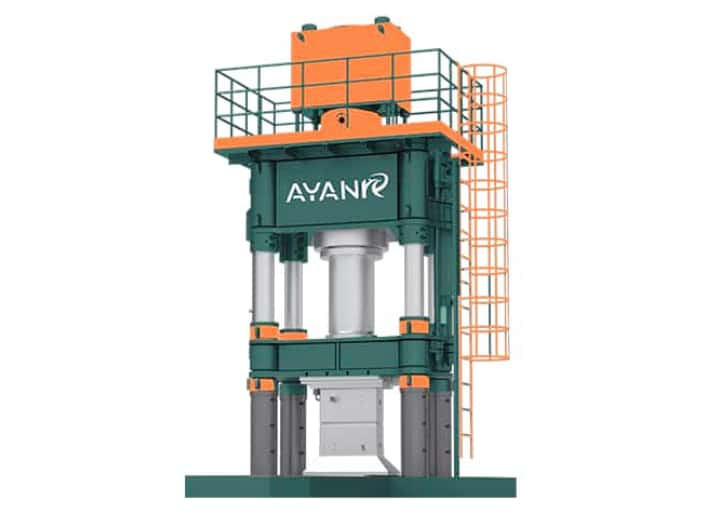
The prestressed frame uses hollow rectangular columns with a large cross-sectional moment of inertia, and the tie rod pre-tightening force is increased to match. That integrates the upper beam, the lower beam and the columns into one solid body, which is where the resistance to eccentric loading comes from. Structural rigidity, stability, fatigue strength and load-bearing capacity all follow, and the machine runs stable over the long term rather than only when it is new.

The guiding arrangement is built long, the moving beam wraps the column cross-section, and the loading system uses a double-concave spherical-hinged short cylindrical rocker shaft that adapts to the load. Once the press is loaded, the deformation of the column guiding surfaces on the high-stiffness frame is reduced, which closes up the guiding clearance between the columns and the moving beam. Tighter clearance is what holds forging repeatability, and repeatability is what lifts the qualification rate.
Mechanisation carries the cycle: a worktable moving device, a die block transverse moving device, a top die quick-clamping rotating device, and an ingot transport and rotating trolley. The workflow between the two-die forging worktable, the die block traverse and the die holder is coordinated so that tooling can be combined and called in a programmed sequence. Auxiliary time falls, physical labour falls with it, and open-die forging production becomes mechanised and automated - which is where the efficiency gain is actually realised.
One operator can control the press, the manipulator and the auxiliary equipment together in a synchronised cycle, and can run the whole forging process to a pre-programmed sequence. The press also supports online control and real-time monitoring with its rail-bound fully hydraulic forging manipulator.
That manipulator uses proportional servo control, so the tong head advances, retreats, rotates, lifts and translates under high-precision automatic control. It tilts and swings laterally as well, which is what lets press and manipulator work together on ingot breakdown, drawing out and rounding. Fewer people, and a lower skill requirement for the people you keep.
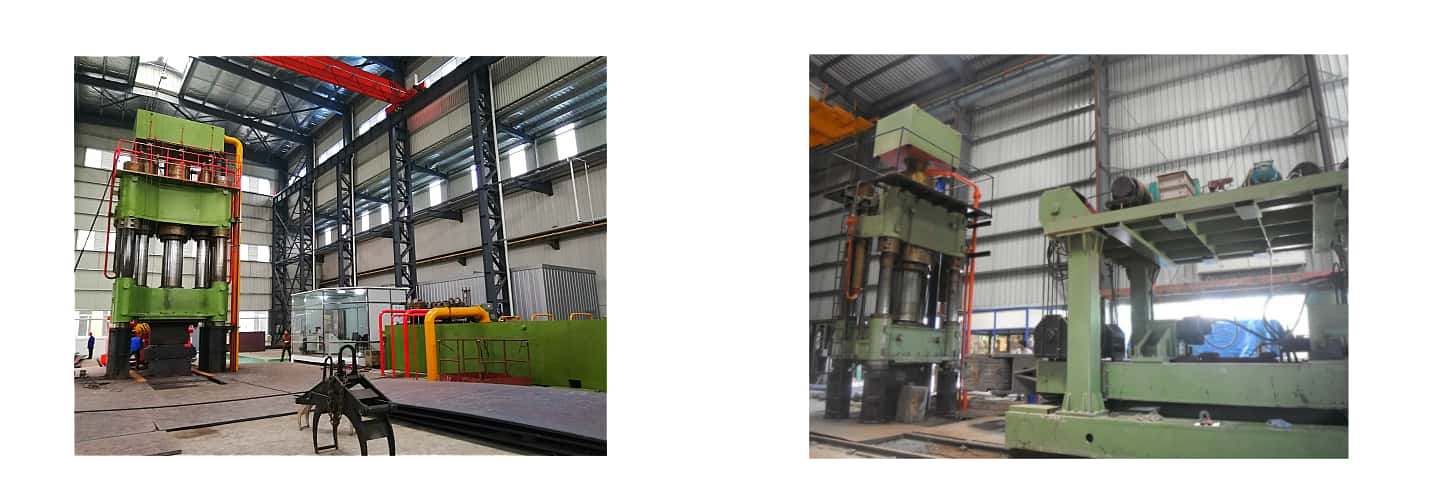
As core forging equipment in the modern forging industry, it completes every open-die process: upsetting, drawing out, punching, ring rolling, twisting, bending, offsetting and cutting off. Its material adaptability is broad, which is what lets one machine meet a wide spread of process requirements.
Thirteen models, Y13A-800 to Y13A-16000, from 8 MN to 160 MN nominal pressure.
| Item | Unit | Y13A-800 | Y13A-1250 | Y13A-1600 | Y13A-2000 | Y13A-2500 | Y13A-3150 | Y13A-4000 | Y13A-5000 | Y13A-6300 | Y13A-8000 | Y13A-10000 | Y13A-12500 | Y13A-16000 | ||
|---|---|---|---|---|---|---|---|---|---|---|---|---|---|---|---|---|
| Nominal pressure | MN | 8 | 12.5 | 16 | 20 | 25 | 31.5 | 40 | 50 | 63 | 80 | 100 | 125 | 160 | ||
| Clearance distance | mm | 2,300 | 2,600 | 2,900 | 3,100 | 3,300 | 3,800 | 4,000 | 4,600 | 5,300 | 6,000 | 6,600 | 7,200 | 7,800 | ||
| Slide stroke | mm | 1,000 | 1,200 | 1,400 | 1,500 | 1,600 | 1,800 | 2,000 | 2,200 | 2,500 | 2,800 | 3,200 | 3,600 | 4,000 | ||
| Column center distance | mm | 1,900 × 1,100 | 2,200 × 1,300 | 2,600 × 1,400 | 2,800 × 1,500 | 3,200 × 1,600 | 3,600 × 1,900 | 4,400 × 2,100 | 4,600 × 2,200 | 4,700 × 2,300 | 4,800 × 2,400 | 5,100 × 2,600 | 5,500 × 2,800 | 6,000 × 3,000 | ||
| Forging speed | Down speed | mm/s | 300 | 300 | 300 | 300 | 250 | 250 | 250 | 250 | 250 | 250 | 250 | 250 | 250 | |
| Working speed | Level 1 (nominal pressure) | mm/s(MN) | 68[8] | 68[12.5] | 180[6] | 160[8] | 172[10] | 164[12.5] | 152[16.5] | 186[16.5] | 183[21] | 183[27] | 183[33] | 180[41] | 180[53] | |
| Level 2 (nominal pressure) | mm/s(MN) | / | / | 108[10] | 105[12] | 102[15] | 104[19] | 104[23.5] | 93[33.5] | 92[42] | 92[53] | 92[67] | 90[84] | 90[107] | ||
| Level 3 (nominal pressure) | mm/s(MN) | / | / | 68[16] | 63[20] | 64[25] | 64[31.5] | 62[40] | 62[50] | 61[63] | 61[80] | 61[100] | 60[125] | 60[160] | ||
| Return speed | mm/s | 300 | 300 | 300 | 300 | 250 | 250 | 250 | 250 | 250 | 250 | 250 | 250 | 250 | ||
| Slider bottom surface | Rapid forging | Level 1 | strokes/min | 60-70 | 60-70 | 60-70 | 60-70 | 60-70 | 55-65 | 50-60 | 45-55 | 40-50 | 35-45 | 30-40 | 25-30 | 20-25 |
| Standard forging | Level 3 | strokes/min | / | / | 25-35 | 25-35 | 25-35 | 20-30 | 20-30 | 20-30 | 15-25 | 10-20 | 7-15 | 5-10 | 3-6 | |
| Travelling worktable | Distance | mm | 2,700 × 1,300 | 3,200 × 1,500 | 3,500 × 1,600 | 3,700 × 1,700 | 5,000 × 2,000 | 5,000 × 2,300 | 6,000 × 2,500 | 6,000 × 2,800 | 7,000 × 3,000 | 7,000 × 3,200 | 8,000 × 3,500 | 9,000 × 4,000 | 12,000 × 4,500 | |
| Left and right stroke | mm | ±1,000 | ±1,400 | ±1,600 | ±1,800 | ±2,000 | ±2,500 | ±2,500 | ±3,000 | ±3,000 | ±3,000 | ±3,250 | ±3,500 | ±4,000 | ||
| Dimensional accuracy | mm | ±1 | ±1 | ±1 | ±1 | ±1 | ±1 | ±1 | ±1.5 | ±1.5 | ±1.5 | ±2 | ±2 | ±3 | ||
| Total power | kW | 700 | 1,050 | 1,400 | 1,600 | 2,050 | 2,500 | 3,200 | 3,800 | 4,800 | 6,200 | 7,500 | 9,500 | 12,000 | ||
| Height above floor | mm | ≤6,800 | ≤8,000 | ≤8,500 | ≤9,000 | ≤9,500 | ≤10,000 | ≤11,000 | ≤13,000 | ≤14,500 | ≤16,000 | ≤17,500 | ≤19,000 | ≤22,000 | ||
Two things in that table need reading carefully. The working speed is given in three levels, each written as speed followed by the pressure it is delivered at - 68[8] means 68 mm/s at 8 MN - so a higher level trades speed for force, and the smallest two models have no level 2 or level 3. And the forging rate is split between rapid forging, which is the high-frequency mode, and standard forging, which is the pressure-first mode: the same press gives 60-70 strokes per minute rapid and no standard rate at all on the small models, because standard forging only becomes a practical mode once there is enough frame to carry it.
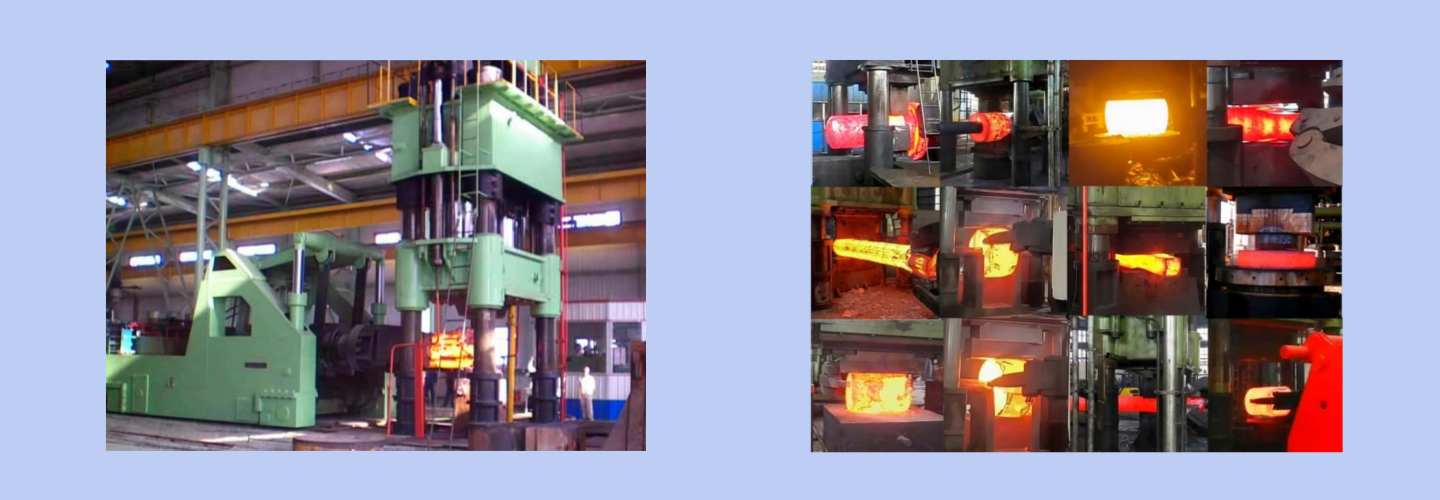
Conventional forging working speed reaches 60-160 mm/s, and the fine rapid forging frequency is 60-100 times per minute. The specification table gives the exact figures model by model, in three working-speed levels.
Each level is a pressure step. The number before the bracket is the speed, the number inside is the pressure it is delivered at, so 68[8] is 68 mm/s at 8 MN. A higher level gives more force at lower speed, and the two smallest models do not offer levels 2 and 3.
Because the hollow rectangular columns carry a large cross-sectional moment of inertia and the tie rods are pre-tightened harder. That ties the upper beam, the lower beam and the columns into one solid body, so an off-centre blow is shared across the frame instead of twisting one corner of it.
Long guides, a moving beam that wraps the column cross-section, and a double-concave spherical-hinged rocker shaft loading system. Under load the guide surfaces deform less, the clearance between column and moving beam stays tight, and the part repeats.
Yes. The press supports single-operator control of the press, the manipulator and the auxiliary equipment, running a pre-programmed forging sequence, with online control and real-time monitoring of the rail-bound manipulator.
An operator intervenes by hand and restarts program forging from that pass. The pass schedule is the program unit, so restarting costs one pass rather than the whole sequence.
Send your forging drawing or part details — we will recommend the machine that fits and quote it.
Receive the news that you are interested in.
