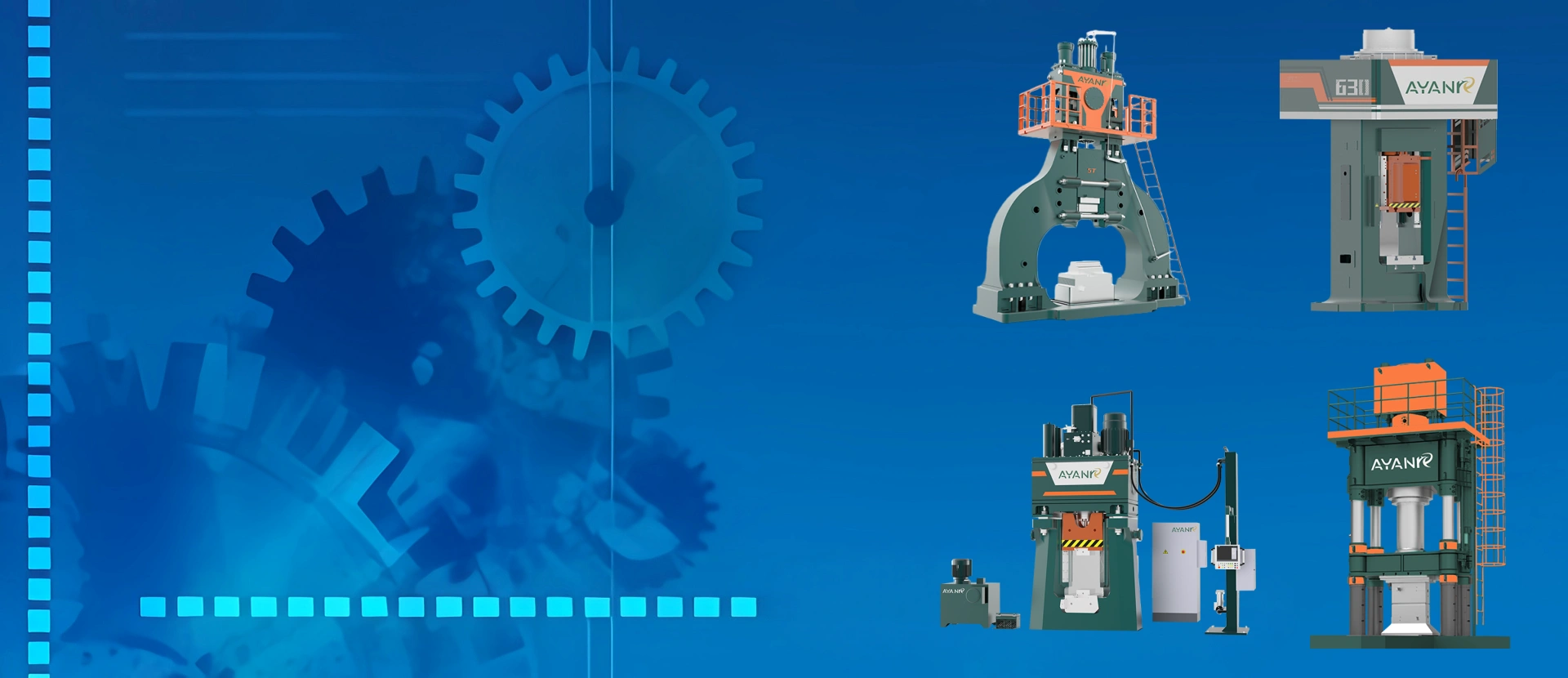
Bucket teeth are high-frequency consumable parts for engineering machinery such as excavators, bulldozers, loaders, electric shovels, and dredgers. They generally need to be replaced every 4 to 7 months. The global construction machinery market continues to grow, especially in regions like India, Turkey, Pakistan, Southeast Asia, and the Middle East, where infrastructure projects are developing rapidly, leading to an increasing consumption of bucket teeth.
There are currently two main solutions for producing bucket teeth on the market: forging and casting.
The casting process has low cost, but its service life is short. When working under hard rock conditions, it is prone to fracture and rapid wear. Forged bucket teeth, due to the continuity of metal flow lines and the density of the structure, have a wear life about 60% higher than that of cast teeth, making them the preferred choice for the mid-to-high-end market.
For manufacturers building new or expanding existing bucket tooth production lines, choosing a stable, efficient, and energy-saving forged bucket tooth production line is key to determining competitiveness.
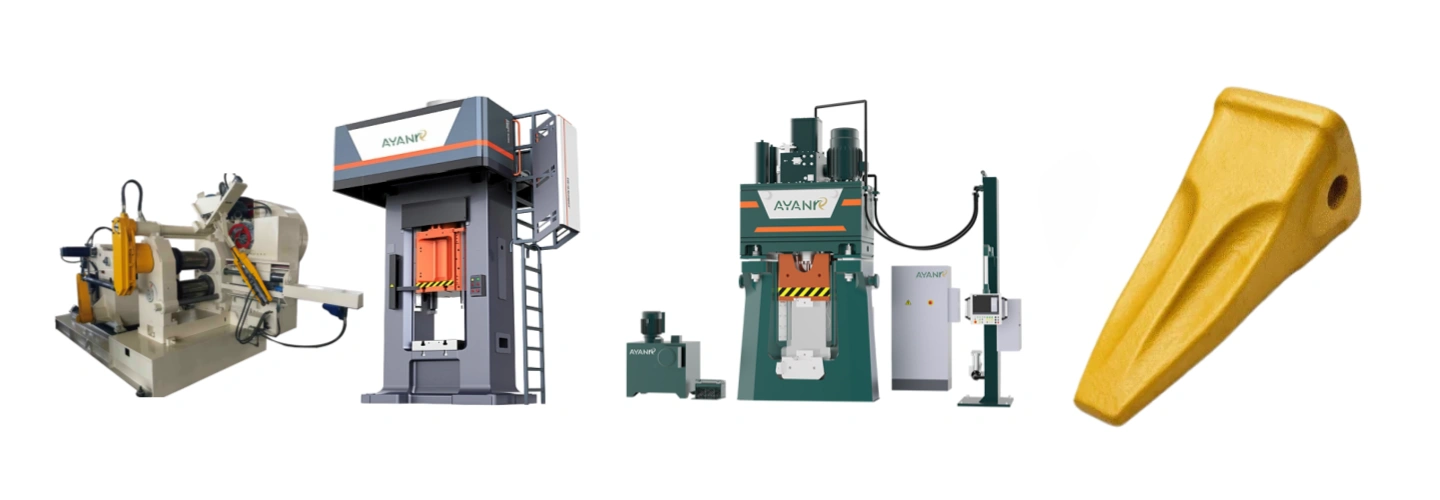
| Process Stage | Process Content | Recommended Equipment |
| Cutting | Cut round steel into finished blank sizes. | Bar Shear / Metal Circular Saw |
| Heating | Heat the billet to the forging temperature. | Medium Frequency Induction Heating Furnace |
| Billet Shaping | Pre-form the round steel into the shape of a tooth billet. | Rolling Mill |
| Finish Forging | Forge the shape in the die. | CNC Hammer or Electric Screw Press |
| Trimming | Remove the flash. | Trimming Press |
| Heat Treatment | Quenching and tempering treatment to achieve a balance of hardness and toughness. | Continuous Quenching + Tempering Furnace |
| Shot Blasting / Machining | Surface cleaning and finishing. | Shot Blasting Machine / CNC Lathe |
Core process combination: Roll forging preforming + Die forging final forming
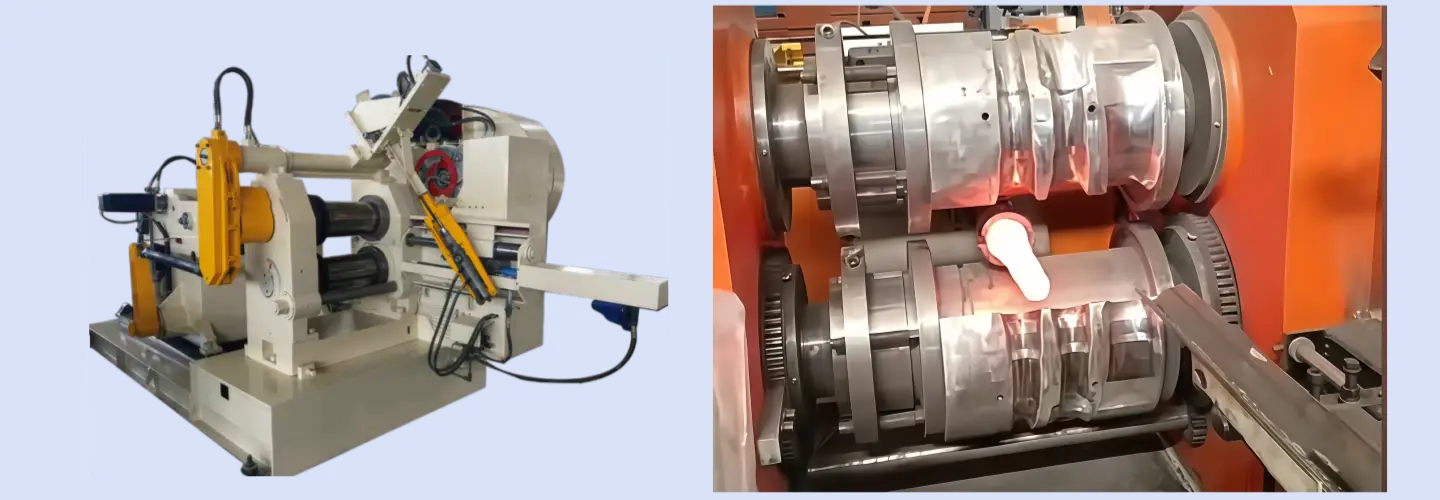
The roll forging machine preforms the round steel into a billet with an approximate tooth shape, which can reduce the material flow distance during final forging, save material by 10%-15%, and at the same time reduce mold wear. Compared with directly using round steel for final forging, the mold life with roll forging preforming can be increased by more than 35%.
What are the product characteristics of bucket teeth?
Bucket tooth structural characteristics: thin tooth tip, thick root, internal cavity with pin hole. It belongs to wear-resistant forgings for engineering machinery with deep cavity, large thickness variation, and requiring multiple fills. Extremely high requirements are placed on the equipment's impact forming capability, energy controllability, and batch consistency.
Then, based on the characteristics of forged bucket teeth, which is more suitable: a CNC hammer or an electric screw press?
Comparison from the perspective of forging equipment characteristics: CNC die forging hammer vs. electric screw press (bucket tooth forging selection comparison table))
| Comparison Dimension | C92KA CNC Hydraulic Die Forging Hammer | J58KA Electric Screw Press |
| Production Characteristics | Multi-variety, small-to-medium batch, export-oriented multi-specification bucket teeth | Single model, large-volume mass production, high-end precision export bucket teeth |
| Forming Effect | High-speed impact, strong metal fluidity, difficult to fill shortages in deep cavities and thin tooth tips; allows multi-hammer rework, high fault tolerance | Constant striking energy, highly uniform workpiece size and weight; mold life increased by 2-3 times, extremely small finished product tolerance |
| Model Change & Process | One-click parameter switching, integrated pre-forging and finish forging; fast model change commissioning, no additional roll forging equipment required | Weak versatility across categories; frequent specification changes consume time for commissioning; strict requirements on billet precision |
| Investment Cost | Lower initial investment in machinery and molds, less pressure on small and medium-sized factories | High equipment purchase price, lower long-term mass production energy consumption and maintenance costs |
| Energy Consumption & Maintenance | Higher electricity consumption during long-term continuous production, loud vibration noise | Servo energy-saving, saves 35%-55% electricity compared to CNC hammers; no hydraulic oil leakage failures, simple maintenance |
| Automation Integration | Large vibration, high difficulty in adapting to fully automatic assembly lines | Precise slide positioning, perfectly compatible with robotic arms; capable of building unmanned production lines, lower requirements for foundation and environmental assessment |
From the perspective of production scale: Bucket tooth forging equipment selection and adaptation comparison table
| Applicable Scenario | Prioritize C92K CNC Die Forging Hammer | Prioritize Electric Screw Press |
| Order Type | Multi-specification export bucket teeth, frequent model changes, small-to-medium batch sizes | Fixed 1-2 product types, tens of thousands of pieces per day, large-volume mass production |
| Process Characteristics | Heavy-duty deep-cavity bucket teeth, difficult cavity filling, average billet precision | High-end export precision bucket teeth, extremely high requirements for dimensional and weight consistency |
| Factory Conditions | Manual loading and unloading, no fully automatic robotic arm; average precision for blanking and heating | Equipped with robotic arm, automatic spray lubrication, heat treatment integrated fully automatic production line |
| Budget | New small factory, controlling early-stage investment in equipment and molds | Focus on long-term electricity savings, low maintenance, reducing continuous operating costs |
| Production Fault Tolerance Requirements | Large deviations in billet temperature and weight, requiring high fault tolerance and rework capability | Stable medium-frequency heating equipment for precise blanking, high uniformity of billets |
It can be seen from this that, considering different perspectives, there is no best forging equipment, only the most suitable forging solution for oneself.
As a manufacturer with 70 years of experience in forging equipment manufacturing, AYANK can provide a complete turnkey service for bucket tooth production lines, including:
Process plan design: Customize the complete process flow according to your tooth type, material, and annual output
Equipment supply: Full-line equipment from cutting to heat treatment
Mold design and coordination: Provide mold design suggestions and cooperate with customers to complete mold development
Installation and commissioning: Engineers arrive on site for installation until qualified products are produced
Operation training: Provide complete operation and maintenance training for the customer team
Spare parts supply and after-sales service: Maintain regular inventory of common spare parts, remote or on-site technical support
We have already provided turnkey solutions for bucket tooth forging lines to customers in multiple countries and regions, including the markets of India, Southeast Asia, South Asia, the Middle East, and South America.
A bucket tooth forging line is a good project with moderate investment, stable returns, and continuously growing market demand. Whether you want to transition from casting to forging or expand existing production capacity, choosing a forging line with mature processes, stable equipment, and reliable after-sales service is the foundation of success.
AYANK FORGING, 70 years dedicated to forging equipment, from a single pneumatic hammer to a complete forging production line, we can provide professional solutions for you.
If you have a need for a bucket tooth forging line, please feel free to contact us.
Tell us your target product weight and annual production capacity, and we will design the most suitable process plan and equipment configuration for you.
Website: www.ayankforging.com
Email:info@ayankforging.com
Receive the news that you are interested in.