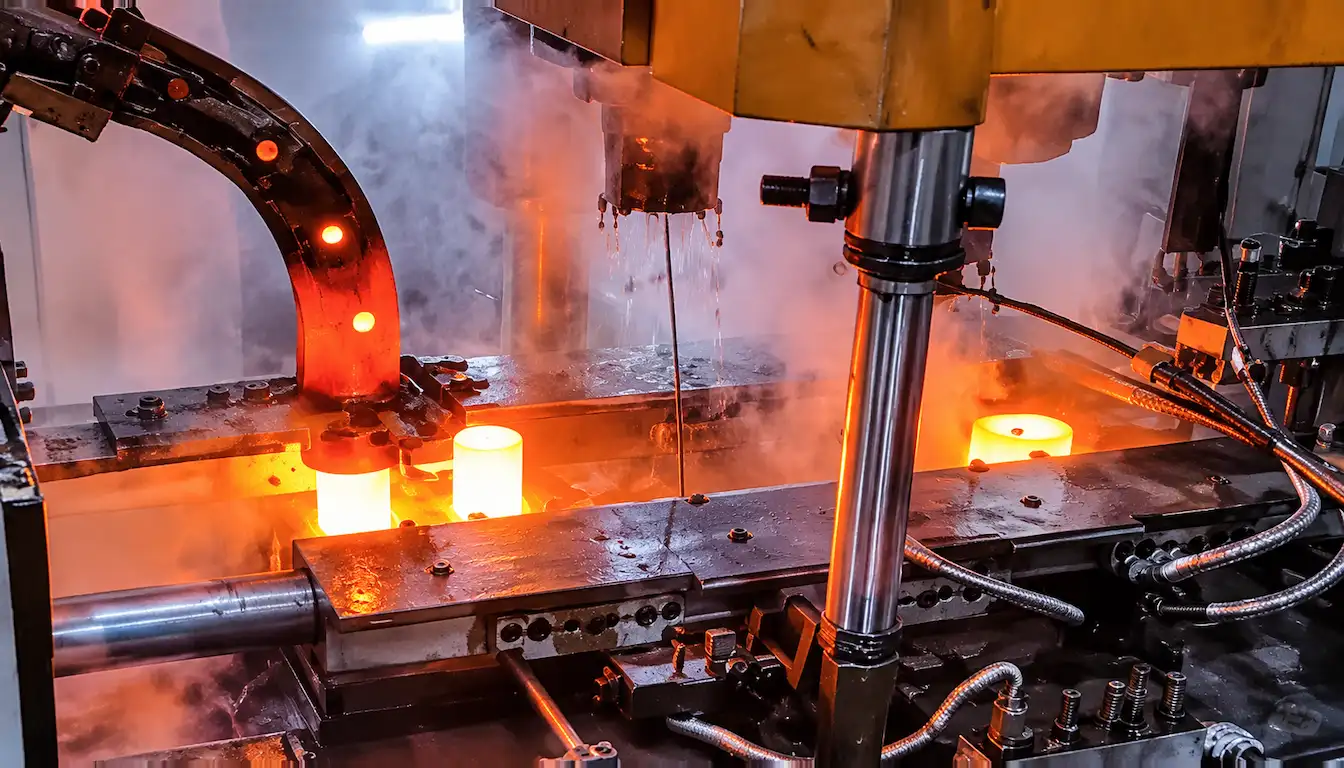
Quick answer: a nut forging process runs five stations: cut the bar to length, feed one blank at a time, heat it through by induction, form it in a three-station die set, then eject the pierced blank. The line produces a blank with a hexagonal outside and a through hole. Threading, heat treatment and any machining happen after the line stops. Cycle rate is set by heater capacity divided by blank weight, not by the press.
Three routes make a hex nut, and the question of how hex nuts are made usually starts here. Machining cuts it from bar or hex stock: accurate, slow, and most of the material ends up as swarf. Cold heading pushes a sheared billet through a sequence of dies at room temperature: fast, cheap at small sizes, and hard on tooling as the section thickens. Hot forging heats the billet first, which lowers the force needed and lets the metal flow into a hex with a counterbore in two blows.
Nut forging earns its place when the nut is large, when the wall section is thick, or when the grain flow around the hex corners matters more than tolerance. The trade is real: heating adds a furnace, scale control and a temperature reject gate, and the blank comes out with hot-forging tolerance rather than machining tolerance. A shop that needs a finished nut to a tight thread class still machines or taps afterwards. Hot forging does not remove that step; it makes the blank cheaper to start from.
Inside the wider nut manufacturing process, hot forging sits between cutting the bar and every finishing operation that follows. It is the step that gives the nut its shape, and it is the step that decides how much material the later operations have to remove.
Every nut forging process carries the same five steps regardless of who builds the line. What changes between suppliers is the size of each step, not the sequence.
| Station | What happens | What it decides |
|---|---|---|
| 1. Cut-off | Bar is sheared to a fixed length by a stop gauge | Blank weight, and therefore material cost per nut |
| 2. Feed | A lift or chain-plate feeder pushes one blank at a time onto the chute | Whether the line can run unattended, and where jams start |
| 3. Heat | Induction coil brings the blank through to forging temperature | The production rate, because heating capacity is the bottleneck |
| 4. Forge | Walking beam carries the blank through upset, hex extrusion, then pierce | Hex dimensions, counterbore depth, hole position |
| 5. Eject | Top ejector pushes the blank clear, a knock-off sends it to the chute | Whether the blank leaves undamaged at full rate |
Two numbers on the upstream end are usually larger than the line needs. A cut-off rated at 40 cuts per minute and a feeder rated at 40 pieces per minute both sit above the forging rate, deliberately: the surplus is what absorbs a missed index without stopping the line. If a quotation shows cut-off and feeder ratings that only just match the forging rate, the line will run at the lower of the three, not the stated figure.
Most line quotations quote a heating capacity in kilograms per hour and a production rate in pieces per minute, and treat them as independent specifications. They are not. One fixes the other.
pieces per minute = heating capacity (kg/h) ÷ blank weight (kg) ÷ 60
Run it in both directions and the question answers itself. A heater rated at 1,000 kg per hour supports 30 pieces per minute only while the blank weighs 0.556 kg or less.
The distinction bites hardest at large sizes. A three-station line is commonly quoted at 28 to 35 pieces per minute, but that rate holds only while the blank stays light enough for the coil to keep up. At a 1.033 kg blank the same line runs at roughly 16 pieces per minute on a 1,000 kg per hour heater, and holding 30 pieces per minute at that weight needs a heater near 1,859 kg per hour, with the coil, the power supply and the site electrical supply all growing with it. Published line rates are usually measured on small blanks, so the figure on the brochure and the figure in your plant can differ by half without anyone being wrong.
This is the first thing to check in a nut forging process quotation. Capacity and rate have to reconcile at the actual blank weight, and blank weight follows nut size. Ask for the figure at your size, and ask which blank weight the quoted rate assumes.
| Billet diameter | Recommended frequency |
|---|---|
| φ20 – 40 mm | 4 kHz |
| φ40 – 60 mm | 3 kHz |
| φ60 – 100 mm | 1 – 2 kHz |
Frequency is chosen from billet diameter, not from output. A coil sized for φ45 bar will not heat φ70 bar evenly, so a line built for one nut size is not automatically a line for the next size up. Modern IGBT supplies hold 90% conversion efficiency and 100% duty cycle, which matters because the furnace runs continuously while the press cycles.
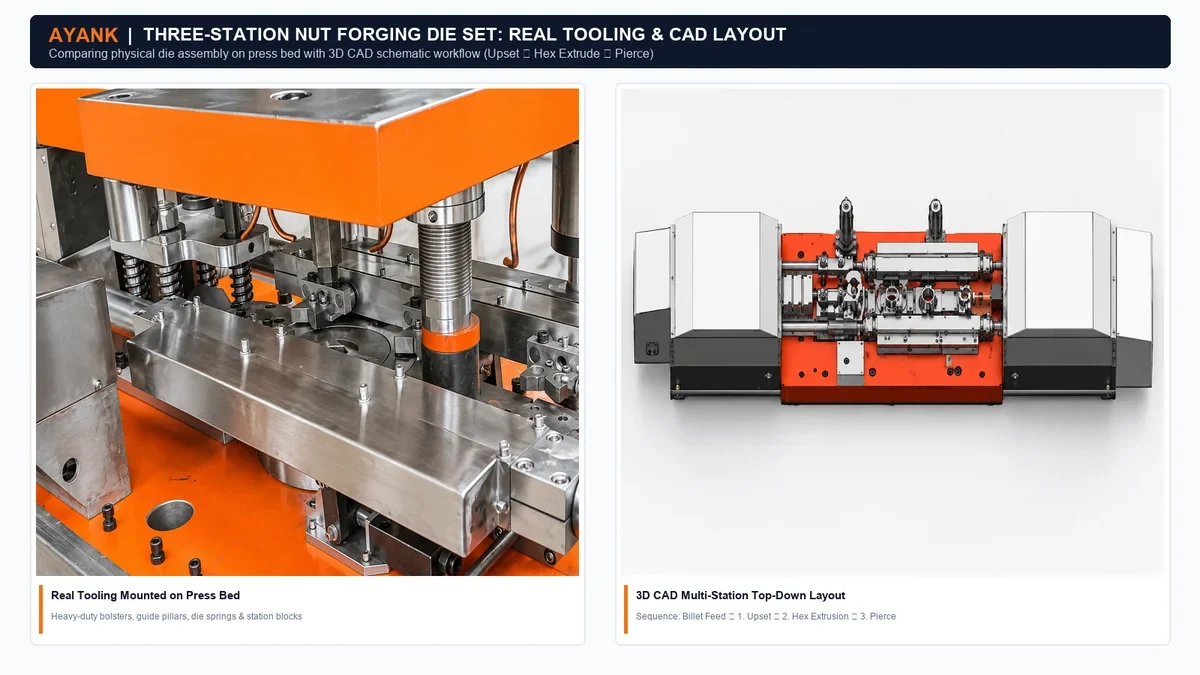
The forming work happens in a single die set carrying three stations, spaced at a fixed pitch, with a walking beam transferring blanks between them in one motion. All three stations strike on the same press stroke, so three nuts are being formed at once, each at a different stage.
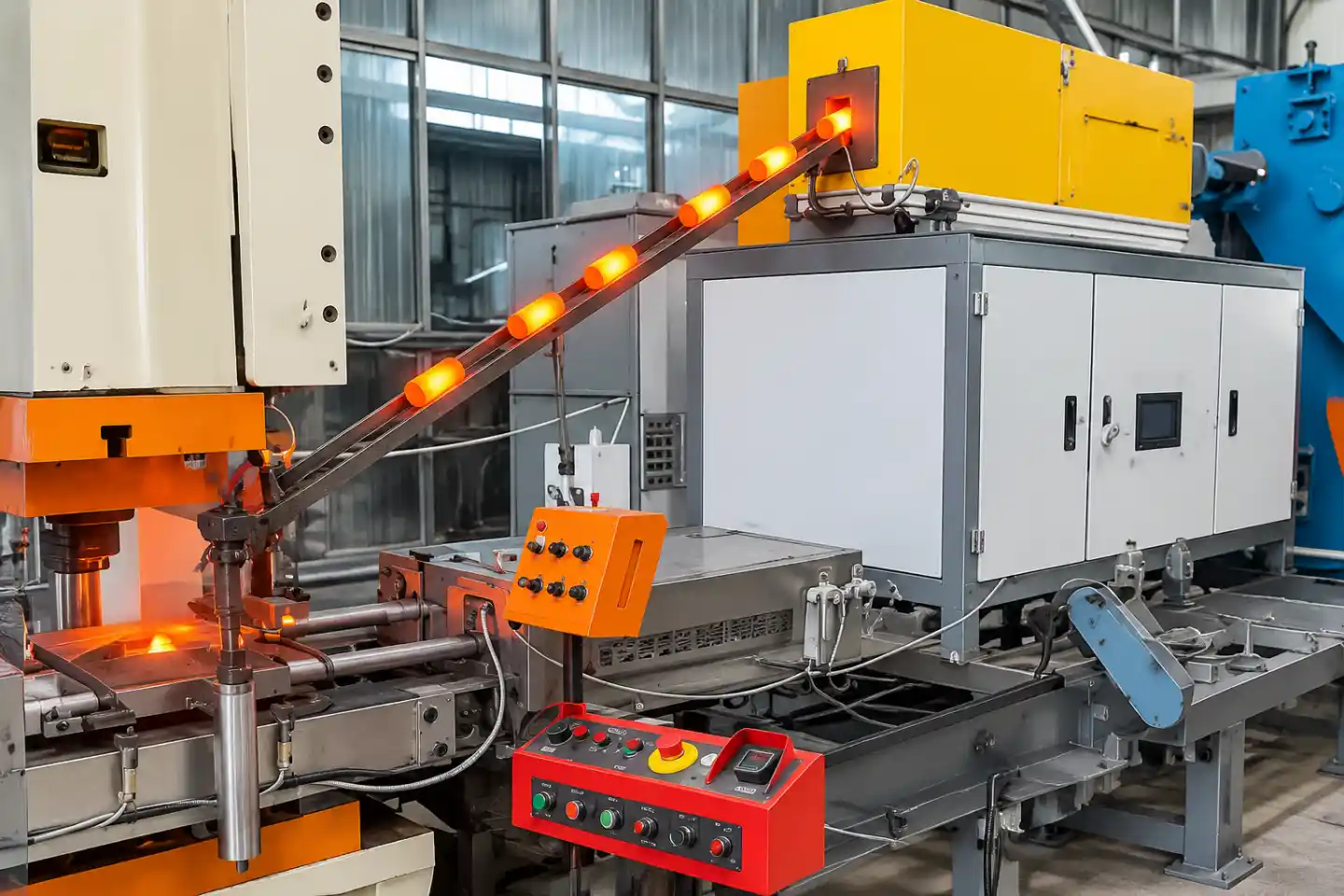
The line in operation: a heated billet in, a pierced blank out, three stations per stroke.
Station one, upset. The sheared billet is flattened. This squares the two cut faces and breaks the oxide skin loose, which is why the cut quality matters so much downstream: a ragged cut becomes a fold.
Station two, hex extrusion. The blank is pressed into the hexagonal cavity, forming the across-flats dimension and the chamfer in one blow. The counterbore is formed here as well, which is why the die needs a relief for it rather than a flat face.
Station three, pierce. A punch drives the through hole and the slug drops clear. Hole diameter and its position relative to the hex are set here, and both are what a tapping operation later depends on.
This is also the station that decides which press goes under the die. One open back fixed bed press carries all three stations on a single stroke, so it is sized for the three blows it has to deliver on every cycle rather than for a tonnage read off a table.
Nut forging leaves no flash ring to remove afterwards. The metal is confined in the die from the upset blow through to the pierce, so the blank comes out at hot-forging tolerance and goes straight to the chute. A standalone trimming press belongs to other die forged parts that do carry flash out of the die, and the same open back press is the machine those lines use for that job.
Station spacing is fixed by the beam pitch, typically 170 mm on a three-station layout, and clamping capacity follows the largest nut the die set can hold. Changing nut size means changing the die set, not the machine.
An M48 hex nut makes the arithmetic of a nut forging process concrete, because at that size the blank weight and the heater capacity stop agreeing with the brochure rate. The table below is one line built around this single size, with the figures that matter for specification rather than the ones that read well in a brochure.
| Item | M48 figure | Why it is that number |
|---|---|---|
| Nut standard | ISO 4032 / GB/T 6170, M48 | Sets across-flats, height and chamfer |
| Across flats / height | 75 mm / 38 mm | Fixes the hex cavity in station two |
| Through hole before tapping | φ43 mm | Fixes the punch in station three |
| Blank weight | 1.033 kg | The single figure that drives rate and material cost |
| Billet | φ45 × 82.5 mm | Chosen for the cut-off and the φ40–60 mm coil band |
| Cut-off | Up to φ60 bar, 40 cuts/min, weight tolerance ≤1% | Must exceed the forging rate, not match it |
| Heater | 400 kW, 2–5 kHz, 1,000 kg/h, efficiency ≥90% | Sets the cycle at this blank weight |
| Press | 3,150 kN, 250 mm stroke, 45 strokes/min | Three stations on one stroke, so 45 strokes is not 45 nuts |
| Transfer | Clamp φ60, pitch 170 mm, pockets φ78 / φ133 / φ78 | Upset, hex extrusion and pierce diameters |
| Cycle at 1.033 kg | About 16 pieces/min | 1,000 ÷ 1.033 ÷ 60 |
| Floor and pit | 9,500 × 4,500 mm, height ≥4,000 mm, pit 850 mm | Fixed before the machine arrives, not after |
Two things in that table are worth pulling out. The press runs 45 strokes per minute and the transfer is rated 28 to 35 pieces per minute, but at 1.033 kg the heater delivers about 16. The heater, not the press and not the robot, is the limit on this size. Anyone quoting this line at 35 pieces per minute on M48 is quoting the transfer's rating against the wrong blank.
The second is the billet choice. A φ45 mm bar cut to 82.5 mm and a φ50 mm bar cut to 66.5 mm both land on the same blank weight, and both are valid. The φ45 option needs more cuts per hour for the same tonnage, the φ50 option needs more force in the upset stroke. Which one a supplier proposes tells you what they are optimising for.
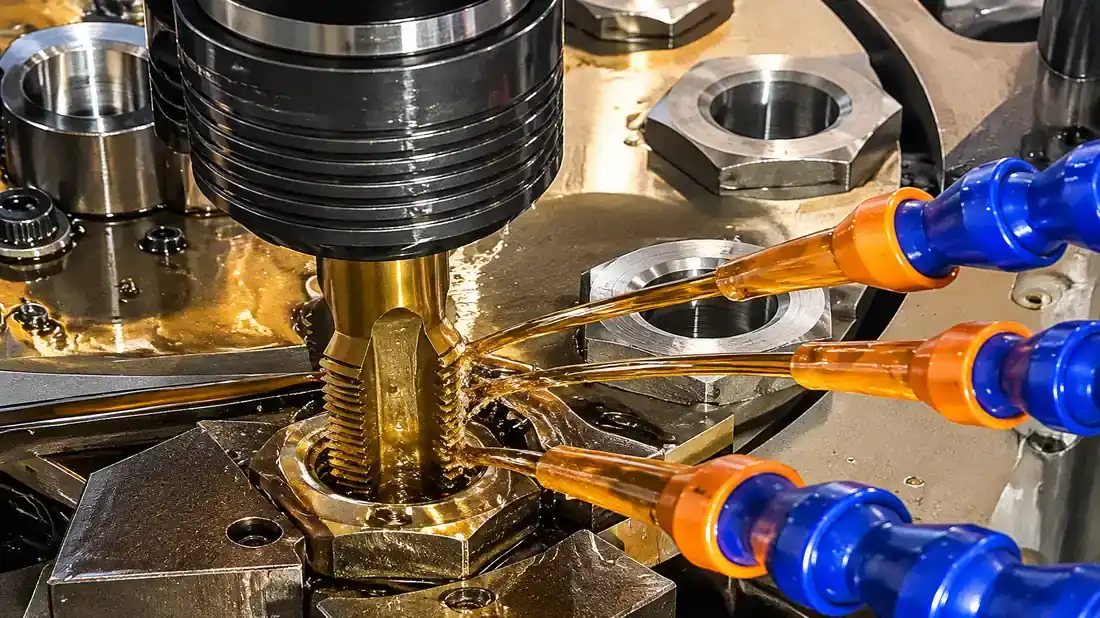
A hex nut drawing carries more numbers than the die can be adjusted for. Some are cut into the die, one is set by the cut-off, one is set by the press shut height, and at least one is a consequence of the others rather than a dimension anyone controls.
| Feature | M48 value | Tolerance | What sets it |
|---|---|---|---|
| Across flats (S) | 75 mm | 0 / −1.90 mm | Hex cavity in station two |
| Across corners (e) | min φ69.4 mm | — | Follows S and the corner radius, not separately adjustable |
| Nut height (m) | 38 mm | 0 / −1.60 mm | Press shut height and blank volume |
| Through hole (d) | φ43 mm | +0.20 / −0.40 mm | Punch in station three |
| Counterbore | max φ51.8 mm | — | Relief ring in the hex cavity |
| Chamfer | 30° both faces | C1 where not stated | Hex cavity entry, both ends |
| Surface finish | Ra ≤ 6.3 µm | — | Die polish and scale control |
| Untoleranced dimensions | IT13 | — | Default for anything the drawing leaves open |
Two of those rows cause most of the arguments between a nut buyer and a forging supplier. Across corners is not a die dimension. It falls out of the across-flats figure and the corner radius, so a drawing that tightens across corners without tightening across flats is asking for something the die cannot deliver independently. The corner radius is where it gets adjusted, and adjusting it changes across corners only.
Height is the one dimension that drifts. Across flats is cut into the cavity and stays put until the die wears. Height follows how much metal went into the die and how far the press closed, so it moves with blank weight and with shut height. A height held to −1.60 mm on a 1.033 kg blank is really a statement about the cut-off tolerance, not about the die.
On nut forming dies the wear is not spread evenly, and knowing where it lands tells you what to stock. The hex cavity entry wears first, at the chamfer, because that is where the hot blank rubs on the way in and where the sharpest edge sits. The punch tip goes next on the pierce station, since it takes the full stroke into hot metal on every cycle and its edge is the smallest feature in the tool. The counterbore relief ring wears slowly but silently, and when it does the symptom is a chipped corner rather than a size change.
Blank weight tolerance matters here more than it looks. A blank that runs heavy loads the cavity walls harder on every stroke, and the blank that was supposed to last a full tool life gets pulled early.
Cut quality. The bar ends have to come out flat with minimal burr. A burred end does not index cleanly into the chute, and a burr folded into the upset station becomes a lap that shows up as a crack after threading. Blank weight tolerance is held around 1% at the cut-off, and that tolerance is the first thing to inspect on a new line.
Temperature rejection. A blank that arrives under temperature will not fill the hex, and it will damage the die on the way. The chute between coil and die is the place to catch it: a short drop onto a hinged platform with a release gate lets an operator drop one cold blank out of the sequence without stopping anything. The chute itself is normally stainless because hot blanks wear a mild steel run quickly.
Ejection. The blank has to leave the die without being dragged. Twin tie rods from the top plate down to a cross plate give a parallel push rather than a single-point shove, which keeps the blank square as it comes out. A blank that tilts on ejection gets caught by the transfer beam on the next stroke, and that is where most short stops come from.
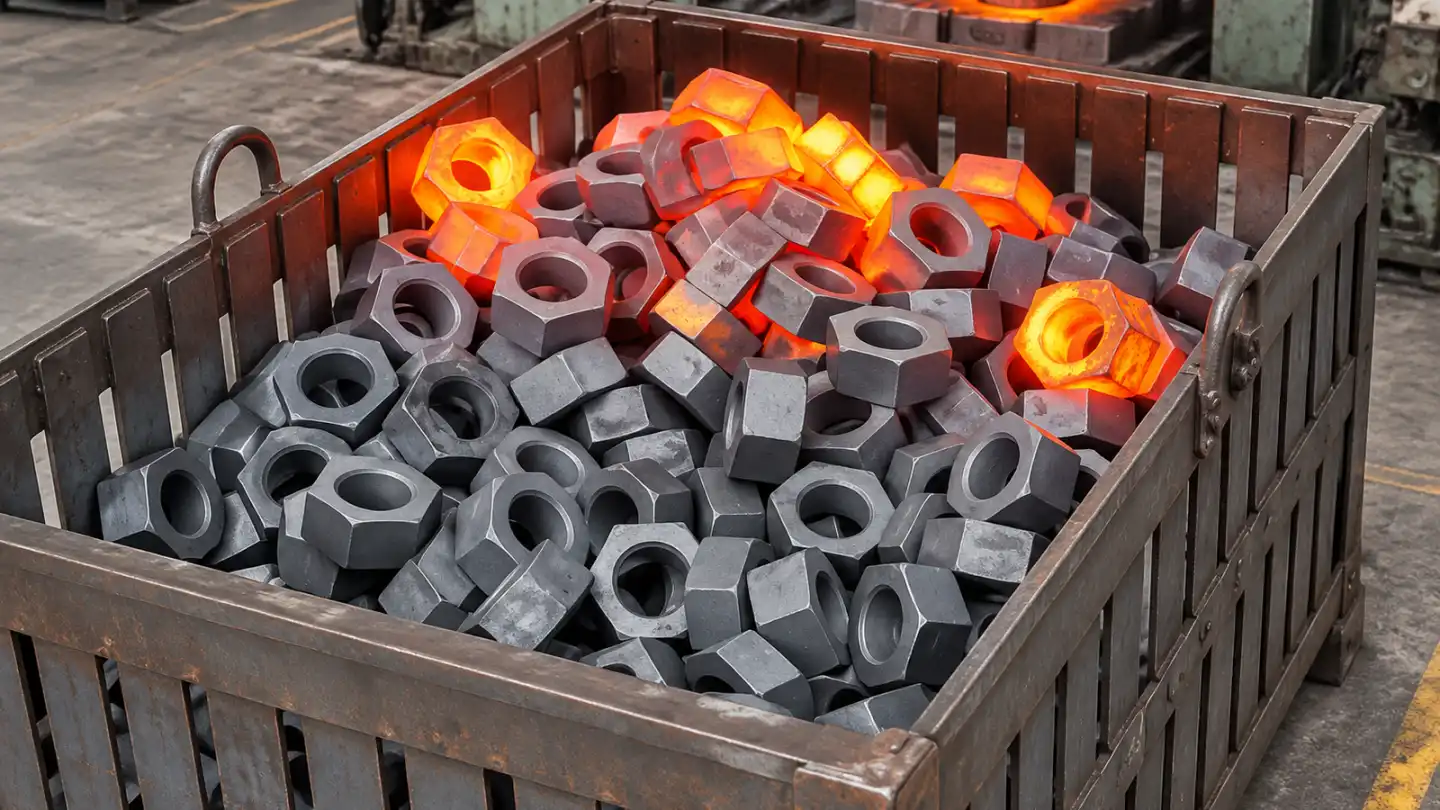
The nut forging line ends at the pierced blank. What leaves the chute has a hex outside and a through hole, both at hot-forging tolerance. It has no thread, and on many sizes it has no finished face.
Because there is no flash to remove, a nut forging process does not need a second press for trimming. That is one machine the quotation does not have to carry.
Three operations follow, and each is a separate decision with its own equipment: heat treatment to bring the blank to the required property class, machining where a face or chamfer needs a machined finish, and tapping or thread rolling for the thread itself. A supplier who describes a hot forging line as producing a finished nut is describing three lines as one. Ask which of the three is in scope before comparing prices, because the answer changes the total by more than the press does.
The cutting station that starts the whole sequence is covered in billet shearing machine selection, and the way the five stations are tied together is covered under forging automation production line.
Most buyers start by asking for a nut forging machine and end up buying a line, or the reverse, and the difference is worth being clear about before any quotation is written. A single machine covers the forming step only: the press, the three-station die set and the transfer. Everything upstream and downstream stays with the buyer, who then has to source a cut-off, a feeder, a heater and a chute, and make four suppliers agree on one cycle time.
A nut forging automated production line closes that gap. The scope runs from bar magazine to discharge chute, including the cut-off, the step feeder, the induction heater with its closed cooling loop, the three-station die set, the walking beam transfer, the reject gate and the discharge conveyor. What changes is not the nut forging process, which is the same five stations described above, but who is responsible when the rate does not hold. On a single machine, a shortfall at the heater is the buyer's problem. On a line, it is the supplier's, and the blank weight calculation becomes a contractual number rather than a commissioning surprise.
That is also where the one-stop framing earns or loses its credibility. A turnkey nut forging solution should include the floor and pit drawings before the machine ships, the die set proven on the buyer's own blank, and a stated cycle at the buyer's blank weight. If any of the three is missing, the offer is a machine with accessories, not a solution.
If the choice is still open, the nut forging automated production line page sets out the scope this article describes, and the contact form is the place to send the drawing, the annual quantity and the floor plan for a cycle calculation at your size.
No. It produces a pierced blank with a hexagonal outside and a through hole. Heat treatment, machining and tapping are separate operations that follow the line, and they are usually quoted separately.
The rate is set by heating capacity divided by blank weight. A 1,000 kg per hour heater gives 30 pieces per minute at a 0.556 kg blank, and about 16 pieces per minute at 1.033 kg. Any quoted rate should reconcile with the heater rating at your blank weight.
About 1.033 kg. It can come from a 45 mm bar cut to 82.5 mm or a 50 mm bar cut to 66.5 mm; both reach the same blank weight, and the choice is a trade between cuts per hour and upset force.
The machine can, but the die set and the coil cannot. Changing size means a new three-station die set and often a different coil frequency, since frequency follows billet diameter. A line built for 45 mm bar will not heat 70 mm bar evenly.
Around 1% at the cut-off, with flat ends and minimal burr. That tolerance drives material cost per nut and also decides whether the upset station folds a burr into the part, so it is worth inspecting on the first production run rather than at acceptance.
Because an under-temperature blank damages the die before anyone can inspect the part. Catching it on the chute between coil and die lets one blank be dropped out of the sequence without stopping the line or scraping a die insert.
On M48, across flats is 75 mm with 0 to minus 1.90 mm, height is 38 mm with 0 to minus 1.60 mm, and the through hole is 43 mm with plus 0.20 to minus 0.40 mm. Untoleranced dimensions default to IT13, and surface finish is around Ra 6.3 micrometres. Across corners is not held independently: it follows across flats and the corner radius.
Receive the news that you are interested in.