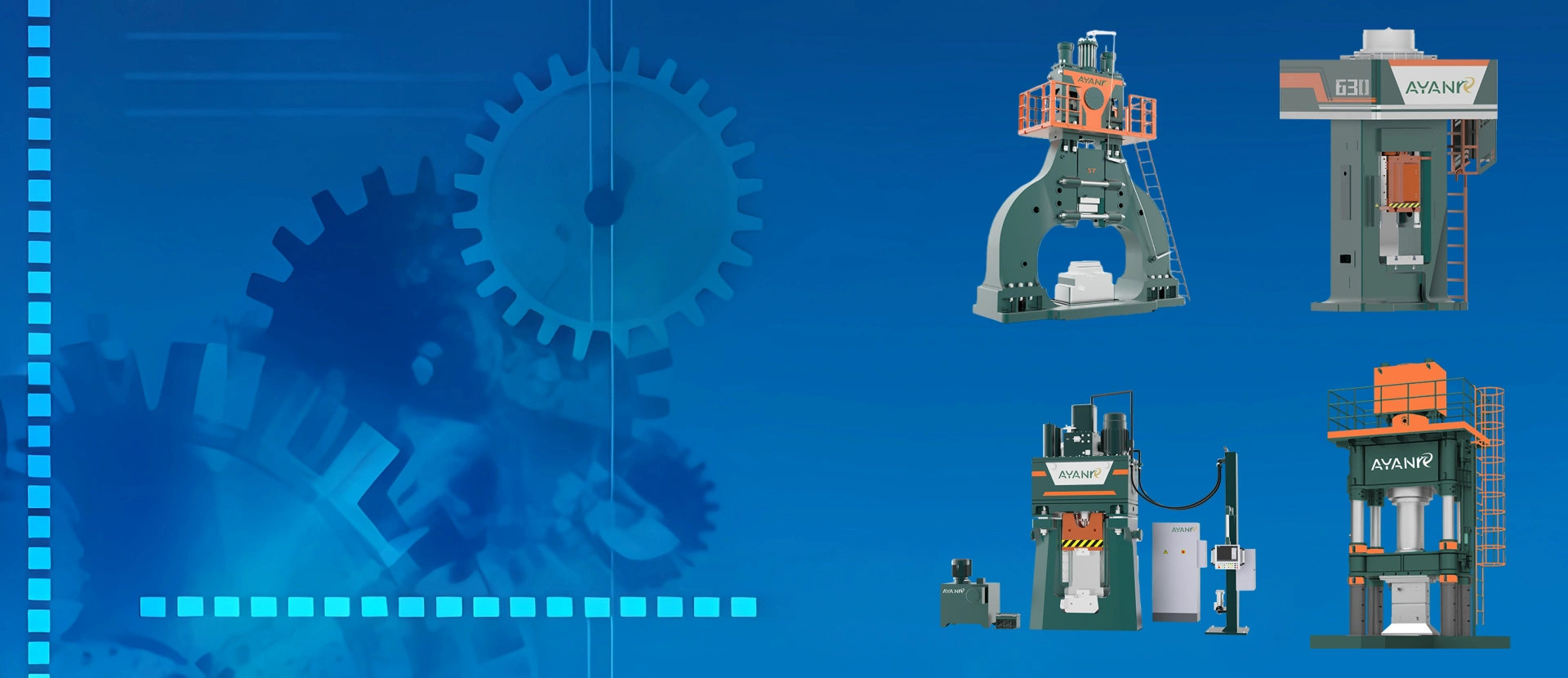
Bucket teeth are high-frequency consumable parts for engineering machinery - excavators, bulldozers, loaders, electric shovels and dredgers - and they generally need replacing every four to seven months. The global construction machinery market keeps growing, particularly in India, Turkey, Pakistan, Southeast Asia and the Middle East, where infrastructure work is moving fast, and consumption of bucket teeth rises with it.
Two solutions produce bucket teeth today: forging and casting.
Casting is cheap, but the service life is short. Working under hard rock, a cast tooth is prone to fracture and to rapid wear. A forged tooth carries continuous metal flow lines and a dense structure, which gives it a wear life about 60% higher than a cast tooth - and that is why it is the preferred choice in the mid-to-high-end market.
For a manufacturer building a new bucket tooth line, or expanding an existing one, the decision that sets competitiveness is choosing a stable, efficient and energy-saving forged bucket tooth production line.
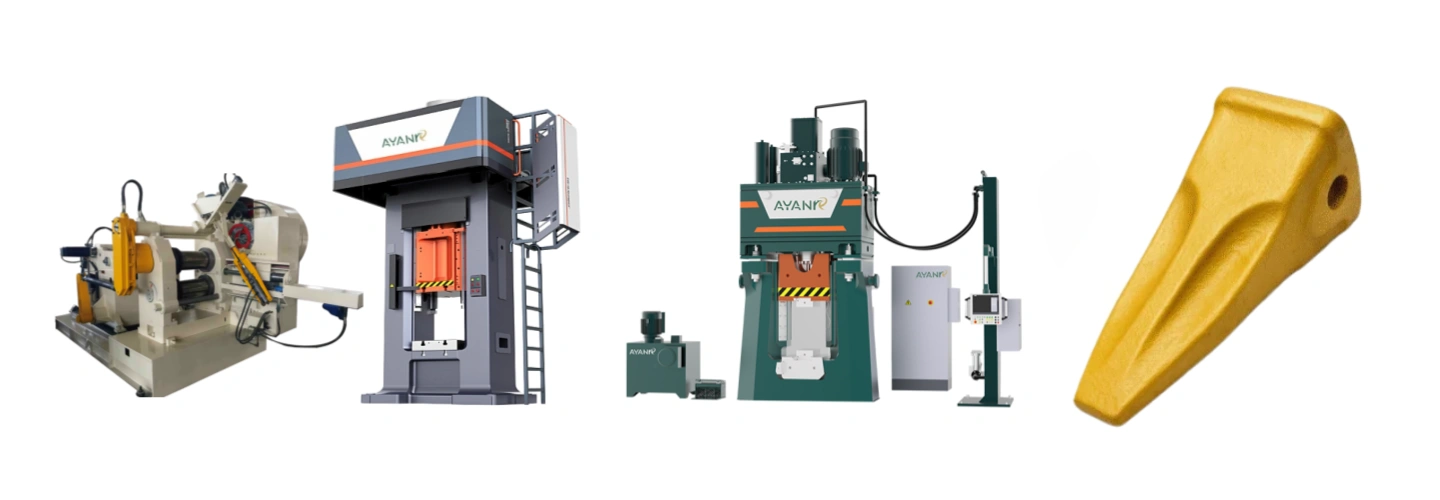
The complete set runs seven stages, and each stage sets what the next one can do.
| Process stage | Process content | Recommended equipment |
|---|---|---|
| Cutting | Cut round steel to finished blank size. | Bar shear / metal circular saw |
| Heating | Heat the billet to forging temperature. | Medium frequency induction heating furnace |
| Billet shaping | Pre-form the round steel into the shape of a tooth billet. | Rolling mill |
| Finish forging | Forge the shape in the die. | CNC hammer or electric screw press |
| Trimming | Remove the flash. | Trimming press |
| Heat treatment | Quenching and tempering, to reach a balance of hardness and toughness. | Continuous quenching and tempering furnace |
| Shot blasting / machining | Surface cleaning and finishing. | Shot blasting machine / CNC lathe |
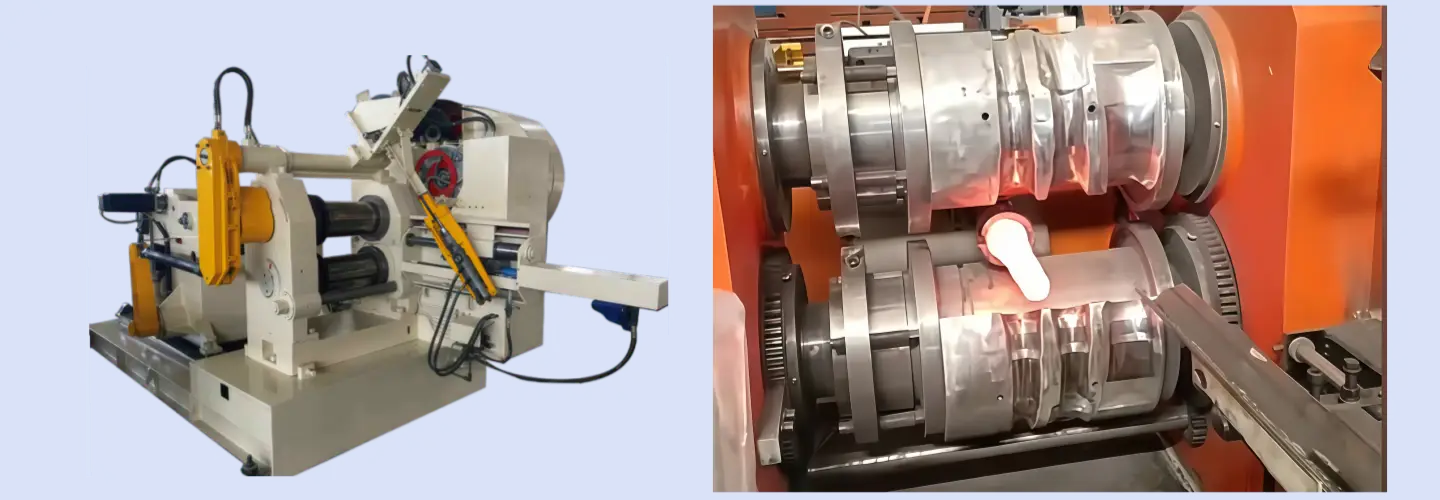
The roll forging machine preforms round steel into a billet that is already close to tooth shape. That shortens the distance the metal has to flow during finish forging, which saves 10% to 15% of material and reduces die wear at the same time. Set against forging straight from round steel, roll forging preforming raises die life by more than 35%.
The reason is straightforward: a preform that already approximates the tooth leaves the finish die doing less work in the two places a bucket tooth is hardest to fill - the deep cavity and the thin tip.
The shape is a thin tooth tip on a thick root, with an internal cavity carrying the pin hole. That makes it a wear-resistant forging with a deep cavity, a large thickness variation, and a requirement for multiple fills. The demands it places on the machine are high impact forming capability, controllable energy and batch consistency.
With those characteristics in mind, the two machines compare as follows for bucket tooth work.
| Comparison dimension | C92KA CNC hydraulic die forging hammer | J58KA electric screw press |
|---|---|---|
| Production characteristics | Multi-variety, small-to-medium batch, export-oriented multi-specification bucket teeth | Single model, large-volume mass production, high-end precision export bucket teeth |
| Forming effect | High-speed impact and strong metal fluidity, which overcomes fill shortages in deep cavities and thin tips; multi-hammer rework is allowed, so fault tolerance is high | Constant striking energy, highly uniform workpiece size and weight; die life up 2 to 3 times, and extremely small finished-product tolerance |
| Model change and process | One-click parameter switching, pre-forging and finish forging integrated; fast model-change commissioning, and no separate roll forging equipment required | Weak versatility across categories; frequent specification changes consume commissioning time; strict requirements on billet precision |
| Investment cost | Lower initial investment in machinery and dies, which is less pressure on a small or medium factory | High purchase price, offset by lower long-term energy and maintenance cost |
| Energy consumption and maintenance | Higher electricity use in long continuous production, and loud vibration noise | Servo energy saving, 35% to 55% less electricity than a CNC hammer; no hydraulic oil leakage faults and simple maintenance |
| Automation integration | Large vibration, which makes adaptation to a fully automatic line difficult | Precise slide positioning and full compatibility with robotic arms; an unmanned line is possible, with lower demands on foundation and environmental assessment |
| Applicable scenario | Prioritize the C92KA CNC die forging hammer | Prioritize the electric screw press |
|---|---|---|
| Order type | Multi-specification export bucket teeth, frequent model changes, small-to-medium batches | One or two fixed product types, tens of thousands of pieces a day, large-volume mass production |
| Process characteristics | Heavy-duty deep-cavity bucket teeth, difficult cavity filling, average billet precision | High-end export precision bucket teeth, with extremely high demands on dimensional and weight consistency |
| Factory conditions | Manual loading and unloading, no fully automatic robotic arm; average precision in blanking and heating | Robotic arm, automatic spray lubrication and heat treatment forming a fully automatic line |
| Budget | A new small factory controlling early-stage investment in equipment and dies | Focus on long-term electricity saving and low maintenance, to cut continuous operating cost |
| Fault tolerance requirement | Large deviation in billet temperature and weight, needing high fault tolerance and rework capability | Stable medium-frequency heating and precise blanking, giving high billet uniformity |
Read together, the two tables say the same thing from different angles: there is no best forging machine, only the solution that fits the order book, the factory and the part.
With 70 years in forging equipment manufacturing, AYANK provides a complete turnkey service for bucket tooth production lines:
Turnkey bucket tooth forging lines have already been supplied in India, Southeast Asia, South Asia, the Middle East and South America.
A bucket tooth forging line is a good project: moderate investment, stable returns, and demand that keeps growing. Whether you are moving from casting to forging or expanding existing capacity, the foundation of success is a line with a mature process, stable equipment and after-sales service you can reach.
AYANK FORGING has spent 70 years on forging equipment - from a single pneumatic hammer to a complete forging production line.
Four to seven months in service, depending on the ground. A forged tooth lasts about 60% longer in wear than a cast one, because the forging keeps the metal flow lines continuous and the structure dense, where a casting is prone to fracture and rapid wear under hard rock.
Because a billet that is already close to tooth shape shortens the distance the metal has to travel in the finish die. That saves 10% to 15% of material and raises die life by more than 35% against forging straight from round bar.
Neither is better in the abstract. The hammer suits multi-specification work in small and medium batches and forgives variation in billet temperature and weight. The screw press suits one or two fixed high-precision products at volume, with lower energy cost and easier automation.
Four things: the order book (how many specifications, how often they change), the precision class of the part, the factory (manual or robot-fed), and the budget - early investment against running cost.
No. The CNC hammer integrates pre-forging and finish forging with one-click parameter switching, so a model change is fast and no separate roll forging machine is required. The screw press route assumes precise blanking and a stable heating line instead.
It is quoted as tens of thousands of pieces per day with one or two fixed product types. Below that, with frequent specification changes, the hammer route is the one the comparison tables point to.
Send your forging drawing or part details — we will recommend the machine that fits and quote it.
info@ayankforging.com · www.ayankforging.com
Receive the news that you are interested in.
